“No one leaves home unless home is the mouth of a shark.” Warsan Shire,Teaching My Mother How to Give Birth
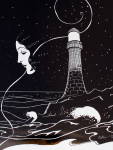
The wandering waters, dripping
Into rising seas and land now lonely
For his human foot, which finding
No room at the inn, wanders
Like the waters, violated like a fish
On the deck of a boat, gasping
Soul bludgeoned, human skulls
And fish entrails, politicos and
Pundits examine like I Ching coins,
Accidents of birth, plight of place
A remote sliver of moon surveils
From the starless sky, unmoved
Dedicated to my friend, Mbizo Chirasha, Zimbabwean Poet in Exhile. Please connect with me if you are able or know someone / some family able to host him in Germany. Thank you! bardogroup@gmail.com
Your donation HERE helps to fund the ongoing mission of The Poet by Day in support of poets and writers, freedom of artistic expression, and human rights.
Link HERE for Free Human Rights eCourse designed and delivered by United For Human Rights, Making Human Rights a Fact
FEEL THE BERN
For Peace, Sustainability, Social Justice
The Poet by Day officially endorses Bernie for President.
“Democracy is not a spectator sport.” Bernie Sanders
“Every pair of eyes facing you has probably experienced something you could not endure.” Lucille Clifton
Thank you for sharing your love of words. Comments will appear after moderation.
“Don’t think of what’s past!” said she. “I am not going to think outside of now. Why should we! Who knows what tomorrow has in store? ” Thomas Hardy, Tess of the D’Urbervilles
I leant upon a coppice gate
When Frost was spectre-gray,
And Winter’s dregs made desolate
The weakening eye of day.
The tangled bine-stems scored the sky
Like strings of broken lyres,
And all mankind that haunted nigh
Had sought their household fires.
The land’s sharp features seemed to be
The Century’s corpse outleant,
His crypt the cloudy canopy,
The wind his death-lament.
The ancient pulse of germ and birth
Was shrunken hard and dry,
And every spirit upon earth
Seemed fervourless as I.
At once a voice arose among
The bleak twigs overhead
In a full-hearted evensong
Of joy illimited;
An aged thrush, frail, gaunt, and small,
In blast-beruffled plume,
Had chosen thus to fling his soul
Upon the growing gloom.
So little cause for carolings
Of such ecstatic sound
Was written on terrestrial things
Afar or nigh around,
That I could think there trembled through
His happy good-night air
Some blessed Hope, whereof he knew
And I was unaware.
– Thomas Hardy
The poem was originally titled By the Century’s Deathbed: 1900 and was published in the Graphic and subsequently in a collection, Poems of Past and Present.
Hardy between about 1910 and 1915 / Bain News Service in LOC Prints and Photographs Division / Public Domain
Thomas HardyOM (1840 – 1928) was an English novelist and poet. A Victorian realist in the tradition of George Eliot, he was influenced both in his novels and in his poetry by Romanticism, especially William Wordsworth
In 1898 Hardy published his first volume of poetry, Wessex Poems, a collection of poems written over thirty years. While some suggest that Hardy gave up writing novels following the harsh criticism of Jude the Obscure in 1896, the poet C. H. Sisson calls this “hypothesis” “superficial and absurd.” In the twentieth century Hardy published only poetry.
Thomas Hardy wrote in a great variety of poetic forms including lyrics, ballads, satire, dramatic monologues, and dialogue, as well as a three-volume epic closet drama The Dynasts (1904–08), and though in some ways a very traditional poet, because he was influenced by folksong and ballads,he “was never conventional,” and “persistently experiment[ed] with different, often invented, stanza forms and meters, and made use of “rough-hewn rhythms and colloquial diction.”
Hardy wrote a number of significant war poems that relate to both the Boer Wars and World War I, including “Drummer Hodge”, “In Time of ‘The Breaking of Nations'”, and “The Man He Killed”; his work had a profound influence on other war poets such as Rupert Brooke and Siegfried Sassoon. Hardy in these poems often used the viewpoint of ordinary soldiers and their colloquial speech. A theme in the Wessex Poems is the long shadow that the Napoleonic Wars cast over the nineteenth century, as seen, for example, in “The Sergeant’s Song” and “Leipzig”.The Napoleonic War is the subject of The Dynasts.
Some of Hardy’s most famous poems are from “Poems of 1912–13”, part of Satires of Circumstance (1914), written following the death of his wife Emma in 1912. They had been estranged for twenty years and these lyric poems express deeply felt “regret and remorse”.[41] Poems like “After a Journey,” “The Voice,” and others from this collection “are by general consent regarded as the peak of his poetic achievement.” In a recent biography on Hardy, Claire Tomalin argues that Hardy became a truly great English poet after the death of his first wife, Emma, beginning with these elegies, which she describes as among “the finest and strangest celebrations of the dead in English poetry.”
Many of Hardy’s poems deal with themes of disappointment in love and life, and “the perversity of fate”, but the best of them present these themes with “a carefully controlled elegiac feeling”. Irony is also an important element in a number of Hardy’s poems, including “The Man he Killed” and “Are You Digging on My Grave”. A few of Hardy’s poems, such as “The Blinded Bird,” a melancholy polemic against the sport of vinkenzetting, reflect his firm stance against animal cruelty, exhibited also in his antivivisectionist views and his membership in The Royal Society for the Prevention of Cruelty to Animals.
A number of notable English composers, including Gerald Finzi, Benjamin Britten, and Gustav Holst, set poems by Hardy to music. Holst also wrote the orchestral tone poem Egdon Heath: A Homage to Thomas Hardy in 1927.
Although his poems were initially not as well received as his novels had been, Hardy is now recognised as one of the greatest twentieth-century poets, and his verse has had a profound influence on later writers, including Robert Frost, W. H. Auden, Dylan Thomas, and, most notably Philip Larkin.
REMINDER
THE POET BY DAY, WEDNESDAY WRITING PROMPT will return next Wednesday, January 8.
Your donation HERE helps to fund the ongoing mission of The Poet by Day in support of poets and writers, freedom of artistic expression, and human rights.
Link HERE for Free Human Rights eCourse designed and delivered by United For Human Rights, Making Human Rights a Fact
FEEL THE BERN
For Peace, Sustainability, Social Justice
The Poet by Day officially endorses Bernie for President.
“Democracy is not a spectator sport.” Bernie Sanders
“Every pair of eyes facing you has probably experienced something you could not endure.” Lucille Clifton
Thank you for sharing your love of words. Comments will appear after moderation.
Cassandra by Evelyn Pickering (1855-1919) / public domain UK/US
Apollo, Apollo! God of all ways, but only Death’s to me, Once and again, O thou, Destroyer named, Thou hast destroyed me, thou, my love of old!
Aeschylus’ Agamemnon
Your donation HERE helps to fund the ongoing mission of The Poet by Day in support of poets and writers, freedom of artistic express, and human rights.
Link HERE for Free Human Rights eCourse designed and delivered by United For Human Rights, Making Human Rights a Fact
“Every pair of eyes facing you has probably experienced something you could not endure.” Lucille Clifton
Thank you for sharing your love of words. Comments will appear after moderation.
Christian reading in his book, one of 28 illustrations Blake did to accompany Bunyon’s “The Pilgrim’s Progress” courtesy of Interesting Literature / Public Domain
“I think; therefore, I am.” René Descartes
Whence it so happened that Descartes left tracks in
John Bunyan who impressed his mind on the way
to William Blake, decent soul that he was. Long ago
we were said to have souls, that mysterious interior
invisible, unknowable. And then things changed.
It was not God so much as that a new burden of knowing
came to be ours. This knowing no bloodless rule, no abstract thing.
Blake no Age of Reason pontificator: “To Generalize is to be an Idiot;
To Particularize is the Alone Distinction of Merit,” Blake wrote.
And here in this, he particularizes, oh how he particularizes.
Christian physically bound in his reading.
Blake kindles hot the near insanity of the meeting,
As his very soul looks right into the physical.
Christian hunched over, hovering, wild eyed.
A look nearly of terror and unearthly joy woven into
the silent shouting shock of reading alone like this.
That bunch of heavy brown modern bears his back down.
Like a hunchback leering, Christian is peering,
Like a frozen loner where Christian has never gone before.
“It is so new,” he says “I am all alone.”
So alone he can’t sort himself out to see
how surrounded he is by dangerous sharp points behind.
Brown peaks assault him from afar, vulnerable as he all be.
This new man, making progress on this new journey of himself.
He is reading in his book. Reading like taking a deep plunge
into the visionary unknown Blake so admires:
“The man who never in his mind and thoughts travel’d to heaven is no artist.”
And the person who does not get hysterically lost doesn’t start to see.
Wounding, piercing brown ochre colors and open slopes
mark Christian in his place as new man trapped in himself.
Christian’s gasping face besieged by what Dr. Johnson,
early psychologist, once called “the invisible riot of the mind.”
Christian knows too much to voice any of it.
He is all lit up with himself and it. So hauntingly, quintessentially alive,
with a new thing, himself and words to see,
that we would offer him a smoke to ease the strain of his face, if we could,
alleviate his face and quiet his burden with a shared smile.
I am delighted to let you know that Linda Chown’s Narrative Authority and Homeostasis in the Novels of Doris Lessing and Carmen Martín Gaite(Routledge Library Editions: Modern Fiction) is now available through Amazon in hardcover and Kindle. Linda tells me a budget-wise paperback edition will be available in six-to-eight months.
This study, originally published in 1990, assesses a shift in the presentation of self-consciousness in two pairs of novels by Doris Lessing and Carmen Martín Gaite: 1) Lessing’s The Summer Before the Dark(1973) and Martín Gaite’s Retahílas (1974) and 2) Lessing’s The Memoirs of a Survivor (1974) and Martín Gaite’s The Back Room (1978). Three major structural divisions facilitate examining implications of the novels for 1) feminism 2) literary narrative and 3) the lives of people-at-large. / J.D.
LINDA E. CHOWN grew up in Berkeley, Ca. in the days of action. Civil Rights arrests at Sheraton Palace and Auto Row. BA UC Berkeley Intellectual History; MA Creative Writing SFSU; PHd Comparative Literature University of Washington. Four books of poetry. Many poems published on line at Numero Cinq, Empty Mirror, The Bezine, Dura, Poet Head and others. Many articles on Oliver Sachs, Doris Lessing, Virginia Woolf, and many others. Twenty years in Spain with friends who lived through the worst of Franco. I was in Spain (Granada, Conil and Cádiz) during Franco’s rule, there the day of his death when people took to the streets in celebration. Interviewed nine major Spanish Women Novelists, including Ana María Matute and Carmen Laforet and Carmen Martín Gaite.





 I am delighted to let you know that Linda Chown’s


 Jamie Dedes' THE POET BY DAY Webzine
