O Master, let me not seek as much to be consoled as to console, to be understood as to understand, to be loved as to love, for it is in giving that one receives, it is in self-forgetting that one finds, it is in pardoning that one is pardoned, it is in dying that one is raised to eternal life.
Excerpt from the beautiful “Prayer of St. Francis,” popularly attributed to Francis, not written by him at all but more likely by his friend, Giles of Assisi.
Brother Francis and Sister Moon
He’s wandering the lanes of Assisi
while other men sleep
or find pleasure
in their sweethearts’ arms.
Holy man Francesco. Il poverello.
All skin and bone
beneath his patched-up robe.
He’s chosen
Lady Poverty’s embrace,
begs for his bread
and shares it with outcasts.
The merchant’s son
who shed his fine clothes
at his father’s feet
and took the narrow way.
He tamed a killer wolf,
some say; calls the earth
his Mother, talks to flowers
and herbs, birds and fish.
Holy fool, roaming barefoot
until a full moon
at the sky’s plumb centre
illuminates his path,
pulls fields and trees
into its orbit
of overflowing light
and he runs to the church,
climbs the tower,
rings the bell.
and summons townsfolk
from their beds.
They wait in the courtyard
for news of fire or pestilence.
Look, he cries, look up
and see the moon!
The Illustration is purported to be the oldest surviving depiction of Saint Francis. The fresco is near the entrance of the Benedictine Abbey of Subiaco, painted between March 1228 and March 1229. St. Francis is shown without the stigmata. It’s a religious image and not meant to be a literal portrait. The photo is shared here under License Art Libre 1.3
SHIELA JACOB was born and raised in Birmingham, England and lives with her husband in Wrexham, on the Welsh border. Her poetry has been published in several U.K. magazines and webzines. She recently self-published a short collection of poems that form a memoir to her father who died in 1965. She finds her 1950s childhood and family background a source of inspiration for many of her poems.
A homebound writer, poet, and former columnist and associate editor to a regional employment newspaper, my work has been featured widely in print and digital publications including: Ramingo’s Porch, Vita Brevis Literature, Connotation Press,The Bar None Group, Salamander Cove, I Am Not a Silent Poet, The Compass Rose and California Woman. I run The Poet by Day, an info hub for poets and writers and am the founding/managing editor of The BeZine.
“Every pair of eyes facing you has probably experienced something you could not endure.” Lucille Clifton
Thank you for sharing your love of words. Comments will appear after moderation.
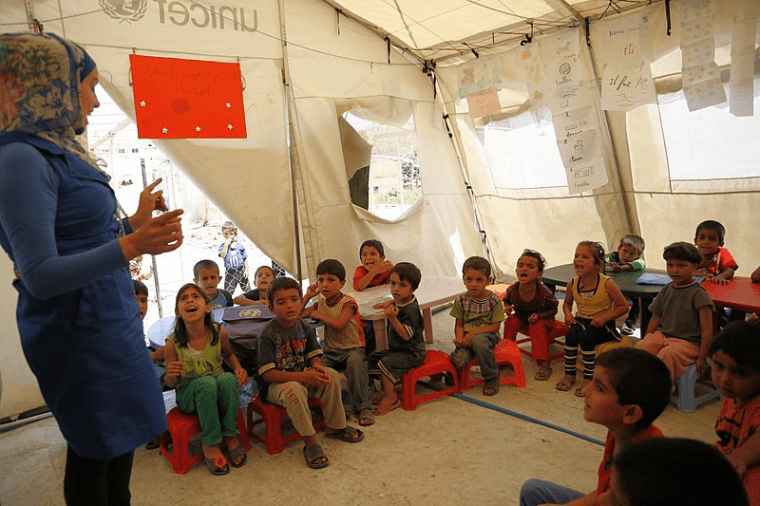
Syrian refugee children attend a lesson in a UNICEF temporary classroom in northern Lebanon, July 2014
“Millions of children are on the move. Some are driven from their homes by conflict, poverty or disaster; others are migrating in the hope of finding a better, safer life. Far too many encounter danger, detention, deprivation and discrimination on their journeys.” UNICEF MORE
...no fair
shout it like an indignant child no fair, the dispossessed and hungry, no fair, the murdered and the maimed, no fair, the great disruption and those
forced to abandoned hopes, homes
the children flee only to camp out
without country, on swollen borders,
escaping by rough land or bloated boat,
starving, bewildered and lost
it’s not fair, not fair, it’s just not fair
this human condition, call it insanity,
the adults who don’t play nice as our
mothers, each one of them, bid us do
“Almost 1 in 10 children live in areas affected by armed conflicts.” UNICEF
According to UNICEF’s Global Compact for Migration:
“Between 2005 and 2015, the number of child refugees worldwide more than doubled from four million to nine million
“Refugee children are five times as likely to be out of school than other children
Almost 1 in 10 children live in areas affected by armed conflicts. More than 400 million live in extreme poverty”
“Not long when I was a child,crossed barbed wires,across borders
in camp for two nights, wonder how Mother felt and held us? Tight
then on we came to the green hills, and I knew not,was it refuge ?
or a new land a home of peace-how attained?what was left with enemy-
“where are the roots that make a family,out of the masses who survived
you cannot guess,for I have seen only images and heard broken voices
who lost half the thought in trying not to remember,bodies cut slain in fields
why we laughed sang,then we cried silently in pain, in the remains”
If you are reading this post from an email subscription, it’s likely you will have to link through to the site to view this very short video on The Global Compact for Migration / UNICEF.
A homebound writer, poet, and former columnist and associate editor to a regional employment newspaper, my work has been featured widely in print and digital publications including: Ramingo’s Porch, Vita Brevis Literature, Connotation Press,The Bar None Group, Salamander Cove, I Am Not a Silent Poet, The Compass Rose and California Woman. I run The Poet by Day, an info hub for poets and writers and am the founding/managing editor of The BeZine.
“Every pair of eyes facing you has probably experienced something you could not endure.” Lucille Clifton
Thank you for sharing your love of words. Comments will appear after moderation.
She does not shirk, but does her work, Amid the world’s fast hustling whirl, And come what may, she’s here to stay, The self-supporting “bachelor girl.”
Effie Waller Smith (1879 – 1960) was an African-American poet of the late nineteenth and early twentieth century. She was smart, independent, and ahead of her time. Her collections are: Songs of the Month (1904), Rhymes From the Cumberland (1904), and Rosemary and Pansies (1909). Her work was featured in local newspapers and in some of the major publications of the day.
Effie Waller was born to former slaves in the rural mountain community of Chloe Creek in Pike County, Kentucky, on a farm located a few miles from Pikeville.Her father, Frank Waller, migrated to the East Kentucky mountains sometime after the Civil War, having spent most of his early life as a laborer on a Virginia plantation. Her mother, Sibbie Ratliff, was born and raised in East Kentucky and met Frank Waller in the early 1870s. Effie was the third of four children.
Frank Waller was a blacksmith and a real estate speculator. Chloe Creek, the area in which the Wallers lived, was unusual for the time. It was racially integrated. The Wallers were responsible, hard-working, and clean-living. Frank and Sibbie, realizing the limits of their own educations, were determined that their children would receive a quality education and Effie and her siblings were educated at Kentucky Normal School for Colored Persons in Frankfort, the capitol of Kentucky. Effie subsequently taught in Kentucky and Tennessee.
Effie Waller Smith’s work is worth reading. Unfortunately, the charges on Amazon and Alibris are outrageous and her work is not included in The Gutenberg Project, where you’d be able to download it for free. You might try connecting with Steve at Scholar and Poet Books, EB and Scholar and Poet Books, Abe Books to see what he has at what price. You can find a few of her poems around on the Internet. Her poems The “Bachelor Girl and The Cuban Cause are included in New Daughters of Africa: An International Anthology of Writing by Women of African Descent, Margaret Busby. The “Bachelor Girl” is also posted on Literary Ladies HERE. I clipped Apple Sauce and Chicken Fried (posted below the video) from Poem Hunter.
With a nod to Wikipedia; Illustration: Public Domain
It you are reading this post from an email subscription, it’s likely you’ll have to link through to the site to view this video of Effie’s life and work.
Apple Sauce and Chicken Fried
You may talk about the knowledge
Which our farmers’ girls have gained
From cooking-schools and cook-books,
(Where all modern cooks are trained):
But I would rather know just how,
(Though vainly I have tried)
To prepare, as mother used to,
Apple sauce and chicken fried.
Our modern cooks know how to fix
Their dainty dishes rare,
But, friend, just let me tell you what!-
None of them can compare
With what my mother used to fix,
And for which I’ve often cried,
When I was but a little tot,-
Apple sauce and chicken fried.
Chicken a la Française,
And also fricassee,
Served with some new fangled sauce
Is plenty good for me,
Till I get to thinking of the home
Where once I used to ‘bide,
And where I used to eat,- um, my!
Apple sauce and chicken fried.
We always had it once a week,
Sometimes we had it twice;
And I have even known the time
When we have had it thrice.
Our good, yet jolly pastor,
During his circuit’s ride
With us once each week gave grateful thanks
For apple sauce and chicken fried.
Why, it seems like I can smell it,
And even taste it, too,
And see it with my natural eyes,
Though of course it can’t be true;
And it seems like I’m a child again,
Standing by mother’s side,
Pulling at her dress and asking
For apple sauce and chicken fried.
A homebound writer, poet, and former columnist and associate editor of a regional employment publication, my work has been featured in print and digital publications including: ‘Levure littéraure,’ ‘Ramingo’s Porch,’ ‘Vita Brevis Literature,’ ‘Connotation Press,’ ‘The Bar None Group,’ ‘Salamander Cove,’ ‘I Am Not a Silent Poet,’ ‘The Compass Rose’ and ‘California Woman.’ I run The Poet by Day (jamiededes.com), an info hub for poets and writers. I am also the editor of a quarterly online publication, ”The BeZine’ (thebezine.com).
Thank you for sharing your love of words. Comments will appear after moderation.
evening rain patters about, plays the
rooftop like a kettle drum, taps a code
on window panes, spills itself and
the scent of petrichor rises from
mud puddles and rain-carved rills
sly stars caper in a game of hide and
seek, shy clouds spoon in the smoky
quartz of a subdued moon, a late
dawn will rise in subtile pewter light
Oh!
how they steal our sleep these, the beloved nights so rich in comforting blisses
The challenge this week is to write about the emotions rain engenders in you. For me it’s joy (and perfect weather for writing), although I’ve never experienced rain to the point of flooding and I don’t have rheumatoid arthritis as so many of my friends do, so no pain or anger. For some people rain is depressing. How about you? Tell us in your own poetry.
Share your poem/s on theme in the comments section below or leave a link to it/them. All poems on theme are published on the first Tuesday following the current Wednesday Writing Prompt. (Please no oddly laid-out poems.)
No poems submitted through email or Facebook will be published.
IF this is your first time joining us for The Poet by Day, Wednesday Writing Prompt, please send a brief bio and photo to me at thepoetbyday@gmail.com to introduce yourself to the community … and to me :-). These are partnered with your poem/s on first publication.
PLEASE send the bio ONLY if you are with us on this for the first time AND only if you have posted a poem (or a link to one of yours) on theme in the comments section below.
Deadline: Monday, May 27 by 8 pm Pacific Standard Time. If you are unsure when that would be in your time zone, we recommend using The Time Zone Converter.
Anyone may take part Wednesday Writing Prompt, no matter the status of your career: novice, emerging or pro. It’s about exercising the poetic muscle, showcasing your work, and getting to know other poets who might be new to you. This is a discerning non-judgemental place to connect.
You are welcome – encouraged – to share your poems in a language other than English but please accompany it with a translation into English.
Poet and writer, I am a former columnist and associate editor of a regional employment publication. Currently, I run this site, The Poet by Day, an information hub for poets and writers. I am the managing editor of The BeZine published by The Bardo Group Beguines (originally The Bardo Group), a virtual arts collective I founded. I am a weekly contributor to Beguine Again, a site showcasing spiritual writers. My work is featured in a variety of publications and on sites, including: Levure littéraure, Ramingo’s Porch, Vita Brevis Literature,Compass Rose, Connotation Press, The Bar None Group, Salamander Cove, Second Light, I Am Not a Silent Poet, Meta / Phor(e) /Play, and California Woman. My poetry was recently read byNorthern California actor Richard Lingua for Poetry Woodshed, Belfast Community Radio. I was featured in a lengthy interview on the Creative Nexus Radio Show where I was dubbed “Poetry Champion.”
“What if our religion was each other. If our practice was our life. If prayer, our words. What if the temple was the Earth. If forests were our church. If holy water–the rivers, lakes, and ocean. What if meditation was our relationships. If the teacher was life. If wisdom was self-knowledge. If love was the center of our being.” Ganga White, teacher and exponent of Yoga and founder of White Lotus, a Yoga center and retreat house in Santa Barbara, CA
“Every pair of eyes facing you has probably experienced something you could not endure.” Lucille Clifton
Thank you for sharing your love of words. Comments will appear after moderation.

 SHIELA JACOB was born and raised in Birmingham, England and lives with her husband in Wrexham, on the Welsh border. Her poetry has been published in several U.K. magazines and webzines. She recently self-published a short collection of poems that form a memoir to her father who died in 1965. She finds her 1950s childhood and family background a source of inspiration for many of her poems.
 A homebound writer, poet, and former columnist and associate editor to a regional employment newspaper, my work has been featured widely in print and digital publications including: Ramingo’s Porch, Vita Brevis Literature, Connotation Press, The Bar None Group, Salamander Cove, I Am Not a Silent Poet, The Compass Rose and California Woman. I run The Poet by Day, an info hub for poets and writers and am the founding/managing editor of The BeZine.




 Jamie Dedes' THE POET BY DAY Webzine