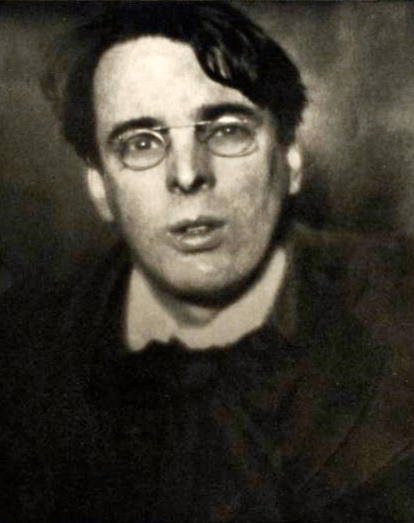
Yeats photographed in 1908 by Alvin Langdon Coburn
“I bring you with reverent hands The books of my numberless dreams.” William Butler Yeats, The Wind Among the Reeds
When you are old and gray and full of sleep,
And nodding by the fire, take down this book,
And slowly read, and dream of the soft look
Your eyes had once, and of their shadows deep;
How many loved your moments of glad grace,
And loved your beauty with love false or true,
But one man loved the pilgrim soul in you,
And loved the sorrows of your changing face;
And bending down beside the glowing bars,
Murmur, a little sadly, how love fled
And paced upon the mountains overhead
And hid his face amid a crowd of stars.
Poet and writer, I am a former columnist and associate editor of a regional employment publication. Currently, I run this site, The Poet by Day, an information hub for poets and writers. I am the managing editor of The BeZine published by The Bardo Group Beguines (originally The Bardo Group), a virtual arts collective I founded. I am a weekly contributor to Beguine Again, a site showcasing spiritual writers. My work is featured in a variety of publications and on sites, including: Levure littéraure, Ramingo’s Porch, Vita Brevis Literature,Compass Rose, Connotation Press, The Bar None Group, Salamander Cove, Second Light, I Am Not a Silent Poet, Meta / Phor(e) /Play, and California Woman. My poetry was recently read byNorthern California actor Richard Lingua for Poetry Woodshed, Belfast Community Radio. I was featured in a lengthy interview on the Creative Nexus Radio Show where I was dubbed “Poetry Champion.”
“What if our religion was each other. If our practice was our life. If prayer, our words. What if the temple was the Earth. If forests were our church. If holy water–the rivers, lakes, and ocean. What if meditation was our relationships. If the teacher was life. If wisdom was self-knowledge. If love was the center of our being.” Ganga White, teacher and exponent of Yoga and founder of White Lotus, a Yoga center and retreat house in Santa Barbara, CA
“Every pair of eyes facing you has probably experienced something you could not endure.” Lucille Clifton
Thank you for sharing your love of words. Comments will appear after moderation.
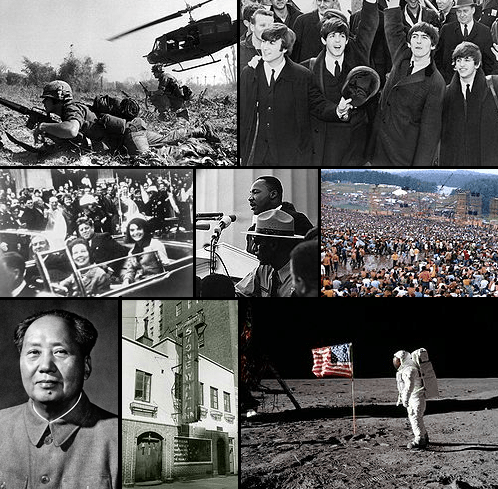
“I was lucky to live in New York when it was dangerous and edgy and cheap enough to play host to young, penniless artists. That was the era of “coffee shops” as they were defined in New York—cheap restaurants open round the clock where you could eat for less than it would cost to cook at home. That was the era of ripped jeans and dirty T-shirts, when the kind of people who are impressed by material signs of success were not the people you wanted to know.” Edmund White, City Boy: My Life in New York in the 1960s and ’70s
Dear Zorch,
No ~
it’s not the sixties anymore. It is a decade of upheaval
and people inflamed and lands laid bare.
Sea levels are rising and the
99% walk desiccated paths.
Once, you jockeyed in suits and ties
while I sat pregnant with poems,
just seventeen
the most unhappening girl in New York,
that most happening town.
We never did walk The Village streets for sips
of espresso in eccentric cafés, places
where Gibran Khalil Gibran might have lounged.
So okay, that was my dream. Yours was
Wall Street and manicured lawns in Westbury.
These days
there are strangers living in the old home place.
Our favorite stores are shuttered.
Our hip fashions are vintage.
Our parents have gone the way of all souls.
They never did hear
their truth over the cacophony of rote prayer.
You were happy to embrace high finance in place of Mystery.
Now though,
the future grows short
and
… word is …
you’ve taken Pascal’s Wager.
Once
we sang “make love not war,”
but
the power mongering persists, just a habit I imagine,
Write a poem that gives us a strong sense of time and place and how you and/or the times have changed.
Share your poem/s on theme in the comments section below or leave a link to it/them. All poems on theme are published on the first Tuesday following the current Wednesday Writing Prompt. (Please no oddly laid-out poems.)
No poems submitted through email or Facebook will be published.
IF this is your first time joining us for The Poet by Day, Wednesday Writing Prompt, please send a brief bio and photo to me at thepoetbyday@gmail.com to introduce yourself to the community … and to me :-). These are partnered with your poem/s on first publication.
PLEASE send the bio ONLY if you are with us on this for the first time AND only if you have posted a poem (or a link to one of yours) on theme in the comments section below.
Deadline: Monday, April 30 by 8 pm Pacific Standard Time.
Anyone may take part Wednesday Writing Prompt, no matter the status of your career: novice, emerging or pro. It’s about exercising the poetic muscle, showcasing your work, and getting to know other poets who might be new to you. This is a discerning non-judgemental place to connect.
You are welcome – encouraged – to share your poems in a language other than English but please accompany it with a translation into English.
Poet and writer, I am a former columnist and associate editor of a regional employment publication. Currently, I run this site, The Poet by Day, an information hub for poets and writers. I am the managing editor of The BeZine published by The Bardo Group Beguines (originally The Bardo Group), a virtual arts collective I founded. I am a weekly contributor to Beguine Again, a site showcasing spiritual writers. My work is featured in a variety of publications and on sites, including: Levure littéraure, Ramingo’s Porch, Vita Brevis Literature,Compass Rose, Connotation Press, The Bar None Group, Salamander Cove, Second Light, I Am Not a Silent Poet, Meta / Phor(e) /Play, and California Woman. My poetry was recently read byNorthern California actor Richard Lingua for Poetry Woodshed, Belfast Community Radio. I was featured in a lengthy interview on the Creative Nexus Radio Show where I was dubbed “Poetry Champion.”
“What if our religion was each other. If our practice was our life. If prayer, our words. What if the temple was the Earth. If forests were our church. If holy water–the rivers, lakes, and ocean. What if meditation was our relationships. If the teacher was life. If wisdom was self-knowledge. If love was the center of our being.” Ganga White, teacher and exponent of Yoga and founder of White Lotus, a Yoga center and retreat house in Santa Barbara, CA
“Every pair of eyes facing you has probably experienced something you could not endure.” Lucille Clifton
Thank you for sharing your love of words. Comments will appear after moderation.
Kreuzigung von Gabriel Wüger, Andachtsbildchen auf dem Vorsatzblatt der Ausgabe des Schott-Messbuchs von 1952
“The soul of the artist cannot remain hidden.” Henri Nouwen
I’m on vacation. This is a prescheduled post. Regular posting will begin again with Wednesday Writing Prompt on April 24 and Opportunity Knocks on April 25.
You are encouraged to display your work (poetry, art, photography, cartoons, music videos and so forth) and your artistic successes and other arts-related announcements at The BeZine Arts & Humanities Facebook Group Page
Many people are honoring Good Friday today, a day considered holy by some and that you likely know even if you are not Christian. These two poems are offered without judgement or analyses, simply as an example of different responses by poets of the same era to a moment marked by history. One poem is from American lyric poet and Pulitzer Prize winner, Sara Teasdale (1884-1933). The second poem is from English poet and classical scholar, A.E. Housman (1889-1936). It is generally agreed that atheist Housman’s poem is a reference to Jesus’ and his death. Sara Teasdale was raised in a devote Baptist family.
The Carpenter’s Son
The summer dawn came over-soon,
The earth was like hot iron at noon
In Nazareth;
There fell no rain to ease the heat,
And dusk drew on with tired feet
And stifled breath.
The shop was low and hot and square,
And fresh-cut wood made sharp the air,
While all day long
The saw went tearing thru the oak
That moaned as tho’ the tree’s heart broke
Beneath its wrong.
The narrow street was full of cries,
Of bickering and snarling lies
In many keys—
The tongues of Egypt and of Rome
And lands beyond the shifting foam
Of windy seas.
Sometimes a ruler riding fast
Scattered the dark crowds as he passed,
And drove them close
In doorways, drawing broken breath
Lest they be trampled to their death
Where the dust rose.
There in the gathering night and noise
A group of Galilean boys
Crowding to see
Gray Joseph toiling with his son,
Saw Jesus, when the task was done,
Turn wearily.
He passed them by with hurried tread
Silently, nor raised his head,
He who looked up
Drinking all beauty from his birth
Out of the heaven and the earth
As from a cup.
And Mary, who was growing old,
Knew that the pottage would be cold
When he returned;
He hungered only for the night,
And westward, bending sharp and bright,
The thin moon burned.
He reached the open western gate
Where whining halt and ***** wait,
And came at last
To the blue desert, where the deep
Great seas of twilight lay asleep,
Windless and vast.
With shining eyes the stars awoke,
The dew lay heavy on his cloak,
The world was dim;
And in the stillness he could hear
His secret thoughts draw very near
And call to him.
Faint voices lifted shrill with pain
And multitudinous as rain;
From all the lands
And all the villages thereof
Men crying for the gift of love
With outstretched hands.
Voices that called with ceaseless crying,
The broken and the blind, the dying,
And those grown dumb
Beneath oppression, and he heard
Upon their lips a single word,
“Come!”
Their cries engulfed him like the night,
The moon put out her placid light
And black and low
Nearer the heavy thunder drew,
Hushing the voices . . . yet he knew
That he would go.
A quick-spun thread of lightning burns,
And for a flash the day returns—
He only hears
Joseph, an old man bent and white
Toiling alone from morn till night
Thru all the years.
Swift clouds make all the heavens blind,
A storm is running on the wind—
He only sees
How Mary will stretch out her hands
Sobbing, who never understands
Voices like these.
– Sara Teasdale
The Carpenter’s Son
Here the hangman stops his cart:
Now the best of friends must part.
Fare you well, for ill fare I:
Live, lads, and I will die.
Oh, at home had I but stayed
‘Prenticed to my father’s trade,
Had I stuck to plane and adze,
I had not been lost, my lads.
Then I might have built perhaps
Gallows-trees for other chaps,
Never dangled on my own,
Had I left but ill alone.
Now, you see, they hang me high,
And the people passing by
Stop to shake their fists and curse;
So ’tis come from ill to worse.
Here hang I, and right and left
Two poor fellows hang for theft:
All the same’s the luck we prove,
Though the midmost hangs for love.
Comrades all, that stand and gaze,
Walk henceforth in other ways;
See my neck and save your own:
Comrades all, leave ill alone.
Make some day a decent end,
Shrewder fellows than your friend.
Fare you well, for ill fare I:
Live lads, and I will die.
Poet and writer, I was once columnist and associate editor of a regional employment publication. I currently run this site, The Poet by Day, an information hub for poets and writers. I am the managing editor of The BeZine published by The Bardo Group Beguines (originally The Bardo Group), a virtual arts collective I founded. I am a weekly contributor to Beguine Again, a site showcasing spiritual writers. My work is featured in a variety of publications and on sites, including: Levure littéraure, Ramingo’s Porch, Vita Brevis Literature,Compass Rose, Connotation Press, The Bar None Group, Salamander Cove, Second Light, I Am Not a Silent Poet, Meta / Phor(e) /Play, and California Woman. My poetry was recently read byNorthern California actor Richard Lingua for Poetry Woodshed, Belfast Community Radio. I was featured in a lengthy interview on the Creative Nexus Radio Show where I was dubbed “Poetry Champion.”
“What if our religion was each other. If our practice was our life. If prayer, our words. What if the temple was the Earth. If forests were our church. If holy water–the rivers, lakes, and ocean. What if meditation was our relationships. If the teacher was life. If wisdom was self-knowledge. If love was the center of our being.” Ganga White, teacher and exponent of Yoga and founder of White Lotus, a Yoga center and retreat house in Santa Barbara, CA
“Every pair of eyes facing you has probably experienced something you could not endure.” Lucille Clifton
Thank you for sharing your love of words. Comments will appear after moderation.
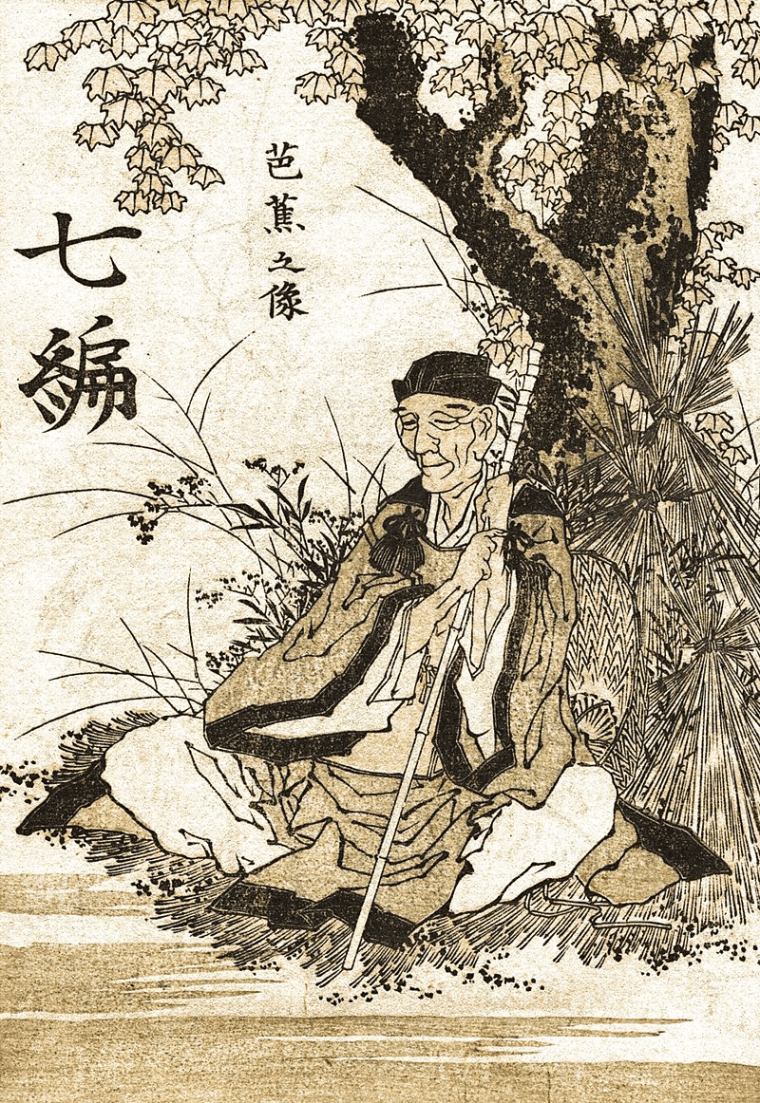
Portrait of Bashō by Hokusai, late 18th century, public domain
On a journey, ill; my dream goes wandering over withered fields.
– Japanese poet Bashō (1644-1694) renown for his haiku, haibun and extended haibun, studied haikai no renga with Kigin, a distinguished poet living in the same region as Bashō. This haiku is alleged by many to be Bashō’s “death poem.”*
I’m on vacation. This is a prescheduled post. Regular posting will begin again with Wednesday Writing Prompt on April 24 and Opportunity Knocks on April 25.
You are encouraged to display your work (poetry, art, photography, cartoons, music videos and so forth) and your artistic successes and other arts-related announcements at The BeZine Arts & Humanities Facebook Group Page
“farewell to life”
Yoel Hoffmann’s Japanese Death Poems is an introduction to an honored Japanese tradition. It includes poems that are pithy and reverent or sometimes quite irreverent, and background on many of the poets, mostly Buddhist monastics.
A tradition among educated Japanese was to write jisei (death poems). These were spontaneously written during the process of dying. In part, it seems they were a kind of courtesy, a final farewell. It was also thought that at the moment of death some insight – perhaps enlightenment – was achieved and could be shared. Philosophically the poems where in accord with Buddhist or Shinto beliefs.
The tradition caught Western attention when Japan’s WW II suicidal warriors wrote them before a mission. More recently – 1970 – the well-known Japanese writer – famously and fiercely anti-marxist – Yukio Mishima (1925-1970) wrote the following before committing seppuku:
A small night storm blows Saying ‘falling is the essence of a flower’ Preceding those who hesitate
Some death poems are profound. Some are humorous or ironic:
Death poems are mere delusion — death is death.
– Tokō (1710–1795)
I suspect this tradition – practiced by Buddhists in China and Korea as well – could only have grown out of Buddhism with its central tenets: impermanence and an acceptance of life as it is, which includes death.
The jisei of Kuroki Hiroshi, a Japanese sailor who died in a Kaiten suicide torpedo accident on September 7, 1944. “This brave man, so filled with love for his country that he finds it difficult to die, is calling out to his friends and about to die” Courtesy of Wikipedia and Kuroko Hiroshi page
As far as I know, neither death nor enlightenment are imminent in my life. I merely happened upon Hoffman’s book, which inspired to try my hand at writing my own death poem, though not in the Japanese style.
GRAND CODA
Gratitude for seas, skies, and mountains,
for Earth’s jeté entrelacé through space.
Luminous, my grand coda with the stars
*The poem that is said to be Bashō’s death poem is actually not. According to Yoel Hoffmann in Japanese Death Poems, at the time of his death Bashō refused to write a death poem claiming that any of his poems could be considered death poems.
Poet and writer, I was once columnist and associate editor of a regional employment publication. I currently run this site, The Poet by Day, an information hub for poets and writers. I am the managing editor of The BeZine published by The Bardo Group Beguines (originally The Bardo Group), a virtual arts collective I founded. I am a weekly contributor to Beguine Again, a site showcasing spiritual writers. My work is featured in a variety of publications and on sites, including: Levure littéraure, Ramingo’s Porch, Vita Brevis Literature,Compass Rose, Connotation Press, The Bar None Group, Salamander Cove, Second Light, I Am Not a Silent Poet, Meta / Phor(e) /Play, and California Woman. My poetry was recently read byNorthern California actor Richard Lingua for Poetry Woodshed, Belfast Community Radio. I was featured in a lengthy interview on the Creative Nexus Radio Show where I was dubbed “Poetry Champion.”
“What if our religion was each other. If our practice was our life. If prayer, our words. What if the temple was the Earth. If forests were our church. If holy water–the rivers, lakes, and ocean. What if meditation was our relationships. If the teacher was life. If wisdom was self-knowledge. If love was the center of our being.” Ganga White, teacher and exponent of Yoga and founder of White Lotus, a Yoga center and retreat house in Santa Barbara, CA
“Every pair of eyes facing you has probably experienced something you could not endure.” Lucille Clift
Thank you for sharing your love of words. Comments will appear after moderation.
 Poet and writer, I am a former columnist and associate editor of a regional employment publication. Currently, I run this site, The Poet by Day, an information hub for poets and writers. I am the managing editor of The BeZine published by The Bardo Group Beguines (originally The Bardo Group), a virtual arts collective I founded. I am a weekly contributor to Beguine Again, a site showcasing spiritual writers. My work is featured in a variety of publications and on sites, including: Levure littéraure, Ramingo’s Porch, Vita Brevis Literature,Compass Rose, Connotation Press, The Bar None Group, Salamander Cove, Second Light, I Am Not a Silent Poet, Meta / Phor(e) /Play, and California Woman. My poetry was recently read by Northern California actor Richard Lingua for Poetry Woodshed, Belfast Community Radio. I was featured in a lengthy interview on the Creative Nexus Radio Show where I was dubbed “Poetry Champion.”






 GRAND CODA

 Jamie Dedes' THE POET BY DAY Webzine