There is a pleasure in the pathless woods,
There is a rapture on the lonely shore,
There is society, where none intrudes,
By the deep sea, and music in its roar:
I love not man the less, but Nature more,
From these our interviews, in which I steal
From all I may be, or have been before,
To mingle with the Universe, and feel
What I can ne’er express, yet cannot all conceal
– Gordon George Byron, Lord Byron from Childe Harold, Canto iv, Verse 178
WEDNESDAY WRITING PROMPT
It’s important – and it’s often a relief – to get out in nature where the quiet is healing and the beauty helps us to feel our connection with the whole of the Universe. Byron writes here of the woods. Where do you go for solitude and solice, refreshing your soul? Woods. Garden, Lake. Ocean. Wilderness lands. Perhaps a park like the one in the photograph above. Tell us about it and how you feel, how it draws you in and wakes you up spiritually. Do it by way of poetry or creative nonfiction. May this be a meditative exercise for you.
A version of this post that I put together several years ago and published elsewhere keeps coming up in the stats for that site, a few people each week popping by to read it … and so I read the poems again myself. Seems we have to learn the same lessons over and over. What Sorely writes still applies …
SUCH, SUCH IS DEATH (1915)
Such, such is Death: no triumph: no defeat:
Only an empty pail, a slate rubbed clean,
A merciful putting away of what has been.
And this we know: Death is not Life, effete,
Life crushed, the broken pail. We who have seen
So marvellous things know well the end not yet.
Victor and vanquished are a-one in death:
Coward and brave: friend, foe. Ghosts do not say,
“Come, what was your record when you drew breath?”
But a big blot has hid each yesterday
So poor, so manifestly incomplete.
And your bright Promise, withered long and sped,
Is touched, stirs, rises, opens and grows sweet
And blossoms and is you, when you are dead.
TO GERMANY (1914)
You are blind like us. Your hurt no man designed,
And no man claimed the conquest of your land.
But gropers both through fields of thought confined
We stumble and we do not understand.
You only saw your future bigly planned,
And we, the tapering paths of our own mind,
And in each other’s dearest ways we stand,
And hiss and hate. And the blind fight the blind.
When it is peace, then we may view again
With new-won eyes each other’s truer form
And wonder. Grown more loving-kind and warm
We’ll grasp firm hands and laugh at the old pain,
When it is peace. But until peace, the storm
The darkness and the thunder and the rain.
– Charles Hamilton Sorely
Charles Hamilton Sorley was born in Aberdeen in 1894. He was the son of a professor of moral philosophy at Aberdeen University. When the First World War was declared in August 1914, Sorley enlisted in the British Army. He joined the Suffolk Regiment and after several months training he became Lieutenant Sorly was sent to the Western Front. Sorley arrived in France in May 1915 and after three months was promoted to captain. He was killed by a sniper at the Battle of Loos on October 13, 1915, leaving just thirty-seven poems completed. Sorley’s posthumously published book, Marlborough and Other Poems was as popular and critical success when it was published in 1916. [A more comprehensive bio is provided by the Poetry Foundation HERE.]
Photo credit ~ Charles Hamilton Sorely dated c. 1914/1915. The photo was first published in 1918. The poems came out in 1919 and are excerpts from Marlborough and Other Poems by Charles Hamilton Sorely. You can read the entire book on or download it from Internet Archives HERE.
Thank you for sharing your love of words. Comments will appear after moderation.
I wonder if that old Watchung home still stands
or has it been demolished by developers building
rows on rows of barracks-like housing where
big maples used to rise to line the roadway ·
Driving up to that sprawling place, soundly built
and well-loved, a kaleidoscope of colors greeted us –
The burnished bronze of our uncle’s skin and the
brown-black of his doe eyes and dense curly hair
The azure sky and snowy clouds tumbling down to
top the perfect juicy purple of ripe Italian plums
and the brisk reds of beefsteak and plum tomatoes
The true-green of the too-long grass feathering the
rich chocolaty shades of the well-mulched earth ·
That antique home was pristine white with green trim
and such a busy, welcoming, wrap-around porch,
often with bushels of fruit and vegetables standing
in the company of freshly cut flowers piled and tossed
All waiting . . . for what and for whom?
The airy rooms were waiting too with windows
and doors thrown open to children like me breezing
in from the The City with our pallid skin and eyes
burning to see our uncle and some untouched nature ·
Well-worn carpets, Persian and Arabian, brushed bare feet
as searching room-to-room for hidden treasures and history
I marveled at the accoutrements of other decades –
the water pump, the dumb-waiter, the pull-chain water closet
Each room was a marvel of furnishings, fine wood and hand-turned
Drawers lined with newspapers, yellow and dissolving with age,
advertising corsets, questionable cures, and other ephemera of this
same place in times mostly forgotten except for stale news
telling its stories to the silence in chests mostly empty and untouched
The mammoth tables in the large white high-ceilinged kitchen and
the stately dining room with its chandelier and heavy drapes spoke of
more formal multi-generational dinners before these days of greater
mobility and the tech distractions of i-This and smart-That
The peaceable, sturdy safe-haven of that white Watchung home
matched the steady embrace of its woods and orchards
where a child like me could lie on the hardy ground,
sun blinding bright, browning spindly arms and legs, small body
soaking in rich damp earth, mind yawning, stretching, awakening
Imagination rising in mists of violet-grey shot with silver stories
and flaxen poems finding their way into the pages of a notebook
Such plum-sweet visions set free by that mystical place –
I wonder if it still stands in Watchung, if it remembers me
And how I loved it – I still do
WRITING PROMPT
I think a lot about houses and housing these days. Here in Silicon Valley there’s a critical shortage of housing in general and especially of affordable housing. I know several families who lost their homes when the housing bubble burst in the later part of the last decade. I have a neighbor who ended up on the street for two years . There are too many folks who make their way by couch-surfing or living out of their cars or trucks. We read in the papers about homeless children here and abroad and think and pray and do what we can for all those people sleeping in the rough, escaping violence in their homelands. I’ve always appreciated our homes, never anything fancy but definitely safe, clean and functional, and I remember warmly the homes and hospitality of friends and relatives with whom I stayed at different times when I was a child.
I’m sure you too have memories of the houses or apartments in which you grew-up or stayed when you were young. Maybe those memories are good. Maybe not. Either way, they probably remain vivid in your mind. Perhaps there was one thing – like the tree in A Tree Grows in Brooklyn – that had special meaning or gave you hope. Outside the complex where my mother lived there were two berry trees, Mulberry perhaps, that I thought of as guardians of the building.
Write a poem or creative nonfiction piece about the house or apartment that most stands out in your memories of childhood and tell us what it meant to you, what was special or loathsome, what dreams you may have nurtured there, or how it might have fixed your vision of the home you’d have as an adult. Take your time and enjoy the process.
May Sarton (1912-1995), American poet, memoirist and novelist
“The creative person, the person who moves from an irrational source of power, has to face the fact that this power antagonizes. Under all the superficial praise of the “creative” is the desire to kill. It is the old war between the mystic and the nonmystic, a war to the death.” May Sarton, Mrs. Stevens Hears the Mermaids Singing
Eleanore Marie Sarton – nom de plume, May Sarton – was born in Ghent in Belgium to an English portrait-artist and interior-designer mother, Mabel Eleanor Elwes, and George Alfred Leon Sarton, a chemist and historian renown as the father of science history.
When the German invasion of Belgium began in August 1914 the family escaped to Mabel Sarton’s mother’s home in Ipswich, England. From there they traveled to America and settled in Boston so George Sarton could teach at Harvard University. May came from a family of gentle nonconformists and her maternal grandfather was among the original Fabians.
“Perhaps every true poem is a dialogue with God … when we are able to write a poem we become for a few hours part of Creation itself.” May Sarton in The Practice of Two Crafts, Christian Science Monitor (1974)
May Sarton’s parents did not belong to any church but she seemed to feel that her parent’s views were not inconsistent with those of the Unitarian Church.
Interviewed in The World in 1987, she told Michael Finley, “My father and mother believed that, though Jesus was not God, he was a mighty leader, and the spirit of Jesus, the logos of him, is the worship of God and the spirit of man.
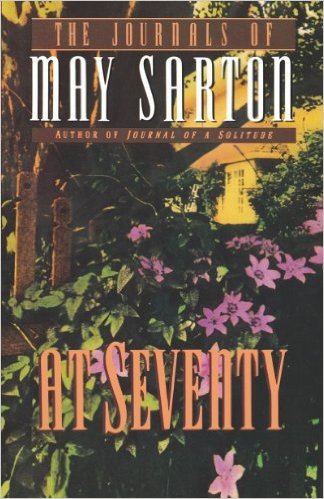
“At the age of ten May was introduced to the Unitarian church by her neighborhood friend Barbara Runkle, whose family attended the First Parish in Cambridge. May was impressed by the minister, Samuel McChord Crothers, whose sermons she thought “full of quiet wisdom.” One sermon in particular, she recalled in her memoir At Seventy, 1984, “made a great impression on me—and really marked me for life. I can hear him saying, ‘Go into the inner chamber of your soul—and shut the door.’ The slight pause after ‘soul’ did it. A revelation to the child who heard it and who never has forgotten it.” The Encyclopedia of Unitarian and Universalist Biography
May began writing early and her first poems – sonnets – were published in Poetry magazine in 1930. Her other love was theatre and she abandoned a scholarship to Vassar to study theatre and to eventually found a theatre company. However, in I Knew a Phoenix, Sketches for an Autobiography she wrote that when her first collection was published she focused on writing and “never looked back.”
Her novel Mrs. Stevens Hears Mermaids Singing is considered a “coming out” book and her work was then labeled lesbian and featured in women’s studies classes. She regretted the label seeing it as limiting, which it is. May Sarton wrote about the experiences, fears and other emotions that are part of being human. Journal of Solitude, for example, is a meditation on aging and the changes aging brings to life, on solitude ( a frequent theme in her work), on love affairs and creativity. May Sarton’s true gifts are poetry and memoir and not to be missed. Her novels – as she knew and admitted – were good but not top-notch.
“Loneliness is the poverty of self; solitude is richness of self.” May Sarton, Journey of Solitude
The following poem, Sisters, My Sisters, is one of May Sarton’s most well know poems. She reads it herself in this video. It was originally published in Kenyon Review in 1943 and is in Selected Poems of May Sarton.
If you are reading this in email, you’ll likely have to link through to the site to view it.
“Nous que voulions poser, image ineffaceable Comme un delta divin notre main sur le sable” – Anna de Noaille
Dorothy Wordsworth, dying, did not want to read,
“I am too busy with my own feelings,” she said.
And all women who have wanted to break out
Of the prison of consciousness to sing or shout
Are strange monsters who renounce the measure
Of their silence for a curious devouring pleasure.
Dickinson, Rossetti, Sappho — they all know it,
Something is lost, strained, unforgiven in the poet.
She abducts from life or like George Sand
Suffers from mortality in an immortal hand,
Loves too much, spends a whole life to discover
She was born a good grandmother, not a good lover.
Too powerful for men: Madame de Stael. Too sensitive:
Madame de Sevigne, who burned where she meant to give
Delicate as that burden was and so supremely lovely,
It was too heavy for her daughter, much too heavy.
Only when she built inward in a fearful isolation
Did any one succeed or learn to fuse emotion
“Does anything in nature despair except man? An animal with a foot caught in a trap does not seem to despair. It is too busy trying to survive. It is all closed in, to a kind of still, intense waiting. Is this a key? Keep busy with survival. Imitate the trees. Learn to lose in order to recover, and remember that nothing stays the same for long, not even pain, psychic pain. Sit it out. Let it all pass. Let it go.” ― May Sarton, Journal of a Solitude
 There is a pleasure in the pathless woods,




 Jamie Dedes' THE POET BY DAY Webzine