Page 52 of 61

CELEBRATING AMERICAN SHE-POETS (29): Emma Lazarus and Liberty Lighting the World … “I lift my lamp beside the golden door.”

Emma Lazarus, 1849 - 1887
Emma Lazarus, 1849 – 1887

In a letter to Emma Lazarus about Alide, an episode of Goethe’s Life. the Russian novelist Turgenev wrote  “An author who writes as you do is not a pupil in art anymore; he is not far from being himself a master.”

 “Emma Lazarus is a new name to us in American poetry, but ‘Admetus’ is not the work of a ‘prentice-hand’; few recent volumes of verse compare favorably with the spirit and musical expression of these genuine effusions of Emma Lazarus.” The Boston Transcript, c 1871

“What Emma Lazarus might have accomplished, had she been spared, it is idle and even ungrateful to speculate. What she did accomplish has real and peculiar significance. It is the privilege of a favored few that every fact and circumstance of their individuality shall add lustre and value to what they achieve. To be born a Jewess was a distinction to Emma Lazarus, and she in turn conferred distinction upon her race.” Josephine Lazarus, Emma’s elder sister who gather her poems together and published them in two volumes, The Poems of Emma Lazarus, 1881

“Until we are all free, we are none of us free.” Emma Lazarus

EMMA LAZARUS, poet, writer and activist, was by all accounts shy and she died at thirty-nine years, much too young. Nonetheless she accomplished a lot in addition to that for which she is most well-known, The New Colossus, the sonnet that is on the pedestal of the Statue of Liberty (Liberty Enlightening the World) in New York Harbor, having been installed there in 1903.

Unveiling of the Statue of Liberty Enlightening the World (1886) by Edward Moran. Oil on canvas. The J. Clarence Davies Collection, Museum of the City of New York.

“The copper statue, designed by Frédéric Auguste Bartholdi, a French sculptor, was built by Gustave Eiffel and dedicated on October 28, 1886. It was a gift to the United States from the people of France. The statue is of a robed female figure representing Libertas, the Roman goddess, who bears a torch and a ]a tablet evoking the law upon which is inscribed the date of the American Declaration of Independence, July 4, 1776. A broken chain lies at her feet. The statue is an icon of freedom and of the United States, and was a welcoming sight to immigrants arriving from abroad.” [Wikipedia]

In fact Lady Liberty greeted my own father and maternal grandparents and their children as they entered the harbor just as she probably did for the families of those reading here today. Their children and grandchildren learned the poem by heart in school. I suspect the majority of us took the ideals expressed as our own.

The bronze plaque inscribed with Emma Lazarus' poem, The New Colassus.
The bronze plaque inscribed with Emma Lazarus’ poem, The New Colossus.

A hymn to America, the “Mother of Exiles,” The New Colossus, was written to raise money for the construction of the pedestal for the Statue of Liberty.

The New Colossus – 1883

Not like the brazen giant of Greek fame,
With conquering limbs astride from land to land;
Here at our sea-washed, sunset gates shall stand
A mighty woman with a torch, whose flame
Is the imprisoned lightning, and her name
Mother of Exiles. From her beacon-hand
Glows world-wide welcome; her mild eyes command
The air-bridged harbor that twin cities frame.
“Keep, ancient lands, your storied pomp!” cries she
With silent lips. “Give me your tired, your poor,
Your huddled masses yearning to breathe free,
The wretched refuse of your teeming shore.
Send these, the homeless, tempest-tossed to me,
I lift my lamp beside the golden door!”

– Emma Lazarus

Emma came from a large Sephardic-Ashkenazi family, the father’s side from Germany and the mother’s side from Portugal. Her maternal great-grandmother was also a poet.  Emma’s first book of poems was published by her father when she was fourteen and apparently showed much promise. She continued to write poetry and eventually wrote a five-act play, a novel and a short-story as well.  She was a linguist, editing and translating works from the German, notably those of Goethe and Heinrich Heine. She wrote fourteen essays entitled Letters to the Hebrews. She was a forerunner in advocating a Jewish homeland, predating Theodore Herzi. She was friends with and an admirer of the American political economist, Henry George, who was instrumental in the birth of several reform movements of the Progressive Era. Essentially, George believed that workers should own the value of what they create, while the land should be held in common. Ralph Waldo Emerson was both friend and mentor.

Emma Lazarus received many posthumous awards. The Emma Lazarus Statue of Liberty Award is sponsored by the American Jewish Historical Society (New York and Massachusetts) and P.S. 268 in Brooklyn is named for her.

Life and Art

Not while the fever of the blood is strong,
The heart throbs loud, the eyes are veiled, no less
With passion than with tears, the Muse shall bless
The poet-sould to help and soothe with song.
Not then she bids his trembling lips express
The aching gladness, the voluptuous pain.
Life is his poem then; flesh, sense, and brain
One full-stringed lyre attuned to happiness.
But when the dream is done, the pulses fail,
The day’s illusion, with the day’s sun set,
He, lonely in the twilight, sees the pale
Divine Consoler, featured like Regret,
Enter and clasp his hand and kiss his brow.
Then his lips ope to sing–as mine do now.

– Emma Lazarus

RELATED


Under the Mango Sky, a poem … and your Wednesday Writing Prompt

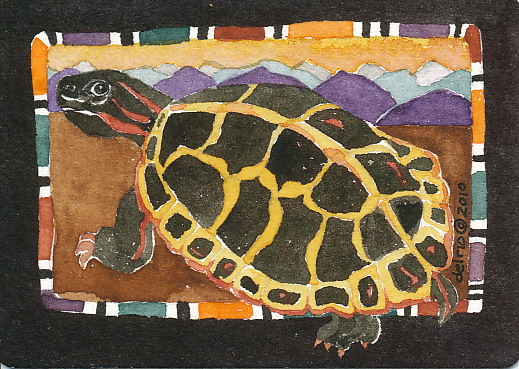
Painted Turtle by Gretchen Del Rio c 2010, rights reserved

our gray skies pass when mango sky comes,
warm with laughter, chanting its gentle way into
the space where turtle speaks in earthy colors,

speaks in that easy way only turtle can, as one who is
at home in herself, between her plastron and carapace,
wisdom in her slow ballet; her introversion, a model

for living well in this grinding war-spun world . . .
turtle is my totem and we live on our turtle island,
she is the everyday re-enchantment of my solitary

cosmos, my solidarity with life, i read her pastoral
letters in green on green, the sweet grasses and seas,
she speaks of connectedness, the basic constituents

of enigma, wizardry, and the madness of the times
and how best to dance the madness into light, she is
essence, the unrushed cure for wretched nature-deficit,

that consuming affliction, the spawn of modern day’s
backlit screens and relentless marketers of every bilk;
turtle healing is simple peace and master lessons in

self-containment, she draws us into our meditations
and back along the first path of Maka Ina, the lost or
forgotten primal path of the earth ways and feminine
energies and the lunar cycles that whirl us heavenward

  • Turtle ~ totem or power animal representing earth in Native American tradition
  • Turtle Island ~ in Iroquois tradition, when the earth was covered over with water, sundry animals attempted  to create land by swimming to the bottom of the ocean and hauling up dirt. Muskrat succeeded. He placed the dirt on the back of  Turtle, which grew into the landmass known today as North America. 
  • Maka Ina ~ Lakota (Sioux) ~ “maka” is earth and “ina” is mother, so Mother Earth. Earth teachings were/are considered a path to wholeness (heaven) by the First Peoples.

© 2013, poem, Jamie Dedes, All rights reserved; turtle watercolor courtesy of Gretchen Del Rio. 

WRITING PROMPT

Several years ago I had the rather odd experience of having three shamans, two Native American and one Mexican, tell me out of the blue (I never asked) that my totem is Turtle.  I think these good people had a fine sense of intuition and of the sacred and possibly were good observers. It would not be surprising or illogical for anyone to decide that an obvious introvert is a Turtle.

If you’ve never been given a totem animal, imagine one yourself. Write a poem about your personal totem. HERE is a list of Native American totems and their meanings to help you along.  Take your time. Enjoy! … and if you feel comfortable, leave the poem or a link to it in the comments section below.


This is Paul Brooks’ (thewombwellrainbow) response to the prompt given two weeks ago: Blown Across Timelessness. Bravo, Paul!  🙂

The Need

The need to remember
The never to forget
This list of essential tasks
On mobile, in my head.

Milk, bread, light bulbs, to live,
To bury my Nanna
Beside my Mum, Sister
Lay her casket to rest.

The need to remember
Why this delay, dither
To fulfill my Nannas
Wish to be buried here.

Join daughter, granddaughter.
I have kept her ashes
Stored in my room at home.
Close to their photographs.

I have told myself ‘Do
It!’ and nothing is done.
I cannot, will not let
Go of her. I am done.

Let her and myself down.
Must get hold of myself.
Must call the vicarage.
Must say a last goodbye.

The never to forget
As I shop these shelves
Everything on my list
That needs to be done.

My Nanna, Sister, Mum
Were my bread, milk, light.
My wife, daughter, grand
Kids are essentials now.

The need to remember,
Never to forget
One list to another
An urgent task undone.

© Paul Brooks (a.k.a. dragonwolfpaul)

unnamedPAUL BROOKS was shop assistant, security guard, postman, admin. assistant, lecturer, poetry performer, with Rats for Love and his work included in Rats for Love: The Book, Bristol Broadsides, 1990. His first chapbook was The Fabulous Invention Of Barnsley, Dearne Community Arts, 1993. He has read his work on BBC Radio Bristol and had a creative writing workshop for sixth formers broadcast on BBC Radio Five Live. Recently published in Clear Poetry, Nixes Mate, Live Nude Poems and others. Forthcoming in the spring 2017 an illustrated chapbook The Spermbot Blues, published by OpPRESS.


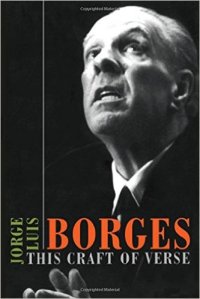
The recommended read for this week is Borges’ The Craft of Verse. (One of my faves.) 41-mshkw5pl-_sx331_bo1204203200_These are the famed lost lectures given in English at Harvard University (1967/68) by Jorge Luis Borges that were transcribed (c. 2000) and published in 2002.

The WordPlay Shop offers books and other tools especially selected for poets and writers. By making your Amazon purchases through this site, you help support it.

THE WORDPLAY SHOP: books, tools and supplies for poets, writers and readers

LITERATURE AND FICTION oo Editor’s Picks oo Award Winners oo NY Times Best Sellers

Rueben Woolley is not a silent poet …

U.K Poet, Reuben Whoolley
U.K Poet, Reuben Woolley bares witness

Reuben Woolley’s poetry is minimalist, sinuous on the page – or sometimes scattered like landmines waiting to explode. I find his work addictive and his latest book UntitledSkins (Hesterglock Pess, 2016) is going to be a gift to myself next month. Proceeds from sales go to CalAid.

Reuben’s poems, while exquisitely trimmed of all excess, are still rich with imagery and emotion.

Stylistically, I’m reminded of e.e.cummings.

Yes! I like the way he writes. More importantly, I’m glad Reuben chose to use his deft pen and kind heart to bring more awareness to the darkness in humanity, hanging our dirty laundry out to be seen and not denied. He tells the hard truth. If you are not devastated then you have grown numb to the injustices of our world. This is why we need poets like Reuben, to sound the clarion call and to bare witness.


With Reuben’s permission, here are two poems and look for more of Reuben’s work in the January 15 issue of The BeZine.

lessons

this is the fear
of a first breath

start counting
now

this is laughter
through bleeding membranes

don’t hope
for wings

or terminal
stations

we walk the subway
mazes.the painted
maps & all their changes

…………drilling
skulls gives no answers
& death itself
is rarely clean


to this we came.not this

wrapping
a mind round wires
& razors
……………..cut

i’ll wear the given
shoes so well in these
white
streets

……………....it isn’t
the same
the running from metal

……………….the bombs
they make who give
the shoes but

still

they’re laughing at us
mother


THE FOURTH INTERNATIONAL FESTIVAL OF POETRY, MARRAKESH

Reuben is invited to the Fourth International Festival of Poetry in Marrakech, Morroco in April. He plans to take poems from I am not a silent poet, his online magazine. The Festival covers hotel and catering costs but doesn’t pay anything towards transport. Like all of us who live off the proceeds of poetry, his purse is a little light. Reuben set-up a crowd funding page to raise the money for the airfare. That’s the main reason I wanted to introduce Reuben to you today. Here’s the invite. The “Mrs.” is a typo and festival organizers have promised to correct it. Reuben’s crowd-funding site is HERE.

marrakech-invitation


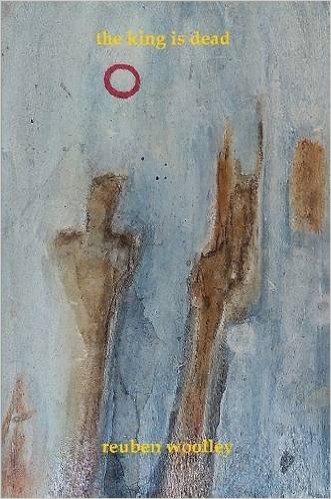
51m8en2wll-_sx329_bo1204203200_Reuben Woolley is published in various magazines including Tears in the Fence, The Lighthouse Literary Journal, The Interpreter’s House, Domestic Cherry, The Stare’s Nest and Ink Sweat and Tears. His collection, the king is dead was published in 2014 with Oneiros Books  and a chapbook, dying notes, in 2015 with Erbacce Press. Reuben was runner-up in the Overton Poetry Pamphlet competition and the Erbacce Prize in 2015. A new collection on the refugee crisis, skins, was published by Hesterglock Press, 2016:
Reubensays, he “pretends to be busy editing the online magazines: I am not a silent poet and The Curly Mind.”

I am not a silent poet is a zine dedicated to poetry and artwork of protest against abuse in all shapes and forms. Reuben’s motivation for founding the site: “I have seen such increased evidence of abuse recently that I felt it was time to do something. I am not a silent poet looks for poems about abuse in any of its forms, colour, gender, disability, the dismantlement of the care services, the privatisation of the NHS, the rape culture and, of course, war and its victims are just the examples that come to mind at the moment.”

© 2017, poems,and photograph, Reuben Whoolley; bookcover art by Sonjia Benskin Mesher

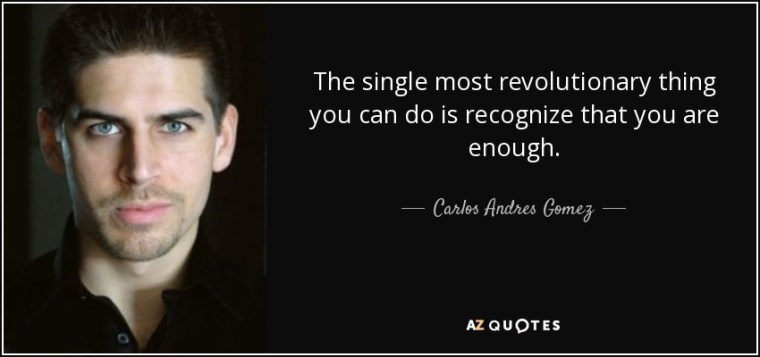
Carlos Andrés Gómez ~ “Genocide” and “Man-up: Reimagining Modern Manhood”

quote-the-single-most-revolutionary-thing-you-can-do-is-recognize-that-you-are-enough-carlos-andres-gomez-80-67-82Mark Twain (a.k.a. Samuel Clemens) famously – or perhaps infamously – was a believer in and adept master of profanity, not as vulgarity, he said, but as release.

“Under certain circumstances, urgent circumstances, desperate circumstances, profanity provides a relief denied even to prayer.” Mark Twain, a Biography

Twain wrote of swearing as “ornamental” when practiced by American miners considered by him to be “gifted among the sons of man.”

I admit I haven’t the gift to turn profanity into art and I have no taste for vulgarity.  You won’t catch a swear word on my tongue or even on my mind but I do recognize that there’s a time and place and manner. I don’t know what Twain would think of award-winning American spoken-word poet, Carlos Andrés Gómez, but I like his work. Carlos moves profanity from emotional release or “ornament” to moral high ground. He applies it with searing honesty to the human condition.

Here’s Carlos telling it like it is:

If you are reading this post FROM in email, you will have to click through to view the video.

“Carlos is amazing. Pretty much everything he says, whether a ‘poem’ or not, is pure poetry. His grace and power and humor demand not only that people listen, but also that they act for change — in themselves and the world around them. And especially when it comes to the narrow norms that constrain men, hurt women, and limit us all, he can help deliver exactly the change we need. Carlos makes me laugh, cry, and hope.”

Mallika Dutt, President & CEO of Breakthrough [the global human rights organization dedicated to making violence against women unacceptable] (India)

61Qvg4B4epL._SX330_BO1,204,203,200_Carlos Andrés Gómez was born in New York City (1983) but he seems very much a citizen of the world.  He’s a poet, writer, actor, activist . . . and  some say, a prophet.  He was a social worker and a public school teacher. He is the son of a United Nation’s diplomat and an indigenous rights’ activist.

His book, Man-up: Reimagining Modern Manhood (Gotham, 2012) is a coming of age memoir that suggests an enlightened masculinity with an open self-embracing emotional life, ready to foster nonviolence and able to see women not as objects but as whole human beings, as equal partners in life and work. The book was written in part to help address some of the crises we are all so concerned about, including school drop-out rates and youth suicide. A worthy read that challenges us to exchange traditional male stereotypes of macho conformity for something more genuine and soul-satifying. Recommended for women as well as men and I’d say for anyone raising and/or educating young men.

© Jamie Dedes

THE WORDPLAY SHOP: books, tools and supplies for poets, writers and readers

LITERATURE AND FICTION oo Editor’s Picks oo Award Winners oo NY Times Best Sellers