LET US
For the Poets of January 15th and the Women of January 21st
Let us
take ourselves aboard a bus
and travel to the dispossessed
And let us praise their dreamless eyes and hardened smiles
with rogue words of truth
to the killing fields of their hopes
The slum wards and ragged towns and stolen farms
Let us take to them the carnival of our mad and scattered lives
Let us bring them the mountain, let us give them the vision
of an open window, an unlocked door, a bed to sleep in, a plate of food
Let us give them the keys to the house of our love
Let us bare our throats tattooed with roses, our breasts sequenced with diamonds
our loins hot with dragons, our hands and feet pierced with beauty
Let us come to their dusty squares and drinking holes with canticles of magnificent defeat
Let us deliver to their mangers
of pollution and penitentiaries, shopping malls and tenements
the hard beautiful birth of the heart
Let us bring renewal, let us declare the death of despondency and tyrants
For I have seen our campfires beside the roads, like fallen still-burning miraculous stars
I have seen our bus voyaging to innocence
I have seen us tossed this century like a bone
after decades of science and war reason and corporation
art and Auschwitz
I have seen my vocation descend like a pen to a page
that can never be filled with enough truth
I have crossed a continent of despair and I swear to you, Poets,
I live for greater than myself
You, street-Latin Elizabethan hustlers, I tell you time has come to deal
death’s passionate kiss to kings
Time has come to bare our asses in Paradise
Time has come to write the Constitution with poetry and flesh
Time has come to costume up and ride
with words like steel-tipped whips
into the soul of American
and rage there and sing
till the mouth of every hungry child
is fed.
Alan Kaufman’s poem is published here with his permission and in anticipation of the event featured in the poster above and initiated by Alan along with Michael Rothenberg. In coordination with their event, the theme for the January 15 issue of The BeZine is “Resist.”
We invite submissions for the January issue. This is the second writing prompt to help you toward participation – online and/or off – in this important event designed to push back against vulgarity, bigotry, xenophobia and misogyny. For The BeZine we invite world-wide participation – not against any one person – but against the renewed growth of these trends all over the Western world and the continued entrenchment – business as usual – for the rest of the world.
For the Zine, you don’t have to write a poem. You can do an essay, feature article, creative nonfiction, art or photography, or music video, which we hope will not only frame the issues but have constructive suggestions toward resolution. No hateful language please. When you have written something on “resist” and if you feel comfortable submitting it to be considered for publication, email it to bardogroup@gmail.com
Save the date for both live and virtual events and prepare to submit your work or works to the Zine by January 10th, end of day. Let your work be both truthful and artistic . . .
Tell all the Truth but tell it slant — Success in Circuit lies Too bright for our infirm Delight The Truth’s superb surprise
As Lightning to the Children eased With explanation kind The Truth must dazzle gradually Or every man be blind — Emily Dickinson
The Zine submission guidelines HERE. The Zine mission statement HERE.
Medallion portrait of John Keats (1795-1821), English Romantic Poet
It’s that time of year again – kick back time between Christmas and the new year – a good time to revisit old movies and see new ones.
Bright Star is based on the tragic love of the quiet and reserved Romance poet, John Keats, and the vivacious Franny Brawne. Their alliance was destined to be cut short by his death at twenty-four of TB. Bright Staris not just another Regency drama. From the costumes, to the changing of the seasons that were a beautiful and meaningful backdrop to the story, to the world-class cast and script (Jane Campion wrote the script and directed the movie), it is about as nearly perfect as any movie can hope to be.
The title of the movie is taken from Keat’s poem Bright Star:
Bright star, would I were stedfast as thou art— …..Not in lone splendour hung aloft the night
And watching, with eternal lids apart, …..Like nature’s patient, sleepless Eremite,
The moving waters at their priestlike task …..Of pure ablution round earth’s human shores,
Or gazing on the new soft-fallen mask …..Of snow upon the mountains and the moors—
No—yet still stedfast, still unchangeable, …..Pillow’d upon my fair love’s ripening breast,
To feel for ever its soft fall and swell, …..Awake for ever in a sweet unrest,
Still, still to hear her tender-taken breath,
And so live ever—or else swoon to death.
– John Keats
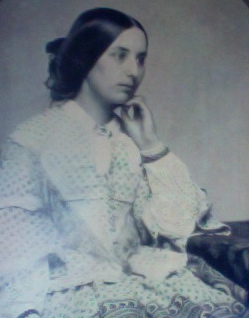
Francis (Fanny) Brawne London (1800-1865)
Abby Cornish plays Fanny Brawne in a performance both understated and charming. Brawne came from a rather straightened background. At sixteen she is savvy and spunky and falls in love with that raw intensity most of us bring to first love. The story is told from Brawne’s perspective.
Ben Whishaw does a splendid job portraying the sensitive Keats. His recitation of Ode to a Nightingale, which is played as the closing credits run is itself worth the time and expense of admission.
Keats and Brawne were separated when a group of the poet’s friends pooled their resources to send him to Italy. Their hope was that the balmy climate would restore him and prolong his life. Keats, however, knew he would die in Italy. So did Brawne. That circumstance leads to a long and tender good-bye. Lying on a bed in Keats’ room, face to face, they recite La Belle Dame sans Merci to each other.Exquisite!
If you haven’t seen Bright Star, put it on your to-watch list. I don’t think you will be disappointed.
Here is Ben Whitsaw’s exquisite rendering of La Belle Dame sans Merci. If you are reading this post in an email, you’ll have to link through to the site to view the video.
Photos ~ John Keats by di Gieovanni Dall’Orto from Keats’ headstone under attribution license via Wikipedia; Franny Brawne, an ambrotype taken circa 1850 and in the public domain.
So often I want toshout: Don’t talk to me about the human condition in sociological terms. Don’t give me a technical analysis of the poem. Don’t talk to me about theology. There’s a place for all that but what I really want is your visceral response to life, art and to the Ineffable. In Hèléne Cardona’s poetry, we get just that. One of Helene’s gifts is to render the mysterious and mystical in often poignant terms expanding the boundaries of physical space into the unfettered space of psyche and Spirit. Writing from her sacred space, Hélène speaks to us in a silken web that is both imaginal and mythic, a space inhabited by visions and creatures we all know. Read with a still mind and open heart,the experience is somewhat like meditating and finding oneself in Rumi’s field where “the world is too full to talk about.”
“I hear beyond the range of sound the ineffable, the sublime, my mother’s breath, grandmother’s smile, ancestors’ voices, to soothe and heal the sorrow.”
Both books express an intimacy with nature and broad cultural exposure. The poems were written in English and include Hélène’s own translations into French.
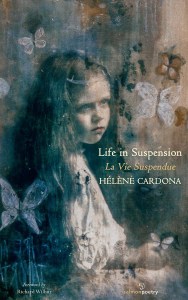
Hélène Cardona is a poet, literary translator and actor, whose most recent books include Life in Suspension and Dreaming My Animal Selves (both from Salmon Poetry), and the translations Beyond Elsewhere (Gabriel Arnou-Laujeac, White Pine Press), winner of a Hemingway Grant; Ce que nous portons (Dorianne Laux, Éditions du Cygne), and Walt Whitman’s Civil War Writings for WhitmanWeb.
She has also translated Rimbaud, Baudelaire, Aloysius Bertrand, Maram Al-Masri, Eric Sarner, René Depestre, Ernest Pépin, Jean-Claude Renard, Nicolas Grenier, and her father José Manuel Cardona. A Romanian translation of Dreaming My Animal Selves was published by Junimea Editions in 2016. Her work has been translated into 13 languages.
She contributes essays to The London Magazine, is co-international editor of Plume, and managing editor of Fulcrum: An Anthology of Poetry and Aesthetics. She holds a Master’s in American Literature from the Sorbonne, received fellowships from the Goethe-Institut and Universidad Internacional de Andalucía, worked as a translator for the Canadian Embassy in Paris, and taught at Hamilton College and Loyola Marymount University.
Publications include Washington Square Review,World Literature Today, Poetry International, Dublin Review of Books, Asymptote, The Brooklyn Rail, Hayden’s Ferry Review, The Warwick Review, Irish Literary Times, Poetry Salzburg Review, and elsewhere.
Acting credits include Chocolat, Dawn of the Planet of the Apes, Jurassic World,X-Men: Days of Future Past, The Hundred-Foot Journey, Mad Max: Fury Road,Inception, and Mumford. She is the Computer voice in the TV series Heroes Reborn and her many voice characters include Happy Feet 2 and Muppets Most Wanted. For Serendipity she co-wrote with director Peter Chelsom and composer Alan Silvestri the song Lucienne, which she also sang. http://helenecardona.com
“Poetry is language for the ineffable, what is impossible to write, the mystery. I seek the light within that mystery. We are stretched to the frontiers of what we know, exploring language and the psyche. The poem is a gesture, a movement, an opening towards a greater truth or understanding.” Hélène Cardona
AN INTERVIEW WITH HÉLÈNE CARDONA
JAMIE: Hélène both the collections I’ve read are beautifully crafted and graceful, ripe with all that is profound and mystical in life. Your love of language is evident in each poem and in the fact that you’ve studied and master several. Tell us how this love was birthed. How did it become clear to you that language – in one way or another – would be a major path in your life?
HÉLÈNE: I grew up in France, Switzerland, Spain, Monaco, England, Wales, Germany and Greece, and absorbed different cultures and ideas.
I go back and forth between French, English and Spanish the most. My father is Spanish and my mother Greek, so I grew up speaking all three languages at home. I deepened my study of Spanish at the Sorbonne, the Universidad Menendez Pelayo in Santander, and the Universidad de Baeza in Andalucía.
I started learning German when I was eleven or so, and went on to study it at the Goethe Institute in Paris and later in Bremen, Germany. I loved German right away. It feels very familiar and comfortable to me, as if I had a past life in Germany.
I loved language early but it was not obvious to me that it would be a major path in my life at first. That’s because I was a math major in high school, which led me to medical school when I was seventeen. After two years I had a breakdown. it was like giving up my soul. I went through a deep depression and nearly died. Which is what saved me. It was a deeply transforming spiritual experience and put me on my path.
JAMIE: Your life is busy with acting, voice over work, translating, teaching, mentoring and the usual things we all must attend to: friends, family and the daily prosaic activities of maintaining life and livelihood. How do you transition from all that into your time for writing? Tell us something about your writing regime.
HÉLÈNE: My ideal writing regime is to write every night. In reality it’s more cyclical, with periods of more intense writing, and times where I write much less.
Regardless, I have notepads I carry with me, where I write things down throughout the day. I also have a notebook by my bed, where I write my dreams in the morning.
JAMIE: Congratulations on your many awards including most recently the Pinnacle Book Award for Best Bilingual Book of Poetry for Life in Suspension. What made you decide to do bilingual collections?
HÉLÈNE: It was my first publisher’s idea and it was brilliant. French is my native language and English is my fifth but it has become my language of choice. So I mostly write in English now. Translating my poems into French, my mother tongue, helped me tremendously because I made some beautiful, creative discoveries and revised the English in the process. It’s become a dance between the two languages.
JAMIE: Congratulations on being a Translation judge for the PEN Center USA Literary Awards. What can you tell us about the experience?
HÉLÈNE: I was very honored to serve as a Translation judge for the PEN Center USA Literary Awards, along with Hilary Kaplan and André Naffis-Sahely. I’ve been a member and supporter of PEN Centre USA and PEN America for many years. PEN champions “the freedom to write, recognizing the power of the word to transform the world.” Their goal is “to ensure that people everywhere have the freedom to create literature, to convey information and ideas, to express their views, and to make it possible for everyone to access the views, ideas, and literatures of others.” As for PEN Center USA, its “mission is to stimulate and maintain interest in the written word, to foster a vital literary culture, and to defend freedom of expression domestically and internationally.” We judged work produced or published by writers living west of the Mississippi River in all genres: poetry, fiction, and nonfiction. Two works really stood out: Forbidden Pleasures: New Selected Poems, Stephen Kessler’s gorgeous translation of Luis Cernuda – the winner -, and Woman in Battle Dress, Jessica Powell’s stunning translation of the bold novel by Antonio Benítez-Rojo, which was one of the finalists.
JAMIE: Among other works you translated Walt Whitman into French. How – if at all – the experience of translating your own work differ from translating the work of others?
HÉLÈNE: With my own work I feel freer to make changes to the original, because I’m only accountable to myself.
JAMIE: Who is the poet (or poets) who have most influenced you?
HÉLÈNE: I’ve been writing poetry since I was ten. Growing up I read poetry and plays and devoured novels. I read all the classics like Victor Hugo and Alexandre Dumas. I loved Balzac. I read most of The Human Comedy. It is composed of a series of stories and novels, some historical like The Chouans (which remains one of my favorite with Old Goriot, Cousin Bette, The Lily of the Valley and The Wild Ass’s Skin) mostly depicting French society in the first half of the 19th century. The genius of it is that characters reappear from novel to novel and the reader keeps asking for more. I enjoyed the French playwrights Molière, Racine, Marivaux and de Musset, the Spanish playwrights Calderón de la Barca, Lope de Vega and Lorca, and Shakespeare of course. I discovered English literature and started spending my summers in England and Wales studying English philology. I would later discover Henry James and fall in love with him the same way I fell in love with Balzac.
Some of my favorite poets, in no particular order, are Anna Akhmatova, Mallarmé, Rilke, H.D., Emily Dickinson, Baudelaire, Rimbaud, Aragon, Alberti, Lorca, Neruda, Machado, Cernuda, Breton, Cocteau, Robin Coste Lewis, Lee Upton, Éluard, Blake, Rumi, Yeats, Marie Ponsot, David Mason, Hafiz, David Wagoner, Louise Glück, Dorianne Laux, Edna St. Vincent Millay, Lao Tzu, Sharon Olds, Geoffrey Hill, Thomas McCarthy, Rita Dove, Wisława Szymborska, Warsan Shire, Heather McHugh, Chase Twichell, Seamus Heaney, Mary Oliver, Larry Levis, Hart Crane, and John FitzGerald.
JAMIE: Our readers have a strong interest in poetry as a healing agent, as witness to the human condition. In what ways do you feel your poetry fills these needs?
HÉLÈNE: For me, poetry is a process of self-revelation, an exploration of hidden dimensions in myself, and it is also at the same time a way to become myself, a process of individuation I try to create throughout my life – a profound experience of the fundamental interconnection of all in the universe. Moreover, writing is cathartic as it extends a search for peace, for serenity, rooted in a desire to transcend and reconcile the fundamental duality I see in life. Ultimately, I seek expansion of consciousness.
POEMS FROM LIFE IN SUSPENSION, La Vie Suspendue (a collection in English and French)
The three poems are shared here with Helene’s permission and are under copyright.
A House Like A Ship
I live in a house like a ship …..at times on land, at times on ocean.
I will myself into existance …..surrender, invite grace in.
I heed the call of the siren. …..On the phantom ship
I don’t know if I’m a wave …..or cloud, undine or seagull.
Lashed by winds, I cling tight to the mast. …..Few return from the journey.
I now wear the memory of nothingness …..a piece of white sail wrapped like skin.
Hélène Cardona
From Life in Suspension (Salmon Poetry, 2016)
Galactic Architect
From the bottom rung of a ladder in the sky
I hang in the void.
Ultramarine is all I need.
Let it be simple,
build a cottage for the spirit
to rest and soar.
I trust, self contained, in equipoise,
resources at my fingertips —
deep-rooted ghosts supporting
the foundation of a throne
to explore and claim whole worlds —
surprised to find you here with me
lighting up my life.
Hélène Cardona
From Life in Suspension (Salmon Poetry, 2016)
Twisting the Moon
Now is the time to know that all you do is sacred. —Hafiz
We shared the coast of Maine in June, …hundreds of whales, lobster …..sandwiches, buttermilk pancakes …….and a room in Bar Harbor with antique tub.
They’re now a cloister of shadows loved, …goldsmith of the music of time. …..She left when circumstances met.
I dream of offering her strawberries on sacred moons, …healed by the beauty of memories, …..ready to start over as if knowing nothing.
– Hélène Cardona
From Life in Suspension (Salmon Poetry, 2016)
Hélène’s Amazon page is HERE and her website is HERE.
“Finally unafraid to be free, Ready to surrender all the illusions of recognition and external securities, Living off the sky and earth like soaring eagles and braying burros . . .
The iconoclast poet, Dr. James Kavanaugh, first gained fame when he wrote A Modern Priest Looks at His Outdated Church. It was published in 1967.
“It is one of the most moving human documents I have ever read! In an earlier day the author would have been burned at the stake.” Dr. Carl Rogers
In this best-selling book the author called for Church reforms on its positions such as birth control, divorce, premarital sex and celibacy for priests. It says a lot about the man that he had the courage to speak his truth and ultimately to leave the Church.
A Modern Priest Looks at His Outdated Churchis worth your timeas an exploration of ideas and ideals and difficult decisions. It seeks to dig the historically accurate from under dust of mythology.
Encouraged by family, teachers and tradition to become a priest, Kavanaugh entered the seminary when he was fourteen. He served as a priest for nine years and, when he left the Church – which he did love – it was to honor the depth and breath of his values and to strike out on an adventure to free his soul and find his own vision of God.
“We searchers are ambitious only for life itself, for everything beautiful it provides.” James Kavanaugh in There Are Men Too Gentle to Live Among Wolves
I believe Dr. Kavanaugh wrote four nonfiction titles, one children’s book, two novels … but the bulk of his work was poetry.
Dr. Kavanaugh’s first collection of poetry was There Are Men Too Gentle to Live Among Wolves. That book’s eponymous poem is below and it reminds us of ourselves and so many we know. It’s a healing and compassionate read. Someone understood!
The second poem here is the complete poem that was refered to and quoted in part in yesterday’s post by Rev. Ben Meyers in Notions of God.
James Kavanaugh died in 2009. His wife and family continue to keep his legacy alive at jameskavanaugh.org where you can read more about him and his work and purchase all of his books, proceeds to charity.
If you have not yet read Kavanaugh, do. His work is frank, profound, accessible, finely crafted and recommended without reservation.
THERE ARE MEN TOO GENTLE TO LIVE AMONG WOLVES
There are men too gentle to live among wolves
Who prey upon them with IBM eyes
And sell their hearts and guts for martinis at noon.
There are men too gentle for a savage world
Who dream instead of snow and children and Halloween
And wonder if the leaves will change their color soon.
There are men too gentle to live among wolves
Who anoint them for burial with greedy claws
And murder them for a merchant’s profit and gain.
There are men too gentle for a corporate world
Who dream instead of candied apples and ferris wheels
And pause to hear the distant whistle of a train.
There are men too gentle to live among wolves
Who devour them with eager appetite and search
For other men to prey upon and suck their childhood dry.
There are men too gentle for an accountant’s world
Who dream instead of Easter eggs and fragrant grass
And search for beauty in the mystery of the sky.
There are men too gentle to live among wolves
Who toss them like a lost and wounded dove.
Such gentle men are lonely in a merchant’s world,
Unless they have a gentle one to love.
– James Kavanaugh
My Easy God is Gone
I have lost my easy God – the one whose name
I knew since childhood.
I knew his temper, his sullen outrage,
his ritual forgiveness.
I knew the strength of his arm, the sound
of his insistent voice.
His beard bristling, his lips full and red
with moisture at the moustache,
His eyes clear and piercing, too blue
to understand all,
His face too unwrinkled to feel my
child’s pain.
He was a good God – so he told me –
a long suffering and manageable one.
I knelt at his feet and kissed them.
I felt the smooth countenance of his forgiveness.
I never told him how he frightened me,
How he followed me as a child,
When I played with friends or begged
for candy on Halloween.
He was a predictable God, I was the
unpredictable one.
He was unchanging, omnipotent, all-seeing,
I was volatile and helpless.
He taught me to thank him for the concern
which gave me no chance to breathe,
For the love which demanded only love in
return – and obedience.
He made pain sensible and patience possible
and the future foreseeable.
He, the mysterious, took all mystery away,
corroded my imagination,
Controlled the stars and would not let
them speak for themselves.
Now he haunts me seldom: some fierce
umbilical is broken,
I live with my own fragile hopes and
sudden rising despair.
Now I do not weep for my sins; I have
learned to love them.
And to know that they are the wounds that
make love real.
His face eludes me; his voice, with all
its pity, does not ring in my ear.
His maxims memorized in boyhood do not
make fruitless and pointless my experience.
I walk alone, but not so terrified as when
he held my hand.
I do not splash in the blood of his son
nor hear the crunch of nails or thorns
piercing protesting flesh.
I am a boy again – I whose boyhood was
turned to manhood in a brutal myth.
Now wine is only wine with drops that do
not taste of blood.
The bread I eat has too much pride for transubstantiation,
I, too – and together the bread and I embrace,
Each grateful to be what we are, each loving
from our own reality.
Now the bread is warm in my mouth and
I am warm in its mouth as well.
Now my easy God is gone – he knew too
much to be real,
He talked too much to listen, he knew
my words before I spoke.
But I knew his answers as well – computerized
and turned to dogma.
His stamp was on my soul, his law locked
cross-like on my heart,
His imperatives tattooed on my breast, his
aloofness canonized in ritual.
Now he is gone – my easy, stuffy God – God,
the father – master, the mother – whiner, the
Dull, whoring God who offered love bought
by an infant’s fear.
Now the world is mine with all its pain and
warmth, with its every color and sound;
The setting sun is my priest with the ocean for its alter.
The rising sun redeems me with rolling
waves warmed in its arms.
A dog barks and I weep to be alive, a
cat studies me and my job is boundless.
I lie on the grass and boy-like, search the sky.
The clouds do not turn to angels, the winds
do not whisper of heaven or hell.
Perhaps I have no God – what does it matter?
I have beauty and joy and transcending loneliness,
I have the beginning of love – as beautiful as it
is feeble – as free as it is human.
I have the mountains that whisper secrets
held before men could speak,
I have the oceans that belches life on
the beach and caresses it in the sand,
I have a friend who smiles when he sees
me, who weeps when he hears my pain,
I have a future of wonder.
I have no past – the steps have disappeared
the wind has blown them away.
I stand in the Heavens and on earth, I
feel the breeze in my hair,
I can drink to the North Star and shout
on a bar stool,
I can feel the teeth of a hangover, the
joy of laziness,
The flush of my own rudeness, the surge of
my own ineptitude.
And I can know my own gentleness as well
my wonder, my nobility.
I sense the call of creation, I feel its
swelling in my hands.
I can lust and love, eat and drink, sleep
and rise,
But my easy God is gone – and in his stead
The mystery of loneliness and love!


_-_Foto_Giovanni_Dall%27Orto,_31-March-2008.jpg)





 Jamie Dedes' THE POET BY DAY Webzine