Adam Zagajewski (b. 1945) is a new poet to me, discovered on reading Tim Beck’s article, The Other Half of a Poem. I did a bit of reading and research and in sum found that Zagajewski began as a protest poet of the Polish “New Wave.” He felt that poetry should address current social needs, incorporating but not serving politics and using unambiguous language. Poetry should undermine communist double-speak. Not surprisingly, Zagajewski was exiled from Poland in 1982.
Zagajewski I found is generally well-considered by his peers, though there are some who criticize him (Czeslaw Milosz is one) for being “one-dimensional.”
I sent for three of Zagajewski’s books. Mysticism for Beginners is among them. I find the poems in this collection beguiling and disquieting at once.
From Vermeer’s Little Girl
Johannes Vermeer, c. 1665, Oil on canvas, 44.5 cm × 39 cm (17.5 in × 15 in), Mauritshuis, The Hague, Netherlands
“Oh, Vermeer’s little girl, oh pearl
blue turban: you are all light
and I am made of shadow.
Light looks down on shadow
with forbearance, perhaps pity.”
From The Traveler
“putting his hand to his chest, checking warily
to make sure he still had his return ticket
to the ordinary places we all live”
From Holy Saturday in Paris
“And two-headed doubts
slim as antelopes,
barricade the street
Lord why did you die”
A week after the Twin Towers collapsed, The New Yorker magazine ran Zagajewski’s Try to Praise the Mutilated World on the final page of its special 9/11 issue along with W.S. Merwin’s To the Words. It became – according to a Newsweek article – “the best known poem in decades.” The poem was not inspired by 9/11. It was written a few years before.
“You’ve seen the refugees heading nowhere,
you’ve heard the executioners sing joyfully.
You should praise the mutilated world.”
So, yes: an intriguing poet full of shadow and light and two-headed doubts.
For everyone who eats, sleeps and breathes poetry and wishes poetry was their day job, THE POET BY DAY (including The Poet by Day Facebook Page) is reinventing itself, transitioning to an information hub on all things poesy with special – but not exclusive – light on:
regional and global poetry initiatives for peace, sustainability and social justice
she-poets
minority poets
poets just finding their voices in maturity
On Occasion: Celebrating American She-Poets. Yes! I know it’s cheeky to steal from Muriel Rukeyser like that, but “American She-Poets” is so pungent v. “American Woman.”
So join with me in the glory of poetry: poets, poems, news, reviews, readings and events. If you’d like to share an announcement for an event, publication, book launch or class, you must send it fourteen days in advance to thepoetbyday@gmail.com. Publication is subject to editorial discretion. Thank you! Jamie Dedes
I first published this piece on Ruth Stone in 2013, but I love her poetry so much I had to include her early in this Thursday series of mine inspired by the work of poet Dilys Wood and the London-based Second Light Network of Women Poets (SLN), which Dilys founded. SLN encourages and supports the poetry of women, including those women with voices emerging in their third act.
Poems clutter the landscape of my mind with bite-sized portions easily committed to memory, ready to be pulled out in a moment of need or want. I like to think of poetry as literary dim sum, which means “touch the heart.” And poems do spring themselves on me and touch the tender places. Depending on the poem and the poet, they may also tickle my funny bone, stimulate my intellect, or affirm some insight. In the art of living hugely, poetry is warp and weft.
Whether I am writing poetry or reading it, poetry gifts to me those blessed eureka moments, the moments when I understand myself or another, can put a name to the demons, or simply realize that I am not alone in my joy or sorrow. Think of W. H. Auden’s Funeral Blues and the simple line, “Pack up the moon and dismantle the sun.” I am getting older, approaching elderly, and though I am always making new friends, I’m of an age where I lose a friend or two each year. Bereft at the loss of someone precious and shocked that the earth hasn’t stood still, I think of this line and know that in this circumstance, everyone feels what I do . . .
. . . and all it takes is one disappointment in love to relate to Mad Girl’s Love Song by Silvia Plath, “I dreamed that you bewitched me into bed/And sung me moon-struck, kissed me quite insane./(I think I made you up inside my head.)
Of the many poets I dearly love, I particularly appreciate Ruth Stone for her quality of giving things their true names and for the practicalities embedded in her poems. “Dear children,/You must try to say/Something when you are in need./Don’t confuse hunger with greed;/And don’t wait until you are dead.”
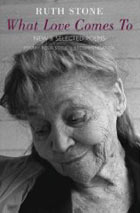
Ruth Stone was an American poet and poetry teacher born into an impoverished family at Roanoke, Virginia in 1915. She lived most of her life in rural Vermont, attended the University of Illinois at Urbana-Champaign, won many awards for her poetry and was a finalist for the Pulitzer Prize for her last collection, What Love Comes To: New & Selected Poems (2008). She was wry, bold, conversational, edgy, philosophical and used the language and imagery of the natural sciences to good effect. Her second husband, the poet Walter Stone, committed suicide leaving her with three young children and an experience that indelibly etched itself on her life, heart and poetry. She once remarked that she spent the rest of her life writing to him.
Not Expecting an Answer
This tedious letter to you,
what is one Life to another?
We walk around inside our bags,
sucking it in, spewing it out.
Then the insects, swarms heavier
than all the animals of the world.
Then the flycatchers on the clothesline,
like seiners leaning from Flemish boats
when the seas were roiled with herring.
This long letter in my mind,
calligraphy, feathery asparagus.
When Ruth Stone won the Whiting Writers’ Award, she got plumbing for her house. When she received the Walter Cerf Award for Lifetime Achievement in the Arts at the National Book Awards, she said “I’ve been writing poetry or whatever it is since I was five or six years old, and I couldn’t stop, I never could stop. I don’t know why I did it.… It was like a stream that went along beside me, you know, my life went along here . . . and all along the time this stream was going along. And I really didn’t know what it was saying. It just talked to me, and I wrote it down. So I can’t even take much credit for it.”
Ruth Stone died in 2011 leaving behind thirteen collections of literary dim sum. This poem, which gave its name to a collection that I just purchased, is a new favorite.
In the Next Galaxy
Things will be different. No one will lose their sight, their hearing, their gallbladder. It will be all Catskills with brand new wrap-around verandas. The idea of Hitler will not have vibrated yet. While back here, they are still cleaning out pockets of wrinkled Nazis hiding in Argentina. But in the next galaxy, certain planets will have true blue skies and drinking water.
In the scant two-minute video that follows, the writer Elizabeth Gilbert(Eat, Pray, Love) shares the revealing story of her meeting with Ruth Stone.
 Mysticism for Beginners, Adam Zagajewski



 For everyone who eats, sleeps and breathes poetry and wishes poetry was their day job, THE POET BY DAY (including

 Jamie Dedes' THE POET BY DAY Webzine