Writing in a far and broken country, my pen
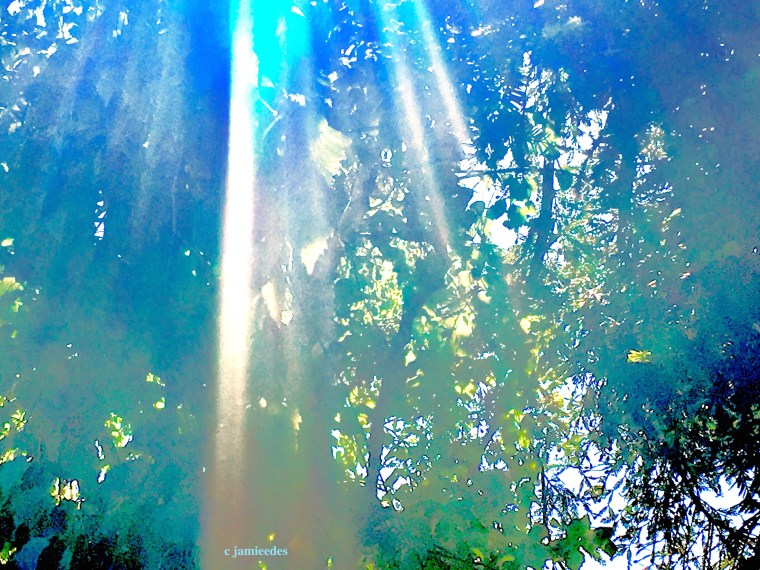
knows its kinship with the dark forest, asks
direction of its trees, celebrates its quiet amity
over the din of plastic medicine vials, the 40-foot
serpentine specter of a cannulae, the hiss and sigh
of an oxygen compressor amid layered silences.
We are named on a long list of regional poets.
The region is the sickroom where the palm and
birch in the courtyard know their meaning and
place. Lend a shaman ear. The trees will speak
and tell you that we are found, we are here,
not lost in those vials but found in the hallowed
company of artful seekers on a Vision Quest. Call it
the hero’s journey – Strike up the hill. Cry out for
the Sacred Dream, for the purpose of your life and
its confusions. A comforting Infinity breaks through
fierce grieving embraced. The great dream comes
to you. The trees come to you. They speak in God’s
tongue, which is – after all – your True Voice. . .
Life gives, leaving behind the key to its wide and
wild essence. Unlock the door. Listen … the voices
are gentle and they mark the pathway with poems.
i admit, it’s so tender, unspoiled
tongue forages for the right words ~
they always carry the light of Spirit,
always merge with the mind and
the heart, always temper and
stir, if you use the right ones,
if you use them the right way,
the way of what we call honest,
durable and full of life, words
that speak in every moment,
to every heart; but words come
stale and dry, jejune or threadbare
devitalized, dull and unimaginative,
pondering – something authentic?
constant, colorful … all that and ..
buoyant, fresh – Yes! the right word,
vibrant and fearless clarifies vision and
frees us from our prison of lost hope
“Trust me, though, the words were on their way, and when they arrived, Liesel would hold them in her hands like the clouds, and she would wring them out like rain.” Markus Zusak, The Book Thief
LESSON EIGHTEEN, Be calm when the unthinkable arrives.“Modern tyranny is terror management. When the terror attack comes, remember that authoritarians exploit such events in order to consolidate power. The sudden desire that requires the end of checks and balances, the dissolution of opposition parties, the suspension of freedom of expression, the right to fair trial, and so on, is the oldest trick in the Hitlerian book. Don’t fall for it.” Prof. Snyder, On Tyranny, Twenty Lessons from the Twentieth Century
Thank you for sharing your love of words. Comments will appear after moderation.
The White Cat and the Monk was a 2016 Christmas gift to me from my son and daughter-in-law. It’s a charmingly illustrated retelling of an old Irish poem, PangurBán, a lovely gift and a lovely addition to my bookshelves.
I wasn’t familiar with the poem, so the gift inspired – as such gifts are want to do – a few hours of pleasurable reading and research, an effort lightly akin to the endeavors of the anonymous but renown author of the poem. Pangur Bán was written by a 9th Century monk somewhere inside or in the vicinity of Reichenau Abby, which is on Reichenau Island in Lake Constance in the south of Germany.
The page of the Reichenau Primer on which Pangur Bán is written. It is now housed in St. Paul’s Abbey – a Benedictine Abby – in the Lavanttal, a market town in Carinthia, Austria. (public domain photograph)
The poet monk tells of a white cat who shares his work and living space. While the monk single-mindedly finds pleasure in scholarly pursuits, the white cat finds pleasure in single-mindedly chasing mice.
There are many translations of Pangur Bán, notably by W. H. Auden and Seamus Heaney. The most famous translation – which turned out to be my favorite – is by Robin Flowler (1881-1946), an English poet and scholar, a Celticist, Anglo-Saxonist and translator of Gaelic.
The Scholar and His Cat, Pangur Bán
I and Pangur Bán my cat,
‘Tis a like task we are at:
Hunting mice is his delight,
Hunting words I sit all night.
Better far than praise of men
‘Tis to sit with book and pen;
Pangur bears me no ill-will,
He too plies his simple skill.
‘Tis a merry task to see
At our tasks how glad are we,
When at home we sit and find
Entertainment to our mind.
Oftentimes a mouse will stray
In the hero Pangur’s way;
Oftentimes my keen thought set
Takes a meaning in its net.
‘Gainst the wall he sets his eye
Full and fierce and sharp and sly;
‘Gainst the wall of knowledge I
All my little wisdom try.
When a mouse darts from its den,
O how glad is Pangur then!
O what gladness do I prove
When I solve the doubts I love!
So in peace our task we ply,
Pangur Ban, my cat, and I;
In our arts we find our bliss,
I have mine and he has his.
Practice every day has made
Pangur perfect in his trade;
I get wisdom day and night
Turning darkness into light.
-translated from the Gaelic by Robin Flowler
THE SECRET OF THE KELLS
Featuring Pangur Bán, both cat and poem
In 2009 the Flatiron Film Company released an animated film, The Secret of Kells, which is inspired by a mix of history, Celtic mythology, magic and fantasy. One of the characters is a white cat, Pangur Bán, and during the credits Pangur Bán is read in modern Irish.
If you are viewing this by email subscription, you’ll likely have to link through to the site to view this video, the Pangur Bán Song from the film.
The Secret of the Kells is a relief from horrifying news and the overflow of often vapid and violent movie offerings. The pace of the film is relaxed. Unlike a lot of movies, it doesn’t yell at you. It does engage with story and beautiful animation reminiscent of traditional Irish art.
Though the story is a fiction, it is grounded in history: an Ireland besieged by Viking raids and a mythical mystical take on the production and preservation of The Book of Kells, an early illustrated (illuminated) New Testament. The Book of Kells is housed now at Trinity College Library in Dublin. The film incorporates the Irish poetic genre – aisling – developed in Irish poetry of the 17th and 18th centuries and in which Ireland appears in a poet’s dream as a woman – maiden, mother or crone – and bemoans the state of Ireland.
The White Cat and the Monk was written by JoEllen Bogart and illustrated by Sydney Smith. It was short-listed for the Governor General’s Literary Awards, Young People’s Literature (Illustrated Books). It was named New York Times Best Illustrated Children’s Book and listed on Brain Pickings’ Best Children’s Books of 2016.
The Secret of the Kellswas nominated for an Oscar and won several other film awards including the Audience Award of the Annecy International Animated Film Festival. It has an overall approval rating of 91% on Rotten Tomatoes where the consensus is “Beautifully drawn and refreshingly calm. The Secret of the Kells harkens back to animation’s gold age …”
Aisling
Pierre-Cécile Puvis de Chavannes: An Aisling, 1883 – Public Domain
Thank you for sharing your love of words. Comments will appear after moderation.
LESSON FIFTEEN, Contribute to good causes: “Be active in organizations, political or not, that express your own view of life Pick a charity or two and set up autopay. Then you will have made a ree choice that supports civil society and helps others to do good.” Prof. Snyder, On Tyranny, Twenty Lessons from the Twentieth Century
Thank you for sharing your love of words. Comments will appear after moderation.