Page 151 of 199

the smell of wood, the scorch of fire, a poem … and Your Wednesday Writing Prompt
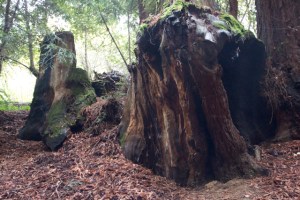
stumpsthis rough-barked sequoia stump, sitting in majesty
in its coastal home, victim of wildfire, burned down
to its gnarly roots, its nicks, holes and char, eons
of scars, life seemingly cut off, goddess snake alive
inside the concentric circles, the smell of wood and
scorch of fire, at the verge of our infinity, in its truth ~

pristine

rugged

pulsing

haunted by the geometry of limbs, the calculus of green,
the algebraic eloquence of a world within a world  ~

So present.

So essential.

So primal.

it sings to itself in the marrow of our bones

– Jamie Dedes

WRITING PROMPT

In preparation for The BeZine 100,000 Poets (and Friends) for Change

Saturday, Sept. 24, 2016

Theme: Environment/Environmental Injustice

This poem was originally written in 2014 for Wilderness Week. There were then and are now a number of fires raging in the western United States. Wildfires are a natural occurrence but since the 1980s they’ve been increasing due to human-caused climate change. According to the Union of Concerned Scientists . . .

Wildfires in the western United States have been . . . occurring nearly four times more often, burning more than six times the land area, and lasting almost five times as long (comparisons are between 1970-1986 and 1986-2003) ….. many of the areas that have seen these increases—such as Yosemite National Park and the Northern Rockies—are protected from or relatively unaffected by human land-use and behaviors. This suggests that climate change is a major factor driving the increase in wildfires.” MORE

We tend to look at these fires in terms of the expense incurred fighting them and the cost of lives, homes, habitat, wild life and so forth. However, there’s one consideration we may forget: Nature teaches us, comforts us, feeds us and is the ebb and flow of our spiritual and physical lives. The loss – the environmental injustice – is profound on more than a material level. This is what the smell of wood, the scorch of fire seeks to illustrate. “Nature” is who we are. Nature is us.

Write a poem or creative nonfiction piece on what the natural environment means to you and perhaps the sense of loss you feel as you note plants, animals, insects and wilderness that you’ve seen damaged or destroyed by climate, industry, overpopulation and whatever else has effected the area in which you live.

© 2014, poem, Jamie Dedes, All rights reservedPhoto credit ~Bay Nature.org: “The Bay Nature Institute, based in Berkeley, California, is dedicated to educating the people of the San Francisco Bay Area about, and celebrating the beauty of, the surrounding natural world. We do so with the aim of inspiring residents to explore and preserve the diverse and unique natural heritage of the region, and of nurturing productive relationships among the many organizations and individuals working towards these same goals.” Read more HERE.

You are invited to join The Bardo Group Beguines at The BeZine blog on Saturday, September 24 for 100,000 Poets (and friends) for Change.  Below is a list of more features to provide you with information. We hope you’ll join us.

RELATED:

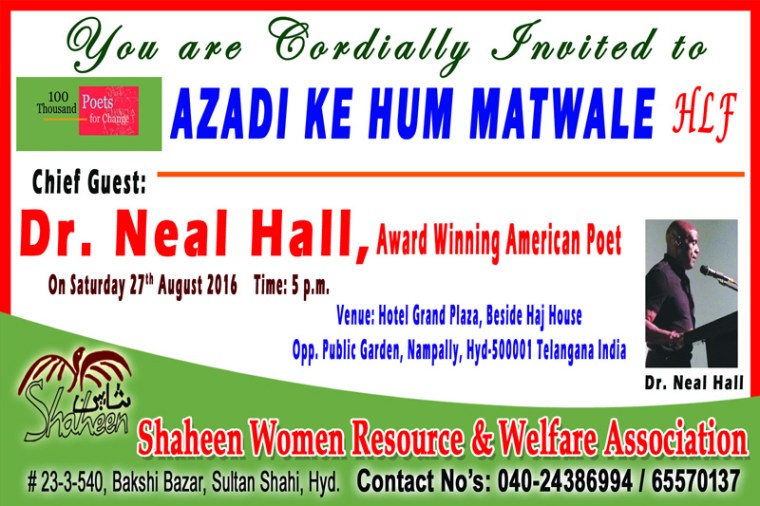
SHAHEEN WOMEN’S RESOURCE AND WELFARE ASSOCIATION (India) organized a program for 100TPC with American Poet Dr Neal Hall

100TPC2014Logo8-27-16-full

To view the video if you are reading from email, please link through to the site.

Poet Neal Hall’s website is HERE.

Δ

A reminder to join us –  The Bardo Group Bequines – at The BeZine for 100,000 Poets (and other artists and friends) for Change (100TPC): on September 15th for the Zine and on September 24th for the 100TPC virtual event, which is celebrated from our blog.  The themes for both are Environment and Environmental Justice. Since this is a virtual event, you can participate from anywhere in the world.

Priscilla Galasso is the lead for the Zine in September.

Michael Dickel is the Master of Ceremonies for our 100TPC virtual event.

These are worthy efforts to:

  • help steer public discourse in a productive direction,
  • define issues and suggest possible solutions,
  • encourage consensus for the environmental and social good, and
  • connect people and raise the general consciousness.

Please do participate. All work will be archived on site and at Stanford University.

Zine submissions should be sent to bardogroup@gmail.com. Please read submission guidelines first. The deadline is September 10th.

Reader participation on the 24th for the virtual event is by way of the comments section or Mister Linkey. Michael will provide direction in his blog-post that day.

More detail is included in: If We Were Rioting in 120 Countries, You’d See Us on the 6 P.M. news: We’re not, so here’s everything you need to know about 100TPC.

Also of note, Michael Rothenberg, cofounder of the 100TPC global initiative, reminds everyone today that it is not too late to register as an organizer of an event.  While ours is a virtual event, people all over the world in 120 countries are sponsoring 500+ events to be held in homes, schools, places of worship, cafés and restaurants, parks, community centers and other sites where people gather. Link HERE to register.

By way of warm-up, this Wednesday, I’ll post a prompt on The Poet by Day related to the themes. 

In the Spirit of Peace, Love and Community
and on behalf of The Bardo Group Beguines,
Jamie

Langston’s Reminder, Langston’s Place

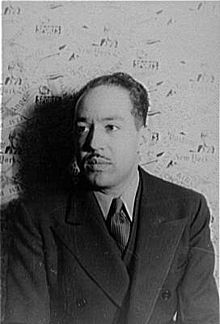
Langston Hughes (1902-1967), poet, novelist, playwright, columnist and social activist

LET AMERICA BE AMERICA AGAIN

Let America be America again.
Let it be the dream it used to be.
Let it be the pioneer on the plain
Seeking a home where he himself is free.

(America never was America to me.)

Let America be the dream the dreamers dreamed—
Let it be that great strong land of love
Where never kings connive nor tyrants scheme
That any man be crushed by one above.

(It never was America to me.)

O, let my land be a land where Liberty
Is crowned with no false patriotic wreath,
But opportunity is real, and life is free,
Equality is in the air we breathe.

(There’s never been equality for me,
Nor freedom in this “homeland of the free.”)

Say, who are you that mumbles in the dark?
And who are you that draws your veil across the stars?

I am the poor white, fooled and pushed apart,
I am the black man bearing slavery’s scars.
I am the red man driven from the land,
I am the immigrant clutching the hope I seek—
And finding only the same old stupid plan
Of dog eat dog, of mighty crush the weak.

I am the young man, full of strength and hope,
Tangled in that ancient endless chain
Of profit, power, gain, of grab the land!
Of grab the gold! Of grab the ways of satisfying need!
Of work the men! Of take the pay!
Of owning everything for one’s own greed!

I am the farmer, bondsman to the soil.
I am the worker sold to the machine.
I am the black man, servant to you all.
I am the people, humble, hungry, mean—
Hungry yet today despite the dream.
Beaten yet today—O, Pioneers!
I am the man who never got ahead,
The poorest worker bartered through the years.

Yet I’m the one who dreamt our basic dream
In the Old World while still a serf of kings,
Who dreamt a dream so strong, so brave, so true,
That even yet its mighty daring sings
In every brick and stone, in every furrow turned
That’s made America the land it has become.
O, I’m the man who sailed those early seas
In search of what I meant to be my home—
For I’m the one who left dark Ireland’s shore,
And Poland’s plain, and England’s grassy lea,
And torn from Black Africa’s strand I came
To build a “homeland of the free.”

The free?

Who said the free? Not me?
Surely not me? The millions on relief today?
The millions shot down when we strike?
The millions who have nothing for our pay?
For all the dreams we’ve dreamed
And all the songs we’ve sung
And all the hopes we’ve held
And all the flags we’ve hung,
The millions who have nothing for our pay—
Except the dream that’s almost dead today.

O, let America be America again—
The land that never has been yet—
And yet must be—the land where every man is free.
The land that’s mine—the poor man’s, Indian’s, Negro’s, ME—
Who made America,
Whose sweat and blood, whose faith and pain,
Whose hand at the foundry, whose plow in the rain,
Must bring back our mighty dream again.

Sure, call me any ugly name you choose—
The steel of freedom does not stain.
From those who live like leeches on the people’s lives,
We must take back our land again,
America!

O, yes,
I say it plain,
America never was America to me,
And yet I swear this oath—
America will be!

Out of the rack and ruin of our gangster death,
The abuse and rot of graft, and stealth, and lies,
We, the people, must redeem
The land, the mines, the plants, the rivers.
The mountains and the endless plain—
All, all the stretch of these great green states—
And make America again

– Langston Hughes

It seems a lot of us could do with a re-read of Langston Hughes’ poem, “Let America Be America Again” … I love this country but it never was and is not now a good time had by all. Let’s work together and continue to make it and the world better place (i.e., safe, respectful, diverse, and equitable). Let’s not go back(ward) again. J.D.

Δ

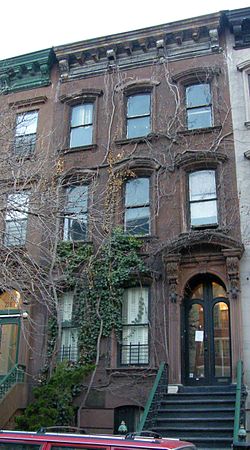
Langston Houghs' House in Harlem
Langston Hughes’ House in Harlem

Misery

Misery is when you heard
on the radio that the neighborhood
you live in is a slum but
you always thought it was home.

– Langston Hughes

“Langston Hughes House is a historic home located in Harlem, New York, New York. It is an Italianate style dwelling built in 1869. It is a three story with basement, rowhouse faced in brownstone and measuring 20 feet wide and 45 feet deep. Noted African American poet and author Langston Hughes (1902-1967) occupied the top floor as his workroom from 1947 to 1967. It was listed on the National Register of Historic Places in 1982.” [Wikipedia]

I, Too, Arts Collective

Harlem-based writer, Renee Watson, just initiated an Indigogo campaign to raise the money to rent Langston’s house and turn it into a cultural center, “for emerging and established artists in Harlem to create, connect, and showcase work…” MORE

If you are reading this from an email subscription, it’s likely that you will have to link through to the site to view the video …

According to Renee, the “I, Too, Arts Collective” is a non-profit organization committed to nurturing voices from underrepresented communities in the creative arts. Our first major project is to provide a space for emerging and established artists in Harlem to create, connect, and showcase work. Our goal is to lease and renovate the brownstone where Langston Hughes lived in Harlem as a way to not only preserve his legacy but also to build on it and impact young poets and artists.”

Photo credits: Langston Hughes’ photograph is from the Carl Van Vetchten collection of the U.S. Library of Congress Prints and Photograph Division id# cph.3a42821 and is in the public domain; the photograph of his house is courtesy of Americasroof under CC BY 3.0 license

The Last Enemy …

KIF_0815DEATH BE NOT PROUD (Holy Sonnet X)

Death be not proud, though some have called thee
Mighty and dreadful, for, thou art not so,
For, those, whom thou think’st, thou dost overthrow,
Die not, poore death, nor yet canst thou kill me.
From rest and sleepe, which but thy pictures bee,
Much pleasure, then from thee, much more must flow,
And soonest our best men with thee doe goe,
Rest of their bones, and souls deliverie.
Thou art slave to Fate, Chance, kings, and desperate men,
And dost with poyson, warre, and sicknesse dwell,
And poppie, or charmes can make us sleepe as well,
And better than thy stroake; why swell’st thou then;
One short sleepe past, wee wake eternally,
And death shall be no more, Death, thou shalt die.

– John Donne

“The last enemy that shall be destroyed is death.” 1 Corinthians, 15:26

Today we are mourning the loss of another friend, a good man, Ralph, to whom this is dedicated. Hence the sharing of this poem rather than the usual Thursday post.