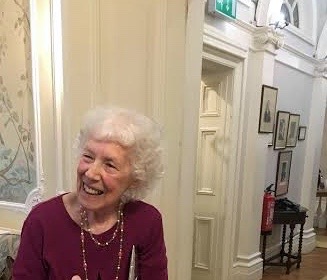
English Poet Myra Schneider at her 80th Birthday celebration and the launch of her 12th collection
for Anne Cluysenaar
A honey sun, the cease of gnawing wind
so we seize the day, unleash ourselves
in the country park, gaze at flowers inscribed To Dad
lying on a bench. They summon a huge bee
to their pink and yellow freesia bells. Dreamily,
I too enter the nectar-laden chambers and feed.
Turning away, we follow the droghte of March track
to the water garden where snowdrops are fading,
daffodils are on the brink of opening
and expectation’s in bloom on naked trees.
Welters of lily stalks in the darks of a pond
are tangles of umbilical cords. Beyond the garden,
beyond the singing of birds is a lake which glitters
as if it’s a source of light. We sit down
on a wicker seat and there you are breathing
in the budding warmth, freed from the last
of October now and that distressed message
you sent before your life was snatched.
You’re stooping over a small plant, stroking
its leaves, tracking the hover-rise of a damsel-fly,
smiling as you follow all the riverlets.
– Myra Schneider
The First of Spring is taken from Myra’s twelfth poetry collection, Persephone in Finsbury Park, which was published last month by Second Light Publications. It is available from poet Anne Stewart’s p f poetry site. The site is set up with PayPal, so it works well if you are making a purchase from outside of England. I haven’t read the collection yet, but Myra never disappoints.
When we marched,
Slithered
Through slimy mud past riot-shielded cops in Alexander
(This is the ghetto.)
While children peered wild-eyed from dark windows,
For some of us these were re-runs of earlier apartheid-burdened days.
But, then, it was defiant resolution that drove our hearts and braced our feet.
Now, sadness at betrayal sat sadly on our hearts.
Our shouted slogans hung heavy over us in grimy air.
We winced at familiar oft-repeated lies
Oft-repeated lies.
There are people for whom poetry exists almost exclusively as an aid to social change, to political discourse– not as some sort of didacticism – but as a discussion, a wake up call (consciousness raising), a way of approaching some truth, finding some meaning, encouraging resolution. A horrific war photo, a terrorist act, a homeless person outside the grocery, a friend in pain that can be traced to a social injustice, and the words start to flow. There’s the urge to respond, to do something …. even if that something is simply the passion to express the moment in poetry. Perhaps righteous passion is the strongest form of resistance and poetry the conscience of the collective soul.
In Dennis Brutus’ poem above, he points to the world we now live in. Having survived Robben Island with Nelson Mandela, he was freed only to find that while racial apartheid ended in South Africa it had become world-pervasive,, expressing itself as economic inequality. The few haves vs. the masses of have-nots.
I can’t help but think that the revolutionary peace, justice and sustainability so many of us seek is rooted in the slow transformation of values. Hence, it is more evolutionary than revolutionary. As such, perhaps that change is as gradual as the pervasiveness of our desires.
Perhaps it is evident in our blogosphere and the heart-born prose and poems of simple folk like you and me with nary a pundit or politician among us. Perhaps it’s a bottom-up thing, more likely to be blogged than broadcast, often rising from homespun poetry – outsider art – sometimes rudimentary and awkward, but always quiet and true and slow like a secret whispered from one person to the next. It is perhaps something stewing even as we write, read, and encourage one another. Perhaps there is some bone and muscle in what we do. Individually we have miniscule “audiences.” Collectively we speak to enormous and geographically diverse populations.
So let some impact from my words echo resonance lend impulse to the bright looming dawn
Dennis Brutus
Poem on, my friends, and keep your ideals. They are real …
… and to my country-folk today …
HappyFourthof July!
In the confusion of these days, let’s not abandon the highest, most ethical and sensible of our aspirations.
Speaking of death
and decay
It hardly matters
Which
Since both are on the
way, maybe –
to being daffodils.
excerpt from Exercises on Themes from Life in Once: Poems (Harcourt Brace Jovanovich, 1968)
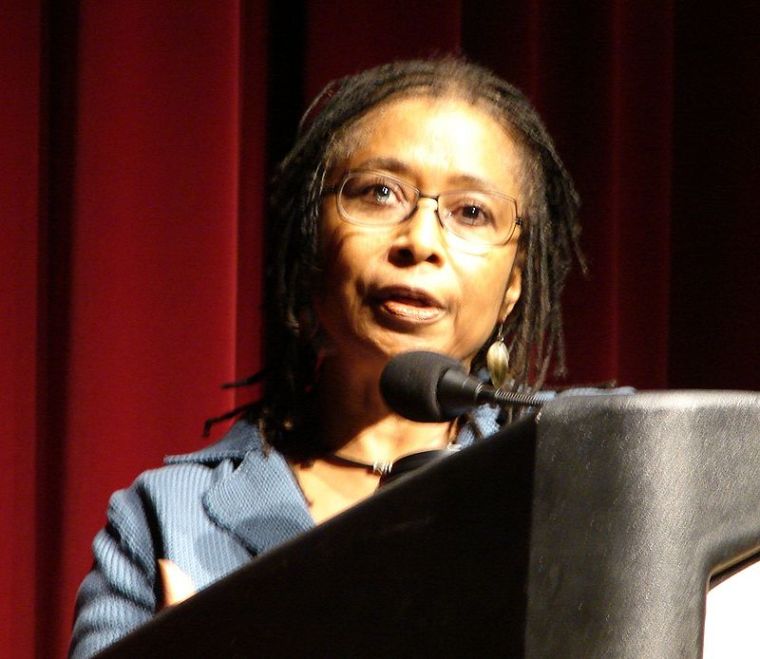
This celebration is a rain-drop next to the ocean of ongoing world-wide applause for Alice Walker (Alice Walker’s Garden). Her roots are in Putnam Country, Georgia where her family subsisted financially on earnings from sharecropping, dairy-farming and her mother’s part-time employment as a maid. Ms. Walker seems to come by her spunk and savvy honestly. When a white plantation owner told her mother that black people had “no need for education,” she replied …
“‘You might have some black children somewhere, but they don’t live in this house. Don’t you ever come around here again talking about how my children don’t need to learn how to read and write.’ Her mother enrolled Alice in first grade when the girl was four years old.” Evelyn C White in Alice Walker: A Life (W.W. Norton, 2004)
Alice Walker is perhaps most well-known to some for her fiction especially The Color Purple, The Temple of My Familiar and Possessing the Secret of Joy (Open Road Media, 2012 – Kindle edition). The Color Purple won her the National Book Award and The Pulitzer Prize. It was adapted for theater, both screen and as a musical stage play. The latter won the 2016 Tony Award for Best Revival of a Musical and the 2016 Drama League Award for Outstanding Revival of a Musical. Alice Walker was the first African-American woman to win the Pulitzer for fiction. (Gwendolyn Brooks was the first African-American woman to win it for poetry.)
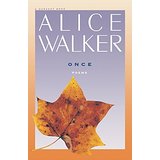
Once:Poems was Alice Walker’s debut poetry collection, written during a 1965 trip to East Africa and her senior year at Sarah Lawrence College. The book established her as an A-list poet and Muriel Rukeyser (among many others) gave it a thumbs-up saying, “Brief slashing poems – Young, and in the sun.”
In Kampala
the young king
goes often to Church
the young girls here
are
so pious.
excerpt from African Images, Glimpses from a Tiger’s Back in Once:Poems
Her other collections include:Hard Times Require Furious Dancing: New Poems (2013); The World Will Follow Joy: Turning Madness into Flowers (2013); Her Blue Body Everything We Know: earthling Poems 1965-1990 (2004); and Absolute Trust in the Goodness of the Earth: New Poems (2004).
With Gloria Steinem on the Fall 2009 Cover of Ms. magazine
No celebration of Alice Walker’s work would be complete without acknowledging her ceaseless efforts on behalf of the poor and marginalized. She is an advocate for peace and understanding. She was initially inspired by Martin Luther King, Jr. and worked in the civil rights movement and by Howard Zin. She dedicated Once:Poems to Mr. Zin. Wherever people are oppressed in this world, you will find Alice Walker fighting the compassionate fight.
If you are viewing this from an email subscription, you’ll have to link through to the site to view this video of Alice Walker in Palestine in August 2010.
Ms. Walker regularly posts new poetry at her site Alice Walker’s Garden along with opinion pieces and updates on her own work and that of others. Her Amazon page is HERE.
U. S. Poet Laureate, Juan Felipe Herrera (b. 1948)
A year ago this month, the United States Library of Congress announced the appointment of former California Poet Laureate (2012-2014), Juan Felipe Herrera, to the position of national poet laureate, the highest honor awared to poets in these United States.
Herrera’s body of work is a reflection of the Mexican-American experience and is also representative of much that immigrants and migrants the world over have in common including the efforts and adjustments made along a path often leading to distinguished contributions to their communities and adoptive countries.
In announcing the appointment, James H. Billington – Librarian of Congress (1987-2015) – said of Herrera …
I see in Herrera’s poems the work of an American original—work that takes the sublimity and largesse of Leaves of Grass and expands upon it,” Billington said. “His poems engage in a serious sense of play—in language and in image—that I feel gives them enduring power. I see how they champion voices, traditions and histories, as well as a cultural perspective, which is a vital part of our larger American identity.”
Herrera is the first Hispanic poet to serve in the position. Herrera said …
This is a mega-honor for me, for my family and my parents who came up north before and after the Mexican Revolution of 1910—the honor is bigger than me. I want to take everything I have in me, weave it, merge it with the beauty that is in the Library of Congress, all the resources, the guidance of the staff and departments, and launch it with the heart-shaped dreams of the people. It is a miracle of many of us coming together.”
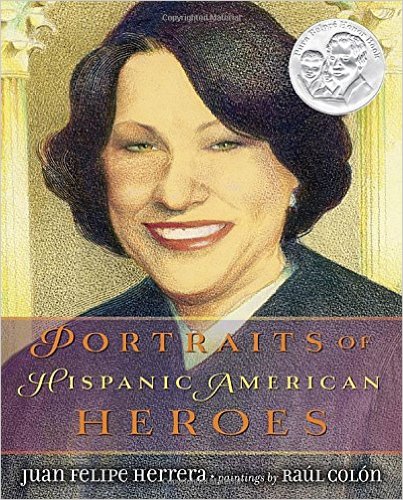
Herrera has authored some twenty-eight books of poetry, novels for young adults and collections for children, including Portraits of Hispanic American Heroes(Dial Books,2014), a picture book showcasing inspirational Hispanic and Latino Americans.
Herrera was born in Fowler, California, in 1948. As the son of migrant farm workers, he moved around often, living in tents and trailers along the road in Southern California. He attended school in a variety of small towns from San Francisco to San Diego. In 1972 he was graduated from the University of California, Los Angeles (UCLA) with a bachelor’s degree in social anthropology. He then attended Stanford University, where he received a master’s degree in social anthropology. In 1990 he received a Masters of Fine Arts at the University of Iowa Writers’ Workshop.
Enter the Void
Sit on the embankment,
a dust fleece, there is a tidal wave ahead of me.
It will never reach me. I live underground, under the Dead Sea,
under the benevolent rocks and forearms and
mortar shells and slender naked red green
torsos, black,
so much black.
en route:
this could be a train, listen:
it derails into a could.
excerpt on the conflict in the West Bank from Half the World Is Light, New and Collected Poems (University of Arizona Press, 2008)
Herrera has published over a dozen poetry collections, including Half the World in Light: New and Selected Poems , which received the National Book Critics Circle Award and the International Latino Book Award. He is also a celebrated young adult and children’s book author. His honors include the Américas Award for both Cinnamon Girl: letters found inside a cereal box and Crashboomlove: A Novel in Verse, as well as the Independent Publisher Book Award for Featherless / Desplumado, the Ezra Jack Keats Award for Calling the Doves and the Pura Belpré Author Honor Award for Portraits of Hispanic American Heroes and for Laughing Out Loud, I Fly.
For his poetry, Herrera has received two Latino Hall of Fame Poetry Awards, a PEN USA National Poetry Award, the PEN Oakland / Josephine Miles Award, a PEN / Beyond Margins Award, and fellowships from the Guggenheim Foundation, the National Endowment for the Arts, the Bread Loaf Writers’ Conference, and the Stanford University Chicano Fellows.
Herrera has served as the chair of the Chicano and Latin American Studies Department at California State University, Fresno. He has held the Tomas Rivera Endowed Chair in the Creative Writing Department at the University of California, Riverside, where he taught until retiring last year. He is currently a visiting professor in the Department of American Ethnic Studies at the University of Washington, Seattle. Appointed in 2011, he serves as a chancellor for the Academy of American Poets.
Juan Felipe Herrera’s Poet Laureate Project is La Casa De Colores or “the House of Colors” …
a house for all voices. In this house we will feed the hearth and heart of our communities with creativity and imagination. And we will stand together in times of struggle and joy. The website includes two features:
“La Familia (The Family) is an opportunity for you to contribute to an epic poem of all our voices and styles and experiences that will run the span of my Laureateship. By contributing to La Familia, you will be part of my family—and all our words will be seen and our voices be heard, throughout the nation and beyond.
“El Jardín (The Garden) is a special place where I will share my experiences with curators at the Library of Congress. Peek into the Library’s wealth of materials, such as: Pablo Neruda’s “España en el Corazón,” given to him by soldiers—the pages made out of their clothes turned to pulp; a letter the folksong pioneer Woody Guthrie wrote on the back of a dust jacket to Alan Lomax; a silkscreen by Yolanda M. López, on the courage of “Mujeres Trabajadoras”—women workers. I hope you will be as inspired by them as I am, and you can take the treasures of El Jardín with you—in heart and with pen.”
Herrera will begin serving his second term as U.S. Poet Laureate this September. His Amazon page is HERE.
Thank you for sharing your love of words. Comments will appear after moderation.








 Jamie Dedes' THE POET BY DAY Webzine