Page 4 of 5

Celebrating American She-Poets (2): Ruth Stone, 1915-2011
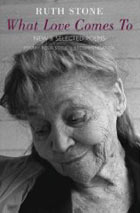
What-Love-Comes-To-by-Rut-001-1I first published this piece on Ruth Stone in 2013, but I love her poetry so much I had to include her early in this Thursday series of mine inspired by the work of poet Dilys Wood and the London-based Second Light Network of Women Poets (SLN), which Dilys founded. SLN encourages and supports the poetry of women, including those women with voices emerging in their third act. 

Poems clutter the landscape of my mind with bite-sized portions easily committed to memory, ready to be pulled out in a moment of need or want. I like to think of poetry as literary dim sum, which means “touch the heart.” And poems do spring themselves on me and touch the tender places. Depending on the poem and the poet, they may also tickle my funny bone, stimulate my intellect, or affirm some insight. In the art of living hugely, poetry is warp and weft.

Whether I am writing poetry or reading it, poetry gifts to me those blessed eureka moments, the moments when I understand myself or another, can put a name to the demons, or simply realize that I am not alone in my joy or sorrow. Think of W. H. Auden’s Funeral Blues and the simple line, “Pack up the moon and dismantle the sun.”  I am getting older, approaching elderly, and though I am always making new friends, I’m of an age where I lose a friend or two each year. Bereft at the loss of someone precious and shocked that the earth hasn’t stood still, I think of this line and know that in this circumstance, everyone feels what I do . . .

. . . and all it takes is one disappointment in love to relate to Mad Girl’s Love Song by Silvia Plath, “I dreamed that you bewitched me into bed/And sung me moon-struck, kissed me quite insane./(I think I made you up inside my head.)

Of the many poets I dearly love, I particularly appreciate Ruth Stone for her quality of giving things their true names and for the practicalities embedded in her poems. “Dear children,/You must try to say/Something when you are in need./Don’t confuse hunger with greed;/And don’t wait until you are dead.”

Ruth Stone was an American poet and poetry teacher born into an impoverished family at Roanoke, Virginia in 1915. She lived most of her life in rural Vermont, attended the University of Illinois at Urbana-Champaign, won many awards for her poetry and was a finalist for the Pulitzer Prize for her last collection, What Love Comes To: New & Selected Poems (2008). She was wry, bold, conversational, edgy, philosophical and used the language and imagery of the natural sciences to good effect.  Her second husband, the poet Walter Stone, committed suicide leaving her with three young children and an experience that indelibly etched itself on her life, heart and poetry. She once remarked that she spent the rest of her life writing to him.

Not Expecting an Answer

This tedious letter to you,
what is one Life to another?
We walk around inside our bags,
sucking it in, spewing it out.
Then the insects, swarms heavier
than all the animals of the world.
Then the flycatchers on the clothesline,
like seiners leaning from Flemish boats
when the seas were roiled with herring.
This long letter in my mind,
calligraphy, feathery asparagus.

When Ruth Stone won the Whiting Writers’ Award, she got plumbing for her house. When she received the Walter Cerf Award for Lifetime Achievement in the Arts at the National Book Awards, she said “I’ve been writing poetry or whatever it is since I was five or six years old, and I couldn’t stop, I never could stop. I don’t know why I did it.… It was like a stream that went along beside me, you know, my life went along here . . . and all along the time this stream was going along. And I really didn’t know what it was saying. It just talked to me, and I wrote it down. So I can’t even take much credit for it.”

Ruth Stone died in 2011 leaving behind thirteen collections of literary dim sum. This poem, which gave its name to a collection that I just purchased, is a new favorite.

In the Next Galaxy

Things will be different.
No one will lose their sight,
their hearing, their gallbladder.
It will be all Catskills with brand
new wrap-around verandas.
The idea of Hitler will not
have vibrated yet.
While back here,
they are still cleaning out
pockets of wrinkled
Nazis hiding in Argentina.
But in the next galaxy,
certain planets will have true
blue skies and drinking water.

In the scant two-minute video that follows, the writer Elizabeth Gilbert (Eat, Pray, Love) shares the revealing story of her meeting with Ruth Stone.

Resources:
Ruth Stone, Amazon Page
Poems of Ruth Stone, World Poetry Database
Ruth Stone Obituary, New York Times
On Ruth Stone by Sharon Olds

© 2013, essay, Jamie Dedes, All rights reserve – This piece originally published in October 2013 on Plum Tree Books website

Celebrating American She-Poets (1): feminist poet, Anne Bradstreet, 1612-1672

Cover art c publisher


Inspired by my long-distance poetry friends at London-based Second Light Network of Women Poets (SLN), which is dedicated to encouraging and promoting women poets and women’s poetry, I’ve decided to feature one American woman poet each week on Thursday. I hope you’ll join me for these short tidbits by way of celebration.

OPPORTUNITY KNOCKS: Second Light Network of Women Poets publishes well-regarded anthologies and the biannual magazine ARTEMISpoetry, which feature the works of both contemporary well-known A-list women poets as well as talented emerging voices. Membership and publication is not limited to the UK but there are demographic restrictions: age and gender. Associate memberships are available for women under 40. Recommended.

I had eight birds hatched in one nest,
Four Cocks there were, and Hens the rest.

Note: I recognize that more correctly Anne Bradstreet would be considered an English poet. I have decided for my purposes here, I’d include her as “American.”

The illustration above is Anne Bradstreet on the cover of The Works of Anne Bradstreet published by The John Harvard Library . The book’s introduction is by contemporary American Poet, Adrienne Rich. Some say she (Bradstreet) was the first serious woman poet in colonial America. It could be though that she was the first to be taken seriously and published while other talents plied their art in the women’s-work ghetto of obscurity

From the publisher:
“Anne Bradstreet was one of our earliest feminists and the first true poet in the American colonies. This collection of her extant poetry and prose, scrupulously edited by Jeannine Hensley, has long been the standard edition of Bradstreet’s work. Hensley’s introduction sketches the poet’s life, and Adrienne Rich’s foreword offers a sensitive critique of Bradstreet as a person and as a writer. The John Harvard Library edition includes a chronology of Bradstreet’s life and an updated bibliography.”

public domain illustratio
public domain illustration

This is telling of the times:

Let Greeks be Greeks, and women what they are
Men have precedency and still excell,
It is but vain unjustly to wage warre;
Men can do best, and women know it well
Preheminence in all and each is yours;
Yet grant some small acknowledgement of ours.

And yet, Anne Bradstreet did have confidence in her gender as we can see in this portrait of Queen Elizabeth:

Who was so good, so just, so learned so wise,
From all the Kings on earth she won the prize.
Nor say I more then duly is her due,
Millions will testifie that this is true.
She has wip’d off th’ aspersion of her Sex,
That women wisdome lack to play the Rex

Resources:
•The Works of Anne Bradstreet
•Anne Bradstreet, The Poetry Foundation
•Anne Bradstreet poems, Poem Hunter
•Wendy Martin, “Anne Bradstreet’s Poetry: a Study in Subversive Poetry,” in Shakespeare’s Sisters, edited by Sandra Gilbert and Susan Gubar (Bloomington: Indiana University Press, 1979)

LOVE and TIME … Parents, an anthology of poems by women writers

51cKCP2xbLL._SX314_BO1,204,203,200_When I noted that Second Light Network of Women Poets (SLN) had produced an anthology of poems about parents, I thought it a wonderful idea. It became the inspiration for the The BeZine’s January theme, Parents and Parenting, and I had to buy a copy.

Parents, an anthology of poems by women writers (Enitharmon, 2000) turns out to be a wonderful collection, moving me to laughter and tears, celebration and remorse through memories that explore the range of experience from loving and nurturing to appalling or abusive. Given the theme, you might expect to find some of the 170 or so poems  to be saccharine or manipulative, but none are. This is, I’m sure, as much a testimony to the taste and discretion of editor/poets Myra Schneider and Dilys Wood as it is to the skill and sensibility of the featured poets.

Particularly touching were the poems that harken back to parents who were refugees during World War II or parents who died during that period. I found these especially poignant partly because many of the elders around me when I was young were refugees from that war and partly because today we have even more people migrating to escape dangerous environments. I can’t help but wonder what poetry will have to say when the children of this diaspora come of age.

About parents as a theme for the collection, U.A. Fanthorpe wrote in the preface:

“I suppose many people, if asked what is the greatest theme of poetry, would say Love, or Time.  It seems clear to me, faced with this fine anthology, that the right answer is Parents.  For parents combine love and time, and in a very striking, difficult way.  The love is often embarrassed, undeclared, too late – tangled in some way.  And the time is reversed; the parent is the child, the child the parent, by the process of time.  So it certainly is here, where the older women see elderly parents as their children, remember the energy and passion of parents who were younger then they are now; or recall their younger, brusque or uncomprehending selves. The originality of the theme with the special insights of women, who are often more vulnerable to their parents than their brothers are, and also less able to escape, adds to the particular qualities of this anthology.”

Both thumbs up on yet another fine collection from the women of SLN.  At this writing Amazon US and UK have one or two new copies and both sites have used copies available.

The January issue of The BeZine will be available on the 15th and, thanks to the generosity of the editors and publisher of the anthology, will include two poems from Parents, an anthology of poems by women writers.

© 2016, review, Jamie Dedes, All rights reserved


A Potpourri for Poets and Writers

13444741_ae809af345_o

Recommended Reading

Ta-Nehisi Coast won the National Book Award for nonfiction for Between the World and Me, an exploration of his experience of being a black man in America.  Well done.  Must read.

51ViHdI1ZtL._SX327_BO1,204,203,200_

“The classroom was a jail of other people’s interests. The library was open, unending, free.”

“You must resist the common urge toward the comforting narrative of divine law, toward fairy tales that imply some irrepressible justice. The enslaved were not bricks in your road, and their lives were not chapters in your redemptive history. They were people turned to fuel for the American machine. Enslavement was not destined to end, and it is wrong to claim our present circumstance—no matter how improved—as the redemption for the lives of people who never asked for the posthumous, untouchable glory of dying for their children. Our triumphs can never compensate for this.”

Poetry Reading

FullSizeRender-2On December 5, at 5:30 p.m. Michael Rothenberg is reading along with San Luis Obispo Poet Laureate, Dian Sousa at Laurel Bookstore, 1423 Broadway, Oakland, CA 94612.  Details HERE.

Michael is an American poet, songwriter, editor and environmentalist. In 1989 Michael started a fine print literary press, Big Bridge, with artist Nancy Davis. Big Bridge has published work by Jim Harrison, Joanne Kryger, Allen Ginsberg, Philip Whalen among other.  Michael also edits Big Bridge, a poetry webzine and Jack magazine.He is the co-founder (with Terri Carrion) of 100,000 Poets for Change (100TPC).  Bay Area residents will be familiar with Shelldance Orchid Gardens (Pacifica), an orchid and bromeliad nursery, co-owned by Michael.

Transatlantic Poetry

TRANSATLANTIC Poetry is global poetry movement bringing some of the most exciting poets from the US, UK, Europe and beyond together for live online readings and conversations. With the help of notable partners, we are transforming the way people experience poetry in the twenty-first century.”

Transatlantic Poetry was founded by an American poet living in England, Robert Peake, the “Transatlantic Poet.”  Peake’s most recent collection of poetry is The Knowledge (Nine Arches Press, 2015).  He writes about poetry and culture. His essays may be found on Huffington Post HERE. Robert Peake also hosts Poetry Writing Prompts.

A Poem a Day

The Academy of American Poets publishes a poem a day online.  You might want to take your morning break with them.

Poem-a-Day is the original and only daily digital poetry series featuring over 200 new, previously unpublished poems by today’s talented poets each year. On weekdays, poems are accompanied by exclusive commentary by the poets. The series highlights classic poems on weekends. Launched in 2006, Poem-a-Day is now distributed via email, web, and social media to 350,000+ readers free of charge….”

The BeZine

398px-Heroesjourney.svg

Our fourteenth issue will publish on December 15.  Submissions should be sent to bardogroup@gmail.com for consideration. Guidelines are HERE. Deadline is December 10.

The theme for the December 2015 issue is The Hero’s Journey.

100TPC Group Discussion Page

The BeZine is hosting an ongoing discussion page on Facebook where we share information related to peace, sustainability and social justice.  Our focus for 2016 is environment/environmental justice.  If you would like to join the Group and you are on Facebook, leave me a message in comments.

From Second Light Network of Women Poets (SLN)

ARTEMISpoetry submission deadline for Issue 16: FEBRUARY 29th.

If you live in the area (Worcestershire, England) or expect to be there, you might be interested in

  • AUGUST 2016: Mon 1st to Fri 5th, Holland House Residential, Worcestershire; and/or
  • JULY/AUGUST 2017: Mon 31st July to Fri 4th August, Holland House Residential, Worcestershire

Copyright (United States)

Creative Commons

Thanks to Corina Ravenscraft (Dragon’s Dreams) for these:

Copyright Laws + Licensing Digital Content Resources

U.S. Copyright Fair Use Index

Resources for Photographs &

llustrations

IMG_2254

First off, I’ve found two sources of public domain* photos, which might serve you well as either inspiration or as illustrations to go with your poem or story.  The first is Public Domain Review.

“Founded in 2011, The Public Domain Review is an online journal and not-for-profit project dedicated to the exploration and sharing of curious and compelling works from the history of literature, art and ideas. In particular, the focus is on showcasing digital copies of public domain works – all drawn from a wide range of various online archives – with a mission to facilitate the appreciation, use and growth of a digital cultural commons which is open for everyone. With a focus on the surprising, the strange, and the beautiful, the site provides an ever-growing cabinet of curiosities for the digital age, a kind of hyperlinked Wunderkammer – an archive of materials which truly celebrates the breadth and variety of our shared cultural commons and the minds that have made it.”

The other is Emilian Robert Vicol Public Domain Photos.

It’s always nice to credit the source even when it’s public domain.

These both come from Flickr, where there are lots of other photos available.  Some are “all rights reserved” but some are available under a Creative Commons license and you should comply with the rules and link the photo back to its source.

Two sites I’ve used for years are: PublicDomainPictures.net and morgueFile. Directions for use are on the sites. You don’t have to sign in to use these and they offer quick and easy downloads.

Wikipedia is another resource.  It’s not enough to just put Wikipedia as the source. You’ll note if you click on the photographs in Wikipedia, the name of the “author” is on the left under the photograph and on the right you’ll see the licensing.  It’s usually either public domain or it’s one of the Creative Commons licenses.

public domain: belonging to the public and not subject to copyright

©Photograph by Chilli Head under CC A-2.0 Generic license and public domain illustration courtesy of Slashme via Wikipedia. Michael Rothenberg’s photograph and the rose illustration are mine.