Page 5 of 5

Second Light Network of Women Poets: Celebrating Anthologies of Women’s Poetry

They thought death was worth it, but I Have a self to recover, a queen. Is she dead, is she sleeping? Where has she been, With her lion-red body, her wings of glass?

They thought death was worth it, but I
Have a self to recover, a queen
Is she dead, is she sleeping?
Where has she been,
With her lion-red body, her wings of glass?
excerpt from “Stings” by Sylvia Plath

*** ANTHOLOGY “HER WINGS OF GLASS” ***
 
“I’m completely wowed … the most important anthology for decades,” John Killick
 
“tremendously inspiring,” Moniza Alvi  

“an amazing anthology,” Pauline Stainer
 
“It’s a magnificent anthology (and I’m not just saying this because my mother’s face peers at me from the cover!),” Adam Horovitz
 
“I’m impressed,” Anne Stevenson

Second Light Network of Women Poets (SLN) does many wonderful things for women poets of a certain age, but among the loveliest is the production of poetry anthologies. SLN’s latest anthology is Her Wings of Glass, the title taken from Sylvia Plath’s poem Stings in which she uses the life in the hive as metaphor for her own life and feelings.

When we consider all the elements of an apiary with its oddly flipped sexual structure, the momentary life of the parthenogenic queen juxtaposed against the leisurely life of drifting drones, we appreciate the brilliance of Plath’s using the apiary as an allegory for her relationship with her husband and her conflicted feelings about domesticity and motherhood.  The bee community makes for an apt illustration of Plath’s poetic self (queen), her domestic self (drudge), her distaste for other women willing to be drudges, to sacrifice themselves.  The poem is intensely personal, has elements of tenderness but ends fiercely. (FYI: You can view photographs of Plath’s worksheets HERE.)

It’s easy to appreciate just why the women of the ’60s were so enamored of Sylvia Plath, why she is still appreciated for both her observations and her craft.  It’s also easy to understand why a reference to Plath’s work would make such a good title for a collection of poetry by contemporary women poets. The anthology, like the poets, poetry and the work in ARTEMISpoetry (biannual magazine) represent a cross-section of A-list poets and a range of themes, subjects and styles.

ARTEMISpoetry, Issue 14
Issue 14

There’s a good piece by Anne Stewart on Her Wings of Glass in the May 2015 issue of ARTEMISpoetry, which focuses on anthologies. Due to the very nature of SLN, many are the poets and poems that might be overlooked by other press as not in line with mainstream literary standard. I deem this an advantage indeed and wish more publishers would take note.

Petronella Gives a Reading c Kate Folley
Petronella Gives a Reading (c) Kate Foley

In addition to celebrating poetry anthologies, the current issue also featured Alison Brackenbury, the award-winning author of eight collections, and Jemma Borg in an interesting piece by Kay Syrad: The Illuminated World, A Dialogue Between Science and Poetry.   Jemma studied evolutionary genetics and worked as a tech editor among other jobs. She stands at the intersection of science and poetry.

“I tend now to think of science and poetry in some kind opposition because they are such different systems of thought in terms of the philosophical roots and development, but essentially it is this love of what is unknown that is common to both and which forms my motivation as an individual: how can we, and indeed is it possible to, understand this world we are embedded in.”

Susan Wicks selected the poetry shared  in this issue, which included these two:

Gift from my Daughter

A pink bag with lime-green flowers
in silk floated
like a lotus as she carried it
down the ward.

We fizzed with giggles over
the contents,
cream laced with sandalwood
and lavender,
lip-salve with lemon,
little bottles steeped in mint
and nutmeg,
a Morpheus spray
to enchant the pillow with sleep.

Outside, the weather slashed its tail
of water-scales
and hail,
and we unpacked the orient,
distilled these gardens from the east.

Isobel Thrilling

Where lies the blame?

Things in their quiet think no harm,
light probes, passes, leaves unmoved
knife, whip, Kalashnikov.

Stone voices grate, shingle shifts,
things in unquiet hands drip blood
the birds no longer sing.

Shadows touch, move on, abandon
farmhouse, barn and empty field
the bees have gone.

Jenna Plewes

The homage to Anne Cluysenaar in this issue was warm and appreciative and the thoughts of several poets who knew her were included. I find this sort of acknowledgement and loyalty touching and asked for permission to include Alison Mace’s poem in this blog post. Alison said that we need to read Anne’s Diary Poems to fully appreciate her poem, but I took it at face value and warmed to it, though I haven’t read Touching Distances: Diary Poems.  I like Alison’s poem for the gentle way it shows how one poet and her work and life were valued.

from LIVES OF THE POETS
ANNE CLUYSENAAR 1936-2014

Alison Mace writes: Since Anne Cluysenaar’s appalling and untimely death, I have meant to write about her, a poem if possible. Anne came, when she could, to our monthly NaCOT poetry-writing group at William and Juliet Ayot’s house near Chepstow. We were so lucky to have her. Her contributions were memorable and heart-warming, both of her own work – several of the Diary Poems that became Touching Distances – and in the help she gave the rest of us with our own poems.

.
Anne

‘Wise’ comes first to mind,
then ‘kind’,
and then so many more.
Heartsore,
we count the ways she was:
capable, nurturing,
loving her cob, her cat,
at home with hens and hay,
Mozart and Henry Vaughan;
happy to teach, to learn –
learned indeed – at ease
combining earth with wit,
abstruse with everyday –
and ours: muse, mentor, friend,
bringing her poetry
for us, wanting our own:
probing, encouraging –
all with her gentle smile.

And so it shatters sense
that such a life should end
with terror, suddenness
and wanton violence –
a bleak atrocity.
The distance we would touch
that our intensest thoughts
might wing to her
has widened beyond reach,
leaving us at a loss,
empty, and blank, and still
heartsore.

– Alison Mace

So, another altogether enjoyable read. Another issue to return to with pleasure.

All things SLN may be found HERE including gatherings and classes, remote – or as we in the U.S. would say “distance” – classes, coaching, contests, books, magazine, samplings of poetry and introductions to poets.  Much appreciation to SLN Founder Dilys Wood and to Myra Schneider and Anne Stewart and all the other women for their work, their poetry, and their commitment to women and poetry. Second Light Network of Women Poets is based in London and most of the members are in the UK, but membership is not geographically restricted. Of note: Anne Stewart has a site – poetry p f – which makes it easy to pay membership fees and to order books, ARTEMISpoetry, poem cards and other goodies.

Congratulations to Myra Schneider: Goulash from her collection Circling the Core (Enitharmon Press, 2008) was recently featured on Anthony Wilson‘s Famous Lifesaving Poems. We’ve featured it in The BeZine and are all fans.  Bravo, Myra! Here it is on the Lifesaving Poems site. Contact Myra for Circling the Core and other books.

Poems, cartoon, cover art are published here with permission of the publishers and authors.

© 2015, article, Jamie Dedes, All rights reserved; cover art, Second Light Live; poems and cartoon as indicated above.

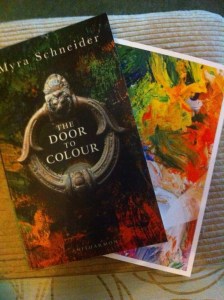
The Door to Colour…Part 1

IMG_9834

I don’t want to appoint myself to the position of apologist for blogging and social networking. I think there are others who could do that job better than I can, but I do believe these tools have a place and a value.

We all have fabulous people in our lives . . . friends, coworkers, neighbors and cherished family . . . folks who share our values, history and place in the world but not necessarily our zeal for a particular cause or art. One of the intrinsic benefits that comes with the ability to easily connect over distance is that it facilitates meeting and sometimes befriending others who share our passions . . .

And so I come to the way an American poet living in Silicon Valley met an English poet who lives in London.  It was over a red dress.  Myra Schneider had written a poem – part of a collection called Circling the Core – and I loved it. In the poem Myra tells about wanting a red sheath, how it didn’t fit comfortably and how in the end she was glad to shed the dress and retrieve her body despite its “flaws.”  You see, Myra’s a survivor of breast cancer. It so happened that around the same time I discovered the poem, read up on Myra and found some more of her work, I found myself sitting in a doctor’s office with a friend. I was there as her moral support and as a sort medical amanuensis. My friend was diagnosed with breast cancer.

I’ve had a number of friends who have survived breast cancer and a mother who succumbed to it and colon cancer.  I know about the fear, pain and the mutilation.  I had to post the poem for the others and I did so on September 28, 2010, THE RED DRESS by Myra Schneider . . . a poetry reading.

Somehow Myra happened on the post and wrote to thank me.  She sent me some of her books, which I eventually reviewed and she introduced me to Second Light Network of Women Poets, a group I appreciate and enjoy very much.  Thanks to Myra and Second Light, I’ve become acquainted with the work of quite a number of accomplished women poets I might never have encountered.

Myra subscribes to my blog. I read her books and articles. We are Facebook friends. Myra has generously contributed poems and feature articles to The BeZine, which I founded and edit. As you can see, blogging and social networking are not just the domain of philistines. They have their place among the artful … I know I am mostly preaching to the choir here. So many of us are WordPress, Facebook and Twitter friends based on our love of literature, art and music … most profoundly, our love poetry.

Now on to a review of Myra Schneider’s latest poetry collection, The Door to Colour (Enitharmon Press) … Look for it here tomorrow in Part 2 …

“Painting is silent poetry, and poetry is painting with the gift of speech.”
~Simonides of Ceos (556-468 BCE), Greek lyric poet

© 2015, article, Jamie Dedes, All rights reserved; 2015, photograph, Myra Schneider, All rights reserved

ARTEMISpoetry: remember, sift, weigh, estimate … total …

“And when is there time to remember, to sift, to weigh, to estimate, to total?” Tillie Olsen (1912-2007), American writer and first-generation American feminist

Unknown-7

I never pick up my copy of Second Light Network’s 2006 anthology, Images of Womenor open the pages of its magazine, ARTEMISpoetry, without thinking of Tillie Olsen and her book, Silences.  Olsen, an intelligent and hugely talented woman, produced a rather modest opus by some estimates.

Ms. Olsen’s nonfiction book, Silences, was published “in 1978, an examination of the impediments that writers face because of sex, race or social class. Reviewing the book in The New York Times Book Review, Margaret Atwood attributed Ms. Olsen’s relatively small output to her full life as a wife and mother, a “grueling obstacle course” experienced by many writers.

[The book] “‘begins with an account, first drafted in 1962, of her own long, circumstantially enforced silence,’ Ms. Atwood wrote. ‘She did not write for a very simple reason: A day has 24 hours. For 20 years she had no time, no energy and none of the money that would have bought both.'” Julie Bosmen, Tillie Olsen, Feminist Writer, Dies at 94

Second Light is about just the opposite of silence. It’s about women getting a second chance to have their say. It offers older women of a certain generation and those women over forty coming up behind them a “room of their own,” if you will; a place to remember, sift, weigh, estimate and – perhaps – to total. (This is not to negate men or to deny that men are often also silenced by their circumstances, but that would be a subject for another day. Among other things, the heart aches for all the voices being silenced by wars and other violence, by starvation and by social and economic inequities.)

****

artemisIssue 12 of ARTEMISpoetry (May 2014) arrived as I was transitioning into senior digs and immediately took its place at the top of the stack of books and magazines waiting for calmer moments and a close read. Reading through the pages, it’s hard to say what is best or better because it’s all good from the featured poets and even to the ad on the back cover that offers a sample of two poems from Hilary Davies‘ poetry collection ImperiumEnitharmon Press.

It’s a difficult thing to pick just a few poems from the wealth of this issue, but here they are … you may chuckle at the first and dab at your tears when you read the other two. They are shared here with the generous permission of the poets and publisher.

The Substitute Sky

Each day we stare at screens,
a sly fluorescence, a not-quite sky
where swarms of data
aggregate and fly

while unseen cloud-and-sunlight
walks the grass, gold shoes
then grey, and aspen, oak,
the green-leaved spirits, pray.

Pilots of pixel storms
what do we bring? Less talk,
less laughter, less sun on our skins;
our lives on hold, our children wired in.

Core addiction, captive eyes.
Outside the real world breathes and dies.

– © Lynne Wycherley

Grab-Handle

In the shower you cling to me, your new grab-handle.
Ignoring my shakes, we both pretend you’re in safe hands.
Ninety years of fair usage, Mum, and your scrap of a body

is shrunken against a cage of chrome bars. Buttocks swing,
their skin an overhang of ragged sack; dugs hang
like empty toothpaste tubes; hip bones jut like garden stakes.

As if flicking a switch, before I can distance or disown them,
wartime images flash on my inner eye, a film-reel
of Pathe horrors. I feel the panic in your grip pinch

when I regulate the shower temperature, causing overflow.
I sense a warder’s buzz of control
knowing you are lost in a huddle of hurt and helplessness.

Though eager for the rush of water to relax your greying skin,
you’re fearful of falls, bruises, broken bones. Should you now
be fearful of me too? Frailty lays a hand on both of us,

each clutching at her hopes. Under the metallic power jets,
I scrub myself to clean my shame away and find the love that,
tight as a rosebud un-blossoming in winter, refused to flower today.

– © June Hall

‘Dear God, all the children can run except me’

Most children come out right. They come with all
their arms and legs, ten fingers and ten toes,
their brains wired up the ordinary way.
They go to Brownies and have sleepovers,
they learn piano, ballet and Tae Kwon Do,
they do the Duke of Edinburgh’s award.
No one avoids them, or their mothers
in the playground. When they grow up
they have good jobs, and partners
and get on the property ladder, climbing steadily.

But you were never most children, and
never will be, your whole life long
my damaged, precious boy,
my baton passed to the future, my fear, my joy.

– © Veronica Zundel

****

To my delight this issue featured  Myra Schneider’s The Real Mrs. Beeton HERE, speculating on the life of Isabella Beeton, the 19th century writer known as the first and “best” cookery writer. Mrs. Beeton wrote about more than cooking though and might be considered the Martha Stewart of her day. Her life, however, was nothing like the glamorous, wealthy and independent Ms. Stewart as you will see when you read the poem.

Further on, Anne Stewart asks:

Why do you take the dark path, knowing
its silences and hiding place?”
excerpt, Making for Home, which will post on The Bardo Group blog this Friday …

Anne handles some of the administration for Second Light, as well as being the administrator for the website. She also developed and maintains poetry p f for poets.Myra Schneider and Anne have been a great helpers, getting permissions to share the work of other poets here on The Poet by Day and on The Bardo Group blog and also sharing information, education and updates with me so that I might share with you. I appreciate these two women and Dilys Wood – the founder of Second Light – for their poetry and for their committment to encouraging other poets and the love of poetry. You can sample some of Anne’s work HERE, Dilys work HERE, and Myra’s work HERE.

Anne Stewart is an accomplished poet. Most recently her poem Snow snow more cold lonely snow won the 2014 Poetry on the Lake “Silver Wyverm” award. Her poem Tiger was long-listed for the Plough Prize. Grief’s Trick and This Stone are included in an upcoming anthology, Love and Loss edited by R. V. Bailey and June Hall.

There were two pieces by publisher, Adele Ward (Ward Wood Publishing). One on Pascale Petit, which I discuss HERE and another on Why Small Is Still Beautiful, which discusses the ins-and-outs of chapbooks from the poet and the publisher perspective. Myra Schneider examines The Rewards of Reading Poetry and there’s the second part to A C Clarke’Lies Like Truth, which is about “fictionalizing” real events. Kay Syrad discusses the radical landscape of poetry and Lavinia Singer the young woman-poet’s view of the poetry world. The issue rounds out as always with a a calendar of events and announcements of members’ new publications and latest awards … an altogether neat, stimulating and rewarding read. Recommended. 

© 2014, review, Jamie Dedes, All rights reserved