I’ve been sitting on three reviews, not for any other reason than the want of time and breath to finalize them.
One review (coming soon) is of the latest issue of ARTEMISpoetry, a publication of Second Light Network. As always I am struck by the many gifts bequeathed to us by that association and publication, not the least being introductions to poets who may be new to us. In the latest issue, I know that one featured poet whose collections I must read is Pascale Petit.
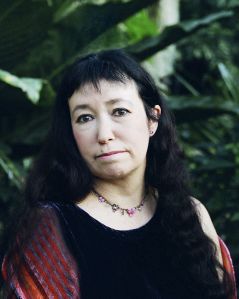
Petit, a poet, artist and one-time sculptor, was interviewed in this issue of ArtemisPoetry by Adele Ward, the co-owner of Ward Wood Publishing and a poet and writer herself.
Petit has five published collections of poetry, the latest is What the Water Gave Me: Poems after Frida Kahlo, which was shortlisted for both the T.S. Eliot Prize and Wales Book of the Year. There are a number of things that are drawing me to Pascale Petit’s work, not the least is this creation of a collection of poems after Frida Kahlo’s art. The very idea is attractive.
I am also drawn to The Zoo Father in which she developes the very private theme of child abuse. I believe such efforts require extraordinary grace and I want to see how Petit handles the matter.
Another attraction is related to my own arts community.There are some who argue against revealing too much that is personal and Adele Ward asks Petit about this very issue. Petit’s response is:
” . . . I don’t have a choice about my subject matter . . . It is important to me to be true to myself and write intensely because what I’m really interested in is writing about the awe and power of nature ~ human nature as well as animals and landscape. My personal themes allow me a way in to write intensely about awe and shock. Life is pretty shocking, the earth is awe-inspiring, and we perceive it as personal beings, however ‘other’ it is, and its otherness is compelling.” [Emphasis mine.]
I so agree … and honoring our personal themes is a ticket to ride, an antidote to stilted works and artistic blocks.
Further, I think one goal of art – both its creation and its consumption – is to introduce us to our own humanity. I don’t see how we can do that if the works we create and consume lack intimacy.
Petit’s sixth collection, Fauverie, will launch in September this year. You can sample her poems and her art by visiting her website HERE.
A review of What Water Gave Me: Poems after Frida Kahlo is HERE.
SECOND LIGHT 20th ANNIVERSARY! The Bardo Group community extends to Second Light Network (women poets forty-years old or better) our best wishes, appreciation, and congratulations for its on-target focus, fine work and unrelenting commitment to poets, poetry, and to giving women in their third act a second chance. Special kudos to poet and founder, Dilys Wood, and all those who provide regular support to us here at The Bardo Group especially poets Myra Schneider who keeps us informed, provides us with wonderful poetry and instructive feature articles and Ann Stewart who so ably assists us with the details of coordination.
Jackie Kay (b. 1961), Scottish poet and novelist is judge for the 2014 Second Light Network Long and Short poetry competition, photo by Slowking4 under CC A – Noncommercial Unported License
SECOND LIGHT POETRY COMPETITION DEADLINE: TUESDAY 17th JUNE. Judge: Multi-award-winning JACKIE KAY. Long and Short Poems by Women. (‘Long’ = 50+ lines). 1st Prize £300 (in each category). More cash & book prizes + publication in ARTEMISpoetry + London reading. Enter by post or online.
Amongst Jackie Kay’s many poetry awards and prizes are the Forward, Saltire, Scottish Arts Council (for The Adoption Papers) and a shortlisting for Costa. She also writes award-winning fiction both for adults and children, and for stage and TV. She is Professor of Creative Writing at Newcastle University. She was awarded an MBE in 2006, and made a fellow of the Royal Society of Literature in 2002.
£300 First Prize for each of Long (no upper limit) and Short (max 50 lines) poems
£100 Second Prize (1 poem from either category)
£50 Third Prize (1 poem from either category)
Commended poets: book prizes
Winning & Commended Poets published (in full or extract) in ARTEMISpoetry
A reading will be organised for winners in London in Autumn 2014.
Entry: £6 each per long poem. Short poems: £4 each or £9 for 3, £14 for 8. Enter by post (2 copies) or online.
Complete details HERE. PLEASE NOTE THAT ALTHOUGH SECOND LIGHT NETWORK OF WOMEN POETS IS BASED IN ENGLAND, MEMBERSHIP IS OPEN WORLDWIDE AND SUBMISSIONS TO ARTEMISpoetry and to various anthologies and competitions are considered from women anywhere in the world. You do not need to be a member to submit your work to be considered for publication.
Please read my Disclosure HERE, particularly paragraphs four and five.
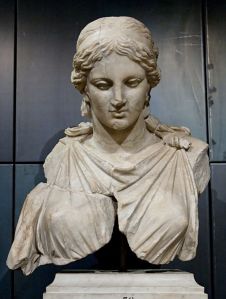
The Greek Goddess Artemis, called Diana by the Romans
The mailbox is the most fun when it delivers literary delights: Poetry magazine, The Paris Review, The Hudson Review and a few others including ARTEMISpoetry, one that you may not have read much about except possibly in reading this blog over the years.
ARTEMIS, the well-chosen namesake of the magazine, is she of the hunt, of nature and birth. She is the moon goddess.
Artemis is an archetype for independence, courage, strength and confidence. Depicted with bow and arrow, she is a free spirit, both huntress and protector of wild animals. Not unlike Artemis are the free-spirited women poets who have the strength and courage, the independence and confidence, to shoot poetic arrows of intuition and insight. Speaking their hearts, they stir the wildness in our souls.
Among the many things that I like about ARTEMISpoetry is the idea behind the organization that birthed and publishes it, Second Light Network. Second Light was founded by English poet Dilys Wood as a movement to encourage and acknowledge a “second” start for older women who, without the responsibilities of their younger days, now have the time to devote to the craft of poetry. It gives women who were once almost invisible in the world of poetry …
a welcoming community of poets,
events at which to gather, learn and celebrate,
and a chance for professional publication of their work in their distinctly feminine voice in its magazine ARTEMISpoetry , on Second Light’s website and in its anthologies.
“The inspiration for Second Light was that vibrant, exciting work is absolutely not sex or age-related. Probably all serious editors and organisers know this, but some number-crunchers are obsessed with youth, trendiness, or any kind of gimic. There may be reverence for famous older poets, but the pattern of women’s lives may mean that a woman may be a ‘new poet’, just starting to publish, at any time up to old age.” Dilys Wood HERE in an article on this blog
English poet and Second Light Network Founder, Dilys Wood
Dilys Wood founded Second Light Network in 1994, which predates the birth in the late 90s of blogging and subsequently of social networking with their easy means to form communities of like interest. Blogs and other social networking technologies had to wait until the development of web publishing tools that facilitated online content publication by non-technical users. Through the gift of blogging we observe that there are many people of both genders that come home to their art – poetry or other arts – late in life, a second chance.
Blogging, however rewarding, doesn’t preclude off-line activities. Second Light Network is open to women all over the world, but is mainly active in England where it was founded and where the bulk of its members appear to reside. I’m guessing women in other countries would be welcome to start chapters, though you’d have to check with Second Light on that. I would start one here if I weren’t often home-bound and undependable due disability. Though my own poetry community is now largely an online adventure, I encourage other poets, women and men, to complement their online creative communities with off-line communities.
A reader of The Bardo Group blog who wishes to remain anonymous had this to say about such creative collectives:
“Prior creative and intellectual movements benefited greatly from geographic proximity. It wasn’t enough to be part of community, but that the community shared and debated some essential values and were in constant contact. The idea is that fervency, serendipity and discovery arise out of actual physical proximity.
“This is why artists still flock to cities. Despite the Internet, we still go to Mecca.
“Connecting technologies have always strengthened the bonds between people with like-minded interests (letter-writing, magazine letter columns, BBS, chatrooms, message boards, social networking, etc), fostering community. But, in the last 40 years, I haven’t seen technology yet truly replicate the creative synergy that occurs with physical proximity.”
I find Second Light Network’s magazine, ARTEMISpoety, a welcome and refreshing read. While many of the poets included are fairly well know, the bulk of the work is by talented lesser-knows. I never have the feeling – as I do for example with American Poetry Review (APR) – that the work is largely (if not exclusively) about big names posturing for critics and marketing their classes and expensive university creative writing programs. Books are marketed through ARTEMISpoetry, but that’s fair, I think.
In addition to a wealth of poems and a dollop of original artwork, there is always an excellent interview or two. In the most recent issue (November 2013) Gillian Allnutt was interviewed by Ruth O’Callaghan in a feature, Among the Already Occluded Worlds. There are thought provoking essays, like the one by Myra Schneider, published HERE as a post. There’s instruction on writing and the writing process. In the November 2013 issue Jill Eulalie Dawson showed the evolution of her poem Owl, a good lesson for those who don’t know what to do with their first draft or wonder how other people move through the development of a poem.
I find much to admire in the enterprise of the ladies of Second Light and much to value in their magazine and in their support of other women poets. The ideals are real.
Mary MacRae (1942 – 2009), English poet and educator
NOTE: Originally published here about two years ago, this post is worthy of a wider audience and more than one read; and so, with some additions, I post it again for the benefit new readers and old. Among other things, the evolution of Mary’s poetic grace in her maturity is certain inspiration for those who come to their art late in life as she did. Enjoy …
Mary MacRae “wrote and published poetry for only the last ten years of her life, after ill-health forced her to take early retirement from teaching. She taught for 15 years at the James Allen Girls School (JAGS), Dulwich, London. Her commitment to writing led to her deep involvement with the first years of the Poetry School under Mimi Khalvati, studying with Mimi and Myra Schneider, whose advanced poetry workshop she attended for 8 years. In these groups her exceptional talent was quickly recognised, leading to publication in many magazines and anthologies.” MORE (Second Light Live)
Elder
A breathing space:
the house expands around me,
· unfolds elastic lungs
drowsing me back ·
to other times and rooms
where I’ve sat alone
writing, as I do now,
when syncope – ·
one two three one two –
breaks in; ·
birdcall’s stained
the half-glazed door with colour, ·
enamelled the elder tree
whose ebony drops ·
hang in rich clusters
on shining scarlet stalks ·
while with one swift stab
the fresh-as-paint ·
starlings get to the heart
of the matter
of matter ·
in a gulp of flesh
and clotted juice that leaves me ·
gasping for words transparent
as glass, as air.
My profound gratitude to poet Myra Schneider for the introduction to a new-to-me poet, Mary MacRae, and to poet Dilys Wood of The Second Light Network (England) for granting this interview. Jamie Dedes
JAMIE: Clearly, and as has been stated by others, Mary was profoundly inspired by art, nature (particularly flowers and gardens), and love. What can you tell us about her life and interests that would account for that?
DILYS: Mary writes tender and accurate poems about wild nature, creatures and landscape, drawing on her stays in a cottage on an untamed part of the coast in Kent, England and visits to her daughter living in remote West Wales. In her London home, it’s easy to guess from her poems about garden birds and flowers how much time she spent at the window. She almost always sees nature in flux, changing moment by moment, unpredictable, mysterious, a spiritual inspiration. One of her great strengths as a poet is catching movement.
Many of Mary’s poems focus on love between close family members. This may relate to a difficult relationship with her own father, which she sought to understand, and the relationships which compensated (with mother, sister, husband Lachlan, daughter and grandchild). A back problem prevented her from holding her baby daughter and she often refers in her poems to young children. She clearly has a yearning towards them.
JAMIE: She wrote poetry apparently only at the end of her life and for ten years. What were her creative outlets before that? How did she come to poetry?
DILYS: Mary was a dedicated teacher of English Literature and language in a leading girls’ secondary school. She was also deeply interested in music and painting (these are strongly reflected in her poetry). Though she had written as a young woman she followed the pattern of many women creative artists in becoming absorbed into her home life and her paid work, only turning to writing when her illness released her from the daily grind of intensive teaching. The remarkable, rapid development of her poetry shows how strong her latent powers really were.
JAMIE: Was writing poetry a part of her healing process when she was diagnosed with cancer? If so, how did it help her?
DILYS: I’m confident that Mary’s diagnosis with cancer enabled her to change her life-style and from then on concentrate on her poetry, urged by the sense that she might be short of time. There is no evidence that Mary wrote therapeutically to come to terms with her cancer. In fact she only ever addressed her illness in relation to the possible unkindness of fate in cutting her off from beloved people and life itself. The poems written in the last 2-3 years of her life give the impression that her dedication to writing, with the spiritual experiences which accompanied it, enabled her to bear terrible distress. She records this distress, using imaginative and metaphorical approaches to focus it, and these poems make heart-wrenching reading.
JAMIE: Can you tell us about her process? When did she write? Where? For how long?
DILYS: I have the impression that Mary’s life revolved around three things, people she loved, gathering experiences that would feed her poetry (travel, listening to music, visiting galleries) and very hard work in direct furtherance of her writing (extensive reading, attending workshops with other inspirational poets, writing, revising and submitting her poems to criticism from critics she respected). She used notebooks to make a full, accurate record of those experiences – landscapes, human encounters, thoughts – that would feed her work. There is an extract from one such entry in the section about keeping a journal in the resource book Writing Your Self, Transforming Personal Material by Myra Schneider and John Killick. This book also includes a contribution in the chapter on spirituality which reveals much about Mary’s attitudes to life, nature and also her writing process.
JAMIE: Do you have any advice from her for other poets and aspiring poets?
DILYS: Mary was a dedicated writer, entirely sincere in her commitment to poetry as opposed to ‘career’ as a poet. She was always ready to enjoy and praise the widest range of subject-matter, approaches and styles from other poets, providing she thought they were ‘busting a gut’ to get their poems right, and not indulging in the trendy or superficial, which she despised (whether from well-knowns or unknowns). She put much emphasis on wide-reading of both past and contemporary poets and she herself had absorbed a huge amount of other poets’ work, always quoting fully and accurately. She liked using another’s work as a starting pont for her own (the Glose) and particularly admired the work in strict form (including Sonnet, Villanelle and Ghazal), which began to be more acceptable from the mid-1990s (eg from such poets as Marilyn Hacker and Mimi Khalvati).
JAMIE: Are any other collections of her poetry planned? If so, when might we look forward to them?
DILYS: When putting together ‘Inside the Brightness of Red’, Myra Schneider and I went through the whole of Mary’s unpublished work and selected all those poems we felt were both complete and would have satisfied her high standards. What remains unpublished would be mainly fragments and early versions of poems she did more work on. There will not, as far as we know, be a further book, but Mary did achieve her aim of being a significant lyric poet, whose work is very attractive, polished and, above all (as she would have wished) deeply moving and consolatory.
* The Second Light Network aims to promote women’s poetry and to help women poets, especially but not only older women poets develop their work. It runs weekends of workshops and readings in London usually twice a year, a residential extended workshop with readings and discussions at least once every 18 months and occasional other events. It is nationwide and includes and some members who live outside Britain altogether. Importantly Dilys is the main editor of ARTEMIS poetry a major poetry magazine for women produced by Second Light twice a year for all women poets. It includes a lot of reviews and some articles as well as poetry. Second L. members receive it free as part of their subscription. An e-newsletter is sent out every few weeks. A few anthologies of poetry have been published by the network but now this magazine has been developed books are only produced in special circumstances – such as Mary’s collections.
Thanks to Second Light Web Administrator, poet Ann Stewart, for the following: The books (Inside the Brightness of Red and As Birds Do) can be bought: via order form and cheque in post: http://www.secondlightlive.co.uk/books.shtml or here online: http://www.poetrypf.co.uk/shop.php (typing ‘ Mary MacRae collection ’ in the filter box will reduce the list to just those 2 books).
Thank you for sharing your love of words. Comments will appear after moderation.
 I am also drawn to The Zoo Father in which she developes the very private theme of child abuse. I believe such efforts require extraordinary grace and I want to see how Petit handles the matter.





 Jamie Dedes' THE POET BY DAY Webzine