Page 3 of 4

BARDO NEWS: What Leibniz Never Learned; Paula’s “three minutes” of fame; Niamh’s new FB page; an opportunity for women poets … and more

Life happens – as you all know too well, I’m sure – and what little time I am able to spend online in this moment is largely dedicated to our collabrative blog, “Into the Bardo,” where lots of exciting things are happening. I’ll be back here within the next two weeks. Meanwhile, this reblog of “Bardo News” provides an overview of events, including some in which you might want to participate. Hope to see you there. Poem on … P.S.: It’s not for women only.

The Bardo Group Beguines's avatarThe BeZine

sllwomanreverseVia contributing poet and good friend to Bardo, Myra Schneider for Second Light Network of Women Poets: AN INVITATION TO WOMEN POETS TO SUBMIT TO A MAJOR NEW ANTHOLOGY FUNDED BY THE ARTS COUNCIL ENGLAND and open to contributions from any women anywhere in the world …

The Second Light Network of Women Poets have recently received Arts Council funding to bring out an anthology of poetry by women poets. It will be calledWings of Glass. The book will focus on ambitious writing and be published next autumn 2014 and launched at the Second Light Festival in central London in late November. The editors are Penelope ShuttleMyra Schneider and Dilys Wood. Submissions will be accepted between 15th November and 15th January. Please see full details for submitting : www.secondlightlive.co.uk

51rk8frRwfL._SY344_BO1,204,203,200_Her Wings of Glass (the title a quotation from Sylvia Plath) is to be…

View original post 1,039 more words

ARTEMISpoetry, Issue 10 … celebrating women poets …

artemisOne of the things I appreciate about this particular poetry magazine – to me this is no small thing – the print is a reasonable size. I can enjoy it without wearing readers … unlike my also much appreciated Poetry Magazine (Poetry Foundation), which necessitates 3.50 readers. Yikes! Having got that off my chest . . .

Opening the cover of Issue 10 of ARTEMIS poetry (Second Light Network) was like unwrapping caramels: one chewy gem after another from the editorial by Myra Schneider and Dilys Wood to the back cover, which featured three poems by Alison Brackenbury, one of the two featured poets. The magazine is a celebration of poetry and women poets and artists and I found myself being introduced to more than the usual number of new-to-me women poets.

“2012-2013 is proving an annus mirabilis for the publication of poetry by women,” write Myra and Dilys in their editorial, “appropriately since we are on the fiftieth anniversary of Sylvia Plath‘s final burst of writing and her death in January 1962.”

Indeed, far more women poets are being published today than in my own youth (50s and early 60s) and a fair share are “celebrity” poets; not that I think that is necessarily the hallmark of the best, but it would seem to indicate a happy breakdown of barriers.

Of special interest was Adele Ward’s short feature on her experience starting and running a publishing company: Ward Wood Publishing. As a poet, writer and former columnist, I have followed the industry for years and find the developments evolving out of  the recession and new technologies an odd mix of fascinating, promising and distressing. Adele addresses women’s roles in publishing and the desire to keep traditional outlets open:.

“Initially, It surprised me that I was regularly congratulated on being a woman starting a publishing company because I hadn’t realized this was still an issue. I don’t see any obstacles to women starting and running this kind of business, but it’s certainly the hardest work I have ever had to do and I’ve had tough jobs in publishing, journalism, and distribution throughout my career. It can also be physically demanding work, as I’m often expected to move the furniture around at venues for events and to carry  a suitcase fill of books to launches, together with bottles of wine . . .

“There weren’t even a lot of women poets on our school curriculum in the 1970s. Times have changed and there are not only more women poets around, there are also more women wanting to face the challenge of keeping publishing outlets open. If we support each other by sharing our experiences and advice on how we have tackled the most difficult problems, poetry publishing will continue to thrive as we move out of recession?”

stainerThe second featured poet in this issue is Pauline Stainer, whose work has been likened to that of Ted Hughes, Frederico García Lorca, and Kathleen Raine. I particularly enjoyed the six poems and this little excerpt from one will give you an inkling why …

“They wear silk
shear as woven wind,
while the bells sewn
into their hems
sound like colours
in rippled water . . . “

The winners of the 2012 Poetry Competition were announced along with a sampling of poems and there was an interview of Mimi Khalvati by Ruth O’Callaghan. This is an organization that goes a long way toward encouraging narrative and long poems in both the content of the publication and in their poetry competitions. I found Myra Schneider’s piece, The Possibilities and Pitfalls of Narrative, worthwhile and I asked for permission to publish the entire piece HERE and extend my thanks once again to Myra for that gift.

With the generous permission of ARTEMISpoetry and poet Wendy Klein, I am able to share her poem with you this evening:

anything in turquiose ffront 2Bird 

….Installation by Anselm Kiefer

Even if you hate installations
there’s an element of purity
about this mammoth recycling of books
…………………………….as bird
………..its wings tatty notebooks
the pages torn or falling out
their whiff of damp or char
…………like scorched feathers

…………reminding me of the fire sales
she took me to as a child
..my sewing grandma the one
who made things

………..There were shelves and tables
covered with tall bolts of cloth their edges
hideously singed her hands reverent
as she unrolled each unpromising bundle
planning curtains    planning
voluminous skirts
………..chintz-covered cushions
………………….rose covered coats
….their blossoms
bursting to escape
…………and in her eyes
the pride of the scavenger

……..Think road-kill red-tailed kites
their wing-span a fraction
the size of this ragged specimen
but functional earning their right
to the sky the planet

– Wendy Klein

In close, here is a bit more of Myra and Dily’s editorial. They address the concerns that all of us have who love, read and write poetry, regardless of our gender:

“The problem remains of how widely our excitement about women’s poetry – and all poetry – can be spread. The cultural revolution that is contemporary poetry – rich in voices that express all human concerns – has already happened. It needs to be recognised. So much poetry is vivid, accessible, meaningful. But the outreach is too small. We feel it is a great loss that such poetry is not reaching the many devourers of novels and biographies, far less winning its way to the attention of a broad base of young and old readers …

“It seems therefore extremely important that poetry and what it has to offer is promoted by the pressure of smaller initiatives. It can be done by modest acts of courage – who dares to suggest a poetry book to their Book Club? And generosity – when did you last buy a poetry book, two poetry books? And initiative – do you aim to put your poems on internet sites, write and submit a review of a book you admire? …

On that note: I am proud of all our poet-bloggers and their efforts to educate, support one another, and promote poetry. Thank you! and Bravo!

…. and thus we begin another week …

The work quoted from ARTEMIS poetry is under copyright by the magazine or the author/s and used here with permission.

ARTEMIS POETRY

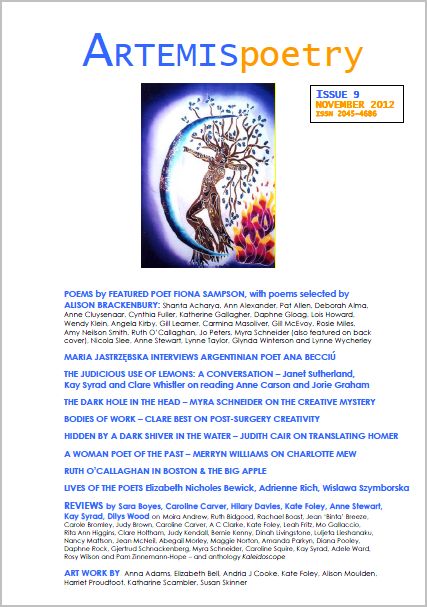
artemispoetrycoverissue9frontNo matter what happens on any given day, when the latest issue of a favored literary magazine crosses the threshold of my home, it’s a good day. Recently I received the November issue of ARTEMISpoetry for review. That was a very good day indeed. The writing and art is by women.The reading is for everyone. I venture to say that this publication of the Second Light Network, while not well-known, is making a mark and growing an audience.

Between the covers of ARTEMISpoetry, I found a rich selection of poems, features, reviews and interviews, biography, and art.

The journal opens with an interview of the Argentinian, Ana Becciú.

“I continue writing because I need to know and to understand … the voices within us, understand the surface of the words we use every day, voices that pronounce suffering, loss, the voices of all of us lost in this present society.”

There follows an exploration on the pleasures of reading and an essay by Myra Schneider on the “mystery of the creative moment.” I enjoyed the detail in Clare Best‘s engaging feature on her project and process for Self-portrait without Breasts. The project evolved from her decision to have a prophylactic double-mastectomy and to go flat chested and not have reconstructive surgery or use prosthesis.

“Cast me and I will become what I must.”

I think the feature I most enjoyed was Judith Cair’s piece on her experience translating passages from Homer’s Odyssey.

“The act of translating is beginning to influence my own writing. Even in writing poems far removed from Ancient Greece, I realize that there is an undertow of lines from the Odyssey, which may or may not be consciously acknowledged. And sometimes I am left with such a strong impression of a particular episode that I must re-imagine it for myself.”

The main course in this delightful menu addressing the interests of poets is the poetry itself. Among the many poems enjoyed is Anne Cluysenaar’s Hearing Your Words, offered here with the permission of the publisher and poet.

HEARING YOUR WORDS
For Ruth Bidgood, reading in Aberystwyth

by Anne Cluysenaar, © 2013, All rights reserved

I used, as a child, to imagine my death, or rather
beyond it. A ship setting out, in flames, at dusk,
counteracting the planet’s roll, on the sunrise path
to a waveless far horizon lit from beneath.

This came to mind, just now, clicking on close-up
through the café window – sea meeting that sky,
distantly smooth, arching high, up above
a jumble of chimneys and roofs backlit at sundown.

I found myself catching my breath, gravity’s curve
seen through such a small frame, from here where we sit
with our cups of tea. Vastness out there, our past.
But on planets elsewhere, other seas, other lives beginning.

Later, among the books, hearing your words,
it was waves I thought of – from land we may never see
reaching across the bulge of this little earth
to break, not one the same, on familiar shores.

taken from a poem diary From Seen to Unseen and Back by Anne Cluysenaar, forthcoming from Cinnamon Press, 2014.

ARTEMISpoetry is published  twice-a-year in November and May. Members receive their copy as part of their membership. Issues are available to nonmembers. For information, link HERE.  The next submission deadline is August 31, 2013. For membership and submission information, link HERE.

© 2013 essay, Jamie Dedes, All rights reserved
© 2012, journal cover and art, Second Light Network, All rights reserved – Many thanks to Anne Stewart for forwarding the cover and to Myra Schneider, Dilys Wood, and Anne Cluysenaar for the poem

THE LIVES OF WOMEN

www-cover… For when I shut myself off the outer tick
I find myself listening to the quickening beat
of this dear planet as if it were my own heart’s clock.”
The Composition Hut, Myra Schneider in What Women Want

In this short collection of nineteen poems  – including the ten-page narratively-driven long-poem, Caroline Norton – Myra Schneider manages to cut through our many-layered lives. Her poems often move from the intimacy of  personal experience to a broader frame of reference. The opening poems are nature-and-spirit driven and bespeak a love of and concern for environment. The second part of the collection fulfills the polemic promise of the title to present hard lives and harder times in a clear and righteous outcry.

Among the opening poems is Losing, written for her publisher. Myra starts with the unimportant lose of socks and moves on to finding what is valuable:

“a sparrowhawk perched on your gate, eyes alert
for prey, words that toadleap from imagination,
from heart – to make sure every day is a finding.”

In two poems she hints at the symmetrical beauty of mathematics, “… the square root of minus one you once grasped, dumbfounded.” A visit to the Garden is bursting with color and movement and triggers speculations …

“but what does it matter? You know too well
how the years have shrunk your future,
that the past is an ever expanding suitcase.”

… and further along in the poem she closes with …

“to your feet, to the bees still milking
flowering raspberries. You free a frog
watch it hop back to its life.”

I was riveted by the story of Paula Schneider in Crossing Point, as Paula (probably Myra’s mother-in-law) crosses with her children from Germany into Holland during World War II. This is included in the second half of Myra’s book, which comes to the business at hand: injustice as it affects women and children.

Interesting that this book came my way when I am standing by two friends whose physical and emotional frailty are much entwined with their relations with fathers and husbands or boyfriends. It’s not that things haven’t been improved since our parents’ days…at least for many of us it has. It’s not that there are no kind and enlightened men. Certainly there are. It’s not because women and society are without culpability, because they are not.

The complexity of the gender and social issues examined are clear in Myra’s long poem, Caroline Norton, about the nineteenth century writer and poet,  social reformer and unwitting feminist. Caroline came to the latter two occupations, not so much by choice as necessity. As the poem folds out, we see that the brutal husband who separated Caroline from her children (with tragic results for them), was abetted and aided by the women in his life, influenced as they were by a social context in which women and children are property with no legal rights of their own. No doubt those women were numb to the implications, threatened by the hint of change, and anxious to bolster the sense of surperiority they got out of putting this woman down.

Myra stands firm in her poetic commitment to continue the fight started with Caroline Norton, since half the world is still under siege and the other half still begs improvements. We read about the child-bride (Woman) and the woman who is stoned (Her Story). One wonders what happens to the children – boys and girls – of such women. The short story here is that: What women want is justice.

For two years, I have enjoyed Myra Schneider’s work and appreciated her commitment to encouraging others to honor their inner artist, through her books on writing, her classes, and her support of Second Light Network (England), an association of women poets over forty. I suspect that her work doesn’t have the audience it deserves. I hope the day comes when that is remedied.

The closing poem in What Women Want:

WOMEN RUNNING
by Myra Schneider, 2013, All rights reserved
posted here with Myra’s permission

after Picasso: Deux femmes courant sur la plage
Look how their large bodies leaping
from dresses fill the beach, how their breasts
swing happiness, how the mediterraneans
of sea and sky fondle their flesh. Nothing

could rein them in. The blown wildnesses
of their dark animal hair, their hands joined
and raised, shout triumph. All their senses
are roused as they hurtle towards tomorrow.

That arm laid across the horizon,
the racing legs, an unstoppable quartet, pull
me from my skin and I become one of them,
believe I’m agile enough to run a mile,

believe I’m young again, believe age
has been stamped out. No wonder, I worship
at the altar of energy, not the energy huge
with hate which revels in tearing apart,

in crushing to dust but the momentum
which carries blood to the brain, these women
across the plage, lovers as they couple,
and tugs at the future till it breaks into bloom.

What Women Want, publisher (Second Light Publications)

© 2013, essay, Jamie Dedes, All rights reserved
Cover art and poetry, Myra Schneider, All rights reserved