Page 2 of 5

CELEBRATING AMERICAN SHE-POETS (18): Joy Harjo, Crazy Brave
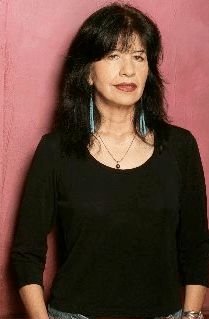
Joy Harjo (b 1951), Mvskoke (Creek) Poet, Musician, author and key player in the second wave of the Native Merican Renaissance (literary efflorescence)
Joy Harjo (b 1951), Mvskoke (Creek) Poet, Musician, author and key player in the second wave of the Native American literary efflorescence

51fFPVB5FTL._SX329_BO1,204,203,200_

 Crazy Brave (Norton & Company, 2012), Joy Harjo’s eminently engaging memoir, flows like a long prose poem. It is rich and well-built on a foundation of tribal mythologies, a strong sense of her ancestry, her difficult childhood and youth and salvation found in poetry and music. From her birth to a handsome much-loved fire-spirit father who inherited Indian oil money, allowing him to indulge a passion for cars, and her beautiful water-spirit singer-mother whose voice was stilled by a bully of a second-husband, Harjo tells the story of girl who survived a physically and emotionally abusive step-father, crushing poverty and the greater cultural obscenities to become one of our most influential poets and a formidable advocate for justice for Native Americans and liberation for women.

I was entrusted with carrying voices, songs, and stories to grow and release into the world, to be of assistance and inspiration. These were my responsibility.”

*****

I can’t imagine the human being who wouldn’t relate to Joy Harjo’s history, but those who have come from “broken” homes, poverty and a family of mixed ethnicity will most especially appreciate it and perhaps find some healing and strength in the pages of Crazy Brave. That Joy Harjo survived so much to become a decent loving person leaves the rest of us with no excuse; and any writer, poet or musician will take to heart the dreams and visions of that long journey to find hope and creative voice in poetry.

Joy Harjo, a member of the Mvskoke tribe was born in Tulsa, Oklahoma, an area where the Native American trail of tears ended, an area to which the indigenous peoples were removed – forced to relocate –  as people of European descent moved into their original home places. The removed were the Five Civilized Tribes – Cherokee, Chickasaw, Choctaw, Mvkoke and Seminole  – who were living as autonomous nations in what is now the American Deep South.

“I fought through the War Between the States and have seen many men shot, but the Cherokee Removal was the cruelest work I ever knew”. Georgian soldier who participated in the removal

*****

When the World as We Knew It Ended
It was coming.
We had been watching since the eve of the missionaries in their long
and solemn clothes, to see what would happen.
We saw it
from the kitchen window over the sink
as we made coffee, cooked rice and potatoes
enough for an army.
We saw it all, as we changed diapers and fed
the babies. We saw it,
through the branches of the knowledgeable tree,
through the snags of stars, through
the sun and storms, from our knees
as we bathed and washed the floors …
The conference of the birds warned us as they flew over
destroyers in the harbor, parked there since the first takeover.
It was by their songs and talk we knew when to rise,
when to look out the window

excerpt from When the World Ended in How We Became Human, New and Selected Poems (W.W. Norton & Co., 2004)

*****
screen-shot-2013-12-27-at-9-02-25-pm

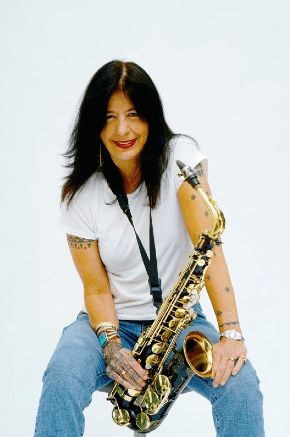
Joy Harjo’s poetry and music are influenced by her ethnic heritage and her feminist and social concerns as well as by her love of word and sound and her education in the arts. Largely autobiographical, her poetry is informed with descriptions of the Southwestern landscape and the mythologies, symbols and values of the Mvskoke people. Hers is the sort of writing that sits with you to become part of your own bone and marrow, which is the way of good poetry and good story. A poet of the people but also a critically-acclaimed poet, her many awards include the Wallace Stevens Award of the Academy of American Poets, The William Carlos Williams Award from the Poetry Society of America and the American Indian Distinguished Achiement in the Arts Award. She is the recipient of several grants and is a teacher, musician (saxophone) and singer.  She has published some fourteen books and ten music albums.

It was a dance,
her back against the wall
at Carmen’s party. He was alone
and he called to her – come here, come here
that was the firs time she saw him
and later she and Carmen drove him home
and all the way he talked to the moon,
to the stars, to someone riding

excerpt from There Was a Dance, Sweetheart in How We Became Human: New and Selected Poems (1975-2022) (W.W. Norton & Co., 2004) © Joy Harjo

If you are reading this post from email, you will likely have to link though to this blog to enjoy the video. Joy Harjo’s Eagle Song, poem and music:

© review, Jamie Dedes; poems, Joy Harjo, photographs courtesy of Ms Harjo

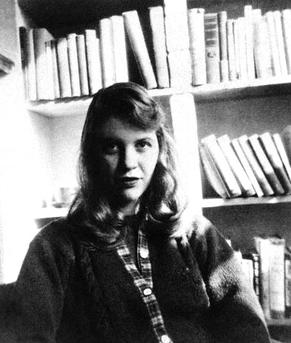
Celebrating American She-Poets (15): Sylvia Plath, Listen to the Poet Reading “Ariel”

Sylvia_plath

I can never read all the books I want; I can never be all the people I want and live all the lives I want. I can never train myself in all the skills I want. And why do I want? I want to live and feel all the shades, tones and variations of mental and physical experience possible in my life. And I am horribly limited. Sylvia Plath, “The Unabridged Journals of Sylvia Plath

What a find! What a treat to hear some of “Ariel” read by its author.  So this being the soundbite world of the blogosphere, I simply give you a short bio for those who need one and leave you to the poet herself. Enjoy!

“Sylvia Plath (October 27, 1932 – February 11, 1963) was an American poet, novelist, and short-story writer. Born in Boston, Massachusetts, she studied at Smith College and Newnham College at the University of Cambridge, before receiving acclaim as a poet and writer. She was married to fellow poet Ted Hughes from 1956 until they separated in September of 1962. They lived together in the United States and then the United Kingdom, and had two children, Frieda and Nicholas. Plath was clinically depressed for most of her adult life. She died by suicide in 1963.

“Plath is credited with advancing the genre of confessional poetry and is best known for her two published collections, The Colossus and Other Poems, and Ariel. She also wrote The Bell Jar, a semi-autobiographical novel published shortly before her death. In 1982, she won a posthumous Pulitzer Prize for The Collected Poems.’ Wikipedia

https://youtu.be/AQZ3GWCAGQ0

https://youtu.be/l11raBHGbl4

https://youtu.be/U4XledceksA

“If neurotic is wanting two mutually exclusive things at one and the same time, then I’m neurotic as hell. I’ll be flying back and forth between one mutually exclusive thing and another for the rest of my days.” Sylvia Plath, “The Bell Jar”

CELEBRATING AMERICAN SHE-POETS (14): Mary Oliver, “I got saved by poetry. I got saved by the beauty of the world.”

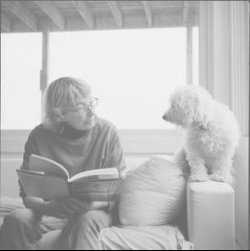
Mary Oliver (b. 1935)
Poet & Essayist Mary Oliver (b. 1935)

I love the line of Flaubert about observing things very intensely. I think our duty as writers begins not with our own feelings, but with the powers of observing.

AWARDS: Mary Oliver’s fourth book, American Primitive, won the Pulitzer Prize for Poetry in 1984. She  received the Shelley Memorial Award; a Guggenheim Fellowship; an American Academy and Institute of Arts and Letters Achievement Award; the Christopher Award and the L.L. Winship/PEN New England Award for House of Light; the National Book Award for New and Selected Poems; a Lannan Foundation Literary Award; and the New England Booksellers Association Award for Literary Excellence.

When it’s over, I want to say: all my life I was a bride married to amazement. I was the bridegroom, taking the world into my arms.

How often we turn to certain poets for certain healing, to those greater “technicians of the sacred” (to borrow from Jerome Rothenberg): Jane Hirchfield for her gentle Buddhist sensibility, John O’Donohue for his lilting Celtic reflections, W.S. Merwin and his deep ecology. Not the least among the greater technicians is Mary Oliver. Our hunger for spiritual healing is underscored by her popularity. The New York Times declared her the best-selling poet. Poet, activist and critic Alicia Ostriker writes of Oliver that she is as “visionary as Emerson.” Where there is criticism, it tends to be among feminists and others who feel she idealizes the feminine connection with nature.

51-N2B0NtNL._SX327_BO1,204,203,200_Mary Oliver’s work is deeply rooted in nature and a sense of place, the Ohio of her childhood and the New England of her adult life. More recently Florida, where she moved to be with friends after her partner of forty years died.

Influenced by Thoreau and Whitman, she’s a keen observer. She has said that she found healing in nature and the greater beauty of the world. Nature was her refuge through a difficult childhood and from an abusive father. She writes about her experience of her father in Rage from Dream Work (the Atlantic Monthly Press, 1989).

Rage

You are the dark song
of the morning…
But you were also the red song
in the night..
When the child’s mother smiles
you see on her cheekbones
a truth you will never confess
and you see how the child grows
timidly, crouching in corners…
In your dreams she’s a tree that will never come to leaf..
in your dreams you have sullied and murdered
and dreams do not lie.

However dark Rage might be, Oliver’s poems are more often filled with light and encouragement. Journey is one such:

You strode deeper and deeper
into the world,
determined to do
the only thing you could do,
determined to save
the only life you could save.

excerpt from The Journey, in Dream Work

and Wild Geese 

You do not have to be good.
You do not have to walk on your knees
for a hundred miles through the desert, repenting.
You only have to let the soft animal of your body
love what it loves. […]
The world offers itself to your imagination,
calls to you like the wild geese, harsh and exciting-
over and over announcing your place
in the family of things.

excerpt from Wild Geese in Dream Work 

When we want to breathe the clear air of nature and the best of the human spirit, we turn to Mary Oliver and the singular meditative grace of her poetry.

– Jamie Dedes

© poems Mary Oliver; photo credit, Rachel Giese Brown, 2009 – that and lists of awards are from Mary Oliver’s Amazon Page; book cover design, publisher. 

CELEBRATING AMERICAN SHE-POETS (13): Poet Laureate Natasha Trethewey, writing at the intersection of personal and cultural history

Natasha Trethewey (b. 1966), U.S. Poet Laureate, Poet Laureate of Mississippi, Pultizer Prize for Poetry, Robert W. Woodruff Professor of English and Creative Writing at Emory University
Natasha Trethewey (b. 1966), U.S. Poet Laureate, Poet Laureate of Mississippi, Pulitzer Prize for Poetry, Robert W. Woodruff Professor of English and Creative Writing at Emory University

After hearing Natasha Trethewey read at a poetry festival, Librarian of Congress Emeritus James H. Billington said he was “struck by a kind of classic quality with a richness and variety of structures with which she presents her poetry … she intermixes her story with the historical story in a way that takes you deep into the human tragedy of it.”

Natasha Trethewey is perhaps uniquely equipped by personal history, American history and public discourse, place of birth, education, inclination and innate talent to address a cruel and criminal aspect of our culture that dogs us unrelentingly: the roots, memory and legacy of racism. She is the daughter of a white father (poet Eric Trethewey) and black mother (social worker Gwendolyn Ann Turnbough).  Her background is rooted in the South. Born in Mississippi, when she was six years old her parents divorced and her young life was then split between Louisiana and Georgia. In Trethewey’s hands the juxtaposition of her biracial heritage and our shared history of colonialism, slavery and racism make a powerful case for the role of poetry to effectively and unflinchingly deliver truth.

At the time of her parent’s marriage and Trethewey’s birth anti-miscegenation laws were still in place, making their marriage illegal. Our laws against interracial marriage were struck down in 1967:

“Loving v. Virginia, 388 U.S. 1 (1967),[X 1] [X 2] is a landmark civil rights decision of the United States Supreme Court, which invalidated laws prohibiting interracial marriage.

“The case was brought by Mildred Loving, a black woman, and Richard Loving, a white man, who had been sentenced to a year in prison in Virginia for marrying each other. Their marriage violated the state’s anti-miscegenation statute, the Racial Integrity Act of 1924, which prohibited marriage between people classified as “white” and people classified as “colored”. The Supreme Court’s unanimous decision determined that this prohibition was unconstitutional, reversing Pace v. Alabama (1883) and ending all race-based legal restrictions on marriage in the United States.” [Wikipedia]

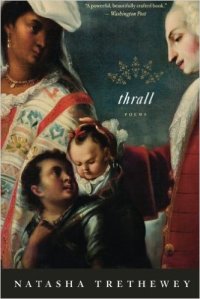
51T8yxaK1xL._SX331_BO1,204,203,200_ Thrall: Poems (Houghton Mifflin Harcourt Publishing Company, 2006) – a sequel to Native Guard (Houghton Mifflin Harcourt Publishing Company, 2005) –  is breathtakingly eloquent. Trethewey explores her relationship with her father in the first poem about a fishing trip. Written as an elegy though he is still alive, it tells him in effect that she is the better poet . . . or so I infered.

Tretheway moves on from that quiet meditation to questions of identity and race, exploring colonial attitudes about race reflected in the art of Spanish painters and the Casta (caste, categorization of mixed-race peoples) Paintings of 17th and 18th Century Mexico. I was unfamiliar with most of the paintings and painters, chose to look them up.  That, however, did not detract one iota from engagement with this collection.

The work is exquisite: formal, clear, precise, perceptive … Although the material is distressing, I find Trethewey’s style understated. These poems are not strident but they have sinew and bone. Her forms are mostly free verse. One poem is a series of cinquains and another is a villanelle.

13550802017232

In the video below, Trethewey offers some insight into the development of the collection and reads the eponymous poem. You will also find a sampling of her poems HERE.

Note: The painting Thrall that inspired the poem is by Juan de Pareja who was apparently the child of indentured servants and left as property to the Spanish painter Diego Rodríguez de Silva y Velázquez to whom he became an assistant. Juan de Pareja was born in 1606, freed in 1650 and died in 1670. The painting featured on the book’s cover is Spaniard and Indian Produce a Mestizo by Juan Rodríguez Juárez (1675-1728).

If you are reading this post from an email, you will have to click through to the site to view the video.

© 2016, essay, Jamie Dedes, All right reserved; Natasha Threthewey’s photograph, Jalissa Gray under CC BY-SA 3.0; cover design, publisher