Page 4 of 5

She-Poet, Maya Angelou, Phenomenal Woman
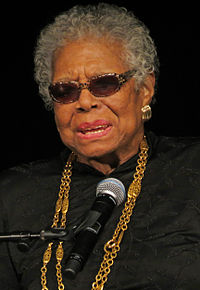
American She-Poet Maya Angelou (1928-2014), Photo 2013, York College under CC BY-SA 2.0
Maya Angelou (1928-2014)


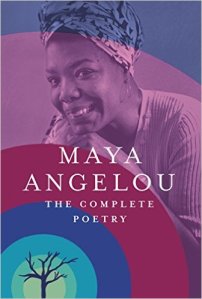
41kNzUbndlL._SX334_BO1,204,203,200_A reading by Maya Angelou yesterday on Poetry Please brought her front and center in my mind.  How could we celebrate Black History Month and not include Maya Angelou? So here she is, not a conventional beauty, but a Beauty and a Refuge … wise and sassy Phenomenal Woman


phenomenal |fəˈnämənəl|
adjective
1 very remarkable; extraordinary
2 perceptible by the senses or through immediate experience: the phenomenal world.

Pretty women wonder where my secret lies.
I’m not cute or built to suit a fashion model’s size
But when I start to tell them,
They think I’m telling lies.
I say,
It’s in the reach of my arms
The span of my hips,
The stride of my step,
The curl of my lips.
I’m a woman
Phenomenally.
Phenomenal woman,
That’s me.

I walk into a room
Just as cool as you please,
And to a man,
The fellows stand or
Fall down on their knees.
Then they swarm around me,
A hive of honey bees.
I say,
It’s the fire in my eyes,
And the flash of my teeth,
The swing in my waist,
And the joy in my feet.
I’m a woman
Phenomenally.
Phenomenal woman,
That’s me.

Men themselves have wondered
What they see in me.
They try so much
But they can’t touch
My inner mystery.
When I try to show them
They say they still can’t see.
I say,
It’s in the arch of my back,
The sun of my smile,
The ride of my breasts,
The grace of my style.
I’m a woman

Phenomenally.
Phenomenal woman,
That’s me.

Now you understand
Just why my head’s not bowed.
I don’t shout or jump about
Or have to talk real loud.
When you see me passing
It ought to make you proud.
I say,
It’s in the click of my heels,
The bend of my hair,
the palm of my hand,
The need of my care,
‘Cause I’m a woman
Phenomenally.
Phenomenal woman,
That’s me.

– Maya Angelou

© poem, excerpt from Maya Angelou, The Complete Poetry; photograph “Maya Angelou visits York College, February 4, 2013” by York College and shared under CC BY-SA 2.0 license.

Celebrating American She-Poets (6): Young People’s Poet Laureate, Jacqueline Woods … Brown Girl Dreaming

Jacqueline Woodson by David Shankbone under CC By SA 3.0 license

American poet and writer, Jacqueline Woods (b. 1963) was named Young People’s Poet Laureate in June last year by The Poetry Foundation. The $25,000 laureate award is given every two years to poets devoted to writing quality poetry for children and youth. Poetry Foundation President, Robert Polito, said Jacqueline is an “elegant, daring, and restlessly innovative writer.”

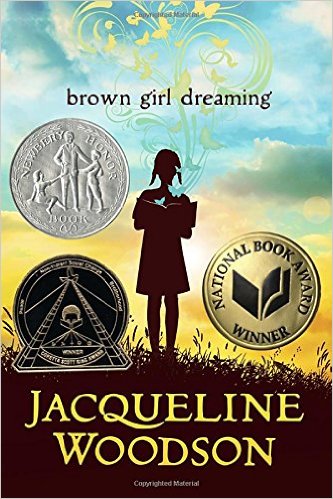
Jacqueline has written some thirty books. She’s won a National Book Award and three Newberry Honor Medals.

51-Pl9BJ7IL._SX331_BO1,204,203,200_I just finished reading Brown Girl Dreaming, a memoir in free verse that is not just for brown girls. It can be read in one sitting but like all good poetry is meant to be relished … there is much to savor.

What I like about this work – and what in part accounts for its popularity – is that it puts family life and youthful reflection smack-dab in the context of history. Woodson grew-up during the civil rights movement and tells of watching the Black Panthers on television and sitting in the back of the bus, though Woodson’s mother made a point of affirming for her children that they were as good as anyone.

I enjoyed – and think most kids would too – how Woodson writes about the contradictions in family stories. The day, for example, that she is born is reported differently by mother, father and grandmother, each absolutely sure that he or she is the only one who got it right.

This is a wonderful book for any young person. I venture to say, however,  if yours is a child who dreams of being a writer and can’t envision it happening, then you must put this book in that child’s hands. S/he will be forever grateful.

© 2016, Jamie Dedes

She-Poet, Sor Juana Inés de la Cruz, the most important poet in the America’s before Whitman & Dickenson

Portrait by Fray Miguel de Herrera (1700-1789)

Sor Juana Inés de la Cruz (1651-1695), a Catholic nun of the Order of Saint Jerome, born an illegitimate child of mixed race (Criolo/Creole), lived during the time when Mexico was a part of the Spanish empire. She was a writer, a playwright and a poet. Self-educated and hungry for learning, she established her educational goals when she was quite young.

These three famous quotes of hers are telling:

“I don’t study to know more, but to ignore less.”

“One can perfectly well philosophize while cooking supper.”

“…for there seemed to be no cause for a head to be adorned with hair and naked of learning…”

In 1989 the Mexican poet, diplomat and Nobel laureate, Octavio Paz wrote in The Traps of Faith that Sor Juana was influenced by Spanish writers of the Golden Age and the Hermetic tradition, especially the works of her contemporary, the Jesuit scholar Athanasius Kircher. Paz felt that Sor Juana’s most formidable poem, Primero Sueño (First Dream) is a representation of a desire for knowledge through hermetic symbols. He concludes that Sor Juana’s work was the most important produced in the Americas until the 19th-Century arrival of Emily Dickinson and Walt Whitman.

Sor Juana Inés de la Cruz was brilliant, independent and nonconforming. She was a feminist before feminism. She was at the forefront of Mexican (v. Spanish) literature and is an icon of the Mexican national identity. Her home town of San Miguel Napantla was renamed Nepantla de Sor Juana Inés de la Cruz in her honor. While the people of the United States have snatched Freida, Sor Juana – though loved by many of us – seems to remain relatively unscathed by cultural appropriation.

I Approach and I Withdraw

I approach, and I withdraw:
who but I could find
absence in the eyes,
presence in what’s far?

From the scorn of Phyllis,
now, alas, I must depart.
One is indeed unhappy
who misses even scorn!

So caring is my love
that my present distress
minds hard-heartedness less
than the thought of its loss.

Leaving, I lose more
than what is merely mine:
in Phyllis, never mine,
I lose what can’t be lost.

Oh, pity the poor person
who aroused such kind disdain
that to avoid giving pain,
it would grant no favor!

For, seeing in my future
obligatory exile,
she disdained me the more,
that the loss might be less.

Oh, where did you discover
so neat a tactic, Phyllis:
denying to disdain
the garb of affection?

To live unobserved
by your eyes, I now go
where never pain of mine
need flatter your disdain.

– Juana Inés de la Cruz

© 2016, Jamie Dedes; Illustration and poem in the public domain. Source of translation unknown.

Celebrating American She-Poets (4): Pearl Buck “Words of Love”

I give you the books I’ve made,
Body and soul, bled and flayed.
Yet the essence they contain
In one poem is made plain,
In one poem is made clear:
On this earth, through far or near,
Without love there’s only fear.

Essence by Pearl Buck, novelist and humanitarian

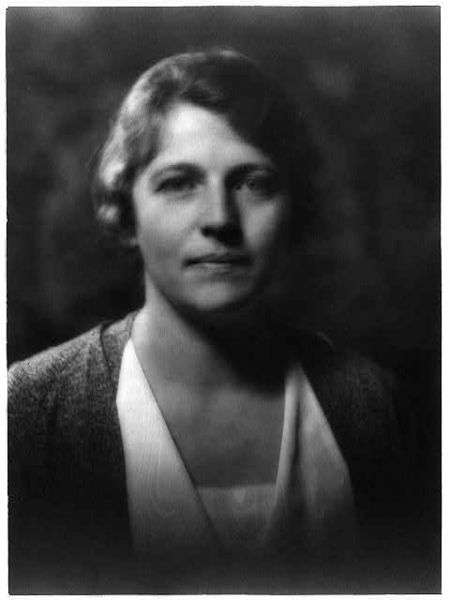
No one will think first of poetry when they think of Pearl Buck. She was primarily a novelist and memoirist. She did write poetry though and one collection was published. I consider her a sort of spiritual mother and so include her early in this ongoing Thursday series: Celebrating American She-Poets.

Pearl S. Buck (1892-1973) was born in Virginia, the daughter of Presbyterian missionaries. She grew up in China and spoke Chinese before she spoke English. Her Chinese name was Sai Zhenzhu.

Pearl Buck was a prolific writer of novels and memoir who started publishing her stories and essays in the 1920s in popular periodicals of the day: The Nation, The Chinese Recorder, Asia, and The Atlantic Monthly. Her first novel was East Wind, West Wind (John Day Company, 1930).

Of her novels, The Good Earth is the best known. It won the Pulitzer in 1932. The focus of most of her writing was China and the Chinese. When Chinese-American author Anchee Min wrote Pearl of Chinaa fictionalized account of Pearl Buck’s life, she said that she was touched by the warmth and understanding with which Ms. Buck had written about Chinese peasants and their lives.

Pearl Buck was awarded the Nobel Prize for Literature in 1938.

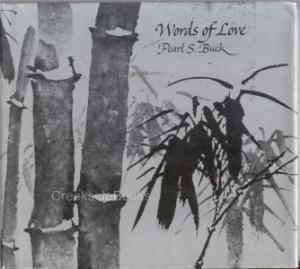
To my knowledge, there is only one small book of her poems. The collection is titled Words of Love. It is simply illustrated with Asian art by Jeanyee Wong and was published a year after Ms. Buck’s death by the John Day Company, the publishing firm run by Pearl Buck’s second husband, Richard Walsh.

I found a copy of Words of Love in a used-book store some years ago. The poem quoted above is an excerpt. In brief, eloquent, deft strokes, Ms. Buck’s poems do indeed express the themes of her novels. I can’t help but wonder whether there might be more of her poetry stored in some university archive awaiting discovery by an ambitious student or devoted biographer.

Dust-jacket, Words of Love by Pearl S. Buck.

© 2016,  Jamie Dedes, All rights reserved; illustrations are in the public domain