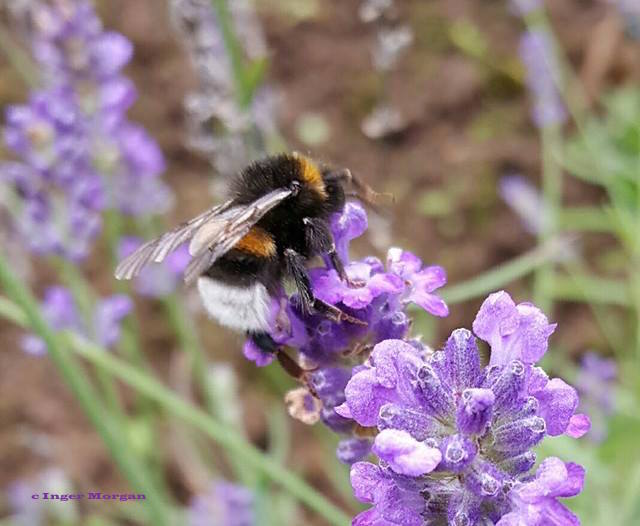
i planted seeds of lavender,
tiny things in the palm of my hand,
then the black soil and water,
patience . . . . and waiting
for the first signs of life,
the need for care and love
’til the splendor of blue,
the comforting fragrance,
a gift for the bumblebees and me
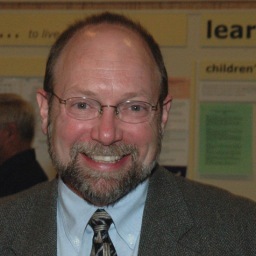
INGER MORGAN lives in Trollhättan,Sweden. She’s a retired nurse who says she’s always written “small pieces” but never shared anything until – much to my delight – she shared a poem with us on Facebook. Inger’s first published poem was about grief and guilt and it was featured in the November issue of The BeZine. It looks like Inger has birthed a new interest, if not a new career, at 74 years-of-age.
When Inger and I talked about the December issue – due out tomorrow – with the theme: The Healing Power of the Arts, Inger said frankly her healing comes from nature. Okay! Fair enough. I know that’s true because she takes wonderful photographs on her property and of the adjacent woods with its wild trees, tumbling brooks, gray stone and green mosses. Just from the photographs, I feel I almost know her place, the care of which is the inspiration for the splendor of blue.
So the question is: Where do YOU find healing? Nature. Poetry. Art. The ocean or the sky. Tell us about it in poem or prose. If you’d like to share what you’ve written, please leave it – or the link to it – in the comments sections below.
Swan (Hansa, हंस) is the symbol for Brahman-Atman in Hindu iconography. Brahman (/brəhmən/; ब्रह्मन्) connotes the highest Universal Principle, the Ultimate Reality in the universe.
WEDNESDAY WRITING PROMPT: Well, it’s December and as noted yesterday the month is dense with the religious holy days. That would be joy to some and disgruntlement to others. Wherever you stand in your thinking about God and by whatever name you call yourself and your vision of God, I thought it might be fun and interesting to write poems or essays about the nature of the Ineffible and why you do or why you don’t believe in God.
Often there is a temptation to view the other guy’s religion as superstition. Today let us write with deference for the diverse ways people try to make moral, spiritual and intellectual sense of a world in which illness, violence, despair, loneliness and death are as prevalent as hope, friendship, reason and birth.
If you’d like to share what you’ve written, just put the link to the piece in the comments below. Today I’ve stollen Ben Meyers’ Sunday sermon as a jumping-off point. Enjoy the read and enjoy your writing adventure. J.D.
SOME NOTIONS OF GOD
by
Rev. Benjamin Meyers
Rev. Ben Meyers of the Unitarian Universalists of San Mateo, California
One of the hazards of being a minister, I have found, is that when people I don’t know well discover that I am a minister – at some social function or party I attend or if I become a captive audience on a flight to somewhere – they will proudly proclaim to me “Oh, I don’t believe in God.”
Usually I respond with a nod and a simple “Un hum,” because sometimes their only purpose in saying this to me as a “reverend” is to shock or somehow upset me. But, if I sense they are sincere about wanting a genuine spiritual dialogue, I might say something like, “Un hum…. Well, tell me about this God in which you don’t believe?” I then listen carefully to their responses and ask questions about why and how and so forth. What generally unfolds is a story about events in their lives that led them to their assertion about the God in which they don’t believe.
Michelangelo’s Creation of Adam
When I have taken the time for such theological dialogue, nine times out of ten, I will eventually say something like: “Yes, I see. And you know what? I don’t believe in that God either (meaning, that old, outworn, dysfunctional, bearded, peeping-tom-in-the-sky God.) Vis-a-vis THAT God we are both atheists!”
Then I’ll suggest that now that we’ve discovered what it is we don’t believe when it comes to God, we can explore just what it is we might believe about God that would be positive, creative, healing, relational liberating and helpful. We’ll discover a kind of practical theology for ourselves.
The truly amazing and delightful and rewarding thing is that, again, nine times out of ten, IF that self-proclaimed atheist and I work together in authentic dialogue, we usually find and articulate a God-concept that we can both agree with or at least discover that our differing ideas of God are in sympathetic, parallel and supportive relationship to one another without anyone getting hurt.
There are so many creative, spirit-enriching ways for us to think about God, but getting there often means revisiting old notions about God that no longer fit our reality or experience. This work is critical to do if we are to mature spiritually as human beings.
Here’s a poem by the American writer, James Kavanaugh, entitled, “My Easy God is Dead”, which is a great expression of what I’m saying. He writes:
“I have lost my easy God— the one whose name I knew since childhood. He was a good God… He was a predictable God… He made pain sensible and patience possible and the future foreseeable… Now he haunts me seldom, some fierce umbilical is broken… now) I live with my own fragile hopes and sudden rising despair… my easy God is gone— and in his stead, the mystery of loneliness and love!”
For some of us, God is, as the old Universalists put it, love, simply love—a powerful spirit of goodness, warmth, mercy and justice that lives in people and the world. For others, God is expressed as a ‘life force’ or ‘creative spirit’ or ‘higher power’ or ‘supreme intelligence’ or ‘infinite ground of being’ that animates creation making life and purpose possible. For others, God is an ‘unknowable mystery’ that utterly defies definition or description. For some of us, God is simply a concept that is of absolutely no spiritual usefulness or practical relevance—in fact, it is viewed as a source of conflict and divisiveness and not considered helpful at all.
Personally and professionally, I don’t believe a God-concept is essential or necessary for people to live lives that reflect compassion, goodness and gratitude. But, there’s no getting around the persistence of the notion of God that has permeated and continues to occupy our minds and hearts and which represents—even in its ineffableness—what I call “The BIG idea.” Our theological nuances about God are endless, and this theological diversity is (to me at least) more beautiful than it is confusing or indulgent. For I believe that God is, above all else, a radically personal reality, rightfully different for each one of us as we experience our lives in our own idiosyncratic ways.
The philosopher, Ludwig Wittgenstein, was wise to declare that religion belongs to the “realm of the inexpressible.” And many Unitarian Universalist ministers attending seminary at Starr King School in the late eighties and early nineties had an incomparable New Testament professor by the name of Marcus Borg, who was so convinced of the utter subjectivity of God that he proclaimed passionately that it was absolute folly and foolishness to even attempt to share our own ideas and experience about God to others, so much so, that he wrote several books on the subject.
In one of them he implored: “Be content to know your own God–and for God’s sake–don’t try to transfer or argue it to someone else…We each must discover our own sense of life’s ultimate sacredness, not try to fit others’ into your own.”
And yet, while I agree with good professor Borg – blessed be his name – that talking about God with our clumsy, imprecise words is, by its very nature, an often subjective and slippery thing to do. I nonetheless believe, as did he by virtue of his writings on the subject, that there is great spiritual value when each of us humbly share what God does (and does not) mean to us, individually. Without such respectful sharing of our own ideas about our experiences and notions of God, how will we ever be able to mature and deepen our theological understandings and spiritual sensitivities and find the common ground that unites us, despite theological differences?
To avoid them is to invite and perpetuate distance, rather than connection. It is easier to embrace our differences and practice acceptance of one another when our differences are made known to us. It is a sign of spiritual growth and maturity to be able to do so. And, given the times in which we live, we need, now more than ever, to clarify and to promote the value of acceptance which is the cornerstone of deep faith and practice. If we can’t or don’t do so, how will we be able to foster the kind of civility and acceptance and search for common ground that is required of us as a world, a nation, a community … as people of faith?
This was the purpose and intention behind the meeting I attended this past Wednesday, from noon to 2pm, with twenty-four other religious leaders from various faith traditions. We agreed to gather and address this topic: “Leading in Difficult Times: Conversations Among Faith Leaders.”
Present were spiritual leaders representing Muslims and Jews, Catholics and Protestants, Buddhists and Unitarian Universalists. We were of various ages and gender-identities, ethnicities and physical abilities and what brought us together was a desire to know and to trust one another so that we could more effectively lead our people…beyond the complacencies of our unique faith communities…and to seek and FIND our common values… around which we might rally a response to the climate of hatred and violence and the wave of dangers that we collectively face…in the greater world, our own nation, in our community, our congregations and our own hearts…to counter our fears and our uncertainties and our distrust about the future.
How do we lead in difficult times unlike any other we have ever faced? We know, as clergy leaders, that to be effective in these ‘interesting times’, we must acknowledge our differences and put them aside in order to stand firm against the attack on the values we hold in common, which are shared and which are central to each of our faith traditions. It was a most remarkable session.
In circles of eight, we shared our stories. We shared our concerns and our fears. But more importantly we shared our values and that which lifts us above our fears so that we may lead beyond them and be emboldened and strengthened in solidarity with our shared purpose.
From a Buddhist minister, I learned of the fear that exists in his community that history may well repeat itself as people in our county are suddenly whisked away and interred in camps as potential enemies of the state, just as so many Japanese-Americans were during World War II. They are willing to stand with our immigrant and Muslim neighbors to ensure this does not happen again and they invited us to do the same.
My Jewish colleagues expressed concern against the quiet acquiescence and acceptance of the erosion of rights of citizens as one line in the sand after another is allowed to be crossed, just as they were in Nazi Germany until the seemingly impossible became possible. They wondered at what point would we stand together to counter the hate speech that precedes the horrors of violence?
A Latina priest from a predominantly Hispanic Episcopal church fears the scapegoating against immigrants and the very real prospect that families will be destroyed and family members ‘disappear’ without a word or trace. And how any knock on the door might mean deportation without due process or warning. She wondered aloud how it would be possible for people, “made in the same likeness of God” to be capable of oppressing “the very presence God” found in those they persecute.
Another colleague realized that we can no longer afford the luxury of believing ourselves separate from one another. They noted that, before 11/9, there seemed to be so many different causes and issues to be concerned about: Islamophobia, Misogyny, Homophobia, anti-Immigration hate and the degradation of our environment….and now we are forced to see that all of these are related and connected that, in the words of John Muir . . .
“When we try to pick out anything by itself, we find it hitched to everything else in the universe.”
In the end, in my mind, we all became one faith, one people. What a moment and in the end, we made a covenant, a promise, to one another that if any ONE of us sent out a plead for help or solidarity, that we would ALL do our utmost to show up and to bring our congregations with us. It was the most deeply moving multi-faith meeting I had ever attended. There was great solidarity among us, solidarity beyond our notions of difference in theology, or culture, or practice. We affirmed one another as one. It was almost the best meeting I attended that day.
But from that meeting I came here…to Beck Hall, where our Justice Ministry Team Leaders had organized a gathering of another 25 of us to address essentially the same questions: What do we do now? How do we, as a spiritual community put our faith to action? How do we embody our mission to transform ourselves and the world in a post-11/9 world?
We began by listening to one another, by naming our fears and concerns and also giving voice to our shared values. We then organized into four areas for action: Immigration Response, Multi-Faith partnerships, Environmental Justice and Racial Justice. We came away with concrete steps to bring these issues into the life of this congregation…so that we may live out our values and stand together on the side of love – within the capacity and ability of each of us to do so – STAY TUNED. Don’t go anywhere…like Canada…yet.
All of this is by way of prefacing the sharing, however briefly, of my own notions of God, and what God (as I experience it in my everyday life) means to me. I offer my elusive understanding of God not (I assure you) to “set you straight once and for all” on the question of God. We are, after all, Unitarian Universalists who understand truth and reality as mysterious and many splendored things. I share what God means to me in the hope that my understanding might stimulate you in your own thinking and feeling about this most fundamental of religious concepts.
Most essentially, and I reserve the right to come back and revisit this subject often, or today, God, to me is a participatory phenomenon….a relational reality….a living process that needs us to exist if it is going to achieve its fullest and finest reality and power.
I believe God comes to life when we, I, become more loving, just, and giving. I like what Dorothee Soelle said …
“To believe in God means to take sides with life and to end our alliance with death. It means to stop killing and wanting to kill, and to do battle with apathy which is so akin to killing. To take sides with life and experience how we can transcend ourselves is a process that has many names and faces. Religion is one of those names. Religion can mean the radical and wholehearted attempt to take sides with life.”
If you or I don’t “take sides with life” —in our little corners of the globe, with the people near us—if we fail to bring our best and most loving gifts to the world of need, then God’s spirit is absent. If, for example, you stand faithfully by someone’s death bed, holding their hand and soothing their brow—it is your presence, your physical embrace, tentative and imperfect as they are—that are the only way that dying person is to know solace and grace and love. It is utterly without self-importance that I tell you that I deeply believe God needs me (and you) if God is to be at all. To me, the most beautiful theological thought of all is that there is a holy spirit breathing through life which WELCOMES AND ENCOURAGES our energies and gifts….the God that haunts and blesses me quietly welcomes my most passionate and loving participation in the creation of life.
This idea of god as a relational process is hardly new. The Jewish theologian Martin Buber described God as an active verb that comes to birth best in the loving “I-Thou” encounter, that mysterious arching of energy and affection, that can spark between human beings. And even more recently, the relatively new school of theology called “Process Theology” proclaims, basically, that God is a verb—a living process of justice, love, compassion and creation. The process theologians believe the God does not exist as some abstract, supernatural, heavenly personality far removed from us, but rather is a living process that invites us in ever-fuller partnership with everything that breathes, cares and grows. As a recent rock opera put it in “The Song of Three Children,” “God is not a she, God is not a he, God is not an it or a maybe. God is a moving, loving, doing, knowing, growing mystery.”
Its a hard thought to hold, isn’t it, that God (or at least one dimension of God) is a verb, a process of noble becoming rather than an actual cosmic being. The God I know and depend on for spiritual wholeness is both a presence and a process. My God is an open, available, holy spirit…a good and gracious spirit astir in-my world, which guides my heart to action, which welcomes my frail, little contributions of beauty and blessing, of service and love. If we human beings awaken to the holy powers and processes that are everywhere around and within us, then we participate in that holiness, and that participation blesses, fills and saves us.
My old, easy, predictable Gods are dead. But the creation in which I live is astir with sacredness and grace. I believe there is a Holy Spirit of Life that blesses and nurtures all who are open to its power and purpose. Name it whatever you will, describe it in whatever words work for you—but both savor and serve life’s irrepressible, unmistakable holiness.
In closing: Dag Hammarskjold had it right when he said …
“God does not die on the day we cease to believe in a personal deity….but we die on the day when our lives cease to be illumined by a steady radiance–renewed daily–of the wonder, the source of which is beyond all reason.”
May the door of this home be wide enough
to receive all who hunger for love,
all who are lonely for friendship.
May it welcome all who have cares to unburden,
thanks to express, hopes to nurture.
May the door of this house be narrow enough
to shut out pettiness and pride, envy and enmity.
May its threshold be no stumbling block
to young or strained feet.
May it be too high to admit to complacency,
selfishness, and harshness.
May this home be for all who enter,
the doorway to richness and a more meaningful life.
This is from a Jewish book of daily prayers. I think it may be meant for a wedding ceremony or perhaps as a blessing for a new home, but I can see it applied to a broader good. “Siddur” apparently means “order” and that sounds as hope-filled as “love” and “welcome” … perhaps to the refugees that are arriving on so many foreign shores.
In that book which is My memory . . .
before which little can be read,
Appear the words
‘Incipit vita nova:
Here begins the new life.
– Dante Allegro
This was written in the medieval spirit of courtly love but also sounds to me like warm welcome to people escaping violent, repressive and hopeless environments. Today it’s them. Tomorrow it might as easily be you or me … let compassion and uncommon good sense reign.
*****
Excerpt from Surat al-Ma’ida, 48
“We have appointed a law and a practice for every one of you. Had God willed, He would have made you a single community, but He wanted to test you regarding what has come to you. So compete with each other in doing good. Every one of you will return to God and He will inform you regarding the things about which you differed.”
Surat = chapter of the Qur’an
WRITING PROMPT
Speaking from your heart, write a prayer, poem or psalm, or a prose paragraph that expresses a welcome to whatever person, family or group with whom you feel a connection and for whom you wish peace and safety. Click on the Mister Linky icon below and enter you name and the link to your piece so that we may all read and enjoy. (Please DON’T enter the link to your blog. DO enter the link to the relevant post.) I’ll check back on this week’s Mister Linky for two weeks. You don’t need to link in something today.
May Peace Prevail In Our World, Our Homes and Our Hearts.
Thank you for sharing your love of words. Comments will appear after moderation.
The Wiyot lived in the Humboldt Bay area of Northern California and they live in my dreams. For about a year-and-half we made our home in Humboldt County, an area about 200 miles north of San Francisco on the far North Coast. It’s a place dense with redwood forests, wild rivers, and creeks that run dry in the summer and overflow in the winter. If you live in a rural area or grew up in one, you might take such things for granted. Having lived in paved-over cities all my life, they seemed magical to me.
Our four acres were rich with sequoia, madrone, oak, and twenty-eight fruit trees. Blue jays flew in to feed in the morning. Quail families visited at night. They marched down our drive in orderly formation. Hawks and hummingbirds put on air shows. Rosemary thrived unattended. There was a beautiful lush 100-year-old rosebush. There were wild roses too. They gifted us hips for homemade cough syrup.
Scotch Broom
The colors there were brilliant and varied: smog-free blue skies (you could see the stars at night!), rich brown earth, a population of purple iris in a grove of California bay laurel, orange cosmos and red dahlias, yellow scotch broom lining our creek-side in the company of cascading Japanese quince. The Japanese quince provided ample housing for Rufus hummingbirds. Nearby, Queen Ann’s lace stood unbent by the wind. When it went to seed we collected the seeds for cooking. They have a taste somewhere between carrot and caraway.
The spread of blackberry bushes was both wonder and wealth. They seemed never to run out of fruit. I gathered some almost every morning for breakfast and every morning I thought of the women in buckskins who preceded me more than a century ago. Perhaps there was a mother who stood on this spot, picking blackberries for her son too.
I think the peace, quiet and simplicity of that place made it easy to imagine the first peoples as they might have lived there in other times. I could see them tending fires, boiling and drying acorns and then grinding them for flour, bathing in the river, raising their children, gathering wood, hunting and enjoying sacred ceremony. I knew the very same ancient sequoia that watched over us had watched over them.
Qual-a-wa-loo (Humboldt Bay) near Eureka, traditional Wiyot lands, The 1860 Wiyot Massacre happened on Indian Island
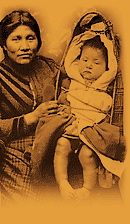
Finally, I did some research. I was sad but not surprised to find that the area was once inhabited by an indigenous people – the Wiyot people – who were decimated in a genocide ~
Wiyot Mother and Child
“Eureka newspapers of the time exulted at the night massacres conducted by the “good citizens of the area”. Good haul of Diggers and Tribe Exterminated! were 2 headlines from the Humboldt Times. Those who thought differently about it were shut up by force. Newspaper publisher and short story writer Bret Harte called it “cowardly butchery of sleeping women and children” — then had to flee ahead of a lynch mob that smashed his printing presses.” MORE [Wiyot Tribal Council Page]
Note: Originally written in 2012, I’ve posted this today as a an acknowledgement of Indigenous Peoples’ Day, October 12. More than 40 US jurisdictions celebrate Indigenous Peoples’ Day; the majority of these have replaced Columbus Day with this holiday, but some jurisdictions celebrate both Columbus Day and Indigenous Peoples’ Day.
In addition to reading here, please also treat yourself to Michael Watson’s post Silence, Story, and Healing, a short and thoughtful piece.
Perhaps you too grew up in a time and place where the history books taught a one-sided view of the land you live on and the people who originated there. Perhaps, like me, you had to get out of school and meet new people, read books that weren’t sanctioned by academic authority and do your own research to learn about the devastation that was and is rained upon indigenous people all over the world … the violence, the slavery and the genocide. Perhaps you are a descendent of the original people who suffered so and know the truth from the stories of your elders. Perhaps your roots are in the nations of empire and you are saddened that they perpetrated or were complicit in such unimaginable injustice.
We can’t change what happened in the past but as writers and poets we can make sure that lies aren’t propagated and that the truth is told and shared. Write a poem, short story, essay or article that illustrates some aspect of colonialism, racial bias and stereotype, or the modern complications of colonial history.
Thank you for sharing your love of words. Comments will appear after moderation.
 i planted seeds of lavender,






 Jamie Dedes' THE POET BY DAY Webzine