A drizzle, not wild rain
No drenching torrents
No puddles forming under
the palm and the birch
No soaking the dry brown earth
while I sit cozy inside
No squall, friend of solitude
to embrace the writing itch, just
a parched blue midnight
an effete sprinkle in the air
Nothing to stir the pen
or green the lawns
This must have been the poetic equivilant of a rain dance. Right after I wrote it we had a soaking downpour.
I am disabled but not unable. Thanks to medical technology, fabulous and caring physicians, family support, social support (both online and off) and computer technology, I continue with my chosen career, my chosen causes and a life that is as full and engaging as anyone could hope.
Now, I’ve discovered The Mighty (details in the video below) thanks to my Bardo Group Beguines colleague, Lana Phillips. What a great find!
A wonderful idea, essentially an online support group for people who are dealing with chronic and catastrophic illness and sharing information and resources. The people who visit The Mighty site and/or write for it, share their stories (including stories of parenting). They are women and men who are ill or disabled themselves or who are caring for others who are ill or disabled … or, perhaps both.
We are so fortune in these days that there are support groups available. My own mother lived with cancer over and over again. First breast cancer, which kept reoccurring. Then thyroid, kidney and other cancers. Ultimately she died at 76 of breast and colon cancer. In her day, there were no support groups, no one in her life who could understand the complications: psychological, financial or physical. There was no adult who could observe, understand and intervene. She also suffered from mental illness and was in an almost constant state of stress and trauma.
Unlike my mom, I have the benefit of a support group at the Medical Center for people with interstitial lung diseases who are in pre-transplant (me), transplant and post transplant programs. I also belong to an off-line support group of people with “life-threatening” (read ultimately fatal) illnesses, which is run by the local Buddhist meditation center. Some are – like me – lucky enough to go on for years. I was diagnosed in 1999 with Idiopathic Pulmonary Fibrosis, which is fatal within five years of diagnosis and for which there is no cure. I’m still here because the diagnosis was wrong. There was no way to know that until time passed and reactions to medical treatments could be observed and evaluated. These proved that the condition is actually Hypersensitivity Pneumonitis. So, as you see, I’m still hanging out. Some of the members of our Buddhist group are not. Over the last seven years we’ve lost nineteen friends. That’s the tough part.
The upside is that our offline support groups provide us safe haven to share information, to be open about our fears and frustrations, and to share our joys. So too The Mighty, where there are a rather remarkable number of conditions addressed from a personal perspective and in a manner that is informed, compassionate and uplifting. Bravo!
WRITING PROMPT
Write a poem, short story or feature article about dealing with chronic catastrophic illness or disability. Directly or indirectly, illness and disability touch all our lives. It’s just part of this package called Life! If you write an article, you might consider submitting it to The Mighty. Submission guidelines are HERE.
The received wisdom given to writers for as long as I can remember is “write what you know.” I haven’t a clue where on earth that might have come from. I have read that Hemingway’s advice was . . .
“From all things that you know and all those you cannot know, you make something through your invention that is not a representation but a whole new thing truer than anything true and alive.”
That makes more sense to me then “write what you know.” So does Nikki Giovanni’s comment …
I want to be clear about this. If you wrote from experience, you’d get maybe one book, maybe three poems. Writers write from empathy.”
Danny Strong (b. 1974), actor, screenwriter, television and film director and producer
In this video Danny Strong makes the same point in his own colorful way.
If you are viewing this post in an email, you will have to link through to the site for view the video.
Photo credit: Danny Strong courtesy of the Annual Peabody Awards under CC SA 2.0 license
Thank you for sharing your love of words. Comments will appear after moderation.
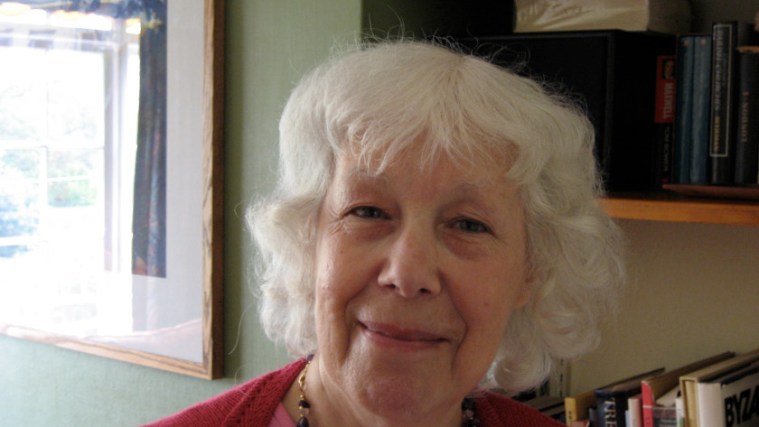
Award Winning British Poet, Myra Schneider (b. 1936), Writer, Writing Coach, Consultant to Second Light Nework of Women Poets
This interview was first published on February 14, 2011, not long after I “met” Myra (Myra Schneider’s Poetry Website). I’m publishing it again in honor of Myra’s 80th birthday this month and because there is value in it. You can see that the career of a poet and writer must evolve like any other career. It takes time to be noticed by public and publishers, to find your voice, your subject, your niche and a way to promote your work with dignity. It is an evolution that requires self-awareness, patience and perseverance.
Myra and many of the other featured poets on this site make excellent – inspiring – role models. They also demonstrate that there is no waiting for outside validation. First you have to be “poet” or “writer” or the practicioner of whatever is your chosen art. The rest will follow, which doesn’t necessarily mean you will have a huge following and a best-selling collection. You will have a following though, people who support you and appreciate your work, share your values and your love of poetry.
Another more recent interview of Myra, A Life Immersed in Poetry, is HERE.
– Jamie Dedes
This is a tentative world. Ahead the ground
rises, unrolls slowly into distance. Grass
straggles from sparse clumps. The only sound
is silence. On trees thin as bird legs: a fuss
of feathers. Maybe the smudged chimney and roof
are figments of imagination. But the wall
has a solidity which would support grief,
guides the walker and her dog up the hill,
reaches beyond the point eyes can see
into the future’s opaque sky. The way
is planted with snares but they’ll plod to its end
and the dog will linger to sniff the moment’s petals,
the wall will shield the woman from the wind
as she hugs her thoughts, their jet darks, opals.
JAMIE: YOU STARTED OUT WRITING FICTION FOR CHILDREN AND YOUNG ADULTS AND THEN MOVED TO POETRY. WHAT INSPIRED THE TRANSITION AND WOULD YOU WRITE FICTION AGAIN?
MYRA: My first published work was fiction for children but the story of my writing life is quite complicated. During my teens and while I was at university I was sure I wanted to be a poet. When I left college – we’re talking about a long time ago 1959/60 – there were not the workshops and openings which we now have in the UK. I was invited to join a group of well-known poets but what they were writing didn’t seem to connect with the poetry I loved from the past and the 20th century. Their poems struck me as pretentious and I felt like a fish out of water. As I found almost nothing to counterbalance this I soon stopped writing poetry and for a few years wrote rather bad adult novels, none of them were published.
When my son was small he kept asking me to tell him stories and after writing down some of these I tried writing a full-length children’s novel. The third one, Marigold’s Monster, was accepted by a well-known publisher who later commissioned me to write two novels for teenagers. By this time I had started writing poems again and had one or two accepted in magazines. At the end of the 1970s there was a cut in library spending in the UK and because of this I didn’t receive a contract for a third novel which the publishers were interested in. I started writing a lot more poetry and after three years I was lucky enough to find a small press publisher. By the mid-1980s I knew that poetry was my real metier and I stopped writing fiction in prose.
What I retained though was a love of narrative and I have written a number of narrative poems. These range from poems of two or three pages to poems of thirty pages or more. Some deal with contemporary life both relationships and social issues and draw indirectly on my own experience. Examples of these are Voice Box in my book, Multiplying The Moon and Hotel in Circling The Core. Others draw on myths or known historical material and explore themes which interest me. The most recent of these is the The Minotaur which has just come out in the Long Poem Magazine. I have also written Becoming which is published as a short book by Second Light Publications. This draws on difficult personal material and presents it in a parallel situation. I love writing narrative poetry – it’s almost a different medium from lyrical poetry and it allows me to approach material in a very different way.
JAMIE: IT IS NOT WELL KNOW THAT THE GREAT AMERICAN NOVELIST, PEARL BUCK, WROTE POETRY AS WELL AS PROSE. A SMALL, ELEGANT COLLECTION OF HER POEMS WAS PUBLISHED POSTHUMOUSLY. ONE POEM CALL ESSENCE IS OF SPECIAL INTEREST:
I give you the books I’ve made,
Body and soul, bled and flayed.
Yet the essence they contain
In one poem is made plain,
In one poem is made clear:
On this earth, through far or near,
Without love there’s only fear.
– Pearl Buck
WOULD YOU SPEAK TO THAT PLEASE AND WRITE ABOUT WHAT YOU SEE AS THE ESSENCE OF POETRY?
MYRA: This spiritual poem is an expression of what Pearl Buck feels is at the heart of living and writing – love. Without it life would have no meaning, nothing to offset the negativity, dangers and fears of living. What I understand too is that in all else she has written, all she has given body and soul to, love is the essence. I’m glad she used the word essence because for me the poetry that really matters – both what I read and what I write – is spiritual poetry, poetry which searches below the surface for meanings . This is not say that I write or look for poetry which is very solemn or far removed from the everyday or humorless – rather that I want to explore what lies beneath the ordinary, what raises it, makes it not ordinary.
MYRA: We wrote the book because we believe that personal writing is very potent both for the writer and the reader, because some of the greatest literature is rooted in personal material. We both became aware years ago that many people feel a strong need to write about their lives and feelings and even when they go to writing workshops without recognising this need it is quickly apparent that it is the driving force behind what they write. What we think is key to the book is the range of personal subject matter which we have examined and the widely different approaches writers have used. We believe the firsthand accounts by a number of writers and also ourselves about how we tackled personal material make the book unique. It also mattered to us to include powerful writing by little-known and unknown writers as well as work by those with high reputations. The second part of the book offers many different techniques and suggestions for tackling personal experience. It also looks closely at the difference between raw and finished writing, the validity of each, and includes ideas for developing work.
JAMIE: WRITING YOUR SELF IS JUST WHAT IT SAYS AND PROMOTES POETRY WRITING AS A HEALING ACTIVITY. YET, READING POEMS IS HEALING AS WELL. ALTHOUGH MANY OF YOUR POEMS DO NOT SEEM PERSONAL, I SUSPECT THEY ARE AND THE SHARED EXPERIENCE IS HEALING FOR US. IT MAKES ME WONDER WHAT YOUR PRIMARY GOAL IS WHEN YOU WRITE. DO YOU WRITE FIRST FOR YOURSELF OR FIRST FOR YOUR READER?
MYRA: Yes, reading, writing and sharing poems is healing and if one is to be fully involved in writing it is crucial to read poetry and read poems closely. Circling The Core, my most recent poetry collection includes a poem about very painful personal material, Room, but it has fewer directly personal poems than my earlier books. I have in fact written many personal poems, in particular about my difficult relationship with each of my parents and my experience of breast cancer. I also write many poems which I consider personal, or partly personal, about my response to situations, other people, my inner self and how I connect with the outer world. Writing, in fact, helps me make sense of my life, of the world we live in. I write poetry above all else because I feel compelled to write. If I didn’t write something central would be missing from my life. Communication with others, however, is very important to me so although I write out of my own need the reader and what he/she will receive is always in my mind as I develop my initial ideas.
I wish I wasn’t putting such a strain on Erwin. I am afraid the breast cancer nurse, who is coming again tomorrow, will give me more information that will worry me. I have to hang onto the thought of friends and the relatives and friends of people I know who have survived for years and years after breast cancer. I owe it to myself to manage my panic and to make this a life experience not a death experience, to concentrate on possibilities, to grab every moment of life I can, to use what has happened for writing, to include the awfulnesses but also the plusses. I mustn’t forget the moments of joy: the sun lying in swathes on the grass, the sharp clean cut of the air, the disc of the sun on water. I must keep the words that came into my head about the snowdrops I saw in a garden when we walked to the shops a couple of hours ago. I think it’s the starting point of a poem.” From Myra’s cancer notebook.
JAMIE: PAIN OFTEN MAKES US FEEL LIKE ISOLATING AND YET WE CREATE SOME FINE ART OUT OF THAT PAIN. IT’S HARD TO REMAIN ISOLATED WHEN YOU WRITE. YOU ARE REVEALED AND YOU TOUCH AND ARE TOUCHED. IS THAT – THE CONNECTION WITH OTHERS – PART OF THE HEALING PROCESS OF POETRY WRITING OR SIMPLY INCIDENTAL TO IT?
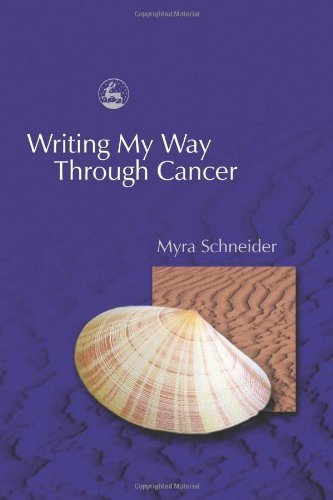
MYRA: Yes, for me, and I think most other people, making connection with others when one writes out of pain or distress, is part of the healing process. I was particularly aware of this when I was being treated for breast cancer. Being weak and having to spend much of my time at home and do very little work for several months made me feel cut off from life but writing my journal and, even more importantly, poems during those months supported me in a way which I found absolutely amazing even though I had always believed writing was therapeutic. While I was writing I felt l was my whole self and not my ill self and also I felt connected with the outside world. The reason I turned my journal, poem notes and poems into a book, Writing My Way Through Cancer was because I wanted to share the possibilities writing can offer anyone in times of trauma and difficulty. For this reason I added a section of therapeutic writing ideas. In total I felt all the writing I did during the year I was being treated for cancer was a way of creating something positive out of a negative experience. This was very uplifting.
JAMIE: YOU SAID YOU “KNIT WORDS INTO POEMS.” THIS SEEMS ALMOST TO IMPLY STRUGGLE. DOES POETRY COME EASILY FOR YOU? ORGANICALLY? OR, IS IT A LABOR?
MYRA: Ah now, writing organically is absolutely crucial if one is produce authentic poetry. If the poem does not come from the centre of oneself, if one is not totally engaged it isn’t possible to write a real poem. Exciting seeds of poems present themselves, often insist on my attention but transforming these visions into poetry – that is work, hard work, at times a struggle. This does not mean to say that it is tedious, unwanted toil. For me it is a compulsion. If it becomes monotonous slog to develop or revise then something has been lost and it is best to leave the poem until the impulse to work returns or if necessary to abandon it altogether. I find the later ‘work’ stages of writing as totally involving as noting down those first images and ideas. The moment of discovering what direction the poem should take when I have been uncertain, finding the way to write a line which has eluded me, is always exciting. I don’t believe many poems find their final shape easily – so my answer is yes, ideas and parts of poems come easily and my writing is organic but it is also hard work, work which I am committed to.
JAMIE: I SEE THAT YOU TEACH AS WELL AS WRITE. DO YOU FEEL THAT TEACHING FEEDS THE CREATIVE MUSE OR IS IT A DISTRACTION? I GUESS WHAT I’M ASKING IS WHAT DO YOU GET BACK FROM TEACHING POETRY WRITING TO OTHERS AND IS THE REWARD NEARLY WHAT IT IS WHEN YOU WRITE?
MYRA: I love teaching. I run two regular monthly courses/ workshops for the Poetry School in London and also one-off workshops which I do for a range of organizations all over England and occasionally in other countries. A few of the one-off workshops are residential. It is very satisfying to open doors which help writers generate ideas, also to run groups where rigorous but supportive feedback is offered not only by me but everyone in the group. Some of the people I work with are very talented and I feel them to be colleagues rather than students. Discussion of their work or of the work of published writers with these groups is always illuminating and the contact with people committed to their work and interested in the writing process feeds my own work. When I set writing exercises in my workshops I always write too and sometimes this triggers a new poem for me so this is another bonus. I am a firm believer in writing courses and workshops. Of course not everyone is going to become a professional poet or writer but everyone can gain more satisfaction from reading and writing poetry, everyone can develop their skills.
You can visit Myra HERE. Myra’s Amazon U.S. Page HERE. Myra’s Amazon U.K. Page HERE.
This video version of Myra’s The Red Dress can’t be viewed from email. If you are reading this post in an email, you will have to come to the site.






 Jamie Dedes' THE POET BY DAY Webzine