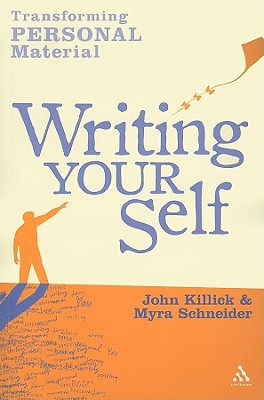
“We wrote the book because we believe that personal writing is very potent both for the writer and the reader, because some of the greatest literature is rooted in personal material.” Myra Schneider in an interview with Jamie Dedes
It always seems to me that writing about life – “personal material” – is a healing activity, a way to live hugely, and a way to empower ourselves and others. Whether we do it for ourselves alone or whether our purpose is to leave history behind for family, to set the record straight, or simply to share and entertain, the experience is rewarding.
Part I: Here the focus is on life experiences, the exploration of those human experiences that are universal. These include childhood, self-concepts, relationships, displacement, physical and mental illness and disability, and abuse.
Part II: Here the focus is on writing techniques, recognizing material that is unfinished, working on refinements, and developing work projects.
Writing Your Self is rich with examples from unknown (students) and known writers including the authors. By example as well as explanation the authors reinforce what we intuitively understand to be true: that telling stories preserves identity and clarifies the human condition. It helps us understand what it means to be human. The experience of working through the book is rather like a rite of passage.
I can see the use of this book by individuals training themselves and by teachers of adult learners who wish to write memoir, poetry, fiction, or creative non-fiction. It would be useful in hospital therapeutic writing programs or in writing programs for active seniors.
Memories, both recent and distant, tell us who we are and so play a crucial role in our experience of life…
You may have memories which you want to plunge into or you may have material like a diary or letters which summon them up. There are other ways though of triggering memories. We offer a series of suggestions. Chapter 13, Accessing memories, secret letters, monologues and dialogues, visualizations.
Chapter 13 alone is worth the price of admission. I work a lot off of childhood memories and even the event that happened two minutes ago comes back to me with a dreamlike quality when I sit to write. I have not thought of the things I do naturally as triggers, but indeed they are. It was quite interesting to see these natural aids laid-out in the book: objects and place as starting points, physical sensation as triggers, people in memory and predominant feelings. The section on secret letters – that is, letters that you write someone and never send – was interesting. I’m sure it would make a fine jumping-off point for some. The authors go on to monologues and dialogues and visualization. We all do those things in our heads anyway. If you can see it or hear it in your mind, you can write it.
If you are inexperienced or stuck midway in a transition from one form of writing to another, you’ll benefit from the exercises, ideas, and instruction in Writing Your Self: Transforming Personal Experience. If you are a more experienced writer, you might find this book will stimulate the muse.This text is a definite thumbs-up.
Myra Schneider is a British poet, a poetry and writing tutor, and author of the acclaimed book: Writing My Way Through Cancer.
John Killick was a teacher for 30 years, in further, adult and prison education. He has written all his life. John Killick’s work includes both prose works and poetry.
Thank you for sharing your love of words. Comments will appear after moderation.
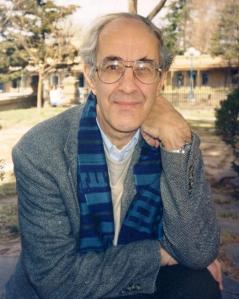
Henri Nouwen (1932-1960) Dutch Catholic priest, professor, writer and theologian
Writing is a process in which we discover what lives in us. The writing itself reveals to us what is alive in us. The deepest satisfaction of writing is precisely that it opens up new spaces within us of which we were not aware before we started to write. To write is to embark on a journey whose final destination we do not know. Thus, writing requires a real act of trust. We have to say to ourselves: ‘I do not yet know what I carry in my heart, but I trust that it will emerge as I write.’ Writing is like giving away the few loaves and fishes one has, trusting that they will multiply in the giving. Once we dare to ‘give away’ on paper the few thoughts that come to us, we start discovering how much is hidden underneath these thoughts and gradually come in touch with our own riches. #HenriNouwen REFLECTIONS ON THEOLOGICAL EDUCATION (unpublished) www.henrinouwen.org
My cousin, Father Daniel Sormani C.S.Sp., shared this quotation with me on Facebook. It is from the Dutch Catholic priest, professor, writer and theologian, Henri Nouwen. I very much agree with Father Nouwen on this matter of writing, its meaning, source and value in our lives.
“Each day I squeeze the contents of my heart over whatever expression I’m wearing & imprint it onto a notebook page–my version of St. Veronica’s veil.”
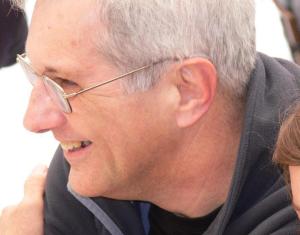
Joseph Hesch (A Thing for Words) lives in a beautiful region, upstate New York, at the confluence of my own beloved Hudson River and the Mohawk River. It’s a nice setting for a poet.
Joe was a professional writer for forty years. Post-retirement finds him doing writing that is more creative – poetry and fiction – with publication in quite a number of magazines, literary journals and an anthology here and there. He has self-published two collections of poetry. Joe is also a member of The BeZinecore team of contributing writers and his poems and flash fiction are featured in the zine just about every month.
JAMIE: Joe, I know you worked as a journalist for a good part of your life. Did you also write poetry or did you come to it late? What’s it like now that you are not working for “the man?”
JOE: Journalist or hired typewriter and gum-flapper for Skidmore College, a three-state professional organization or the State of New York over my 40-plus years in the working world. And no, I definitely was not writing poetry until I reached the age of 55. Not in high school, college nor when I was a professional writer.
A pretty miraculous recovery from a heart condition let me know each day is a blessing not to be wasted. I decided I’d best hurry and let the writer’s heart I thought I had within me live again.
I started to write sassy essays that I shared with friends. Then I wrote a bit of memoir one afternoon about my childhood Christmases. I took a chance and it was accepted for publication in a Christmas anthology. I continued to write for the discoveries I was making in myself and my world. And then everything stopped. Absolutely dead in the water. I’d run out of those easily reached ideas and emotions. I didn’t know what to do.
A friend told me my prose always sounded quite poetic to her. “Why don’t you write a poem?” she said. So I started out with the 5-7-5 structured hug of haiku. Then I wrote a poem about not being able to write anymore, stringing together those five-and-seven-syllable lines. She suggested I submit it to some journals. I did and it was accepted for publication. Poetry had recharged my life machine and put me back in the world as a writer.
I never wanted to be a poet. Never wrote a poem in my life before those haiku. I consider myself a storyteller. You could say my poems are stories with the sentences broken into bite-sized pieces, stacked like crackers. But I’ve discovered more about myself as an emotional being, as a feeling man since I began to write poetry than I could have imagined in fifty-some years on this Earth. So, about no longer writing for the man? They can’t pay you enough in any job to learn the discoveries I have as a poet.
JAMIE: Tell us about your two collections.Do you have plans for another? If so, what would be the theme.
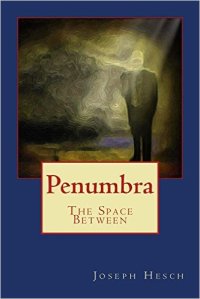
JOE: Oh, thanks for asking. Yes, I have two collections available on amazon.com. The first, Penumbra: The Space Between, I put together in 2014. I guess you could say it’s my coming-out as a poet in middle age. I hope I expressed my impressions on life and nature from the view of a man emerging from years of darkness into a brighter personal and artistic existence, standing astride middle age. Neither young nor old, still peering at things from the edge of shadow and light, the penumbra. I’m kinda proud of it as a first effort.
In my second collection,One Hundred Beats A Minute, I hope to convey impressions and imaginings of life, love, art, nature and what I see outside or inside the swirly-glassed windows of my soul. All of its sixty poems, the number of seconds in a minute, are bound within the frame of one hundred words. No wiggle room, exactly one hundred, or my obsessive mind gets all edgy. When I succeeded at hitting 100 and putting that final period on the page, where my obsession met compulsion and life met art, I squirmed in my seat, my knees and heels tended to flutter up and down from the floor and my heart beat like I’d just run a sprint of a hundred meters. I hope readers can experience that feeling here and there in this collection, too.
My next collection? I haven’t thought very hard about anything yet. However, I have thought for long time about putting together a collection of my short stories and flash fiction. Already have the title, the title of my first short story after I began writing for myself again—But Don’t Touch, as in “You can look, but…” So many of my stories are the opposite of my poetry. Many seem to have the theme of men who have problems reaching out to or accepting intimacy, whether it be carnal or merely the simple warm touch of another’s hand.
“Writer and poet who’s spent decades writing for The Man. Still do. Except now I’M the man.”
JAMIE: What sorts of poetic activities do you participate in and why?
JOE: Not many, and I feel badly about that. But when I go out to read to other writers, I just don’t feel a sense that I belong. Never have. Nevertheless, for the past four or five years, I’ve read at the Albany Word Fest Open Mic that the Albany Poets group holds during April for National Poetry Month. I’ve also run up the Adirondack Northway to read at the legendary Caffe Lena in Saratoga Springs. That’s an interesting feeling, reading your poetry where Bob Dylan made his bones as a poet in song. But I don’t get out enough to share my work with others. Maybe I’m shy that way. Or maybe just lazy, other than writing something for someone, only lately myself, every day for the past 40 years.
JAMIE: Why is poetry important to you and why should it be important to us?
JOE: Wow, that’s a big one. I guess it merits a big answer, then. Simply put, poetry, my finding poetry as an outlet for my long dormant creative self, helped save my life, most certainly the quality of it. I don’t know how long I could go on wandering in that vast desert of empty when I knew I was supposed to do something creative to fulfill myself.
Beyond that, though, I like to think poetry holds up a mirror, sometimes cracked and refracting, others with a soul-illuminating clarity, to who we are as individuals, families, communities, nations, a world. They can bring us the great Ahh moment, as well as the Ahh-Hah! And most of the time goes for the writer—at least this one—as well as the reader.
IN THE ROOM
Here in the room the breaths come
maybe every ten seconds apart,
snoring sounds from a mouth agape,
now voiceless, beneath eyes mostly closed,
but probably unseeing.
She doesn’t hear the talk in the room.
We think. We hope.
Above the bed, a little plastic bag
of morphine perches like blessed fruit
from a swirly silver branch atop
the six-wheeled tree they’ll roll
out of the room whenever her spirit does.
Here in the room we watch, we wait,
hearing only the sounds of the family,
of the bubbling O2 humidifier,
the beeps of monitors and machines,
the murmurs and shoe-squeaks from staff
in the hallway on the fifth floor
as the hospital awakens this morning.
And punctuating it all come
the snorting gasps of a life dwindling away
every ten–no, fifteen–seconds.
We think. God help her, we hope.
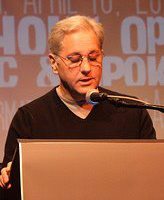
Jacqueline Woodson by David Shankbone under CC By SA 3.0 license
American poet and writer, Jacqueline Woods (b. 1963) was named Young People’s Poet Laureate in June last year by The Poetry Foundation. The $25,000 laureate award is given every two years to poets devoted to writing quality poetry for children and youth. Poetry Foundation President, Robert Polito, said Jacqueline is an “elegant, daring, and restlessly innovative writer.”
Jacqueline has written some thirty books. She’s won a National Book Award and three Newberry Honor Medals.
I just finished reading Brown Girl Dreaming, a memoir in free verse that is not just for brown girls. It can be read in one sitting but like all good poetry is meant to be relished … there is much to savor.
What I like about this work – and what in part accounts for its popularity – is that it puts family life and youthful reflection smack-dab in the context of history. Woodson grew-up during the civil rights movement and tells of watching the Black Panthers on television and sitting in the back of the bus, though Woodson’s mother made a point of affirming for her children that they were as good as anyone.
I enjoyed – and think most kids would too – how Woodson writes about the contradictions in family stories. The day, for example, that she is born is reported differently by mother, father and grandmother, each absolutely sure that he or she is the only one who got it right.
This is a wonderful book for any young person. I venture to say, however, if yours is a child who dreams of being a writer and can’t envision it happening, then you must put this book in that child’s hands. S/he will be forever grateful.






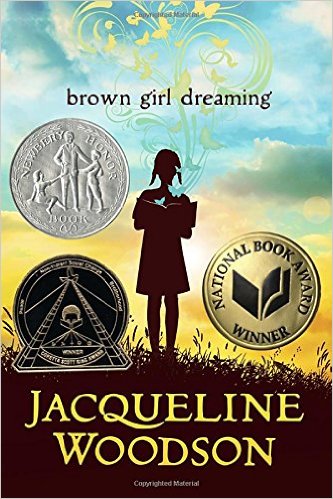 I just finished reading Brown Girl Dreaming, a memoir in free verse that is not just for brown girls. It can be read in one sitting but like all good poetry is meant to be relished … there is much to savor.
 Jamie Dedes' THE POET BY DAY Webzine