Page 7 of 8

My Year of the Horse

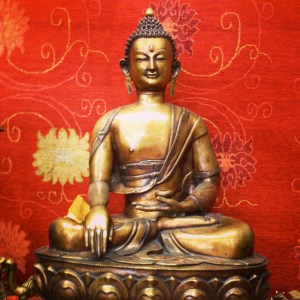
17th Century Mongolian Bronze, photo courtesy of the curator of The Buddha Gallery

2014 IS THE YEAR OF THE HORSE IN CHINESE ASTROLOGY, which promises adventure. (Okay, I made that last bit up, but where is it written we can’t hope?)

I’ve adopted Horse as my guiding spirit. In the ethos of the Chinese people, the spirit of Horse is marked by unrelenting effort. It is characterized by intelligence and ability. The ancient Chinese thought of an able person as Qian Li Ma, a horse that travels a thousand li a day, about 360 miles or 500 meters.

A thousand li according to Lao Tzu writing in the Tao Te Ching is the journey that “starts beneath our feet.”  We would say the journey begins with a single step. My first step is this: my first post of the year and my current re-reading of Isaac Asimov‘s autobiographies, In Memory Yet Green (1920-1954) and In Joy Still Felt (1954-1978). They present the opportunity to re-experience a time and place I have in common with Mr. Asimov (the ’50s onward) and also to immerse myself in  Pulp Era of Science Fiction (magazines, 1920s/30s) and the Golden  Age (“Hard SF”- linear, 1950s) and New Wave Age (“Soft” – artistic, literary, experimental, 1960s/70s). One cannot live by poetry alone.These books also provide the chance to observe the skill and absorb the wisdom of one of the finest, most versatile and most prolific of American writers. Some say his life was dull. I don’t agree. Isaac Asimov had many adventures in life but his adventures were of the mind.

“We have two ears and one mouth so that we can listen twice as much as we speak”. Epictitus

Another way to express my plan is that this will be a year of listening (reading) more and talking (writing) less. My father – not unlike Epictetus – used to say, “You have two ears and one mouth. That’s God’s way of telling human beings how important listening is.”  So this year – my sixth blogging – there will be fewer of my own poems posted here, far fewer posts, and significantly more reviews of books and collections.  As Stephen King said:

“If you don’t have time to read, you don’t have the time (or the tools) to write. Simple as that.”

I’ve posted a small poetry collection on the Home page (My Poetry Sampler).

225592_347930165315583_165440687_n-1

… and thus the journey continues …

May this be your best year yet for intellectual and artistic adventures.

© 2014, Jamie Dedes, essay and the rose photograph, All rights reserved

Toward Healing and Understanding

photo-1

INTO THE BARDO, A Blogazine is an informal collection of works from diverse and visionary creatives. Our goal is to make – however modestly – a contribution toward healing and understanding. We are a collaboration of writers, poets, story-tellers, artists, musicians, and teachers from around the world.

Our focus is on sacred space (common ground) as it is expressed through the arts. Our posts cover a range of topics: religions and spirituality, life, death, personal experience, culture, politics and current events, history, art and photography. We cover these topics in the form of essay, poetry, fiction and creative nonfiction, music, art, and photography. Generally we offer a new post each day.

We consider that all art is meditation and comes from sacred space. Through their artistic inclinations, the contributors featured express the sacred. Our contributors hail from many places including: England and U.S., the Netherlands and Greece, China and India, Malaysia, Canada and South Africa.

Many different religions are represented on the site as are atheists and agnostics. What we learn in the end is that we hold pretty much the same ideals – though we may express them in different terms – and that we all have the same desire to travel our chosen paths peacefully, to live quietly, and to know that our children will grow up and grow old in a world that is not in conflict.

We’ve learned in our years of blogging that these efforts do evolve. When I started Bardo  more than two years ago, the audience was nil and the focus was narrow: one path, three people, and a wee corner of planet earth. Today  Into the Bardo has a loyal readership, steadily growing and world-wide. The works featured are the gifts of nearly forty poets and writers, photographers and artists . We hope you’ll share our adventures in sacred space and stay with us as we continue to evolve …

We’ve just redesigned the site and expanded our core team of creatives, which is complementary to a group of fine contributors, some known and loved by many of you. Announcements of more additions to the core team will be forthcoming over the next weeks.

HOW DID WE GET OUR NAME AND WHAT DOES IT MEAN? “Bardo” is a Tibetan Buddhist term referring to that place after physical death when our soul is between material manifestations. It might be likened by some (Brother David Steindle-Rast, for one) to the Christian purgatory. Chögyam Trungpa Rinchoche has written of it as the “in between, like a flowing river which belongs neither to this shore nor the other. In other words: it is the present experience, the immediate experience of now.” The expression “into the bardo,” was the name originally selected because the three people initially involved were living with life-threatening illness. Our dear friend, the poet Ann Emerson, died earlier this year. Her work is on “private” until we know the status of her copyright.

Link to Into the Bardo HERE.

Photo credit ~ Our Gravitar – a “golden” Buddha against lovely red damask is the work of our own Wendy Alger. a fine arts photographer.

MEET POET MARY MacRAE

Mary MacRae (1942 – 2009), English poet

[Mary MacRae] wrote and published poetry for only the last ten years of her life, after ill-health forced her to take early retirement from teaching. She taught for 15 years at the James Allen Girls School (JAGS), Dulwich, London. Her commitment to writing led to her deep involvement with the first years of the Poetry School under Mimi Khalvati,studying with Mimi and Myra Schneider, whose advanced poetry workshop she attended for 8 years. In these groups her exceptional talent was quickly recognised, leading to publication in many magazines and anthologies. MORE [Second Light Live]
Elder

by

Mary MacRae

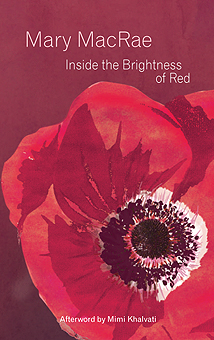
This poem is an from Mary MacRae’s book, Inside the Brightness of Red.

Reprinted with permission. All rights reserved.

·

A breathing space:

the house expands around me,

·

unfolds elastic lungs

drowsing me back

·

to other times and rooms

where I’ve sat alone

writing, as I do now,

when syncope –

·

one two three one two –

breaks in;

·

birdcall’s stained

the half-glazed door with colour,

·

enamelled the elder tree

whose ebony drops

·

hang in rich clusters

on shining scarlet stalks

·

while with one swift stab

the fresh-as-paint

·

starlings get to the heart

of the matter

of matter

·

in a gulp of flesh

and clotted juice that leaves me

·

gasping for words transparent

as glass, as air.

♥ ♥ ♥ ♥

My profound gratitude to poet Myra Schneider for the introduction to a new-to-me poet, Mary MacRae, and to poet Dilys Wood of The Second Light Network (England) for granting this interview. Jamie Dedes

JAMIE: Clearly, and as has been stated by others, Mary was profoundly inspired by art, nature (particularly flowers and gardens), and love. What can you tell us about her life and interests that would account for that?

DILYS: Mary writes tender and accurate poems about wild nature, creatures and landscape, drawing on her stays in a cottage on an untamed part of the coast in Kent, England and visits to her daughter living in remote West Wales. In her London home, it’s easy to guess from her poems about garden birds and flowers how much time she spent at the window. She almost always sees nature in flux, changing moment by moment, unpredictable, mysterious, a spiritual inspiration. One of her great strengths as a poet is catching movement.

Many of Mary’s poems focus on love between close family members. This may relate to a difficult relationship with her own father, which she sought to understand, and the relationships which compensated (with mother, sister, husband Lachlan, daughter and grandchild). A back problem prevented her from holding her baby daughter and she often refers in her poems to young children. She clearly has a yearning towards them.

JAMIE: She wrote poetry apparently only at the end of her life and for ten years. What were her creative outlets before that? How did she come to poetry?

DILYS: Mary was a dedicated teacher of English Literature and language in a leading girls’ secondary school. She was also deeply interested in music and painting (these are strongly reflected in her poetry). Though she had written as a young woman she followed the pattern of many women creative artists in becoming absorbed into her home life and her paid work, only turning to writing when her illness released her from the daily grind of intensive teaching. The remarkable, rapid development of her poetry shows how strong her latent powers really were.

JAMIE: Was writing poetry a part of her healing process when she was diagnosed with cancer? If so, how did it help her?

DILYS: I’m confident that Mary’s diagnosis with cancer enabled her to change her life-style and from then on concentrate on her poetry, urged by the sense that she might be short of time. There is no evidence that Mary wrote therapeutically to come to terms with her cancer. In fact she only ever addressed her illness in relation to the possible unkindness of fate in cutting her off from beloved people and life itself. The poems written in the last 2-3 years of her life give the impression that her dedication to writing, with the spiritual experiences which accompanied it, enabled her to bear terrible distress. She records this distress, using imaginative and metaphorical approaches to focus it, and these poems make heart-wrenching reading.

JAMIE: Can you tell us about her process? When did she write? Where? For how long?

DILYS: I have the impression that Mary’s life revolved around three things, people she loved, gathering experiences that would feed her poetry (travel, listening to music, visiting galleries) and very hard work in direct furtherance of her writing (extensive reading, attending workshops with other inspirational poets, writing, revising and submitting her poems to criticism from critics she respected). She used notebooks to make a full, accurate record of those experiences – landscapes, human encounters, thoughts – that would feed her work. There is an extract from one such entry in the section about keeping a journal in the resource book Writing Your Self, Transforming Personal Material by Myra Schneider and John Killick. This book also includes a contribution in the chapter on spirituality which reveals much about Mary’s attitudes to life, nature and also her writing process.

JAMIE: Do you have any advice from her for other poets and aspiring poets?

DILYS: Mary was a dedicated writer, entirely sincere in her commitment to poetry as opposed to ‘career’ as a poet. She was always ready to enjoy and praise the widest range of subject-matter, approaches and styles from other poets, providing she thought they were ‘busting a gut’ to get their poems right, and not indulging in the trendy or superficial, which she despised (whether from well-knowns or unknowns). She put much emphasis on wide-reading of both past and contemporary poets and she herself had absorbed a huge amount of other poets’ work, always quoting fully and accurately. She liked using another’s work as a starting pont for her own (the Glose) and particularly admired the work in strict form (including SonnetVillanelle and Ghazal), which began to be more acceptable from the mid-1990s (eg from such poets as Marilyn Hacker and Mimi Khalvati).

JAMIE: Are any other collections of her poetry planned? If so, when might we look forward to them?

DILYS: When putting together ‘Inside the Brightness of Red’, Myra Schneider and I went through the whole of Mary’s unpublished work and selected all those poems we felt were both complete and would have satisfied her high standards. What remains unpublished would be mainly fragments and early versions of poems she did more work on. There will not, as far as we know, be a further book, but Mary did achieve her aim of being a significant lyric poet, whose work is very attractive, polished and, above all (as she would have wished) deeply moving and consolatory.


* The Second Light Network aims to promote women’s poetry and to help women poets, especially but not only older women poets develop their work. It runs weekends of workshops and readings in London usually twice a year, a residential extended workshop with readings and discussions at least once every 18 months and occasional other events. It is nationwide and includes and some members who live outside Britain altogether. Importantly Dilys is the main editor of ARTEMIS poetry a major poetry magazine for women produced by Second Light twice a year for all women poets. It includes a lot of reviews and some articles as well as poetry. Second L. members receive it free as part of their subscription. An e-newsletter is sent out every few weeks. A few anthologies of poetry have been published by the network but now this magazine has been developed books are only produced in special circumstances – such as Mary’s collections.

Thanks to Second Light Web Administrator, poet Ann Stewart, for the following: The books (Inside the Brightness of Red and As Birds Do) can be bought: via order form and cheque in post: http://www.secondlightlive.co.uk/books.shtml or here online: http://www.poetrypf.co.uk/shop.php (typing  ‘ Mary MacRae collection ’ in the filter box will reduce the list to just those 2 books).

SATURDAY ReVIEW: Writing Your Self, Transforming Personal Material

Copyrighted cover art, fair use.

We wrote the book because we believe that personal writing is very potent both for the writer and the reader, because some of the greatest literature is rooted in personal material. Myra Schneider in an interview HERE.

The subtitle of this book about personal writing is “transforming personal material.”  I think it is implicitly also about personal transformation. It always seems to me that writing and reading about life is a healing activity, a way to live hugely, and a way to empower ourselves and others. If we can do it well enough to engage others, whether our purpose is to leave a record behind for family, to set the record straight, or simply to share and entertain, the experience is rewarding.

Writing Your Self is the most comprehensive book of its type that I’ve yet to read, and I’ve read many. It is organized in two parts:

  • Part I: Here the focus is on life experiences, the exploration of those human experiences that are universal. These include childhood, self-conceptions, relationships, displacement, physical and mental illness and disability, and abuse.
  • Part II: Here the focus is on writing techniques, recognizing material that is unfinished, working on refinements, and developing work projects.

Writing Your Self is rich with examples from known and unknown writers including the authors. By example as well as explanation the authors reinforce what we all intuitively understand to be true: that telling stories preserves identity and clarifies the human condition. It helps us understand what it means to be human. The experience of working through the book was something like a rite of passage.

I very much can see the use of this book by individuals training themselves and by teachers of adult learners who wish to write memoir, poetry, fiction, or creative non-fiction. It would be useful in hospital therapeutic writing programs or in writing programs for active seniors.

Memories, both recent and distant, tell us who we are and so play a crucial role in our experience of life…

You may have memories which you want to plunge into or you may have material like a diary or letters which summon them up. There are other ways though of triggering memories. We offer a series of suggestions. Chapter 13, Accessing memories, secret letters, monologues and dialogues, visualizations.

I think Chapter 13 alone is worth the price of admission. I work a lot off of childhood memories and even the event that happened two minutes ago comes back to me with a dreamlike quality when I sit to write. I have not thought of the things I do naturally as triggers, but indeed they are. It was quite interesting to see these natural aids laid-out and organized on the page to read: objects and place as starting points, physical sensation as triggers, people in memory, and predominant feelings. The section on secret letters – that is, letters that you write someone and never send – was particularly interesting. I’ve only done this twice in my life, but I know some folks who do it all the time. I’m sure it is a common practice and would make a fine jumping-off point for some. The authors go on to monologues and dialogues – now everyone does that in their heads – and visualization. Hey, if you can see it, you can write it.

I’m an experienced writer and I enjoyed the book and the exercises and learned a few new things, got a few new ideas. If you are inexperienced or stuck midway in a transition from one form of writing to another, you’ll benefit from the exercises, ideas, and instruction in Writing Your Self: Transforming Personal Experience. This one’s a definite thumbs-up.

Myra Schneider  is a British poet, a poetry and writing tutor, and author of the acclaimed book: Writing My Way Through Cancer. Your can visit her HERE.

John Killick was a teacher for 30 years, in further, adult and prison education, but has written all his life. His work includes both prose works and poetry. You can visit him HERE.