All is abolished but the mute Alone.
The mind from thought released, the heart from grief,
Grow inexistent now beyond belief;
There is no I, no Nature, known-unknown.
The city, a shadow picture without tone,
Floats, quivers unreal; forms without relief
Flow, a cinema’s vacant shapes; like a reef
Foundering in shoreless gulfs the world is done.
Only the illimitable Permanent
Is here. A Peace stupendous, featureless, still.
Replaces all, – what once was I, in It
A silent unnamed emptiness content
Either to fade in the Unknowable
Or thrill with the luminous seas of the Infinite
– Sri Aurobindo
Heads-up: All but one of these have a June deadline.
CALL FOR SUBMISSIONS
DIGGING PRESS, LLC is open for submission of fiction, poetry, or hybrid manuscripts between 16-36 pages. Submission fee. Cash award. Small print run. Deadline: June 15, Details HERE.
COMPETITIONS
THE BLACK RIVER CHAPBOOK FALL COMPETITION (fiction and poetry) is open for entries from September 1 – October 31. Entry fee. Details HERE.
EX OPHIDIA PRESSPoetry Book Prize opens for submissions July 1, 2019 – August 31, 2019. Entry fee. Cash award and author copies. Details HERE. (Thanks to Michael Dickel for sharing this one with us.)
HUDSON VALLEY WRITERS CENTER Annual Slapering Hol Press Chapbook Competition is open through June 15. Reading fee. Cash award and publication. 10 author’s copies. Details HERE.
JUXTAPROSE LITERARY MAGAZINE Poetry Chapbook Prize is open through June 25. Entry fee. Cash award, publication, and author copies. Details HERE.
PUB HOUSE BOOKS 2019 CHAPBOOK SERIES CONTEST is open through June 30. Reading fee, publication, and author copies. Details HERE.
A homebound writer, poet, and former columnist and associate editor of a regional employment newspaper, my work has been featured widely in print and digital publications including: Ramingo’s Porch, Vita Brevis Literature, Connotation Press,The Bar None Group, Salamander Cove, I Am Not a Silent Poet, The Compass Rose and California Woman. I run The Poet by Day, an info hub for poets and writers and am the founding/managing editor of The BeZine.
“Every pair of eyes facing you has probably experienced something you could not endure.” Lucille Clifton
Thank you for sharing your love of words. Comments will appear after moderation.
“Prayer is said Standing A Barechu, a call to Worship We have not bothered, we are weak We are too weak to even Speak Every day is our Yom Kippur” Reading the Tao at Auschwitz, VII, DeWitt Clinton, At the End of War (Kelsay Books, 2018)
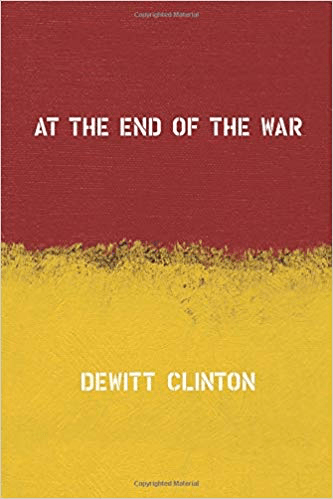
DeWitt Clinton’s At the End of War moves with a graceful precision weaving Old Testament stories with contemporary life, visits to the opera or cafe. Here and there are notes of humor as in On Leaving Socrates with His Jailer and hints of middle-America folksy, as in On the Way to Church Camp, Mother Meets the Devil. He speaks in many voices, blending the perspectives of Judaism and the Tao, slowly moving into the unspeakable tragedy of World War II and the Jewish Holocaust. This is the main event, if you will, of the collection, the obscenity of it layered with sacred ritual and text, an unflinching attempt to come to terms, to find identity, to rise above, to move past. The collection derives its name from the closing poem, which is after Wislawa Szymorska’s The End and the Beginning.
Wislawa Szymorska begins her poem with:
“After every war
someone has to clean up.
Things won’t
straighten themselves up, after all.”
DeWitt Clinton closes his collection with:
“Brooms. everybody, find all the brooms.
Can anyone send a letter? We need to let
someone know this has happened.
“Tomorrow we can start burning our families.
Surely someone will see the smoke.
Surely someone will come.”
We are in tears as we close the book. We are at once bathed in despair and hope. How many brooms will we need to clean up after all the wars and genocides? Do we finally grasp the futility of war? Will there ever be an end to the genocides of which twenty-four are happening as we “speak”? / J.D.
The excerpts from At the End of War are published here with permission. This book is recommended. / The quotation from The End and the Beginning is from Miracle Fair by Wislawa Szymborsk, translated by Joanna Trzeciack (W.W. Norton and Company Inc., 2001), also recommended.
ON LEAVING SOCRATES ALONE WITH HIS JAILER
(for my students of The Symposium, The Apology,
Crito and Phaedo)
What started out as a sex wine party turned into a major
Mind concussion for my students, but still, we waded
Through the prose, hopeful they’d find out why
He insisted on so many questions, so many questions,
So many disillusioned Athenians. Yet toward the end,
We could only face the charges, something about impiety
And influencing the youth, both trumped up, of course,
Mostly as a ruse to run him out of town, if he would go.
But we knew he would not go. We voted to acquit,
Even invoking Johnny Cochran’s “if it doesn’t fit,”
But sadly they were only seven at the time, more up
On Paris’s short sojourn than old football stars facing
Bogus trials. Late in the day, we even considered assisting
Our friend out into the dark, but as you must know,
He trusted in the Laws even if the Laws never assumed
It would go this far. We talked about “Prison Break,”
But few even had time to watch that, so busy chewing
The dense prose of friend/reporter Plato late on the scene.
Most of us were quite done in by all the “soul talk”
Of those last pages, and then, we had to leave, some students
Actually having lost their speech, some needing crutches,
Some on life support, leaving our friend wandering
Through the underground calling out for Homer or Orpheus
Or anyone who wouldn’t mind sitting down for a very long
Conversation about nearly everything, since time is now
Beyond even Infinity. That’s when I left, too, our poor
Cave-like classroom a faux jail cell, wondering if any of us
Could have comforted our gadfly, our inquirer, who is
Just now lifting his cup, resigned, cheery even. Au revoir,
Old friend, let’s hope your students do well on their final.
JAMIE: I think it takes enormous courage to visit Holocaust sites – even to visit the museum in Los Angeles – and then to relive the experience through your writing. Would you speak of that?
DeWITT: One of the more provocative statements about art and The Holocaust is Theodor Adorno’s comment, “To write poetry after Auschwitz is barbaric.” This remark can be taken several ways, including any poetry about anything after Auschwitz, or as I take it, poetry written about Auschwitz after Auschwitz is barbaric. And why is that? Perhaps because for all who died, and the few who survived at Auschwitz, and at all the other work and death camps, there was nothing “artistic” about it.
Ralph Fiennes, playing the character of Michael Berg, in the film, “The Reader,” asks a child survivor of Auschwitz, “Did you learn anything?” The now aging daughter, played by Lena Olin, replies, “People ask all the time what I learned in the camps. But the camps weren’t therapy. What do you think these places were? Universities? We didn’t go there to learn.” She continues by saying, “Nothing comes out of the camps. Nothing.”
The death camps were neither schools, nor artistic experiences, but it is through art that we can at least remember some of what happened, even if it did not happen to the artist. I’ve been writing about historical events for a number of decades now, and while the art is anachronistic, I think it is also an extension of that history as well. I recall writing about the Spanish conquistador wars against the native Maya, Aztec and Incan tribes, (The Conquistador Dog Texts, and The Coyot. Inca Texts, New Rivers Press, o.o.p.) and the poetry is certainly not “accurate,” as a historian might write, but it is an artistic rendering of the horrible inflictions the native tribes experienced. The same may be true for writing about the Holocaust.
I’ve read historical renderings of the Holocaust, and read poetry and plays and memoirs about the Holocaust as well, and the latter are far more interesting to me as an artist. While studying the Tao de Ching with my undergraduate students, I began to consider a new path that I might take in trying to remember my experience of visiting Auschwitz I and II camps several years ago. The result is an unusual fusion, and quite anachronistic, but I hope readers will ponder the insights of Lao Tzu as they read “Taoist like” poems of what the prisoners might have thought about as they were starving to death, or what they might have wondered as tens of thousands were marched to the gas chambers and crematoriums.
I have read a number of artistic renderings of Holocaust experiences, and I hope anyone who reads “Reading the Tao at Auschwitz” will be open to considering a new lens to consider the horrors experienced by all who died, or survived. I can also appreciate how survivors, or children, or grandchildren of survivors, might be appalled by such artistic renderings of mine. It’s a long and difficult to absorb poem, but I hope it is also a valuable contribution to Holocaust literature.
JAMIE: As a writer, what drew you to poetry instead of other literary options?
DeWITT: I’ve always imagined writing screen plays, novels, stage plays, short stories, novellas, and an array of other genres of imaginative writing, but I’ve been drawn to poetry ever since a college professor asked me to rewrite a prose piece to poetry. Then I enrolled in a poetry writing workshop with the same professor my last semester, and though I can’t or don’t want to remember what I wrote in that class, the experience was quite wonderful, especially the instructor’s wife’s cookies. I’ve been drawn to poetry workshops, classes, conferences, and retreats for quite some time now, and do I know why I’m still drawn to poetry? No I don’t, even though I am still poking around for images and lines. It’s just a huge joy to be able to still compose poetry, no matter what evolves from a writing session.
JAMIE: As a beginning writer, what poetry most inspired you and why?
DeWITT: I took a copy of Coney Island of the Mind with me to Vietnam in late 1969 and read it over and over, but not when we were being shelled or fired upon. I may have taken other poetry collections, perhaps The Wasteland, but I’m not sure about what I read. But I did enroll (by correspondence) in an extension class from the University of Kansas at Lawrence. The course was a fairly traditional reading class of modern poetry, and though I enjoyed it, I soon asked the professor if I could send him some scraps of poetry I’d been writing on a 105 howitzer firebase in Vietnam which would later become “The Spirit of the Bayonet Fighter,” published in Harper & Row’s Winning Hearts and Minds.
By the end of my tour, I was hoping to enroll in grad school at Wichita State University which offered a M.A. in English & Creative Writing, and later an M.F.A. and a Ph.D. in English and Creative Writing at Bowling Green State University (Ohio). By then, and then was a long time ago, I was interested in what would later become a career of teaching English and creative writing, and hopefully, writing more poetry, and finding a few kind hearted editors. The teaching career is over, but I still look forward to writing new poems, and I’m still sending out a few now and then.
JAMIE: What’s next on the agenda for you?
It occurred to me only a few days ago that I may have a third collection of poems (a second collection is in production with Michael Dickel, Gary Lundy, and Is a Rose Press, an adaptation of Kenneth Rexroth’s 100 Poemsfrom the Chinese) as I’ve been writing much more since I retired from teaching a few years ago. I’m not quite sure it’s ready for submission as a book, but I’d like to keep working on it. One press has a deadline in late August, and I’m hoping to aim for that as a possible submission. Poetry isn’t everything in my life, as I also appreciate the benefits of Iyengar Yoga, and training for races and triathlons. The next big one is in Berlin, one of the 6 world major marathons. I certainly did not qualify to be in the race because of my lightning speed, but instead I earned a “lottery” ticket, which was a random selection of thousands of hopeful participants. Sightseeing a few days after, including a short trip to the Wannsee chateau where during a luncheon in early 1942, high ranking Nazi Party and military officers designed what was known as “The Final Solution.”
“From this place
Ashes rising from this place
Ashes circling as far as one could see
Ashes circling over All
Over Everyone over Everything
Circling a constant circling
A rink forever circling
a constant ringing s’hma Israel”
Reading the Tao at Auschwitz, XVIII, excerpt from At the End of War
Sh’ma Yisrael Adonai Eloheinu Adonai Ecḥad
Hear, O Israel: the Lord is our God, the Lord is One
Photo by Meredith W. Watts, “For Good” Photography
DeWITT CLINTON is the author of three books of poetry: The Conquistador Dog Texts and The Coyot. Inca Texts (New Rivers Press), At the End of the War (Kelsay Books, 2018), and a fourth collection is coming out in late 2019 or 2020: On a Lake by a Moon: Fishing with the Chinese Masters, (Is A Rose Press). His poems and essays have appeared inThe Journal of Progressive Judaism (with co-author Rabbi David Lipper), Journal of Inter-Religious Dialogue, Cultural Studies< => Critical Methodologies, Storytelling Sociology: Narrative as Social Inquiry, and Divine Inspiration: The Life of Jesus in World Poetry (Oxford U Press).
A few recent publications includeThe Last Call: The Anthology of Beer, Wine & SpiritsPoetry, Santa Fe Literary Review, Verse-Virtual, New Verse News, Ekphrastic Review,Diaphanous Press, Meta/Phor(e)Play, The Arabesques Review, and The New Reader Review. He is Professor Emeritus of English at the University of Wisconsin—Whitewater, and lives with his wife, Jacqueline, in Shorewood, a small village one street north of Milwaukee.
DeWitt’s Amazon Page U.S. is HERE. DeWitt’s Amazon Page U.K. is HERE.
A homebound writer, poet, and former columnist and associate editor of a regional employment newspaper, my work has been featured widely in print and digital publications including: Ramingo’s Porch, Vita Brevis Literature, Connotation Press,The Bar None Group, Salamander Cove, I Am Not a Silent Poet, The Compass Rose and California Woman. I run The Poet by Day, an info hub for poets and writers and am the founding/managing editor of The BeZine.
“Every pair of eyes facing you has probably experienced something you could not endure.” Lucille Clifton
Thank you for sharing your love of words. Comments will appear after moderation.
A rainbow comes pouring into my window, I am electrified.
Songs burst from my breast, all my crying stops, mistory fills
the air.
I look for my shues under my bed.
Peter Orlovsky, excerpt from Frist Poem
I was going through notes and realized that Peter Orlovsky died nine years ago this Thursday past. Born in the East Side of New York on July 8, 1933, he was probably best known as poet Allen Ginsberg’s companion. However, Orlovsky was a poet himself. You’ll note, if you’ve not been introduced to him before, that he is playful and his spelling eccentric…..
Snail Poem
Make my grave shape of heart so like a flower …..be free aired …..& handsome felt,
Grave root pillow, tung up from grave and …..wiggle at …..blown up clowd
Ear turns close to underlayer of green felt moss & sound …..or rain dribble thru this layer …..down to the roots that will tickle my ear
Hay grave, my toes need cutting so file away …..in sound curve or
Garbage grave, way above my head, blood will soon …..tickle in my ear –
no choise but the grave, so cat & sheep are daisey …..turned.
Train will tug my grave, my breath hueing gentil vapor …..between weel & track.
So kitten string & ball, jumpe over this mound so …..gently & cutely
So my toe can curl & become a snail & go curiousely …..on its way
A homebound writer, poet, and former columnist and associate editor of a regional employment newspaper, my work has been featured widely in print and digital publications including: Ramingo’s Porch, Vita Brevis Literature, Connotation Press,The Bar None Group, Salamander Cove, I Am Not a Silent Poet, The Compass Rose and California Woman. I run The Poet by Day, an info hub for poets and writers and am the founding/managing editor of The BeZine.
“Every pair of eyes facing you has probably experienced something you could not endure.” Lucille Clifton
Thank you for sharing your love of words. Comments will appear after moderation.
“The oldest monthly devoted to verse in the English-speaking world.”
The Poetry Foundation, poetry website host and publisher of publisher of Poetry magazine, is an independent literary organization committed to a vigorous presence for poetry in American culture, The Foundation was named the Best Charitable Organizations/Non-Profit Website in the 23rd Annual Webby Awards. The Foundation was honored at a ceremony on Monday evening, May 13, in New York City. Hailed as the “Internet’s highest honor” by the New York Times, The Webby Awards, presented by the International Academy of Digital Arts and Sciences (IADAS), is the leading international awards organization honoring excellence on the Internet.
The first Poetry issue, October 1912 / public domain
The Poetry Foundation Website, Resource for Poets and Poetry Lovers
The Poetry Foundation website reaches a global audience of poem enthusiasts, students and educators, and the culturally curious. The website features the most robust online poem archive available, more than 4,000 poet biographies, six podcasts, and multiple newsletters. In 2018, poetryfoundation.org added 300 new poet biographies, 900 new poems to the archive, 35 feature articles, and averaged 3.9 million monthly visitors.
“Our goal is to reach and engage a broad audience with poetry,” said Harlan Wallach, Poetry Foundation chief technology officer and director of digital programs. “We’re humbled to recognize the countless contributors, poets, writers, artists, illustrators, and editors who bring new poetry content to the Internet every day.”
If you are viewing this post from an email subscription, you’ll likely have to link through to the site to view this video to senior editor James Sitar delivering the five-word (customary at the Webbly’s) acceptance speech:
IADAS, which nominates and selects the Webby Award winners, is comprised of digital industry experts, including Instagram’s head of fashion partnerships Eva Chen, director of Harvard’s Berkman Center for Internet & Society Susan P. Crawford, actor and activist Jesse Williams, GE CMO Linda Boff, Pod Save the People host and activist DeRay Mckesson, Google’s head of conversation design Cathy Pearl, Fortnite designer Eric Williamson, HBO digital chief Diane Tryneski, Los Angeles Laker Isaiah Thomas, and DDB Worldwide CEO Wendy Clark.
A full list of both The Webby Awards and Webby People’s Voice winners can be found at webbyawards.com/winners.
About the Poetry Foundation
The Poetry Foundation exists to discover and celebrate the best poetry and to place it before the largest possible audience. The Poetry Foundation seeks to be a leader in shaping a receptive climate for poetry by developing new audiences, creating new avenues for delivery, and encouraging new kinds of poetry through innovative literary prizes and programs.
About The Webby Awards
Hailed as the “Internet’s highest honor” by the New York Times, The Webby Awards is the leading international awards organization honoring excellence on the Internet, including Websites, Video, Advertising, Media & PR, Apps, Mobile, and Voice, Social, Podcasts, and Games. Established in 1996, this year’s Webby Awards received nearly 13,000 entries from all 50 states and 70 countries worldwide. The Webby Awards is presented by the International Academy of Digital Arts and Sciences (IADAS). Sponsors and Partners of The Webby Awards include: Instagram, WP Engine, EY, YouGov, Vitamin T, YouTube, WNYC Studios, Fast Company, ESA, Product Hunt, and Social Media Week.
A homebound writer, poet, and former columnist and associate editor of a regional employment newspaper, my work has been featured widely in print and digital publications including: Ramingo’s Porch, Vita Brevis Literature, Connotation Press,The Bar None Group, Salamander Cove, I Am Not a Silent Poet, The Compass Rose and California Woman. I run The Poet by Day, an info hub for poets and writers and am the founding/managing editor of The BeZine.
“Every pair of eyes facing you has probably experienced something you could not endure.” Lucille Clifton
Thank you for sharing your love of words. Comments will appear after moderation.
 A homebound writer, poet, and former columnist and associate editor of a regional employment newspaper, my work has been featured widely in print and digital publications including: Ramingo’s Porch, Vita Brevis Literature, Connotation Press, The Bar None Group, Salamander Cove, I Am Not a Silent Poet, The Compass Rose and California Woman. I run The Poet by Day, an info hub for poets and writers and am the founding/managing editor of The BeZine.



 I was going through notes and realized that Peter Orlovsky died nine years ago this Thursday past. Born in the East Side of New York on July 8, 1933, he was probably best known as poet Allen Ginsberg’s companion. However, Orlovsky was a poet himself. You’ll note, if you’ve not been introduced to him before, that he is playful and his spelling eccentric…..


 Jamie Dedes' THE POET BY DAY Webzine