Page 164 of 433

Pine Cone, a poem by John Anstie for his granddaughter and to honor 100,000 Poets (and Friends) for Change

“Grandchildren restore our zest for life and our faith in humanity.” Anon


In the midst of turmoil,
our Mother Earth besieged
by bloody conflict,
in a world beleaguered
by well healed negligence,
humanity is laced
with latent evil …
its one great flaw.

Children are dying
We are dying with you.
I am crying for you.

Yet, whilst this goes on,
you walk the woods,
harvesting your pine cones
and put them in your wishing well,
your unconscious prayer
for a better world,
for love, for life,
that sow the seeds
of perfect purity
in heart and mind,
that will not fade with time.
This is the magnificence,
the magic of your spirit
that is untouched
by a tainted world.

Then, in one gesture,
one single act of generosity,
of utterly moving faith,
you beckoned me
come close to you.
You looked me in the eyes;
and I was hypnotised.
Then, you gave it to me,
one single piece of magic,
a piece of nature’s bounty,
and bade me keep its secret
as covert as a spy.

Each time I hold your gift,
when we are far apart,
I’ll think of you and
remember this moment,
by which you have renewed
my faith in all our futures.

You could melt the heart,
like chocolate on a Summer’s day.
You could soften steel
in hardened minds.
You and your magic
are our future.

© 2018, poem and words below, John Anstie, All rights reserved; photo illustration, male Cedar of Lebanon, courtesy of Rosser1954 and generously released into the public domain.

“Five years ago, my then 4-year old granddaughter gave me a pine cone. She had found it as we walked in the woods and called me to her, very secretively, and put it in my hand, confiding in me that it was magic secret and that I should tell no one. She bade me keep the secret, which I have done for five full years. Today, 29th September, is the annual celebration of the campaign that calls itself “100,000 Poets for Change” (100TPC), one of whose initiatives for 2018 is to read a poem to a child … finally I feel today is the day that I should share that magic moment with the world for the sake of the mission of Michael Rothenberg and Terri Carrion, who established the 100TPC and its mission of peace and sustainability; and for the BeZine and its founder and Chief Editor, Jamie Dedes, whose mission is to promote peace, sustainability and social justice. Let us appreciate, value and respect our more …

… thank you Jessica.”

AN INVITATION

COME OUT AND STAND FOR PEACE, SUSTAINABILITY and SOCIAL JUSTICE: This is just one sample of the work being shared by poets and writers for 100,000 Poets (and Friends) for Change (100TPC) Global 2018.  Join us at The BeZine Virtual 100TPC to read and to share. Support this extraordinary Global push for peace, sustainability and social justice.


John Anstie

JOHN ANSTIE (My Poetry Library and 42) ~ is a British writer, poet and musician –  a multi-talented gentleman self-described as a “Family man, Grandfather, Occasional Musician, Singer, Amateur photographer and Film-maker, Apple-MAC user, Implementation Manager, and Engineer”. He has participated in d’Verse Poet’s Pub and is a player in New World Creative Union as well as a being a ‘spoken-voice’ participant in Roger Allen Baut’s excellent ‘Blue Sky Highway‘ radio broadcasts. He’s been blogging since the beginning of 2011. He is also a member of The Poetry Society (UK).

Recent publications are anthologies resulting from online collaborations among two international groups of amateur and professional poets. One of these is The Grass Roots Poetry Group (Petrichor* Rising. The other group is d’Verse Poet Pub, in which John’s poetry also appears The d’Verse Anthology: Voices of Contemporary World Poetry, produced and edited by Frank Watson.

Petrichor – from the Greek pɛtrɨkər, the scent of rain on the dry earth.

HEADS-UP U.K.

As a part of his commitment to 100TPC John Anstie was at Grimm & Co.today reading poems to children and young people at lunchtime.

November 3, 2018

HALLMARK OF HARMONY

John is also a bass singer with Hallmark of Harmony. Mark your calendars for what promises to be a most enjoyable event.

Click on the posters to see all the details.


ABOUT

Poet and writer, I was once columnist and associate editor of a regional employment publication. Currently I run this site, The Poet by Day, an information hub for poets and writers. I am the managing editor of The BeZine published by The Bardo Group Beguines (originally The Bardo Group), a virtual arts collective I founded.  I am a weekly contributor to Beguine Again, a site showcasing spiritual writers.

My work is featured in a variety of publications and on sites, including: Levure littéraure, Ramingo’s PorchVita Brevis Literature,Compass Rose, Connotation PressThe Bar None GroupSalamander CoveSecond LightI Am Not a Silent PoetMeta / Phor(e) /Play, and California Woman.

To write a peace poem … A virtual lesson for children from Michael Dickel to honor 100,000 Poets (and Friends) for Change …


“Poetry. It’s better than war!”Michael Rothenberg, cofounder of 100,000 Poets (and friends) for Change

Introduction for grownups

This year, 100,000 Poets for Change promoted its newest initiative, Read a Poem to a Child! Poets all over the world have visited schools, community centers, libraries, and living rooms to read poetry to children.

As a supplement to this amazing sharing of poetry (and stories, music, art), I am sharing this updated and revised exercise. In 2013, I originally developed this exercise for some poetry workshops geared to upper-elementary school children in English language classes at The Jerusalem School of Beit Hanina, in East Jerusalem. The school’s motto is “Peace begins with me,” also the name of a poetry anthology for children. My workshops coincided with Peace Days at the school. This version is modified here for the blog and a different audience.

Please feel free to use this exercise with children you know or work with, and to modify it to your needs. I ask only that you give me credit for it and include the credits for the poems, if you use them.

– Michael Dickel (Meta/ Phor(e) /Play)

Introduction for everybody

There are some words a poet might call “big.” They are not long words, with lots of letters. However, they are “big” because when you say them or when you read them, they hold a lot of things in them or a large, important meaning.

Now, if a word is very big, a poet may not want to use it in the poem at all. The whole poem may be about this very big word. If I put the word in my poem, though, it could break the poem. A person reading it would not know exactly what I meant by it. Or a person may mean one of the other things the word could mean.

Peace can be a very big word like that. We can all say we want peace. Every person might make a wish like this: “May Peace prevail on Earth.” (When something “prevails,” it wins, it is everywhere and leads everything.) Yet, the poet asks, “What do I mean by peace? What exactly is this peace I want?”

Poets can write about a big word like peace though, if they ask questions about it. They write about the answers they find. They do not always use the word “peace” when they do.

Let’s try to write a poem now, about peace. But don’t use the word peace!

Instead, ask some questions about peace, and write your answers down.

What kind of questions do poets ask?

Some of the questions poets ask have to do with the senses. Others have to do with places, or people, or things.

Below are some questions a poet might ask. They are here to help you write a poem about peace. You can ask your own questions, too.

Write down some answers to these questions (or your own, or both). You can make a list of words or phrases, write a sentence, a paragraph, a story, or a piece of a poem…

But you don’t have to write the whole poem. You will do that after answering the questions.

Some questions to help you start:

1. What does peace look like? Is there a place that you go to or have gone to where you can see peace? Where the view looks like peace?

2. What would peace feel like, if you could touch it? Is there something you touch that feels like peace to you?

3. What does peace sound like? Is there a sound you hear every day or just sometimes that sounds like peace for you?

4 What about a taste? What would peace taste like ? Do you eat anything that tastes like peace?

5. What would peace smell like? Do you ever smell peace? What other things might smell like peace?

Some more questions

Your answers from the questions you just answered can help you answer some of these questions. Or, write new answers.

Imagine someone who doesn’t know what peace is. Try to describe peace to this person as though it is an object in the world.

What does it look like?

What does it sound like?

What does it smell like?

What does it taste like?

And, what does it feel like?

Imagine someone else who doesn’t know what peace is. Try to describe peace as something people do.


Who does it?

What do they do?

Where do they do it?

When do they do it?

Why do they do it?

How do they do it?

What do they look like doing it?

What do they sound like?

Write your own poem

Look over all of your answers. Can you think of other things to write to say more about your answers? Do you have other questions that you want to ask about peace?

Do some of your answers help you think of a poem to write?

Are some of your answers fun? Funny?

Do some excite you?

Do some seem very true to you?

Do the answers to one question seem connected to the answers to another one?

Now write down a poem. You can change it as you go. You can change it after it is all written down the first time, too.

Your poem can rhyme, but it doesn’t have to. The lines of a poem are usually short, but you can also write them longer. Usually, they are not really, really long.

Try it now!

NOW THAT YOU HAVE WRITTEN A POEM

Michael Dickel (c) 2018, Photo credit Zaki Qutteineh

MICHAEL DICKEL a poet, fiction writer, and photographer, has taught at various colleges and universities in Israel and the United States. Dickel’s writing, art, and photographs appear in print and online. His poetry has won international awards and been translated into several languages. His chapbook, Breakfast at the End of Capitalism came out from Locofo Chaps in 2017. Is a Rose Press released his most recent full-length book (flash fiction), The Palm Reading after The Toad’s Garden, in 2016. Previous books: War Surrounds Us, Midwest / Mid-East, and The World Behind It, Chaos… He co-edited Voices Israel Volume 36(2010). He was managing editor for arc-23 and arc-24. With producer / director David Fisher, he received an NEH grant to write a film script about Yiddish theatre. He is the former chair of the Israel Association of Writers in English. Meta/ Phor(e) /Play is Michael’s blogZine. Michael on Social Media: Twitter | FaceBook Page | Instagram | Academia


ABOUT

Poet and writer, I was once columnist and associate editor of a regional employment publication. Currently I run this site, The Poet by Day, an information hub for poets and writers. I am the managing editor of The BeZine published by The Bardo Group Beguines (originally The Bardo Group), a virtual arts collective I founded.  I am a weekly contributor to Beguine Again, a site showcasing spiritual writers.

My work is featured in a variety of publications and on sites, including: Levure littéraure, Ramingo’s PorchVita Brevis Literature,Compass Rose, Connotation PressThe Bar None GroupSalamander CoveSecond LightI Am Not a Silent PoetMeta / Phor(e) /Play, and California Woman.

THE BeZINE’S Virtual 100,000 Poets and Friends IS LIVE NOW … Join Us and Stand Up for Peace, Sustainability and Social Justice

We’re just getting started on The BeZine 100,000 Poets (and friends)for Change, Global 2018. Come join us … share your work and read that of others.

The Bardo Group Beguines's avatarThe BeZine

“Poetry. It’s better than war!” Michael Rothenberg, cofounder of 100,000 Poets (and friends) for Change


“It is from numberless diverse acts of courage and belief that human history is shaped. Each time a [woman or] man stands up for an ideal, or acts to improve the lot of others, or strikes out against injustice, he [or she] sends forth a tiny ripple of hope, and crossing each other from a million different centers of energy and daring, those ripples build a current that can sweep down the mightiest walls of oppression and resistance.” —Robert F. Kennedy South Africa, 1966

Today, under the banner of 100,000 Poets (and friends) for Change (100TPC), people the world over are gathered to stand up and stand together for PEACE, SUSTAINABILITY and SOCIAL JUSTICE.

Think on this when you are tempted to lose all hope for our species. Remember that—not just today, but everyday—there are…

View original post 177 more words

Paul Brookes of “The Wombwell Rainbow” Interviews Bulgarian Poet Bozhidar Pangelov a.k.a. bogpan,

Bozhidar Pangelov

All of the interviews on Paul’s blog – The Wombwell Rainbow – are interesting and worth your time. Paul’s doing a fabulous job. I have selected Bozhidar Pangelov’s interview to feature today because it includes a tidbit of a reference about what it is like to be a writer and lover of literature in times and places of repression. Though those of us who came of age during the Cold War are conscious of this, I often wonder about younger people. Perhaps I’m just out of touch. Bozhidar also shares some thoughts on authenticity that I appreciate as well as his practical perspective on the poet as professional. 

At any rate, many of you are familiar with Bozhidar’s work since he is a frequent contributor to The Poet by Day, Wednesday Writing Prompt (as is Paul) and he has also been featured on this site before.

My thanks to both Paul and Bozhidar for permission to share this interview with you here today. And thanks to Paul for doing this series. I think it’s a real contribution. / J.D.


Prolific Yorkshire Poet, Paul Brookes

PAUL BROOKES (The Wombwell Rainbow): “I am honoured and privileged that . . .  poets, local, national and international have agreed to be interviewed by me. I gave the writers two options: an emailed list of questions or a more fluid interview via messenger.

“The usual ground is covered about motivation, daily routines and work ethic, but some surprises too…”


Bozhidar Pangelov

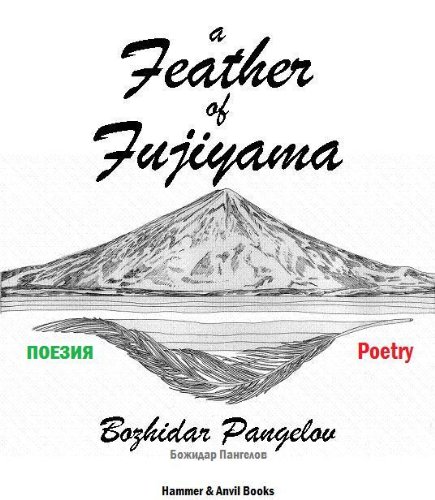
BOZHIDAR PANGELOV (bogpan – блог за авторска поезия  блог за авторска поезия ) was born in the soft month of October in the city of the chestnut trees, Sofia, Bulgaria, where he lives and works. He likes joking that the only authorship which he acknowledges are his three children and the job-hobby in the sphere of the business services. His first book Four Cycles was written entirely with an unknown author but in a complete synchronicity on motifs of the Hellenic legends and mythos. The coauthor (Vanja Konstantinova) is the editor of his next book Delta. She is the woman to whom The Girl Who… is dedicated. Bozhidar’s last (so far) book is The Man Who. A bilingual poetry book A Feather of Fujiama is being published on Amazon as a Kindle edition.

Some of Bozhidar’s poems are translated in Italian, German, Polish, Russian,Chinese, Turkish, Arabic, Romanian, Portuguese and English languages and are published on poetry sites as well as in anthologies and some periodicals all over the world. Bozhidar Pangelov is on of the German project Europe .. takes Europa ein Gedicht. Castrop Rauxel ein Gedicht RUHR 2010 and the project SPRING POETRY RAIN 2012, Cyprus.

Bozhidar’s pen name “bogpan” means “god Pan” – in Greek religion and mythology.

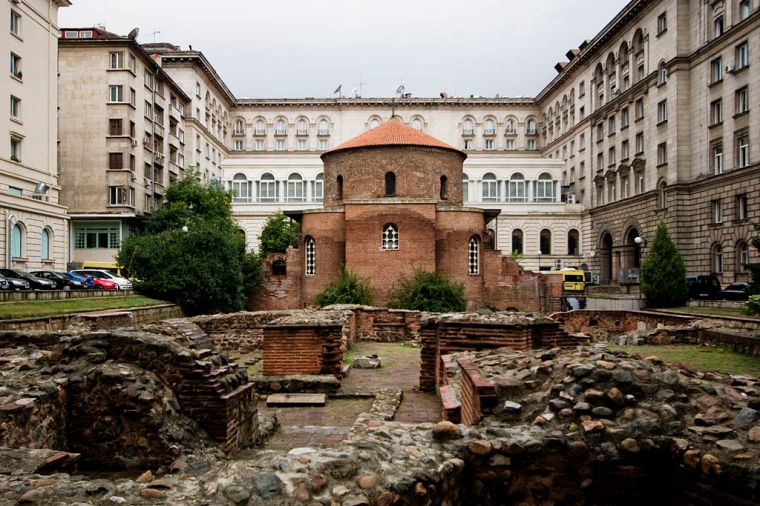
The Fourth Century St. George Rotunda is considered the oldest building in Sofia, the capital of Bulgaria, the city in which Bozhidar was born and lives. Photo courtesy of Sveti Georgi underCC BY 2.0 license.

The Interview

  1. What were the circumstances under which you began to write poetry?

I have the feeling that I have always written poetry. At home we used to have quite rich book library. Throughout my awkward past the (the political system), reading was a way of having a life in another worlds. Can you imagine that there used to be long queues for each translated book from a foreign author! Well, eventually the cause of writing my first poem was quite funny. Me and a friend of mine used to be in love with the same girl. The conflict about who is going to meet her was resolved after each of us wrote a poem. Romantics of the youth.

2.       Who introduced you to poetry?

To answer this question I would like to make some clarifications concerning the educational system in my country. In that system literature is considered as a compulsory subject and leads to serious exams that allow you to apply for a higher educational degree. In the study books are included national as well as international authors. In that aspect, if you like literature you just start writing.

3.       How aware were you of the dominating presence of older poets?

During the time when I was young, the government used to dictate names of poets, but I have always been a rebel and that’s why I never accepted any names. Later on, when the political system changed what remained was my love and amusement by the great worldwide poets.

4.       What is your daily writing routine?

I am not a professional poet and I don’t need to write every day to earn my living. Certainly I don’t trust poems written by professional poets because in most of the cases these poems have unclear aesthetic values and are there to satisfy the popular reader’s taste.

5.       What motivates you to write?

The emotions. Despite the fact that everybody feels the defined emotions as love,pain and etc., each person senses them in their own unique way. The thought that inevitably exists in a poem rests between the conscious and unconscious. I think that a poem written only by the conscious effort of one’s mind is rather a short essay or a short novel. Still there should be a cross point between poetry and prose and for me that’s the emotions.

6.   What is your work ethic?

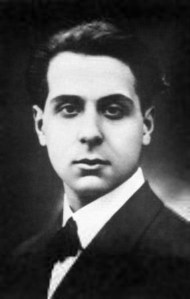
George Seferis [Georgios Seferiades] (1900 – 1971). One of the most important Greek poets of the last century, a diplomat and a Nobel laureate.
I understand this question as related to writing. Ethic for me means to write a “real” poem. Now I sense the forthcoming question which would be what is the criteria or how would you determine what “real” is. A possible answer to this question is the one of the Nobel winner of Greek origin Georgius Seferis, who answers to a similar question in the following way: “But he must somehow have an instinct—a guiding instinct—which says to him: ‘My dear boy, my dear chap, be careful; you are going to fall. You are exaggerating at this moment.'” In this sense my instinct tells me that it’s an absurdity to expect everybody to understand poetry. Whoever wants to understand everything can read newspapers or magazine news. Still it’s uncertain that one will understand everything. At that point I would like to remind the following thought of T.S. Eliot:  “Genuine poetry can communicate before it is understood.“

7.   How do the writers you read when you were young influence you today?

Youngsters, who tend to get highly impressed after reading an author who relates to their inner self remember this artwork and this author which remains forever in their subconscious no matter if they are aware of it or not. That’s how the model works, which we reproduce in our own way. A poem doesn’t emerge from the nowhere.

8.   Who of today’s writers do you admire the most and why?

Considering my experience and age it’s hard for me to get impressed. I just get extremely happy when I come across with an author, who has his/her own unique style, who is distinguishable from the majority. I would like to point at one single name, so I don’t miss out on some of my favourite authors. Stefan Goncharov – a young poet, who established his presence in a quite powerful and mature way just within few months time and having in mind that these were his first poems! As I can say – this man was born a poet.

9.       Why do you write?

With writing I’m trying to express the inexpressible.

10.   What would you say to someone who asked you “How do you become a writer?

In case that your question is – how can I become a professional writer, I can’t reply. I guess that this is something you can learn at the creative writing courses. For me this question has never been important. I just write. I think that if one wants to become a good writer, not only many books need to be read, but that person at a certain point needs to forget about all the knowledge and without a fear start writing in the way of expressing his/her own thoughts and feelings. To be honest with himself/herself and without thinking how to be liked by the readers. There isn’t an ultimate audience of readers that is there to like your writing. Here I would give a longer quote from the interview with Georgius Seferis – Henri Michaux “You know, my dear, a man who has only one reader is not a writer. A man who has two readers is not a writer, either. But a man who has three readers”—and he pronounced “three readers” as though they were three million—“that man is really a writer.”

Нова асоциална поезия

New Asocial Poetry Translations

11.   Tell me about the writing projects you have on at the moment.

At the moment I don’t run my own projects. I’m engaged as an editor of the monthly magazine, New Asocial Poetry. We are preparing surprises for the published authors and new sections. There is already a new section for translations from mostly English language. At this point I would like to say that most of the young people know English, but unfortunately only few people for whom English is their mother tongue know my language. Maybe the reason for that the Cyrillic alphabet is mistaken for the Russian alphabet. Historically is exactly the opposite. Translations require hard work, especially when the literature is created in another language. For that reason we came up with the idea of having a new section for foreign literature dedicated to foreign authors who are a living example for language’s application and usage. All the authors, who are interested in participating in such project can read more about it HERE. .Whoever wants to learn more about the publishing requirements is kindly invited to apply with his/her literature by contacting me at newasocialpoetry@gmail.com.


ABOUT

Poet and writer, I was once columnist and associate editor of a regional employment publication. Currently I run this site, The Poet by Day, an information hub for poets and writers. I am the managing editor of The BeZine published by The Bardo Group Beguines (originally The Bardo Group), a virtual arts collective I founded.  I am a weekly contributor to Beguine Again, a site showcasing spiritual writers.

My work is featured in a variety of publications and on sites, including: Levure littéraure, Ramingo’s PorchVita Brevis Literature,Compass Rose, Connotation PressThe Bar None GroupSalamander CoveSecond LightI Am Not a Silent PoetMeta / Phor(e) /Play, and California Woman.