Page 287 of 433

JEWS, CHRISTIANS, MUSLIMS, UNITARIAN UNIVERSALISTS: San Francisco Peninsula Clergy standing in solidarity for the sacredness of all humans

USGS Satellite photo of the San Francisco Bay Area. The San Francisco peninsula protrudes northward. San Francisco is at its tip, public domain
Public domain USGS Satellite photo of the San Francisco Bay Area. The San Francisco peninsula protrudes northward. San Francisco is at its tip.

As you might suspect, there was a reason for featuring Emma Lazarus and her poem, The New Colossus, as part of the American She-Poets series this a.m. … the reason being a reminder of our American ideals in the face an unreasonable ban, free-flowing hostilitities, and the fear vulnerable people have given the ramped-up deportation policies finding support and stride under the current Republican administration. Almost all immigrants to this country are refugees even if they are not formally declared so. Formally or informally they seek refuge from violence, poverty, joblessness, hunger and environmental degradation.

“Now ‘refugees’ are those of us who have been so unfortunate as to arrive in a new country without means and have to be helped by refugee committees …. We lost our home, which means the familiarity of daily life. We lost our occupation, which means the confidence that we are of some use in this world. We lost our language, which means the naturalness of reactions, the simplicity of gestures, the unaffected expression of feelings. . . . ” We Refugees, an essay by Hannah Arendt in the 1943 issue of Menorah

The lack of empathy and compassion for and the fear of and prejudice toward immigrants is not new in American history and, as better people than me have said, unless you are a Native American, you are an immigrant, no matter how far back your roots go in these United States. It is likely that your own progenitors felt the sting of prejudice, might have suffered greatly and even died at its hands.

Here I report on the programs and practices that are being implemented by our interfaith community with the help of a number of organizations including Faith In Action, which is integral to the design of a Rapid Response Program. My hope is that in reading this more people in our own community will become involved and that other communities that don’t have programs and collaborations will be inspired to create them.


The Peninsula Solidarity Network of clergy representing diverse faiths was originally initiated to discuss and address the shortage of housing and affordable rents throughout the San Francisco Peninsula and South Bay area and is now taking on another crisis: creating sanctuary and building a Rapid Response Network to witness, accompany and advocate for immigrants facing deportation. On Wednesday, February 8th, it hosted a training by Faith In Action Bay Area. The training was on the Sanctuary Movement and The Rapid Response Network, a project of Faith In Action Bay Area, PICO and the Archdiocese of San Francisco in collaboration with Pangea Legal Services and California Immigrant Youth Justice Alliance.

Please note: I do not speak for or represent the Peninsula Solidarity Network or its clergy and lay-leader members, Faith In Action or the Rapid Response Network, but  I was a butterfly on the wall with the good fortune to listen in and report back to you. This is what I learned. Any mistakes or mistaken assumptions are my own. If you are clergy or a professional journalist interested in the Peninsula Solidarity Network, the Sanctuary Movement, and/or Rapid Response email clergyhousingsummit2@gmail.com J.D.

While deportation is not a new problem, these efforts by the federal government are escalating and Faith In Action is working to bring our congregations together to foster the bigger scale of action and involvement that is necessary now . . . and we need everyone. Our job is to facilitate support among the races. Everyone has a role to play: diverse immigrant communities supporting one another and the greater community showing presence. Vulnerable ethnic and religious groups need special help and American citizens have responsibility to be present for victims and involved in this work.

Within the immigrant community congregations are the center for hope. Faith organizations can offer training to help families to defend themselves, to know their rights, and to get deportation defense through community campaigns, solidarity networks and for advocacy at local, state and federal levels.

Each city needs RAPID RESPONSE TEAMS of at least forty people. First responders verify raids, are moral and legal observers and connect families with legal services, social and economic services, advocacy and accompaniment services.

Victims of immigration raids can’t leave home or work to find sanctuary in a congregation. With rapid response, the congregation goes to the people.

In California, clergy and congregation members can also help by supporting the proposed California Values Act (SB 54) of California Senate President pro Tempore Kevin de León. Here is the short link to info about SB 54: http://tinyurl.com/j6e6ayv

Donate to Faith In Action Bay Area, 1336 Arroyo Ave, San Carlos, CA 94070-3913 (510) 234-8983

OUR PENINSULA RESIDENTS ARE INVITED TO attend the Faith In Practicing Solidarity During Immigration Raids Training (Rapid Response Network: Witness, Accompany and Advocate) to be offered on February 12, 4 p.m. –  6 p.m. at the First Congregational Church, 225 Tilton Ave., San Mateo, CA (Parking on Catalpa). You will learn how to witness (be a legal observer), accompany (provide moral support) and advocate (prepare for opportunity to pass new protections). There will be a second training offered on February 28, 6:30 – 8:30pm, 2266 California St, San Francisco.

For more information on the training call  415 867 6279. REGISTER HERE or RSVP at fiaba@faithinactionba.org … Faith In Action Bay Area website is in the development stage.


What follows  is a short film (about 20 min.), which tells the history of immigration in the United States. If you are reading this feature from an email subscription, you’ll likely have to link through to watch the video.


The following Q & A on the Sanctuary Movement was shared with me by Rev. Ben Meyers (Unitarian Universalists of San Mateo) and was developed by Rev. Dr. Penny Nixon (Congregational Church of San Mateo) with minor adaptions for use here.

  • Why a revival of the Sanctuary Movement?

Too many people are deported – or “returned” – many of them are long-term residents woven into the fabric of our communities and congregations, including our neighbors. Often this results in splitting up families with children who are U.S. citizens.

Time after time Congress has refused to address our broken immigration system. Donald Trump launched his campaign for president pledging to build a wall and deport immigrants. During his first two weeks in office he issued orders intended to begin implementing his vision for America. An order establishing a travel ban on Muslims from seven majority Muslim nations has had a chilling effect on nearly all foreign nationals living among us as friends, neighbors, classmates, coworkers or family in communities nationwide. Consequently, a New Sanctuary Movement is rapidly gaining momentum among people of faith and moral conscience.

  • Why get involved as a Faith Community?

Our shared religious ideals call us to affirm and promote the inherent worth and dignity of all people; to seek justice, equity, and compassion in human relations, and to create world community with peace, liberty and justice for all. We commit our values to action as we work together to transform ourselves while creating congruence between our ideals and our actions. Deportation of our neighbors and the breaking up of immigrant families in our communities are among the most compelling social justice issues of our time. Our congregations can make a difference. We can get involved in the New Sanctuary Movement by taking the National Sanctuary Pledge and becoming a Sanctuary Congregation, joining hundreds of others from all faith traditions across the country

  • What does it mean to be a Sanctuary Congregation?

Principally, it means helping prevent deportation of persons facing an order of deportation, on a case-by-case basis, one at a time, in concert with their legal representation. Participation varies from joining Networks of Protection and Rapid Response teams; Advocating for due process and policies; Accompanying Immigrant families and youth for protection and providing a safe haven.  This latter role means hosting or otherwise supporting a person in your facility and possibly their family too, while the person is engaged in legal proceedings intended to prevent them from being deported. We expect the duration of a person’s stay in Sanctuary would be from three weeks to three months. As part of growing coalitions of congregations you would not be doing this alone.

  • Is a house of worship a safe place?

Historically, churches, schools and hospitals have been classified as “sensitive locations” under the U.S. Immigration and Customs Enforcement (ICE) Sensitive Locations Policy. ICE has not entered any of those venues to take custody of a person facing an order of deportation. However, we should be aware that this could change as the current administration implements its plans. [ICE officials can make entry with a warrant. / J.D.]

  • How are candidates for Sanctuary vetted?

As a Sanctuary Congregation, you will have a Memorandum of Understanding (MOU) with one or more not-for-profit organizations providing legal services for immigrants in or around your area. That organization, in concert with a person’s lawyer, will decide that the person would be the right candidate for Sanctuary: (1) ICE would not likely consider them a priority for deportation; (2) they are a good candidate for prosecutorial discretion, winning a stay of removal or an order of supervision or some other form of legal relief from deportation; and (3) they would satisfy any other requirements specified in our MOU. Where a candidate meets the requirements, the organization presents the case to the Sanctuary Congregations’ rabbi, minister or Iman and a “Vetting Team.”

  • What are the risks?

During the last forty years, no congregation has been prosecuted for allowing undocumented people to find shelter in their Church; no person associated with a Church Sanctuary Program has been convicted for offering Sanctuary; and no Church’s tax-exempt status has been affected. In the words of Martin Luther King, Jr., “There comes a time when a moral man [sic] can’t obey a law which his conscience tells him is unjust. And the important thing is that when he does that he willingly accepts the penalty – because if he refuses to accept the penalty he becomes reckless, and he becomes an anarchist.”

RELATED

CELEBRATING AMERICAN SHE-POETS (29): Emma Lazarus and Liberty Lighting the World … “I lift my lamp beside the golden door.”

Emma Lazarus, 1849 - 1887
Emma Lazarus, 1849 – 1887

In a letter to Emma Lazarus about Alide, an episode of Goethe’s Life. the Russian novelist Turgenev wrote  “An author who writes as you do is not a pupil in art anymore; he is not far from being himself a master.”

 “Emma Lazarus is a new name to us in American poetry, but ‘Admetus’ is not the work of a ‘prentice-hand’; few recent volumes of verse compare favorably with the spirit and musical expression of these genuine effusions of Emma Lazarus.” The Boston Transcript, c 1871

“What Emma Lazarus might have accomplished, had she been spared, it is idle and even ungrateful to speculate. What she did accomplish has real and peculiar significance. It is the privilege of a favored few that every fact and circumstance of their individuality shall add lustre and value to what they achieve. To be born a Jewess was a distinction to Emma Lazarus, and she in turn conferred distinction upon her race.” Josephine Lazarus, Emma’s elder sister who gather her poems together and published them in two volumes, The Poems of Emma Lazarus, 1881

“Until we are all free, we are none of us free.” Emma Lazarus

EMMA LAZARUS, poet, writer and activist, was by all accounts shy and she died at thirty-nine years, much too young. Nonetheless she accomplished a lot in addition to that for which she is most well-known, The New Colossus, the sonnet that is on the pedestal of the Statue of Liberty (Liberty Enlightening the World) in New York Harbor, having been installed there in 1903.

Unveiling of the Statue of Liberty Enlightening the World (1886) by Edward Moran. Oil on canvas. The J. Clarence Davies Collection, Museum of the City of New York.

“The copper statue, designed by Frédéric Auguste Bartholdi, a French sculptor, was built by Gustave Eiffel and dedicated on October 28, 1886. It was a gift to the United States from the people of France. The statue is of a robed female figure representing Libertas, the Roman goddess, who bears a torch and a ]a tablet evoking the law upon which is inscribed the date of the American Declaration of Independence, July 4, 1776. A broken chain lies at her feet. The statue is an icon of freedom and of the United States, and was a welcoming sight to immigrants arriving from abroad.” [Wikipedia]

In fact Lady Liberty greeted my own father and maternal grandparents and their children as they entered the harbor just as she probably did for the families of those reading here today. Their children and grandchildren learned the poem by heart in school. I suspect the majority of us took the ideals expressed as our own.

The bronze plaque inscribed with Emma Lazarus' poem, The New Colassus.
The bronze plaque inscribed with Emma Lazarus’ poem, The New Colossus.

A hymn to America, the “Mother of Exiles,” The New Colossus, was written to raise money for the construction of the pedestal for the Statue of Liberty.

The New Colossus – 1883

Not like the brazen giant of Greek fame,
With conquering limbs astride from land to land;
Here at our sea-washed, sunset gates shall stand
A mighty woman with a torch, whose flame
Is the imprisoned lightning, and her name
Mother of Exiles. From her beacon-hand
Glows world-wide welcome; her mild eyes command
The air-bridged harbor that twin cities frame.
“Keep, ancient lands, your storied pomp!” cries she
With silent lips. “Give me your tired, your poor,
Your huddled masses yearning to breathe free,
The wretched refuse of your teeming shore.
Send these, the homeless, tempest-tossed to me,
I lift my lamp beside the golden door!”

– Emma Lazarus

Emma came from a large Sephardic-Ashkenazi family, the father’s side from Germany and the mother’s side from Portugal. Her maternal great-grandmother was also a poet.  Emma’s first book of poems was published by her father when she was fourteen and apparently showed much promise. She continued to write poetry and eventually wrote a five-act play, a novel and a short-story as well.  She was a linguist, editing and translating works from the German, notably those of Goethe and Heinrich Heine. She wrote fourteen essays entitled Letters to the Hebrews. She was a forerunner in advocating a Jewish homeland, predating Theodore Herzi. She was friends with and an admirer of the American political economist, Henry George, who was instrumental in the birth of several reform movements of the Progressive Era. Essentially, George believed that workers should own the value of what they create, while the land should be held in common. Ralph Waldo Emerson was both friend and mentor.

Emma Lazarus received many posthumous awards. The Emma Lazarus Statue of Liberty Award is sponsored by the American Jewish Historical Society (New York and Massachusetts) and P.S. 268 in Brooklyn is named for her.

Life and Art

Not while the fever of the blood is strong,
The heart throbs loud, the eyes are veiled, no less
With passion than with tears, the Muse shall bless
The poet-sould to help and soothe with song.
Not then she bids his trembling lips express
The aching gladness, the voluptuous pain.
Life is his poem then; flesh, sense, and brain
One full-stringed lyre attuned to happiness.
But when the dream is done, the pulses fail,
The day’s illusion, with the day’s sun set,
He, lonely in the twilight, sees the pale
Divine Consoler, featured like Regret,
Enter and clasp his hand and kiss his brow.
Then his lips ope to sing–as mine do now.

– Emma Lazarus

RELATED


Take Action: Defend Standing Rock Reporter Jenni Monet

tumblr_okv1lt81ku1qflj9ao1_1280This message is from PEN Center U.S.A. Feel free to re-blog or link to this post.

The information for this campaign was sourced from The Los Angeles Times and the High Country News

PEN Center USA objects to the arrest and the charges made against Native American journalist Jenni Monet (her website), who was covering protests against the North Dakota Access pipeline in North Dakota.

“Monet was wearing press credentials as she covered ongoing protests near the Standing Rock reservation. She provided her credentials to an officer when asked, but was arrested Feb. 1, at 4 p.m., Central, near protest encampments along Highway 1806. Monet was held for about thirty hours and was not released until 9 p.m., Feb. 2. She faces charges of criminal trespassing and engaging in a riot from Morton County prosecutors.” High Country News

A statement was released by Indian Country Today Media Network reiterating her press credentials.

We call on Wayne Stenehjem District Attorney of North Dakota to drop these charges immediately.

Take Action – Please Sign

The first amendment rights of journalists and free press liberties are in danger. Please join us in demanding that the District Attorney of North Dakota drop these charges immediately. ADD your name to the petition that will be sent to Wayne Stenehjem, District Attorney of North Dakota, and Allen Kopp, Morton County State’s Attorney.

“I believe in the resistance as I believe there can be no light without shadow; or rather, no shadow unless there is also light.” Margaret Atwood

Under the Mango Sky, a poem … and your Wednesday Writing Prompt

Painted Turtle by Gretchen Del Rio c 2010, rights reserved

our gray skies pass when mango sky comes,
warm with laughter, chanting its gentle way into
the space where turtle speaks in earthy colors,

speaks in that easy way only turtle can, as one who is
at home in herself, between her plastron and carapace,
wisdom in her slow ballet; her introversion, a model

for living well in this grinding war-spun world . . .
turtle is my totem and we live on our turtle island,
she is the everyday re-enchantment of my solitary

cosmos, my solidarity with life, i read her pastoral
letters in green on green, the sweet grasses and seas,
she speaks of connectedness, the basic constituents

of enigma, wizardry, and the madness of the times
and how best to dance the madness into light, she is
essence, the unrushed cure for wretched nature-deficit,

that consuming affliction, the spawn of modern day’s
backlit screens and relentless marketers of every bilk;
turtle healing is simple peace and master lessons in

self-containment, she draws us into our meditations
and back along the first path of Maka Ina, the lost or
forgotten primal path of the earth ways and feminine
energies and the lunar cycles that whirl us heavenward

  • Turtle ~ totem or power animal representing earth in Native American tradition
  • Turtle Island ~ in Iroquois tradition, when the earth was covered over with water, sundry animals attempted  to create land by swimming to the bottom of the ocean and hauling up dirt. Muskrat succeeded. He placed the dirt on the back of  Turtle, which grew into the landmass known today as North America. 
  • Maka Ina ~ Lakota (Sioux) ~ “maka” is earth and “ina” is mother, so Mother Earth. Earth teachings were/are considered a path to wholeness (heaven) by the First Peoples.

© 2013, poem, Jamie Dedes, All rights reserved; turtle watercolor courtesy of Gretchen Del Rio. 

WRITING PROMPT

Several years ago I had the rather odd experience of having three shamans, two Native American and one Mexican, tell me out of the blue (I never asked) that my totem is Turtle.  I think these good people had a fine sense of intuition and of the sacred and possibly were good observers. It would not be surprising or illogical for anyone to decide that an obvious introvert is a Turtle.

If you’ve never been given a totem animal, imagine one yourself. Write a poem about your personal totem. HERE is a list of Native American totems and their meanings to help you along.  Take your time. Enjoy! … and if you feel comfortable, leave the poem or a link to it in the comments section below.


This is Paul Brooks’ (thewombwellrainbow) response to the prompt given two weeks ago: Blown Across Timelessness. Bravo, Paul!  🙂

The Need

The need to remember
The never to forget
This list of essential tasks
On mobile, in my head.

Milk, bread, light bulbs, to live,
To bury my Nanna
Beside my Mum, Sister
Lay her casket to rest.

The need to remember
Why this delay, dither
To fulfill my Nannas
Wish to be buried here.

Join daughter, granddaughter.
I have kept her ashes
Stored in my room at home.
Close to their photographs.

I have told myself ‘Do
It!’ and nothing is done.
I cannot, will not let
Go of her. I am done.

Let her and myself down.
Must get hold of myself.
Must call the vicarage.
Must say a last goodbye.

The never to forget
As I shop these shelves
Everything on my list
That needs to be done.

My Nanna, Sister, Mum
Were my bread, milk, light.
My wife, daughter, grand
Kids are essentials now.

The need to remember,
Never to forget
One list to another
An urgent task undone.

© Paul Brooks (a.k.a. dragonwolfpaul)

unnamedPAUL BROOKS was shop assistant, security guard, postman, admin. assistant, lecturer, poetry performer, with Rats for Love and his work included in Rats for Love: The Book, Bristol Broadsides, 1990. His first chapbook was The Fabulous Invention Of Barnsley, Dearne Community Arts, 1993. He has read his work on BBC Radio Bristol and had a creative writing workshop for sixth formers broadcast on BBC Radio Five Live. Recently published in Clear Poetry, Nixes Mate, Live Nude Poems and others. Forthcoming in the spring 2017 an illustrated chapbook The Spermbot Blues, published by OpPRESS.


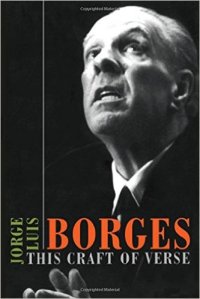
The recommended read for this week is Borges’ The Craft of Verse. (One of my faves.) 41-mshkw5pl-_sx331_bo1204203200_These are the famed lost lectures given in English at Harvard University (1967/68) by Jorge Luis Borges that were transcribed (c. 2000) and published in 2002.

The WordPlay Shop offers books and other tools especially selected for poets and writers. By making your Amazon purchases through this site, you help support it.

THE WORDPLAY SHOP: books, tools and supplies for poets, writers and readers

LITERATURE AND FICTION oo Editor’s Picks oo Award Winners oo NY Times Best Sellers