Page 299 of 433

POETRY ON THE BIG SCREEN: “And I a smiling woman./I am only thirty.”

51pnhss455l-_sy445_I must admit to mixed feelings on Sylvia, a film about the American poet Sylvia Plath. There’s not much of Path’s poetry included and no poems from her husband Ted Hughes. I understand that their daughter, the poet and painter Frieda Hughes, refused permission. She felt the producers were “voyeuristically raking over the ashes of her mother’s death.” What poetry is quoted includes:  “Dying is an art … I do it exceptionally well …” from Ariel, which was read in voice over (as were any other bits of poetry) more than once. This perhaps speaks to Frieda Hughes’ concerns.

The producer (BBC) and director (Christine Jeffs) chose to focus on Plath’s clinical depression, her tumultuous relationship with Hughes, and her suicide.The sense of Plath as a poet is background to all that. One could argue that it should have been the other way around.

Gwyneth Paltrow plays Plath and while she does bare some resemblance to Plath, she is rather wooden. If you’ve listened to recordings of Plath’s interviews, you know she was animated. Lively.  A smoldering and sauterne Ted Hughes was played by Daniel Craig. Blyth Danner (Paltrow’s real-life mom) plays Plath’s stern, knowing and concerned mother, not a big part but well done.

I think what’s redeeming is that the interplay between Plath and Hughes illustrates the extraordinary challenge presented to their marriage by the depth and persistence of her depression. Neither excusing nor judging Hughes for his adultery, the film gives a nod to his pain and the fact of his love despite all.

After Plath’s death, Hughes was vilified as someone tantamount to a murderer. He often still is even after the publication of Birthday Letters, which gives his side of the story.

“Nor did I know I was being auditioned
For the male lead in your drama,
Miming through the first easy movements
As if with eyes closed, feeling for the role.
As if a puppet were being tried on its strings,
Or a dead frog’s legs touched by electrodes.”

Plath was deeply wounded by her father’s death when she was eight and saw in Hughes a replacement. The situation couldn’t have been easy for the man. And, after all, Plath’s depression predates her relationship with Hughes, as did her first attempt at suicide.

If I was using stars to rate Sylvia, I’d give it two out of five, mainly because it perpetuates the mythology that surrounds Plath over her poetry, which I find intrusive and ultimately disrespectful. If you’re a Plath fan and haven’t seen the movie, you might want to just because of your affinity for the poet and her poetry … and, of course, you might like it more than I do. If you have no particular affinity for Plath or know little about her, you might appreciate it as the story of a depressive.

THE WORDPLAY SHOP: books, tools and supplies for poets, writers and readers

LITERATURE AND FICTION oo Editor’s Picks oo Award Winners oo NY Times Best Sellers

POETRY ON THE BIG SCREEN: “It is difficult to have the heart to write a poem.”

Poetry_WebBase

“The apricot throws itself on the ground. It is crushed and trampled for its next life.”  Yang Mija “sees” while walking through an orchard and takes notes in her poetry notebook

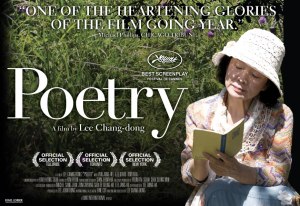
Poetry  (2009), the second movie suggestion for a holiday break movie, is a Korean movie with English subtitles. It speaks quietly about life and art, devastation and redemption. Like the most refined poetry, it is nuanced, honest and dramatic without being melodramatic or manipulative. It is a spare work, whittled down to essentials. It whispers. It never shouts.  Its pacing is leisurely and thoughtful. There is no suggestive music here to help you grasp the story’s progression. There are no stars who’ve been nipped, tucked, brushed, trussed and boosted. These people are real. They could be me or you or a next-door neighbor.  The story could be anyone’s story anywhere in the world. Indeed, Director Lee Chang-dong got the basic idea for the screenplay from news reports..

… this story was finally born from a combination of different elements: the sexual assault case, the suicide of a girl, and the lady in her 60s writing a poem.” Lee Chang-dong

Yoon Jeong-hee stars in the leading role (Yang Mija) and it is the lean script (though the movie is over two hours long) and Jeon-hee’s exquisitely understated acting that transfix us. Watch her face. Watch her body movements.  These also are a kind of poetry.

“I’m quite a poet. I do like flowers and say odd things.” Yang Mija

Yang Mija is a sixty-six year-old grandmother charged with the care of a teenaged grandson, Jongwook – or Wook – whose mother is divorced and living in Busan. Wook is lazy and ungrateful and shows no respect for his grandmother or sensitivity to her age and her loneliness.

“You’re sprouting a mustache but acting like a child.” Yang Mija to Wook

Wook is part of a gang of male friends, fellow students, who over the course of six months repeatedly rape a young woman who subsequently drowns herself. News of this comes coincident with Yang Mija’s diagnosis of Alzheimer’s disease and her first poetry class. It is her poetry classes and effort to write a poem that provide the through-line for this story.

“The most important thing is seeing.” the poetry instructor to the class on the first day

img1-lgWe walk alongside Yang Mija as she struggles with these multiple challenges – not without some humor – and sorts through her emotions regarding her grandson’s actions, her sympathy for the drowned girl, and the desire of other parents to hide the boys’ culpability by buying off the drowned girl’s mother. While Yang Mija may be suffering the early stages of memory loss, she hasn’t lost her moral compass.

As she moves from one experience to the next, Yang Mija questions: How do you write a poem? Where does the poetry come from? When she decides her grandson must face the consequences of his actions, she is finally able to write her poem.

Agnes’s Song

How is it over there?
How lonely is it?
Is it still glowing red at sunset?
Are the birds still singing on
the way to the forest?

Can you receive the letter
I dared not send?
Can I convey the confession
I dared not make?
Will time pass and roses fade?

Now it is time to say goodbye,
Like the wind that lingers
And then goes, just like shadows.

To promises that never came,
To the love sealed till the end,
To the grass kissing my weary ankles,
and to the tiny footsteps following me,
It is time to say goodbye.

Now as darkness falls
will a candle be lit again?
Here I pray nobody shall cry
and for you to know
how deeply I loved you.

The long wait in the middle
of a hot summer day.
An old path resembling my father’s face.
Even the lonesome wild flower
shyly turning away.

How deeply I loved.
How my heart fluttered at
hearing your faint song.
I bless you
before crossing the black river
with my soul’s last breath.

I am beginning to dream…
A bright sunny morning again I awake,
blinded by the light and meet you
standing by me.

– Yang Mija

“It is not difficult to write a poem. It is difficult to have the heart to write a poem.” the poetry instructor on the last day of class. Yang Meja is not in attendance but has left a bouquet of flowers and her poem.

You can stream Poetry on Amazon, if you are interested. It’s quite a memorable film.

© 2016, review, Jamie Dedes, All rights reserved; Photographs, poem, quotes courtesy of and property of the filmmaker and used here under fair use.

THE WORDPLAY SHOP: books, tools and supplies for poets, writers and readers

LITERATURE AND FICTION oo Editor’s Picks oo Award Winners oo NY Times Best Sellers

POETRY ON THE BIG SCREEN: The tragic love of John Keats and Franny Brawne

Medallion portrati of John Keats (1795-1821), English Romanic Poet
Medallion portrait of John Keats (1795-1821), English Romantic Poet

It’s that time of year again – kick back time between Christmas and the new year – a good time to revisit old movies and see new ones.  

Bright Star  is based on the tragic love of the quiet and reserved Romance poet, John Keats, and the vivacious Franny Brawne. Their alliance was destined to be cut short by his death at twenty-four of TB. Bright Star is not just another Regency drama. From the costumes, to the changing of the seasons that were a beautiful and meaningful backdrop to the story, to the world-class cast and script (Jane Campion wrote the script and directed the movie), it is about as nearly perfect as any movie can hope to be.

The title of the movie is taken from Keat’s poem Bright Star:

Bright star, would I were stedfast as thou art—
…..Not in lone splendour hung aloft the night
And watching, with eternal lids apart,
…..Like nature’s patient, sleepless Eremite,
The moving waters at their priestlike task
…..Of pure ablution round earth’s human shores,
Or gazing on the new soft-fallen mask
…..Of snow upon the mountains and the moors—
No—yet still stedfast, still unchangeable,
…..Pillow’d upon my fair love’s ripening breast,
To feel for ever its soft fall and swell,
…..Awake for ever in a sweet unrest,
Still, still to hear her tender-taken breath,
And so live ever—or else swoon to death.

– John Keats

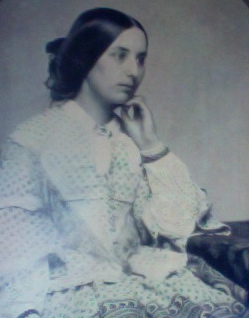
Francis (Fanny) Brawne Lindon (1800-1865
Francis (Fanny) Brawne London (1800-1865)

Abby Cornish plays Fanny Brawne in a performance both understated and charming.  Brawne came from a rather straightened background. At sixteen she is savvy and spunky and falls in love with that raw intensity most of us bring to first love. The story is told from Brawne’s perspective.

Ben Whishaw does a splendid job portraying the sensitive Keats. His recitation of Ode to a Nightingale, which is played as the closing credits run is itself worth the time and expense of admission.

Keats and Brawne were separated when a group of the poet’s friends pooled their resources to send him to Italy. Their hope was that the balmy climate would restore him and prolong his life. Keats, however, knew he would die in Italy. So did Brawne. That circumstance leads to a long and tender good-bye. Lying on a bed in Keats’ room, face to face, they recite La Belle Dame sans Merci to each other. Exquisite!

If you haven’t seen Bright Star, put it on your to-watch list.  I don’t think you will be disappointed.

Here is Ben Whitsaw’s exquisite rendering of La Belle Dame sans Merci. If you are reading this post in an email, you’ll have to link through to the site to view the video.

Photos ~ John Keats by di Gieovanni Dall’Orto from Keats’ headstone under attribution license via Wikipedia; Franny Brawne, an ambrotype taken circa 1850 and in the public domain.

THE WORDPLAY SHOP: books, tools and supplies for poets, writers and readers

LITERATURE AND FICTION oo Editor’s Picks oo Award Winners oo NY Times Best Sellers
THREE WISE WOMEN

15284007_1577006242315679_1821868716518552259_n

I don’t know who made this but it’s great! Thank you.

wishing everyone

~ celebrants or not ~

every blessing today

and throughout 2017

The Sunday Poesy will be back next week.

THE WORDPLAY SHOP: books, tools and supplies for poets, writers and readers

LITERATURE AND FICTION oo Editor’s Picks oo Award Winners oo NY Times Best Sellers