Page 3 of 3

Review “Raven’s Wire” and Interview, poet Matt Pasca

MattMatt Pasca, an American poet, teacher and speaker, is someone to watch. On February 27, his second poetry collection, Raven Wire (Shanti Arts Publishing) will launch at Bay Shore, Long Island, New York.  For those living in that area, the details are HERE.

12718356_10153377544577895_4241506836986252048_n

Two of Matt’s poems are featured in the January issue of The BeZine. His work is refined, ambitious and precise. It exposes an intimacy with mythology, history, music and literature as well as a keen eye and ear for the complexities and pains of our post-modern times.

Matt demonstrates a sensitivity to the moral responsibilities of the artist and all human beings and an appreciation of social insults and human frailty that is intelligent and compassionate and able to be transformed by beauty. His work is not trite or cheapened by sensationalism or voyeurism. It invites one to read and reread to fully appreciate it.

The name of the book is a reference to the Norse god Odin’s ravens, Huginn and Muninn, thought and memory. The collection is divided into two sections, one for each category.

So … artists, I humbly submit, in addition to craft and toil, [we must] maintain a vigorous and sacred practice of Listening, becoming a receptacle that extends into the universe, hoping to return with something true. It is not Odin‘s ring, spear, or death-defying feats I wish to spotlight here, but his practice, our tether as humans seeking compassion and connection, wonder and wisdom…” Matt Pasca, Raven Wire


JAMIE: What first drew you to poetry at age eleven?

MATT: I was never much of a talker. I spent lots of time alone as a kid—just my hyper-awareness and a constant hailstorm of words banging off the windshield of my consciousness. Before writing, my only relief from the intensity of life’s stimuli was music. Then, yes, at 11, I discovered a word processing program on the Commodore 64 called Easy Script and fell immediately and unimpeachably in love with the process of making external what had been entirely internal. Not to be dramatic but it felt, as I typed, as if I were writing myself into existence—calmly, honestly and courageously, without shame or judgment or raised voices. Absolute freedom. I was hooked. As years passed and my process evolved, I learned how to hover while the external and internal intertwined and became not only transfixed by these conversations but spurred on to render them with potency.

As for the genre itself, I was around poetry often as a boy, but didn’t take much of a liking to it. I avoided it out of a sense of distaste and saturation, seeking out short stories and non-fiction instead. I remember thinking, “If there is James Baldwin in the world, why bother with poetry?” Even in Kenneth McClane’s wonderful verse-writing course at Cornell, I found poetry composition an arduous and frustrating endeavor. At some point in my late 20s, poetry suddenly “clicked” with me. It became all I wanted to write or read.

JAMIE: As you matured, what surprised you about poetry as both writer and reader?

MATT: In some ways, I think poetry finally “clicked” for me as an outgrowth of my passion for cinema. I had always loved the experience of being in a theatre, dreaming while awake—it felt familiar. When I became a trained projectionist at Cornell Cinema, the flames of my passion for film were mightily fanned. I spent countless nights up in that booth, mesmerized. I decided to sign up for a film class and was lucky enough to have the late Don Fredericksen as my professor. One day he taught a lesson on cinema’s early experimental filmmakers who said to hell with filming stage plays, let’s use this new technology to create something ONLY the film camera can do! During this lesson, we watched Leger’s Ballet Mecanique, a brief 15 minute film that capitalized on the basic principle that a huge screen and a zoom lens could create instant and utter defamiliarization. This made so much sense to me, and reminded me of how I had perceived the world even as a child: intensely, fragmentedly, impressionistically, with a different aperture and at a different speed. Poetry, in turn, more than any other genre, seemed perfectly equipped to provide me with Leger-like shortcuts to the creation of/expression of defamiliarized perception. I began to chase this as both as a writer and reader – the isolation of the familiar in a way that reframes and challenges, both artistically and emotionally. And me, with my long, detail-oriented attention span (perfect for both cinema and poetry), I do enjoy the infamously laborious process of sculpting a single page of defamiliarizing verse.

JAMIE: Your interests are quite diverse. They appear to me to influence your language and bring a multi-layered perspective to your poetry. Russian. Africana studies. Gospel music. Sports and travel. How do they move into your poetry?

MATT: I credit my family for fostering in me not only an aversion to rigid thinking but a relentless pursuit of others’ points of view. I was exposed, as a kid, to people from countries all over the world—ate their food, heard their accents, wanted to memorize the contours and colors of their flags. The more foreign a thing was to me, the more interesting it became; the more misunderstood a thing was by my more homogenous Long Island surroundings, the more sense it made to me; the more marginalized, the more attractive. Diversity is the hallmark of my cellular structure and every pursuit I undertake consists of new and dissimilar information. I don’t remember a time when I didn’t want to grab on to what I do not know and absorb it, walk around inside of it and get to know how it feels. A poet-friend of mine, Steven T. Licardi, writes in a poem about life on the autism spectrum, “Even numbers have feelings,” and I so get that. Everything seems to be alive and vibrating. As a word-lover/wordsmith, I find I want to upload every activity or subculture’s “lexical field”, to the point where a single new word or detail can trigger an entire poem. The interests I have stuck with the longest—baseball, social justice, music, travel—are also a kind of spiritual chiropractic; they align my rhythms and spaces and prepare me for poetry’s entry and excavation.

JAMIE: I think a lot of my readers will be interested to know how you carve out time for creativity with job, marriage, children, social commitments and so forth. What can you share with them that will assist them in their own work?

MATT: My wife (author Terri Muuss) and I get this question a lot and I have a few answers that may be of some use. First and foremost, my marriage is the engine that drives everything else, just as in a plane, car, ship or train. If you take care of your engine, make sure it fires on all cylinders, there is no telling what you can accomplish. (Astrologically inclined friends would say it’s because she is a Capricorn and I am a Taurus and, despite being wildly creative, neither one of us likes to be un-grounded or unorganized. Guilty as charged.) ☺ So back to the question—since, for both of us, parenting and job and marriage are non-negotiables, where do we find the time to run workshops, perform, curate, edit and write?

The simple answer, and my second point, is that we use what time we have rather than ruing its deficient quantity. We write in stolen moments at work, taking off in a plane, speaking into our phones while stopped at red lights, during faculty meetings. Once you start waiting for “enough time”, or the “right kind of time” to create, you are dead in the water. It simply won’t happen, unless you are willing to sacrifice your relationships or professional standing. Naturally, these stolen moments must be attended by some ongoing and suspended organizational system (i.e., somewhere to store the scraps and composted bits until there is time to assemble them)—that is what Dropbox, IClouds or folders are for. ☺

Thirdly, I feel I would be remiss if I didn’t offer a word about process. If one has only stolen moments here and there that require immediate generation and organization, one must be coherent and focused, with a writing process that precludes writers’ block or any notions of perfectionism. This tends to also preclude drinking and/or drugging, neither of which my wife and I do. There is no judgment in this, just a fact that does influence our ability to get so much done in so little available time. Rather than subscribe to the archetypal “artist mystique” involving inebriation and inordinate drama, we believe more can be accomplished creatively and perceptively when one stands in the honest space of clarity and fullness or brokenness, whichever is ascendant in the moment. It is hard not to get in one’s own way, but it’s awfully important to try. ☺

JAMIE: Our mutual friend, Michael Dickel, said in his interview that the job of a poet is to bare witness. You write in a different frame, so what to you is the poet’s job? What is the poet’s social and artistic responsibility?

MATT: Well I would agree whole-heartedly with Michael and posit, further, that there is no “other frame” than bearing witness in poetry. To the casual observer, there is ostensibly socio-political poetry and its more internal-leaning counterpart, but I don’t find this dichotomy convincing. No. A good poet friend of mine, Veronica Golos, once said in a Q&A, when asked, “Do you set out to write political poetry?” that she believed all poetry is political. I agree with her. The very paradigm of our individual perception at any given time is what creates our sense of reality as well as our response to it. Even bearing witness to how we witness is political.

At the micro level, how we learn to honor complexity and timelessness in an age bent on thumbs up/thumbs down exigencies and disposabilities is, ultimately, political. My hero in so many ways, James Baldwin, said, “One must know what is happening around them in order to know what is happening to them.” No, not everyone finds their way from the specific to the general, from the micro to the macro, but I believe deeply that peace begins with a more robust, nuanced and empathic perception that begins at the molecular level. This is the job of the poet: to listen, notice, pan for truth, scrape for justice and undertake the alchemic sculpting of language and space to illuminate and, hopefully, heal. In my ongoing effort to cure myself of ignorance, I want each of my poems to act as a dissertation highlighting and easing humanity’s tragic miscalculations.

review portion, Jamie Dedes; © interview responses, photograph and cover art, Matt Pasca, All rights reserved

The Poet As Witness: “War Surrounds Us,” an interview with American-Israeli Poet, Michael Dickel

5182N5cYeEL._SX355_BO1,204,203,200_“That some of those labelled as enemies
have crossed the lines to offer condolences
at the mourning tents; that the mourning
families spoke to each other as parents
and cried on each others’ shoulders;
that we cried for the children who died
on both sides of the divide; that the
war began anyway; that hope must
still remain with those who cross
borders, ignore false lines and divisions;
that children should be allowed to live;
that we must cry for all children who die”

– Michael Dickel, (Mosquitos) War Surrounds Us

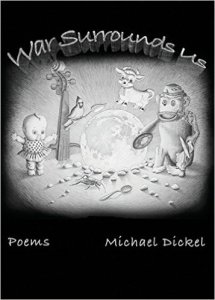
Jerusalem, Summer 2014: Michael Dickel and his family including Moshe (3 years) and Naomi (1 year) hear the air raid sirens, find safety in shelters, and don’t find relief during vacation travels.  In a country smaller than New Jersey, there is no escaping the grumbling wars that encircle. So Michael did what writers and poets do. He bore witness. He picked up his pen and recorded thoughts, feelings, sounds, fears, colors, events and concerns in poetry. The result is his third collection of poems, a chapbook, War Surrounds Us.

While some use poetry to galvanize war, Michael’s poetry is a cry for peace. He watched the provocations between Israel and Hamas that resulted in war in 2014 and he illustrates the insanity.

            And the retaliation
Continues, reptilian and cold,
retaliation the perpetrator
of all massacres.

Though the poems change their pacing and structure, they present a cohesive logical and emotional flow, one that takes you blood and bone into the heart of Michael’s experience as a human being, a poet, a Jew, a father and husband. He touches the humanity in all of us with his record of the tension between summer outings and death tolls, life as usual and the omnipresence of war.  Both thumbs up on this one. Bravo, Michael.

– Jamie Dedes

813UAJBTpUL._UX250_

MY INTERVIEW WITH MICHAEL DICKEL:

Jamie: Putting together a poetry collection and ordering the work in a way that enhances the meaning and clarity of poems included is not easy. One of the first things to strike me about the collection as a whole is how it flows, so well in fact that it reads almost like one long poem. I found that quality contributed to the work’s readability. How did you work out the order? Was it consciously ordered or did it arise organically out of the experience of the war?

Michael: I’m very gratified that you noticed this about my book. I hadn’t thought of it quite in that sense, of being one poem, but I like that it reads that way. The sense of a book holding together, a collection of poems having some coherence, is important to me. I don’t think my first book achieved this very well, although it has some flow poem to poem. The whole is not focused, though. My second book has a sense of motion and narrative, from the Midwest where I grew up to arriving and living in Israel, and now being part of the Mid-East. However, War Surrounds Us, my third book, finally has a sense of focus that the other two did not.

Unfortunately, I probably can’t take too much credit for that coherence. Even more unfortunate, a real war raged in Gaza, with rockets also hitting the Jerusalem area, not that far from where I live. As we know now, thousands died, most apparently civilians, many children. Just across the border to the Northeast, diagonally opposite of Gaza, a much larger scale conflict burned and still burns through Syria—with even larger death tolls and even more atrocities over a longer time. These wars had, and still have, a huge impact on me and my family.

During last summer, the summer of 2014, this reality of war surrounding us had all of my attention. And it came out in my writing as obsession with the war, my family, the dissonance between living everyday life and the reality of death and destruction a missile’s throw away. So the topic filled my poems those months, as it did my thoughts. And the poems emerged as events unfolded over time, so a sort of narrative wove into them—not a plot, mind you, not exactly, anyway.

This gives a chronological structure to the book. However, not all of the poems appear in the order I wrote them. I did move some around, seeing connections in a theme or image—if it did not jar the sense of the underlying chronology of the war. Some of the events in our life could move around, and I did move some poems to places where I thought they fit better. I also revised the poems, reading from beginning to end several times, trying to smooth out the flow. A few of the poems I actually wrote or started before this phase of the ongoing conflict broke out—but where they also fit into a pattern, I included them. In the end, I moved and revised intuitively, following my own sense of flow and connection. I’m glad that it seems to have worked for you, as a reader, too.

Jamie: What is the place of the poet and poetry in war? Can poetry, art and literature move us to peace? How and why?

Michael: This is a difficult question. Historically, one place of poets was to call the soldiers to war, to rile them up and denounce the enemy. There is a famous poem from the Hebrew Scriptures. Balaam is called by Balak to curse Jacob and his army. The story sets a talking donkey who sees an angel with a sword and other obstacles in his way, but long story short, he arrives and raises his voice. He is the poet who is supposed to curse the enemy. Instead, he begins, “How beautiful your tents, O Jacob…” and recites a poem that is now part of the Jewish liturgy. This is not necessarily a peace poem, but it shows words and their power to curse of bless. I think the place of the poet is to bless and, rather than curse, to witness with clear sight.

There is a long history of poet as witness and observer. Czeslaw Milosz in The Witness of Poetry and Carolyn Forché, following him, in her books Against Forgetting: Twentieth Century Poetry of Witness and Poetry of Witness, which goes back to the 16th Century, argue that the poet’s role is to observe and bear witness to the world—to the darkness, the atrocities, genocide, war… Forché quotes Bertolt Brecht: “In these dark times, will there also be singing? / Yes, there will be singing. / About the dark times.” I think that is what we do as poets. That’s what I hope that War Surrounds Us does at its best, albeit as much a witnessing of my own family and context as of the Other. Then, as feminist theory has taught me, the personal is political, the political personal.

A1oKsOxRrJL._UY200_Can art and literature move us to peace? I don’t know. I hope it can move us to see more clearly, to feel more acutely, and to embrace our humanity and the humanity of others. Perhaps that will move us toward peace. There is so much to do, and it is as the rabbinic wisdom says about healing creation: it may not be ours to see the work completed, but that does not free us from the responsibility to do the work. As poets, we make a contribution. I hope the songs about the dark times will also be blessings for us all.

Jamie: Tell us about your life as a poet. When did you start and how did you pursue the path? How do you carve out time for it in a life that includes work, children and community responsibilities. You live on a kibbutz, I think.

Michael: Well, starting at the end, no, I don’t live on a kibbutz, I live in Jerusalem (the pre-1967 side of the Green Line). I do teach English at a college that was started by the Kibbutz Movement as a teacher’s college in the 1960s, now Kibbutzim College of Education, Arts and Technology. That appears in my email signature and confuses some people outside of Israel, who think I teach as part of living at a kibbutz. I’m actually more like adjunct faculty, but no one at the college works directly for a kibbutz as far as I know, and the college is open to anybody who qualifies.

While I only have a short day, from when the kids of my current family go to pre-school until I pick them up, I also usually only teach part-time. Some semesters I teach full-time or even more, but usually not. And, many of my courses in the past couple of years have been online, meeting only a few times during the semester. This helps.

My wife works full-time in high tech, which allows us to survive on my irregular, adjunct pay. She also has some flexibility, which allows her to usually be free to pick up the kids as needed around my teaching schedule, and we have on occasion hired someone to help with the kids so I could teach, not so much for my writing. But that has allowed writing time on other days.

Mostly, I write during those few hours when the kids are at pre-school, after the kids have gone to bed, or even later, after my wife has also gone to bed. If I’m working on a deadline or a large project, such as some of the freelance work I do for film production companies, I write after my wife gets home from work even if the kids are still awake. Usually, though, I write when I find time, and I find time when I don’t have other obligations.

Perhaps of relevance to this book, the writing took over. I was late in getting papers back to students and delayed other obligations and deadlines, even canceling a couple of other projects—although it was not just the writing, but the whole experience of the war, dealing with it and wanting to be very present with my children. As the poems relate, we went to the Galilee, in the North, for a month, a vacation we have taken before. Last summer, though, it had extra urgency because of the war. Unfortunately, during an outing picking apples in the Golan Heights, we heard artillery across the border in Syria, and that’s when I wrote the title poem of the book, “War Surrounds Us.”

The summer before, on that same month-long getaway, I wrote a lot of flash fiction, which makes up most of my next book, which should come out by the end of the year. I wrote during both summers when the kids were napping or after their bedtime, mostly. The place we stay in, a friend’s house (he travels every summer), has a lovely courtyard, and after the children went to bed, Aviva and I would sit out in it, usually with a glass of wine. She would read or work online and I would write on my laptop into the night. It was lovely and romantic.

I have to say that I almost don’t remember a time when I didn’t write poetry or stories. I recall trying to stop on a few occasions, either to work in some other aspect of my life, or when I did a different kind of writing, such as for my dissertation (which devolved into creative writing for more than half of it). But really, going back into my early years, I wrote stories or poems of some sort—influenced I suppose by A. A. Milne, Sol Silverstein, Kenneth Grahame and, later, Mark Twain and even Shakespeare. I had books of Roman and Greek myths, the Lambs’ bowdlerized Shakespeare for children, and some Arthurian tales as a child, not to mention shelves of Golden Books. Later, I read Madeleine L’Engle and a lot of science fiction. And everything I read made me also want to write.

I owe the earliest of my poems that I can remember to exercises from grade school teachers, one in 3rd grade, maybe 4th, the other in 6th grade. However, I’m sure that I wrote stories and possibly “poems” earlier. My first sense that I could become a poet arrived via a junior high school teacher, who encouraged me to submit some poetry to a school contest. I tied for first place.

So, I started writing forever ago. By the time of the junior high contest, I had read e e cummings, Emily Dickinson, some Whitman. By 9th grade, I discovered the Beats through a recording of Ginsberg reading “Kaddish” and other poems. Hearing him read the poems, then reading them myself, changed everything.

Alongside this development, one of my brothers brought Dylan records home that I listened to. All three of my brothers, with my parents’ tacit approval, played folk music and protest music in the form of songs of Woody Guthrie; The Weavers; Joan Baez; Peter, Paul and Mary; in addition to Dylan. These influenced both my writing and my world view. The same year that I came across Ginsberg’s work, I was involved in anti-war activity in my high school. That spring, four students were shot at Kent State. In another way, that changed everything, too.

Writing, activism, and politics, for me have always been interwoven. I also heard that year about “The Woman’s Movement,” which today we call Feminism. Later, much later, I would read and take to heart the idea of the personal being political, the body being political. I think my poems, even the most personal, always have a political and theoretical lens. And the most philosophical or political or theoretical, also have a personal lens. I don’t think that we can help but do that, but I try to be aware of the various lenses, of using their different foci deliberately as part of my craft. I’m not sure that is the current trend, and much of my work doesn’t fit well in spoken word or slam settings (some of it fits). However, this is my poetry and poetics—and they arise from a specific cultural context, the complexity of which I could not begin to convey in less than a lifetime of writing.

My development from those awakening moments looked like this: I read. I wrote. I shared my work with other people who wrote. Sometimes I talked with others about writing. My first degree in college was in psychology, not English, because I naively thought that psych would help me understand the human condition and that English would “ruin” – suppress – my writing voice. However, I took a lot of literature courses and my study abroad term focused entirely on literature.

After college, I had a career as a counselor working with runaways, with street teens, with children undergoing in-patient psych evaluations, and in a crisis intervention and suicide prevention center—a career that taught me a lot about politics, gender, race, and justice. I continued to write, often about some of the most disturbing realities that I encountered, but not well.

I had been out of college nearly a decade when I took some courses in creative writing at the University of Minnesota, at the suggestion of some friends in a writing group who had also taken some. One of the professors encouraged me to apply to the Creative Writing Program, where I was accepted. The acceptance was a poignant moment—I was out of state at my father’s burial. My now ex-wife remained back with our then 2 year-old daughter. She saw the letter in the mail, so called and read it to me. It was also my 32nd birthday. So many emotions all at the same time. Mostly, I remember wishing I could have told my father—from when he first heard that I’d applied, every phone call we had included his asking if I had heard yet if I had been accepted. It was the most direct way he had of saying he was proud.

IMG_1250

Jamie: Tell us a little about 100,000 Poets for Change (100TPC) in Israel and how people can get in touch with you if they want to participate this year. Are you able to manage a mix of Arabs and Jews?

Michael: The thing about 100TPC is that it’s pretty loose, as an organization, and very anarchic in governance. Which is to say, I’m not sure there is something I could call 100TPC in Israel. There’s a wonderful poet in Haifa who does some events, I don’t think every year. She is very active in peace activism and poetry. There’s an Israeli mentor of mine, Karen Alkalay-Gut, who has organized 100TPC events in Tel Aviv since the first year. For the past two years, I organized a poetry reading in Jerusalem. The first one was small, a few people I knew and cajoled into reading. The second one was much larger, over 25 poets. We had one Arab writer, who writes in English, at the second reading. Her poetry is powerful and personal, written as an Arab woman, a mother, and an Israeli. An Arab musician was going to join us, but he had a conflict arise with a paying gig. It is difficult to manage the practical, political, and social barriers, but people do it here. I am just learning a bit how to do this now.

For this year, I am working with two other organizations—the Lindberg Peace Foundation, which has held annual Poetry for Peace events. This year will be the 40th anniversary (yartzheit, in Hebrew) of Miriam Lindberg’s tragic death at the age of 18. She wrote poetry, was a peace activist, and also an environmental activist. Her mother was a poet and professor, and passed away a few years ago. Joining us in planning the Jerusalem event will be the Interfaith Center for Sustainable Development. Their mission as I understand it is to develop interfaith leadership for common goals related to eco-justice that would also provide a model for solving the Middle East conflicts.

The Jerusalem events won’t be the same date as the national event (26 September)—our dates will be 15–16 October, to honor the 40th anniversary of Miriam Lindberg’s death. Dorit Weissman, a Hebrew-language poet and playwright, also has become part of 100TPC this year, and she and I are having a smaller reading on 8 October with other poets.

We are just setting up a Facebook page for organizing with the three groups, 100TPC, the foundation, and the center. People could look for me on FB and send me a chat message there to be in touch. I hope that we will have the events posted on FB in the next few weeks, but we are still working on the details. The devil is always in the details, as the saying goes.

Michael will host The BeZine‘s virtual 100TPC this 26 September 2015.

Poems from War Surrounds Us:
Again
Musical Meditations
The Roses

TLV1 Interview and Poetry Reading

Be the peace.

© 2015, book review, Jamie Dedes, All rights reserved; words, poetry, photographs of Michael, Michael Dickel, All rights reserved; cover illustration, The Evolution of Music, by Jerry Ingeman, All rights reserved

The Door to Colour … Part 2

IMG_9834


Yesterday in Part 1 of this piece I closed with …

“Painting is silent poetry, and poetry is painting with the gift of speech.”
~Simonides of Ceos (556-468 BCE), Greek lyric poet

I chose that quote for two reasons.  First, Myra Schneider‘s way with poetry lends truth to Simonides’ observation that “poetry is painting with the gift of speech.”  Second, Simonides was known in his day for presenting the human condition in terms that were basic yet moving. I’ve never been able to find enough of Simonides’ work to confirm that for myself. I suspect that not much of his work survives for anyone to really know. However, I have read a great deal of Myra’s work. I can say with confidence that her canvas is lively and colorful, her poetic sensibility accessible and affective.

There is nothing that does not seem to lend itself to poetry in Myra’s mind. Nature. Art. Music. Beauty. Humanity. Events great and small. Even those things that some would see as too pedestrian to inspire are ink in Myra’s pen, inspiration for meditations on larger concerns. For example, from Circling the Core (Enitharmon Press), the poem Milk Bottle shared with readers in the May 2015 issue of The BeZine. These are subjects to be explored and savored in Myra’s poetry … and never more so than in her newest collection.

The Door to Colour (Enitharmon Press) came out last November.  (I’m sorry to present this review so late. Life sometimes gets in the way of intention, but the operative word is “life.”) Short story: I enjoyed it. I recommend it. It is worth – in fact it calls for – frequent and careful reading. And, if you find yourself recuperating from some devastating event, you will surely find balm in the artistry of this collection and its shared experience of life with all its colors and shadows.

The Door to Colour starts with a simple piece, Le Citron, after Monet’s painting of the same name and includes several poems inspired by works of art or music.

There’s the human element, of course, and one of my faves, His Room, which everyone who has ever raised a child will appreciate. “On the door: posters, cuttings/and a warning: Parents Keep Out,/I knock, Am admitted . . .’I’ve got to find out if life/has any meaning,’ he tells me/He is fifteen, I am forty-five …/and the meanings I’d thought I’d found/have vanished. But behind him/I see myself at fifteen overwhelmed …”

And then there’s the poem Silence, which asks “what colour is noise?” It’s one to post above your computer. In Panic you’ll likely recognize yourself.

The narrative poem, Minotaur ends the collection. It is an alternate view of the Greek myth of Theseus and the Minotaur and it will stay with you long after reading. This poem moves, moves, moves.

I thoroughly enjoyed The Throw, for its details. The Throw is “kind to my uncomfortable body,” It is a poem to which you’ll relate if you are of an age when discomfort is your constant companion.

The poem, Cloud, made me think of Rilke for its concern, not its style. “I can’t believe/the divine exists in a fixed place overhead-/isn’t god the energy driving the universe/the dimensions of its mathematics visible/in patterns on this planet …” And let me whet your appetite with this tidbit from Garden: ” . . . Go/into the garden where dandelions pit themselves/against primroses …” 

The door to color turns out to be the door to transformation and transcendence and no doubt the reading is as deeply felt as the writing was … Each poem asks to be devoured . . .

… and so to close this piece – with Myra’s permission – the gift of two poems for you to read from The Door to Colour … Enjoy!

LOST

after Chagall: Adam et Eve chassés du Paradis

There is no music now in paradise.
The garden’s ripped by cries of consternation,
a blinding white circle of face belongs

to a figure whose body is flower-blur
and stems twinned with leaves, a figure
inseparable from this place, its din.

There is no music now in paradise.
Tranquillity is a shrivelled fruit, trees
wrenched from roots are hurtled to the sky,

birds plummet to ocean, stampeding hooves
smash grasses. The tempter’s vanished,
panic-bitten humans are in flight.

There is no music now in paradise.
The word sin hisses in ears, guilt
lays its eggs, hearts work like clappers,

selves are in tatters. Though daisies
will rise again, moments gleam with sound
there is no music now in paradise.

– Myra Schneider

ON THE TRAIN

Sometimes when the computer’s in sulk,
when you’ve failed to appease your partner,
mother, child or cat, when you’ve hurried
down roads hoping to escape the conundrum
of yourself or limped from the dentist’s to daylight
with all the stuffing knocked from body and mind
even though pain is no longer boring into your teeth,
all you can do is climb chilling flights of steps,
clamber on board and thank god or your lucky stars
that no one’s bellowing the obvious into a mobile.
All you can do is gaze at the backsides of houses,
their clumsy sheds and drooping lines of washing,
at hoardings, factories, and outbursts of October leaves,
at glints from sudden streams, interludes of grass.
All you can do is accept the sumptuous dark of chocolate
melting in your mouth, gaze at the magenta lipstick
filling a double-spread in the magazine you picked up
at Whistlestop, imagine buying it though you never
colour your face, then feel inferior as you read
about the woman who rules the National Trust.
All you can do is smack shut the complacent pages
and look at the everyday girl who’s sitting opposite.
Her pinkish high-heeled shoes are fragile as slippers,
her face is creased with fatigue. You doubt she could rule
a pocket-sized kitchen or a stack of pots in a shed
but you can’t take your eyes off her handbag,
its amber clip, the silvergold lustre of its fabric,
the zips to its many enticing compartments.

– Myra Schneider

IMG_0032-1” . . . reading, writing and sharing poems is healing and if one is to be fully involved in writing it is crucial to read poetry and read poems closely.” Myra Schneider in an interview with me, February 2011.

© 2015, review, Jamie Dedes, All rights reserved; 2015, poems and photographs, Myra Schneider, All rights reserved

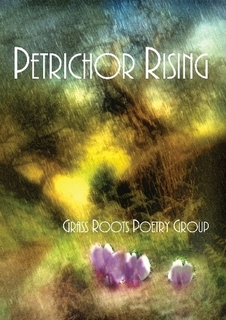
“Petrichor Rising” and how the Twitterverse birthed friendships that in turn birthed a poetry collection

product_thumbnail-3.php“I always had this notion that you earned your living and that poetry was a grace.” Seamus Heaney (1939-2013), Irish, poet, playwright, translator, educator and Nobel Prize winner

I’m sure my friend, John Anstie, poet and renaissance man, The Bardo Group core team member, and editor of and contributor to Petrichor Rising (eBook and paperback), a 2013 poetry collection of The Grass Roots Poetry Group (GRPG), would prefer that I focused on the poems and the collection. The feature-writer in me loves a good story though. (Forgive me, John!) The coming together of this group and the publication of their collection is as good a story as any and better than most … and hence, I break my usual self-imposed word limit on posts. Read on … You may recognize yourself in some of this …

“I do accounting. I am a writer.” an employee corrected me when I introduced him as an accountant.

I spent many years in the employment and training field, serving in sundry positions and writing columns, feature articles and journal pieces ad nauseam about recruiting and job search, chosing careers, assessing post-secondary vocational education programs, structuring community programs for at-risk populations (read the poor and marginalized), as well as writing about labor and job market trends including changes evolving out of advances in technology.

Wherever I worked whether it was counseling, placing executives in career positions or teaching career development and job search to ex-offenders or people transitioning off welfare, I found the same thing. Scratch the surface of almost anyone and you will find an artist.  Several of the poets to this anthology earn or have earned their living doing something other than writing. John Anstie talks about discovering his “inner poet.” At core, we are creators.  This is a great truth about human beings.

It used to be that most evidence of creativity ended in storage somewhere: dresser drawers, file cabinets, attics or garages … until the accessibility of social networking and self-publishing via blogs, videos, blog radio and other venues. Now  creatives have easy means to deliver their work independently and to find their own audiences, modest but genuine. No longer unknown, these poets and artists join the ranks of lesser-knows. They also have a wider opportunity to meet others with the same interests and values.  Put the mix together – a wonderous serendipity – and the birth of productive collaborations …

Freinds in the Forest (eCollage by Anu) (c) all rights reserved
Friends in the Forest (eCollage by Anu) (c) all rights reserved

“As far as I recall, it all started with freshly-baked lemon drizzle cake . . . ‘@peterwilkin1: Good Morning. Coffee & lemon drizzle cake, anyone?’ …. One may be forgiven for thinking the GRPG is an international social network-based association for the deep appreciation and virtual consumption of cyber cake and other comestibles. Indeed this is what they do, but they also do something else remarkable – they write poetry – delightful, delicious, scrumptious, tasty, and delectable at that, poetry.” Introduction, Craig Morris

And thus it began, with friendly – often quick-witted – Twitter chat and an affinity evolved. Two years later Petrichor Rising was born and featured artwork by one, the Introduction by another, and the poetry of the rest.  How did they pull it all together?

Interview with John Anstie

john_in_pose_half_face3

JAMIE: Expanding on your piece about editing Petrichor Rising (posted this evening on The Bardo Group): Learning to use language gracefully and words accurately is a lifelong challenge (and a pleasure); but editing English when the works are from such diverse regions of the world throws extra spice into the mix. There are many variations on the themes of grammar, spelling, and on syllable accent and speech inflection, how did you approach that particular challenge?

JOHN: Your first question is not a question, it is several questions, which, as you imply, could take me a lifetime (and possibly a few pages) to answer! But the simplest way I can answer this is to be entirely honest. By and large, I took each piece as it was presented and interpreted it as it was written. Grammar and spelling was not really a problem, since I left the words spelled as they were presented; my two North American friends, Jackie and Joe, if they used American English spelling, that’s how it stayed, of course. There were few issues in the grammar department. As for syllable stress and speech inflection, I had little issue with the effects of these on scansion, since almost all of the poems, except some of my own, were pretty much in the ‘free verse’ form. But you certainly have raised a valid issue for editors of international poetry collections.
.

JAMIE: How did you work out the collaboration? The book is admirably unified and surely there must have been some back-and-forth about which poems to use from each poet and how to organize the sequence.

.
JOHN: Over the two years of its gestation, there were a few changes of poems. Some of the original poems submitted were withdrawn, because of submissions elsewhere and a handful were edited and resubmitted for inclusion. The sequence was the greatest challenge for me. Initially, I asked each poet to attach key words or tags to each of their own poems, from which I intended to attempt dividing the whole body of work into sections. That didn’t work, simply because I inevitably ended up with too many key words. In the end, after we’d decided on the title, I felt it important that any themed sections should reflect the theme of the title in some way. So I worked through the whole collection of sixty-five or so poems and categorised them myself. The three sections were the end result of that part of my work on the book.
.
JAMIE: Have you had the opportunity to speak by phone or meet in person with any of the members of the Group? If so, what was that experience like.
.
JOHN: Five of us live in the UK. It was Louise, who bravely blazed a trail to Yorkshire to stay with Peter and his wife for a week. I guess she judged him to be trustworthy enough (and not the mad axe murderer he might have been!). I  journeyed up to meet them both on neutral ground. We spent a fruitful and enjoyable day in each other’s company. Shan and Abi were the next to visit Yorkshire. I’ve lost count of how many times we met after that, including a couple of poetry readings at Ally Wilkin’s shop “Crystal Space” (one of the locations in Peter’s and Marsha’s joint publication, “Brianca and The Crystal Dragons”). All of this was capped in a confluence in May 2012, when the five of us from the UK, along with Joe and Quirina, who flew in from Albany, New York and Germany, came together in London – photos of this are in my Facebook album of that day HERE.
.
It was a very happy day, but one that wasn’t long enough for us all. Finally, last June, Marsha came to the UK for a conference in Leeds. She lodged with Peter and Ally for the first part of her stay and with me for the last part. It was very special to meet her too. So, in answer to your question, I’ve met nearly all of them; only Jackie in New York and Craig in South Africa have yet to meet us. Quite incredible, considering we only met on Twitter two and a half years ago! One final twist to this tale, to cut a long story short, is that Abigail turns out to be the daughter of an old school friend of mine, whom I had very recently met up with again along with another friend! It’s a very small world!
.
JAMIE: What made you choose print-on-demand over ebook? Does the GRPG plan to offer the book in ebook format? It a lovely volume, and I think would make a fine addition to anyone’s poetry library. These days, though, many appreciate ebooks for their portability as well as the saving grace of saving shelf-space.
.
JOHN: Print on demand, in the end, seems like a very sensible choice. Self publishing would have been difficult, deciding how big a print run dramatically affects the cost-per-unit economies. However, it was the publisher, Aquillrelle, who determined the route to print and we chose them, because they had published Marsha’s collection, “Spinning”, and she was very impressed with their service and attention to detail. It proved to be a good choice for me, as their Chief Editor, did have a keen eye for detail. As for the ebook, Amazon should have produced one by now, but it’s not happened yet. I suspected it might be a demand thing; I’m not sure. Even though I own an iPad Mini, which is, of course, a perfect ebook reader, it has to be said that I prefer to have a real book in my hands.
.
Note: I see that Lulu has an eBook available since we did this interview. The link is above in the opening paragraph. Jamie
.
JAMIE: Would you do it all again and if so, why?
.
JOHN: I think the answer is yes, probably, but not in the same way. What would I do differently? I couldn’t answer that until I saw the material I was working with. However, there are two more projects on my horizon before another anthology comes along. The first is going to be some kind of account of the story of an historic house, gardens and estate, for which my wife and I are members of the volunteer teams. The second may be my own first full collection. Then, for the sake of my family history, maybe I ought to complete my own autobiography.
.
Book Review in Brief
 Petrichor – from the Greek pɛtrɨkər, the scent of rain on the dry earth.
.
I dislike using the word “accessible.” There have been times when I’ve wondered if that is code for a lack of intricacy or profundity. The work here is comprehensible but still complex. The poems move from nostalgia to appreciation, from the beauty of nature to the frailties of humanity, from sorrow to hope. From Craig Morris’ Introduction, which sets the mood, to Joe Hesch’s theme poem Petrichor, which closes the book, it’s a joy. Well organized with the weather metaphor as the through line, the sections are The Drought, Gathering Storm, and The Rain. Its hallmark is the show of humanity at its best.
.

This morning I will cast open the curtains, chasing the fear away
and hold this crystal up to the sunlight, releasing my soul to fly

– Prism, Abigal Baker

…. and at its worst

Haunted by
proper thoughts
of his wife at home
he wryly recollects
how he told her
before friends and family
on their silver anniversary
“I love every wrinkle,
every scar I celebrate,
such wonderous depths
are etched upon your body
a cartography of our marriage
I love the silver in the gold
of our hair”
then renewed
his marriage vows
his fingers crossed,
avoiding his own reflection
in the mirror

– Cracks of Angst: A Portrait of an Unhappy Man, Marsha Berry

Both my thumbs up on this one. There’s still time to order Petrichor Rising for the holidays and profits go to UNICEF, making it a definite win-win.

© 2013, feature article, Jamie Dedes, All rights reserved
Artwork and poetry quotes are the property of their creators