Page 3 of 4

PEN America celebrates the release of Turkish Journalist and Artist, Zehra Doğan
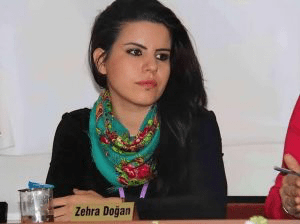
“Art should never be a crime. [Zehra] Doğan is a model of courage for all journalists and artists for standing up against injustice and silence, especially because of her determination to work and create while incarcerated.” Julie Trébault, Director of the Artists at Risk Connection (ARC) at PEN America


Last week PEN America celebrated the release of Turkish painter, journalist and feminist activist, incarcerated Zehra Doğan (Free Zehra Doğan • Zehra Doğan’a özgürlük). Doğan was released on February 24 after spending 600 days in a Turkish jail after courts deemed her journalistic and artistic work to be “terrorist propaganda.”

Doğan was the editor of Jin News Agency (JINHA), a feminist Kurdish news agency. She was arrested on July 21, 2016, and detained until December 2016 when she was released pending trial. On March 7, 2017, Doğan was sentenced to prison for 2 years, 10 months and 22 days on charges of “terrorist propaganda” as a result of her reporting, social media posts, and her paintings about the Turkish military’s operations in the largely Kurdish town of Nusaybin. The indictment stated that one of her paintings, which depicted a real-life scene of Turkish flags on war-torn buildings and was based on a photo circulated by the Turkish military on social media, went ‘beyond the limits of criticism.’ JINHA was also shut down as part of the government crackdown following an attempted coup in 2016.

“We are delighted that Zehra has been released and reunited with family and friends after her unjust imprisonment, which was an appalling affront to free expression,” said Julie Trébault, Director of the Artists at Risk Connection (ARC) at PEN America. “Art should never be a crime. Doğan is a model of courage for all journalists and artists for standing up against injustice and silence, especially because of her determination to work and create while incarcerated. Many other journalists in Turkey remain behind bars. As we celebrate Zehra’s release, we call for the release of all other Turkish journalists, artists, and activists who are in prison for their journalism or their expression.”

While imprisoned, Doğan rigorously continued to work on her paintings using diverse media including pomegranate shells, tincture of iodine, and bedsheets, despite restricted access to painting materials. Following her release, she told BBC Turkish that she had never painted as much as she did in prison. Also while in prison, she founded the 8-page handmade newspaper Özgür Gündem Zindan (Free Agenda Dungeon) with the help of several of her fellow inmates. As an inmate, Doğan received public support from numerous human rights organizations and renowned artists, including the graffiti artist Banksy and prominent Chinese artist Ai Weiwei. During her imprisonment, Doğan became the second woman in Turkey to receive the International Women’s Media Foundation’s “Courage in Journalism” award. She also received the Freethinker Prize from the Swiss Freethinker Association. Most recently, Doğan was shortlisted in the Arts category for the Index on Censorship Awards 2019.

*****

Post and photograph courtesy of PEN America.

PEN America stands at the intersection of literature and human rights to protect open expression in the United States and worldwide. It champions the freedom to write, recognizing the power of the word to transform the world. Its mission is to unite writers and their allies to celebrate creative expression and defend the liberties that make it possible.


ABOUT

POPULAR POLITICAL BLOGGER, LAURA BERLIN, DENIED PRESS CREDENTIAL TO COVER IOWA’S 2019 LEGISLATIVE SESSION

“PEN declares for a free press and opposes arbitrary censorship. It believes that the necessary advance of the world toward a more highly organized political and economic order renders free criticism of governments, administrations, and institutions imperative.” PEN Charter, 1948


“The Iowa House’s decision to deny press credentials to influential political blogger Laura Belin (Bleeding Heart, A community blog about Iowa politics) is a disturbing limitation on her First Amendment rights,” PEN America announced in a statement earlier this week.

Laura Belin, a writer and blogger who has covered political news at the Iowa state legislature since 2007, recently applied for and was reportedly denied a formal press credential that would have allowed her to cover the 2019 legislative session. The press credential would have provided deeper access to lawmaker briefings throughout the session as well as a workspace to focus on her blog, The Bleeding Heartland, which receives more than 1,500 unique daily visitors when the legislature is in session. Belin has been touted as “one of the best political reporters in Iowa” by news executive Michael Gartner. In denying Belin’s application, the Iowa House stated that “press credentials are not issued to members of the public.” Belin told the Associated Press that other non-traditional news outlets have been issued press credentials in the past and suggested that the reason for the denial may be the liberal-leaning nature of her blog. Belin has attempted to appeal the House’s decision and is considering legal action.

“There is little obvious reason why the Iowa House might have denied Belin’s press credential application, and it would be deeply concerning if their decision was motivated by wanting to restrict the political viewpoints espoused in her blog,” said Nora Benavidez, Director of U.S. Free Expression Programs at PEN America. “The general lack of transparency around the House’s process for approving press credentials creates space for unfounded restrictions of journalist access. We caution the Iowa House that any content-based limitations on journalists’ ability to report on government business would be an affront to press freedoms.”

In October 2018, PEN America filed a lawsuit, PEN America v. Trump, that seeks to stop President Trump from using the machinery of government to retaliate or threaten reprisals against journalists and media outlets for coverage he dislikes.

*****

Photo credit: The State Capitol of Iowa, with its Golden Dome courtesy of Iqkotze under CC BY-SA 3.0 license.

PEN America stands at the intersection of literature and human rights to protect open expression in the United States and worldwide. It champions the freedom to write, recognizing the power of the word to transform the world. Its mission is to unite writers and their allies to celebrate creative expression and defend the liberties that make it possible.


ABOUT

Testimonials

Disclosure

Facebook

Twitter

Poet and writer, I was once columnist and associate editor of a regional employment publication. I currently run this site, The Poet by Day, an information hub for poets and writers. I am the managing editor of The BeZine published by The Bardo Group Beguines (originally The Bardo Group), a virtual arts collective I founded.  I am a weekly contributor to Beguine Again, a site showcasing spiritual writers. My work is featured in a variety of publications and on sites, including: Levure littéraure, Ramingo’s PorchVita Brevis Literature,Compass Rose, Connotation PressThe Bar None GroupSalamander CoveSecond LightI Am Not a Silent PoetMeta / Phor(e) /Play, and California Woman. My poetry was recently read by Northern California actor Richard Lingua for Poetry Woodshed, Belfast Community Radio. I was featured in a lengthy interview on the Creative Nexus Radio Show where I was dubbed “Poetry Champion.”


The BeZine: Waging the Peace, An Interfaith Exploration featuring Fr. Daniel Sormani, Rev. Benjamin Meyers, and the Venerable Bhikkhu Bodhi among others

“What if our religion was each other. If our practice was our life. If prayer, our words. What if the temple was the Earth. If forests were our church. If holy water–the rivers, lakes, and ocean. What if meditation was our relationships. If the teacher was life. If wisdom was self-knowledge. If love was the center of our being.” Ganga White, teacher and exponent of Yoga and founder of White Lotus, a Yoga center and retreat house in Santa Barbara, CA

“Every pair of eyes facing you has probably experienced something you could not endure.” Lucille Clifton

YANG TONGYAN, IMPRISONED CHINESE WRITER and ACTIVIST, DIED WHILE ON MEDICAL PAROLE, his imprisonment a further blow to free expression

Photo from Yang Tongyan’s Facebook Page.
“Yang Tongyan was a peaceful champion of human rights and democracy, who made a huge personal sacrifice to stay true to his principles. The authorities feared the power of his writing and did all they could to silence him.He should never have spent a single day in jail let alone nearly half his life,” Nicholas Bequelin, East Asia Director at Amnesty International.
.

News that Chinese writer and recipient of the 2008 PEN/Barbara Goldsmith Freedom to Write Award Yang Tongyan has passed away, less than four months after the death of Liu Xiaobo under similar circumstances, is a further devastating loss for free expression advocates around the world and a harsh reminder of how critics of the government are treated by Chinese authorities, PEN America announced Tuesday.

According to a contact at the Independent Chinese PEN Center (ICPC), Yang Tongyan passed away after being released from Nanjing Prison on medical parole in August 2017 following his diagnosis with an aggressive form of brain cancer. He briefly returned to his home in Siyang, Jiangsu province. Although he was sent to a hospital in Shanghai that specializes in neurological care to have brain surgery, his family were informed that, as he was a “criminal,” he would not be permitted to leave the country for treatment, according to Yang’s sister.

According to Amnesty International, “Yang Tongyan was months away from completing a 12-year prison sentence when he was released on medical parole. His conviction for ‘subversion’ in 2006 was based on his writings in support of political and democratic change in China. He previously served a 10-year prison sentence for criticizing the crackdown on China’s 1989 pro-democracy movement.”

“Yang Tongyan’s death, so soon after that of Liu Xiaobo, is another black mark on the Chinese authorities’ human rights record,” said Karin Karlekar, PEN America’s Director of Free Expression at Risk Programs.

Yang, who wrote under the pseudonym Yang Tianshui, was a brilliant writer, literary critic, and member of the Independent Chinese PEN Center (ICPC), an organization of leading writers working on free expression issues both inside and outside of China. He was known for his critical writings published on web sites such as Boxun.com and EpochTimes.com. His catalog of literary writing includes poems, short stories, essays, novels, and memos, many of which were written during his time in prison. In May 2006, after a three hour trial that was closed to the public, Yang was sentenced to twelve years’ imprisonment and four years’ deprivation of political rights by the Zhenjiang Intermediate Court in eastern China’s Jiangsu province, on charges of “subversion of state power” for writing dissident articles, and for his political activism. He had suffered from poor health for years, and had served eleven years of his twelve-year sentence before his family’s third request for medical parole was approved.

News of Yang’s death comes less than four months after Nobel Peace Laureate and notable writer Liu Xiaobo’s death in custody from liver cancer. Following Liu’s release from prison, the authorities also denied his wish to travel overseas to access high-quality medical treatment. Since his death and funeral, his widow, poet and painter Liu Xia, has been held at an unknown location and has had no contact with family and friends.

China’s extensive censorship apparatus limits freedom of speech both within and outside its borders. The situation has grown more alarming since President Xi Jinping took office in early 2013, with an increased crackdown on free speech and implementation of additional censorship laws and restrictions on the internet. Lengthy prison sentences have long been used in China to silence dissident voices, and many Chinese writers, journalists, and pro-democracy activists live in fear of censorship, harassment, and incarceration as a result of speaking out about sensitive issues.

*****

This feature is courtesy of Yang Tongyan’s Facebook Page, PEN America and Amnesty International

PEN America stands at the intersection of literature and human rights to protect open expression in the United States and worldwide. It champions the freedom to write, recognizing the power of the word to transform the world. Its mission is to unite writers and their allies to celebrate creative expression and defend the liberties that make it possible.

Amnesty International is a global movement of over seven million people who, under this umbrella, campaign for a world where human rights are enjoyed by all.

“Only when the last prisoner of conscience has been freed, when the last torture chamber has been closed, when the United Nations Universal Declaration of Human Rights is a reality for the world’s people, will our work be done.” Peter Benenson, Amnesty International Founder

ABOUT THE POET BY DAY

A New Report from PEN America Warns: Epidemic of “Fake News” Poses Looming Threat to Free Expression


The spread of “fake news” is reaching a crisis point, PEN America warns in its new report,  Faking News: Fraudulent News and the Fight for Truth. The comprehensive, 100+-page report evaluates the array of strategies that Facebook, Google, Twitter, newsrooms, and civil society are undertaking to address the problem, stressing solutions that empower news consumers while vigilantly avoiding new infringements on free speech.

Coming from the leading US free expression organization, the PEN America report argues that even though most “fake news” is protected by the First Amendment, its proliferation creates a flood of disinformation that imperils open expression writ large and demands a concerted response.

“Fake news is mendacious publication gone viral in the digital age,” said Suzanne Nossel, executive director of PEN America, citing the organization’s 1948 Charter which commits PEN to “oppose such evils of a free press as mendacious publication, deliberate falsehood and distortion of facts for political and personal ends.”

“That most fraudulent news may be protected by the First Amendment doesn’t mean it isn’t corroding our discourse and, ultimately, our democracy,” said Nossel. “When the public loses its bearings in terms of what’s true or false, it shakes the foundations that make freedom of speech valuable.”

Faking News rates the range of fact-checking, algorithmic, educational and standards-based approaches being taken to counter the proliferation of fake news.  The report identifies sound methods that merit investment, and sounds a warning bell for tactics that risk suppressing controversial speech, such as giving government new powers to regulate or calling on social media companies to block specific content entirely.

The report comes out as tech giants Facebook, Google, and Twitter are being called to Capitol Hill to testify about how their companies’ platforms and technologies were used by Russian actors in an effort to sway the 2016 presidential election. Arguing that these companies—which are many Americans’ primary channels for news consumption—must play a critical and transparent role in curbing the spread of false news, the report spells out a series of specific strategies that center on empowering news consumers with access to fact-checking initiatives and news literacy programs.

In Faking News, PEN America also sets out a News Consumers Bill of Rights and Responsibilities outlining what consumers should expect from the outlets and social media platforms that convey news and how they can protect themselves and others.

In addition to the report, PEN America will host a public panel discussion about “fake news” on October 13 at the Newseum in Washington, featuring Nossel, NPR Editorial Director Michael Oreskes, executive director of the Newseum Institute’s First Amendment Center Lata Nott, media critic Rem Rieder, and George Stanley, award-winning editor of the Pulitzer Prize-winning Milwaukee Journal Sentinel and the Newseum’s Gene Policinski.

The report is available here.

*****

PEN America stands at the intersection of literature and human rights to protect free expression in the United States and worldwide. The organization champions the freedom to write, recognizing the power of the word to transform the world. Its mission is to unite writers and their allies to celebrate creative expression and defend the liberties that make it possible