THE WORDPLAY SHOP: books, tools and supplies for poets, writers and readers
Since the 11th of this month posts here often include a link to The Poet by Day store (The WordPlay Shop, an Amazon Affiliate), a natural extension in support of this site and its mission to champion poets and writers and to broaden and continue to offer resources and inspiration.
THE POET BY DAY POLICIES:
Though I have made the site an Amazon Affiliate, I continue my standard policy of not accepting – and I will never receive or accept – compensation to offer opinions on books, magazines, movies and documentaries, products, services, websites or political interests.The opinions expressed on this blog are entirely my own. I reserve the right to change my mind.
If I review it here or recommend it in the bookstore, it means I appreciate the work and find the content worthwhile.
I don’t do negative reviews, I simply don’t review books, magazines or films I don’t like or find wanting.
I do not return material submitted to me for review.
If you would like me to consider reviewing your book, chapbook, magazine or film, here are some general guidelines:
nothing that foments hate or misunderstanding
nothing violent or encouraging of violence
English only, though Spanish is okay if accompanied by translation
your book or other product doesn’t have to be available through Amazon for review here, but it does need to be easy for readers to find through your website or other source.
I do my best to feature products or services that I believe are worthy of your time and consideration based on my experience or their reputation or on recommendations by colleagues and readers. Nonetheless, any event, competition, product claim, statistic, quote or other representation about an event, competition, book, magazine, association, practice, film or other type of product or service should be verified by you with the author, manufacturer, provider, or other authority.
Awards and Contests – These are for generating income for the host organization. As in any other line of work, some are more reputable than others. I don’t enter every competition or have experience with all hosts, so please be sure to do your own homework.
Events – I am largely homebound due to disability and the need for supplemental oxygen. I no longer attend conventions and other events for poets and writers. For event information I have to rely on reputation and/or recommendations from readers, colleagues and friends. Again, be sure to do your own homework.
Some information is just that – information – and not necessarily recommendation.
REV. BARBER is a conservative Christian who embraces the full religious, ethnic and racial diversity of our country. Some say he is this era’s Martin Luther King, Jr. He believes in the dignity and worth of all people and the essential inter-relationship of all human beings. He stands for compassion, unity and social, environmental and economic justice.
In reading his views and about his work, I found myself moved to both hope and joy. This memoir is not simply an emotional or moral reaction. It’s a pragmatic plan for a more just and equitable country. I agree with Rev. Barber that our emerging leadership is encouraging scapegoating, a divide-and-conquer strategy that foments racial strife and economic inequality and the pitting of the 99% against one-another for the exclusive benefit of the 1%.
” … he laid the groundwork for a state-by-state movement that unites black, white, and brown, rich and poor, employed and unemployed, gay and straight, documented and undocumented, religious and secular. Only such a diverse fusion movement, Rev. Barber argues, can heal our nation’s wounds and produce public policy that is morally defensible, constitutionally consistent, and economically sane. The Third Reconstruction is both a blueprint for movement building and an inspiring call to action from the twenty-first century’s most effective grassroots organizer.”
Photo credit ~ courtesy of TWBuckner under CC BY 2.O License
Thank you for sharing your love of words. Comments will appear after moderation.
Many of us are concerned about the rhetoric, policies and appointees of the incoming administration and my church – Unitarian Universalists of San Mateo (UUSM) – is organizing a peaceful protest. We’re inviting people to line the El Camino Real (ECR) from San Francisco to San Jose with messages of love (respect), not hate, on Inauguration Day, January 20, Friday, from noon to 1 p.m. This form of PEACEFUL protest comes from the People Power tradition of the Philippines.
If you share our concerns, we invite you to look at the EVENT FLYER and to consider joining with us … but also to consider promoting it through your faith organization or other organizations and among your friends and family. In addition to sponsorship by UUSM, this event is also endorsed/sponsored by Suit Up! Action Network Mid-Peninsula/SF Bay Area, an offshot of Pantsuit Nation, and will likely be endorsed/sponsored by our local interfaith partnership.
Please mark your calendars and look for more information soon.
“We’ve made love private, contained it in family, when its audacity is in its potential to cross tribal lines.” Krista Trippet Leading in Difficult Times, Conversations Among the Clergy of San Mateo County, CA http://wp.me/pne74-dvy
Thank you for sharing your love of words. Comments will appear after moderation.
“At the end of the day, it isn’t where I came from. Maybe home is somewhere I’m going and never have been before.” Warsan Shire
I was diagnosed with interstitual lung disease in 1999. It wasn’t until 2008, however, that the most dramatic adjustments to my manner of living were required. What follows was written in April of that year. It was originally published in the now defunct California Woman.
It’s a good writing room, this room into which I have downsized to accommodate my disabled body. The room is big enough for comfort and small enough to be easy – and quick – to clean. Perfect! It’s the master suite in a sprawl of a condo on the gentle sweep of a tree-lined street in Menlo Park, California, a long way from home . . .
That march of trees down the drive, by the way – the oak and maple and campertown elm – is important. I’m enamoured of trees. Their proximity influenced my decision to rent.
“Trees are sanctuaries. Whoever knows how to speak to them, whoever knows how to listen to them, can learn the truth. They do not preach learning and precepts, they preach, undeterred by particulars, the ancient law of life.” ― Hermann Hesse, Trees: Reflections and Poems
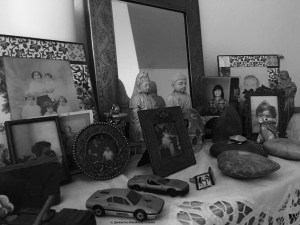
This place has a solid, foursquare feel to it. There are no stairs inside the condo and no stairs to reach it, and this is an added attraction. The colors are soft and peaceful: creams, peaches and pistachios, maroons and deep green. My large and cherished statue of Quan Yin and two tall plants add grace to one corner. My pie crust table with a small forest of variegated greenery sits in the other. There’s a maple secretary, which is perfect for my laptop and family photographs, a shrine (or so my world-class daughter-in-law says) to those who sit at the center of my heart. I have tossed a white cloth of Brandenburg lace over my round bedside table. My stereo lives on top of the old oak dresser. There are two mismatched-bookcases, much valued by me. They are part of our family history.
Once, forty-some years ago and 3,000 miles away, I was addicted to Georgette Heyer‘s Regency romances. I think if she would have written about this room with its fine, healthy plants, good books, good music, and hodgepodge of furniture, she might have described it as “shabby genteel”. That’s okay by me. I’ve got no one to impress and it serves my body, my spirit and my latter-day ambitions well.
I decided on a double-bed. It offers ample enough room to lay out books, pens and colored pencils, paper and even my laptop. My darling landlady’s two yellow-eyed black cats are also ample and like to hop on the bed for a visit. Executives both, they supervise and comment petulantly when I ignore their direction. I’ve had many kitty companions. My last was Pywacket. I’ve learned over time that cats, like moonlight, inspire the muse. They are very welcome in here.
There’s a washer and dryer inside the condo, so I don’t have to try to lug laundry to a garage or laundry room and back. The kitchen isn’t quite as bright as I’d like, but it’s clean – scrupulous – in granite and stainless steel. I enjoy cooking almost as much as writing. It’s an endeavor that feeds my soul as well as my body, though I admit I miss having the energy and opportunity to cook for others.
I’m all moved in and settled. If you peeked in at me, you’d think me a housefrau, not a bad thing, running the laundry while preparing dinner: creamy yogurt, enchanted broccoli with olive oil, garlic, and lemon, and cheery orange carrot-coins with fried onions and dill. I prepared a risotto with rose brown rice, shallots, and shiitake mushrooms. Later, a mug of honeyed Citrus Chamomile for a restful night of writing and sleep.
From this stillness, this cleanliness, this simplicity, I will write, cook and love my people with reckless abandon. For the moment, there is safe harbor. Life is good and tomorrow is a new day.
Swan (Hansa, हंस) is the symbol for Brahman-Atman in Hindu iconography. Brahman (/brəhmən/; ब्रह्मन्) connotes the highest Universal Principle, the Ultimate Reality in the universe.
WEDNESDAY WRITING PROMPT: Well, it’s December and as noted yesterday the month is dense with the religious holy days. That would be joy to some and disgruntlement to others. Wherever you stand in your thinking about God and by whatever name you call yourself and your vision of God, I thought it might be fun and interesting to write poems or essays about the nature of the Ineffible and why you do or why you don’t believe in God.
Often there is a temptation to view the other guy’s religion as superstition. Today let us write with deference for the diverse ways people try to make moral, spiritual and intellectual sense of a world in which illness, violence, despair, loneliness and death are as prevalent as hope, friendship, reason and birth.
If you’d like to share what you’ve written, just put the link to the piece in the comments below. Today I’ve stollen Ben Meyers’ Sunday sermon as a jumping-off point. Enjoy the read and enjoy your writing adventure. J.D.
SOME NOTIONS OF GOD
by
Rev. Benjamin Meyers
Rev. Ben Meyers of the Unitarian Universalists of San Mateo, California
One of the hazards of being a minister, I have found, is that when people I don’t know well discover that I am a minister – at some social function or party I attend or if I become a captive audience on a flight to somewhere – they will proudly proclaim to me “Oh, I don’t believe in God.”
Usually I respond with a nod and a simple “Un hum,” because sometimes their only purpose in saying this to me as a “reverend” is to shock or somehow upset me. But, if I sense they are sincere about wanting a genuine spiritual dialogue, I might say something like, “Un hum…. Well, tell me about this God in which you don’t believe?” I then listen carefully to their responses and ask questions about why and how and so forth. What generally unfolds is a story about events in their lives that led them to their assertion about the God in which they don’t believe.
Michelangelo’s Creation of Adam
When I have taken the time for such theological dialogue, nine times out of ten, I will eventually say something like: “Yes, I see. And you know what? I don’t believe in that God either (meaning, that old, outworn, dysfunctional, bearded, peeping-tom-in-the-sky God.) Vis-a-vis THAT God we are both atheists!”
Then I’ll suggest that now that we’ve discovered what it is we don’t believe when it comes to God, we can explore just what it is we might believe about God that would be positive, creative, healing, relational liberating and helpful. We’ll discover a kind of practical theology for ourselves.
The truly amazing and delightful and rewarding thing is that, again, nine times out of ten, IF that self-proclaimed atheist and I work together in authentic dialogue, we usually find and articulate a God-concept that we can both agree with or at least discover that our differing ideas of God are in sympathetic, parallel and supportive relationship to one another without anyone getting hurt.
There are so many creative, spirit-enriching ways for us to think about God, but getting there often means revisiting old notions about God that no longer fit our reality or experience. This work is critical to do if we are to mature spiritually as human beings.
Here’s a poem by the American writer, James Kavanaugh, entitled, “My Easy God is Dead”, which is a great expression of what I’m saying. He writes:
“I have lost my easy God— the one whose name I knew since childhood. He was a good God… He was a predictable God… He made pain sensible and patience possible and the future foreseeable… Now he haunts me seldom, some fierce umbilical is broken… now) I live with my own fragile hopes and sudden rising despair… my easy God is gone— and in his stead, the mystery of loneliness and love!”
For some of us, God is, as the old Universalists put it, love, simply love—a powerful spirit of goodness, warmth, mercy and justice that lives in people and the world. For others, God is expressed as a ‘life force’ or ‘creative spirit’ or ‘higher power’ or ‘supreme intelligence’ or ‘infinite ground of being’ that animates creation making life and purpose possible. For others, God is an ‘unknowable mystery’ that utterly defies definition or description. For some of us, God is simply a concept that is of absolutely no spiritual usefulness or practical relevance—in fact, it is viewed as a source of conflict and divisiveness and not considered helpful at all.
Personally and professionally, I don’t believe a God-concept is essential or necessary for people to live lives that reflect compassion, goodness and gratitude. But, there’s no getting around the persistence of the notion of God that has permeated and continues to occupy our minds and hearts and which represents—even in its ineffableness—what I call “The BIG idea.” Our theological nuances about God are endless, and this theological diversity is (to me at least) more beautiful than it is confusing or indulgent. For I believe that God is, above all else, a radically personal reality, rightfully different for each one of us as we experience our lives in our own idiosyncratic ways.
The philosopher, Ludwig Wittgenstein, was wise to declare that religion belongs to the “realm of the inexpressible.” And many Unitarian Universalist ministers attending seminary at Starr King School in the late eighties and early nineties had an incomparable New Testament professor by the name of Marcus Borg, who was so convinced of the utter subjectivity of God that he proclaimed passionately that it was absolute folly and foolishness to even attempt to share our own ideas and experience about God to others, so much so, that he wrote several books on the subject.
In one of them he implored: “Be content to know your own God–and for God’s sake–don’t try to transfer or argue it to someone else…We each must discover our own sense of life’s ultimate sacredness, not try to fit others’ into your own.”
And yet, while I agree with good professor Borg – blessed be his name – that talking about God with our clumsy, imprecise words is, by its very nature, an often subjective and slippery thing to do. I nonetheless believe, as did he by virtue of his writings on the subject, that there is great spiritual value when each of us humbly share what God does (and does not) mean to us, individually. Without such respectful sharing of our own ideas about our experiences and notions of God, how will we ever be able to mature and deepen our theological understandings and spiritual sensitivities and find the common ground that unites us, despite theological differences?
To avoid them is to invite and perpetuate distance, rather than connection. It is easier to embrace our differences and practice acceptance of one another when our differences are made known to us. It is a sign of spiritual growth and maturity to be able to do so. And, given the times in which we live, we need, now more than ever, to clarify and to promote the value of acceptance which is the cornerstone of deep faith and practice. If we can’t or don’t do so, how will we be able to foster the kind of civility and acceptance and search for common ground that is required of us as a world, a nation, a community … as people of faith?
This was the purpose and intention behind the meeting I attended this past Wednesday, from noon to 2pm, with twenty-four other religious leaders from various faith traditions. We agreed to gather and address this topic: “Leading in Difficult Times: Conversations Among Faith Leaders.”
Present were spiritual leaders representing Muslims and Jews, Catholics and Protestants, Buddhists and Unitarian Universalists. We were of various ages and gender-identities, ethnicities and physical abilities and what brought us together was a desire to know and to trust one another so that we could more effectively lead our people…beyond the complacencies of our unique faith communities…and to seek and FIND our common values… around which we might rally a response to the climate of hatred and violence and the wave of dangers that we collectively face…in the greater world, our own nation, in our community, our congregations and our own hearts…to counter our fears and our uncertainties and our distrust about the future.
How do we lead in difficult times unlike any other we have ever faced? We know, as clergy leaders, that to be effective in these ‘interesting times’, we must acknowledge our differences and put them aside in order to stand firm against the attack on the values we hold in common, which are shared and which are central to each of our faith traditions. It was a most remarkable session.
In circles of eight, we shared our stories. We shared our concerns and our fears. But more importantly we shared our values and that which lifts us above our fears so that we may lead beyond them and be emboldened and strengthened in solidarity with our shared purpose.
From a Buddhist minister, I learned of the fear that exists in his community that history may well repeat itself as people in our county are suddenly whisked away and interred in camps as potential enemies of the state, just as so many Japanese-Americans were during World War II. They are willing to stand with our immigrant and Muslim neighbors to ensure this does not happen again and they invited us to do the same.
My Jewish colleagues expressed concern against the quiet acquiescence and acceptance of the erosion of rights of citizens as one line in the sand after another is allowed to be crossed, just as they were in Nazi Germany until the seemingly impossible became possible. They wondered at what point would we stand together to counter the hate speech that precedes the horrors of violence?
A Latina priest from a predominantly Hispanic Episcopal church fears the scapegoating against immigrants and the very real prospect that families will be destroyed and family members ‘disappear’ without a word or trace. And how any knock on the door might mean deportation without due process or warning. She wondered aloud how it would be possible for people, “made in the same likeness of God” to be capable of oppressing “the very presence God” found in those they persecute.
Another colleague realized that we can no longer afford the luxury of believing ourselves separate from one another. They noted that, before 11/9, there seemed to be so many different causes and issues to be concerned about: Islamophobia, Misogyny, Homophobia, anti-Immigration hate and the degradation of our environment….and now we are forced to see that all of these are related and connected that, in the words of John Muir . . .
“When we try to pick out anything by itself, we find it hitched to everything else in the universe.”
In the end, in my mind, we all became one faith, one people. What a moment and in the end, we made a covenant, a promise, to one another that if any ONE of us sent out a plead for help or solidarity, that we would ALL do our utmost to show up and to bring our congregations with us. It was the most deeply moving multi-faith meeting I had ever attended. There was great solidarity among us, solidarity beyond our notions of difference in theology, or culture, or practice. We affirmed one another as one. It was almost the best meeting I attended that day.
But from that meeting I came here…to Beck Hall, where our Justice Ministry Team Leaders had organized a gathering of another 25 of us to address essentially the same questions: What do we do now? How do we, as a spiritual community put our faith to action? How do we embody our mission to transform ourselves and the world in a post-11/9 world?
We began by listening to one another, by naming our fears and concerns and also giving voice to our shared values. We then organized into four areas for action: Immigration Response, Multi-Faith partnerships, Environmental Justice and Racial Justice. We came away with concrete steps to bring these issues into the life of this congregation…so that we may live out our values and stand together on the side of love – within the capacity and ability of each of us to do so – STAY TUNED. Don’t go anywhere…like Canada…yet.
All of this is by way of prefacing the sharing, however briefly, of my own notions of God, and what God (as I experience it in my everyday life) means to me. I offer my elusive understanding of God not (I assure you) to “set you straight once and for all” on the question of God. We are, after all, Unitarian Universalists who understand truth and reality as mysterious and many splendored things. I share what God means to me in the hope that my understanding might stimulate you in your own thinking and feeling about this most fundamental of religious concepts.
Most essentially, and I reserve the right to come back and revisit this subject often, or today, God, to me is a participatory phenomenon….a relational reality….a living process that needs us to exist if it is going to achieve its fullest and finest reality and power.
I believe God comes to life when we, I, become more loving, just, and giving. I like what Dorothee Soelle said …
“To believe in God means to take sides with life and to end our alliance with death. It means to stop killing and wanting to kill, and to do battle with apathy which is so akin to killing. To take sides with life and experience how we can transcend ourselves is a process that has many names and faces. Religion is one of those names. Religion can mean the radical and wholehearted attempt to take sides with life.”
If you or I don’t “take sides with life” —in our little corners of the globe, with the people near us—if we fail to bring our best and most loving gifts to the world of need, then God’s spirit is absent. If, for example, you stand faithfully by someone’s death bed, holding their hand and soothing their brow—it is your presence, your physical embrace, tentative and imperfect as they are—that are the only way that dying person is to know solace and grace and love. It is utterly without self-importance that I tell you that I deeply believe God needs me (and you) if God is to be at all. To me, the most beautiful theological thought of all is that there is a holy spirit breathing through life which WELCOMES AND ENCOURAGES our energies and gifts….the God that haunts and blesses me quietly welcomes my most passionate and loving participation in the creation of life.
This idea of god as a relational process is hardly new. The Jewish theologian Martin Buber described God as an active verb that comes to birth best in the loving “I-Thou” encounter, that mysterious arching of energy and affection, that can spark between human beings. And even more recently, the relatively new school of theology called “Process Theology” proclaims, basically, that God is a verb—a living process of justice, love, compassion and creation. The process theologians believe the God does not exist as some abstract, supernatural, heavenly personality far removed from us, but rather is a living process that invites us in ever-fuller partnership with everything that breathes, cares and grows. As a recent rock opera put it in “The Song of Three Children,” “God is not a she, God is not a he, God is not an it or a maybe. God is a moving, loving, doing, knowing, growing mystery.”
Its a hard thought to hold, isn’t it, that God (or at least one dimension of God) is a verb, a process of noble becoming rather than an actual cosmic being. The God I know and depend on for spiritual wholeness is both a presence and a process. My God is an open, available, holy spirit…a good and gracious spirit astir in-my world, which guides my heart to action, which welcomes my frail, little contributions of beauty and blessing, of service and love. If we human beings awaken to the holy powers and processes that are everywhere around and within us, then we participate in that holiness, and that participation blesses, fills and saves us.
My old, easy, predictable Gods are dead. But the creation in which I live is astir with sacredness and grace. I believe there is a Holy Spirit of Life that blesses and nurtures all who are open to its power and purpose. Name it whatever you will, describe it in whatever words work for you—but both savor and serve life’s irrepressible, unmistakable holiness.
In closing: Dag Hammarskjold had it right when he said …
“God does not die on the day we cease to believe in a personal deity….but we die on the day when our lives cease to be illumined by a steady radiance–renewed daily–of the wonder, the source of which is beyond all reason.”

 REV. BARBER is a conservative Christian who embraces the full religious, ethnic and racial diversity of our country. Some say he is this era’s Martin Luther King, Jr. He believes in the dignity and worth of all people and the essential inter-relationship of all human beings. He stands for compassion, unity and social, environmental and economic justice.






 Jamie Dedes' THE POET BY DAY Webzine