Page 81 of 131

The Other Half of a Poem

9833029by Tim Buck and originally published in Spectralyre (an online journal, recommended) and presented here with permission.

A poem should have two kinds of presence, because most quality poems have two kinds of presence — what’s written and what’s implicit.

A marvelous poem is composed of what’s on the page and what hovers like a ghost. Combined, those two aspects make up a glowing artistic volume. The written half of a marvelous poem transmutes segments of being into supple images and other inscribed substances — memory, metaphor, irony. That other, unwritten half, existing abstractly and silently, is made up of enriched consciousness, large time, and metaphysical atmosphere. Those three aspects lend the poem an aesthetic weight, a confident flair, an artistic momentum.

What’s unwritten bequeaths the glow to what’s written.

Poems that aren’t marvelous are almost always what’s on the page. Even accounting for an occasional quality flourish of textured mood and symbol, the un-marvelous poem betrays its deep artistic lack by not containing stuff that’s not there, that’s not written on the page. Instead of bringing enriched consciousness, large time, and metaphysical atmosphere to implicit presence and effect, an inartistic poem contents itself with shrunken spaces of personal and cultural experience. Also, an acquiescence to academic persona — to routinized materials of attitude and saying — results in spiritual anemia, small occasion, and airless being. It’s only what’s on the page. It’s surface and ego. It’s missing an unwritten aura.

There are, thankfully, exceptional poets today who do write in the haunted, elegant, and expansive style.

The poems of Adam Zagajewski allow unusual depth to happen and aesthetic presence to manifest. His work isn’t missing the glow, the echo, and the ambiance of what’s not written. The everyday therefore becomes clothed in subtle qualities of unexpected significance. It’s as if a strange luminescence has been added to ordinary light, imbuing written substance with In his poem “Luxembourg Gardens” from Unseen Hand, Zagajewski creates a sense of quiet and marvelous drama out of what trembles beyond the self:

Adam_Zagajewski_2014_in_Stockholm

Foreignness is lovely, a cold joy.

Yellow lights illuminate the windows on the Seine

(something truly enigmatic: other people’s lives).

Also from Unseen Hand comes the poem “Faces”. Here, the poet conjures from normality a volume of aesthetic savor and suspense:

I thought that the city is built not of houses,

squares, boulevards, parks, wide streets,

but of faces gleaming like lamps,

How does a writer of poems learn how to make poems that have another, unwritten half? How did the marvelous, exceptional poets like Zagajewski acquire enriched consciousness, accumulate large time, absorb metaphysical atmosphere?

Some basic research reveals interesting things.

In Zagajewski’s case, he is appreciative of classical music, especially sensitive to the works of Schubert and Mahler. An aspiring poet should consider saturating himself or herself with the music of Schubert and Mahler. Something significant that is intangible and ineffable might arc from ear to page, enriching the page with unwritten aspects.

Zagajewski’s essays, in addition to his poems, teem with much more time than the now. An aspiring poet should consider saturating himself or herself with history, especially keeping alive the textured worlds of great dead poets. Something peculiar having to do with old clocks and forgotten graveyards might rub off onto one’s work, enlarging its scope and spirit.

Most poets today write a sort of strident, over-confident verse. Orientation in these poems is a view straight onto materiality and personal circumstance. No buffering spiritual distance separates poet from his precipitate language, no suspicion that language itself is a form of unknown being. An almost hectoring absence of contemplative space and mystical concern makes today’s poetry a trial to endure. Zagajewski strives for what he calls “metaphysical modesty.” He also thinks about the problem and the possibility of hope in an absurd and deathly world. An aspiring poet should consider saturating himself or herself with the ideas of, say, Plotinus, Kant, and Unamuno, with the novels of Dostoevsky and Kafka, with the films of Bergman and Tarkovsky. If you’re unaccustomed to thinking about existence as such, about art as a mode of possible transcendence, perhaps you could work on that. Something weird might leak in, causing one’s poems to softly fill with paradox and wonder.

Poets should be conduits of the unwritten, of the unseen. A poem doesn’t have to be about or even mention music, history, and philosophy but should be infused or imbued with those elements.

– Tim Buck

© 2016, essay, Tim Buck, All rights reserved; photograph of Adam Zagajewski by Frankie Fouganthin under CC BY-SA license

Seven Poems for Children

Eckhart

How awkward to play with glue, Constance Levy

About the Teeth of Sharks, John Chardi

Valentine, Donald Hall

Daddy Fell Into the Pond, Alfred Noyes

Perfect, Ken Nesbitt

Freddie, Phil Bolsta

My First Best Friend, Jack Prelutsky

Celebrating American She-Poets (6): Young People’s Poet Laureate, Jacqueline Woods … Brown Girl Dreaming

Jacqueline Woodson by David Shankbone under CC By SA 3.0 license

American poet and writer, Jacqueline Woods (b. 1963) was named Young People’s Poet Laureate in June last year by The Poetry Foundation. The $25,000 laureate award is given every two years to poets devoted to writing quality poetry for children and youth. Poetry Foundation President, Robert Polito, said Jacqueline is an “elegant, daring, and restlessly innovative writer.”

Jacqueline has written some thirty books. She’s won a National Book Award and three Newberry Honor Medals.

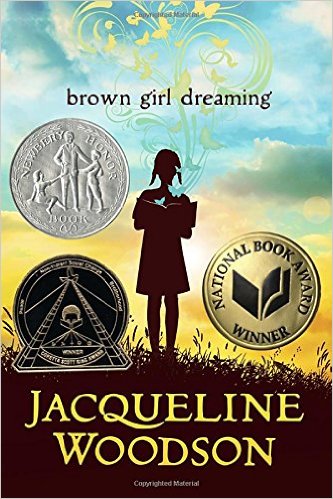
51-Pl9BJ7IL._SX331_BO1,204,203,200_I just finished reading Brown Girl Dreaming, a memoir in free verse that is not just for brown girls. It can be read in one sitting but like all good poetry is meant to be relished … there is much to savor.

What I like about this work – and what in part accounts for its popularity – is that it puts family life and youthful reflection smack-dab in the context of history. Woodson grew-up during the civil rights movement and tells of watching the Black Panthers on television and sitting in the back of the bus, though Woodson’s mother made a point of affirming for her children that they were as good as anyone.

I enjoyed – and think most kids would too – how Woodson writes about the contradictions in family stories. The day, for example, that she is born is reported differently by mother, father and grandmother, each absolutely sure that he or she is the only one who got it right.

This is a wonderful book for any young person. I venture to say, however,  if yours is a child who dreams of being a writer and can’t envision it happening, then you must put this book in that child’s hands. S/he will be forever grateful.

© 2016, Jamie Dedes

THE SUNDAY POESY: opportunities, events, classes and other news for poets

PBD - blogrollCONTESTS/COMPETITIONS:

Opportunity Knocks:

  • The Lexi Rudnitsky/Editor’s Choice Award is an annual collaboration between Persea Books and The Lexi Rudnitsky Poetry Project. It is open to any poet who has previously published at least one full-length book of poems. The winner receives an advance of $1,000.00, publication of his/her collection by Persea, and a stipend of $1,000 for expenses related to the promotion of the collection (e.g. travel to and from readings). DEADLINE: 9 March 2016
  • The 2016 Pinch Literary Awards
    Sponsored by the Hohenberg Foundation
    December 15, 2015 – DEADLINE: 15 MARCH 2016
    1st Place in fiction, nonfiction, and poetry each receive $1000.
  • The Robinson Jeffers Tor House 2016 Prize for Poetry (Scroll down in newsletter for details) DEADLINE: 15 MARCH 2016The annual Tor House Prize for Poetry is a living memorial to American poet Robinson Jeffers (1887-1962)
    $2,000 for an original, unpublished poem not to exceed three pages in length. $200 for Honorable Mentions.
  • Main Street Rag Publishing Company: Cathy Smith Bowers Chapbook Contest, The inaugural Cathy Smith Bower Chapbook Contest will open in 2016. DETAILS TO BE ANNOUNCED
  • DEADLINE: May 6, 2016, Writer’s Digest Annual Writing Competition 85th Annual Writing Competition for a chance to win and have your work be seen by editors and agents. The winning entries of this writing contest will also be on display in the 85th Annual Writer’s Digest Competition Collection. Categories include rhyming and nonrhyming poems.

PUBLICATION POSSIBILITIES:

Opportunity Knocks:

  • HEADS-UP: Residents of Swindon UK

Amaryllis is Poetry Swindon’s poetry blog and publishes a poem each week. HERE.

EVENTS:

logoJoin poet Natasha Head (The Tashtoo Parlour) and poet and “poetry champion,” Jamie Dedes (The Poet by Day and The BeZine) for a radio chat about online poetry connections and community … Also on the program are: poet and photographer, Roger Allan Baut (Chasing Tao), artist Matthew Hatt (Matthew Hatt and Calculated Kaos), poet Susie Clevenger (Butterly PoetBlog 4 Peace, and Confessions of a Laundry Goddess) and others.

On 28 February 2016, Sunday, at 2:00 p.m. ET

3 p.m. AT – 1 p.m. CT – 12 p.m. MT – 11 p.m. PT

  • POETRY UNBOUND:

HEADS-UP: Berkeley, CA and the San Francisco Bay Area
March 6, as below and poet bios are HERE.
12744141_10207737672172762_6902229050544911951_n

  • SEEING THE TRUTH ARRIVE:

HEADS-UP: Carmel CA, Monterey County 
Friday, March 11, 7:30
Seeing the Truth Arrive
A reading of the poetry of Muriel Rukeyser and Robinson Jeffers and their own work by Kathryn Petruccelli and Elliot Ruchowitz-Roberts
Carl Cherry Center for the Arts
Guadalupe and Fourth Carmel, Carmel
Admission: $15 Co-sponsored by the Carl Cherry Center for the Arts For reservations: 624-7491, info@carlcherrycenter.org. MORE

  • Every Second Friday, James Street North Art Crawl, Hamilton, Ontario, Canada: visit, connect, be inspired.  If you don’t live in Hamilton, search out art crawls in your area. They’re good for the soul.
  • March is Black History Month in the United States. To honor the month, the people and our shared history, The Poet by Day, will shine its light on a number of Black American poets.

PUBLICATIONS/BOOK LAUNCHS:

  • interNational Poetry Month, A Celebration of The BeZine is in April, publication date April 15.
  • The next issue of ARTEMISpoetry, a publication of Second Light Network of Women Poets, will come out in May.
  • Matt Pasca’s Raven’s Wire launched yesterday. The book is now available on Amazon. Link HERE to The Poet by Day book review and interview with Matt
  • Grabbing the Apple (JBStillwater, 2016), an anthology of poems by New York Women Writers, editors Terri Muuss and Mary Jane Tenerelli, will launch in March.

KUDOS:

  • American-Isreali poet, Michael Dickel (Fragments of Michael Dickel and War Surrounds Us, Is a Rose Press, 2015) made .Kred’s “Most Influenctial Bloggers” list. Michael is also a member of The BeZine core team and the lead for The BeZine, 100,000 Poets for Change project.
  • Cannoness to The Bardo Group Bequines (publishers of The BeZine), Terri Stewart (Beguine Again) completed the final interviews and gained a recommendation to become an ordained elder in full connection within the United Methodist Church. Look for news in May when the final vote of the full Board of Ordained Ministry affirms the recommendation.

DISTANCE LEARNING CLASSES

shopfanfarePoet and founder of Second Light Network of Women Poets (SLN), Dilys Wood, announced the launch of the second in the Series of Second Light ‘Remote’ Workshops. Dilys says these are suitable for individuals at home or for working in groups. As with their first series (based on our 2014 anthology Her Wings of Glass), this Series has eight workshops, based on SLN’s 2015 anthology Fanfare.