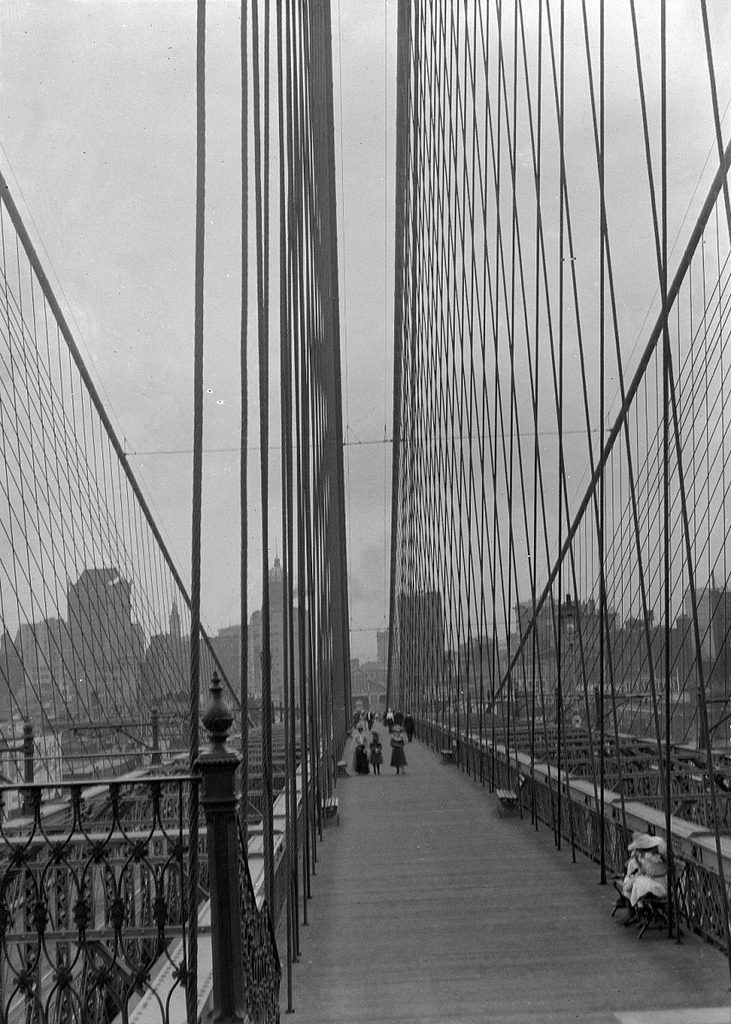
Brooklyn Bridge, looking west from Brooklyn, July 1899
The courageous immigrants of the elder generations cast the shards of their hopes and dreams across the landscape of this continent as prophecy. They worked hard and long for their visions. These people included my Lebanese maternal grandparents with their first-born children. They arrived in New York in 1897 on a boat from Syria. They petitioned for citizenship in 1925. Included also was my Turkish father who arrived here alone in 1919. He was just seventeen, eager to make good and to earn dowries for his four older sisters. The distaff side eventually settled in Brooklyn. That’s where they were when I was born and that’s where I was raised.
These were people who came to America in “the days of sail,” as the great New York writer, Irish-American Pete Hamill, would say. Today’s immigrants can and often easily do visit their countries of origin. They connect with their families and their linguistic and cultural roots. This was something that was generally not available to the people of my grandparent’s generation and before. Among the many reasons for this was an often crushing poverty. In Ireland “American wakes” were held for the sons and daughters who left for the United States. Heart-shattered parents knew it was unlikely they’d ever see their children again.
The immigrants I knew growing up worked hard. The immigrants that I know today work hard, often holding more than one job. They make real – though generally quiet – contributions to their communities, work places and their new country. They serve in the military. They make sure their children are educated.
Because of parents and grandparents who were resourceful and brave enough to come to this country, we had as children, not just economic opportunity, but a wealth of artistic and educational resources. On occasion we went, for example, to the Leonard Bernstein‘s Young People’s Concerts at the New York Philharmonic. I remember Mr. Bernstein with his charming and contagious enthusiasm calling our imaginations to Peter and the Wolf. We didn’t have to travel far to have access to talents like Mr. Bernstein or to visit museums, cathedrals, art galleries, music venues, theater (movies and stage), parks and so much more. It was all right there, ready to be plucked and savored like so many sweet and juicy summer plums.
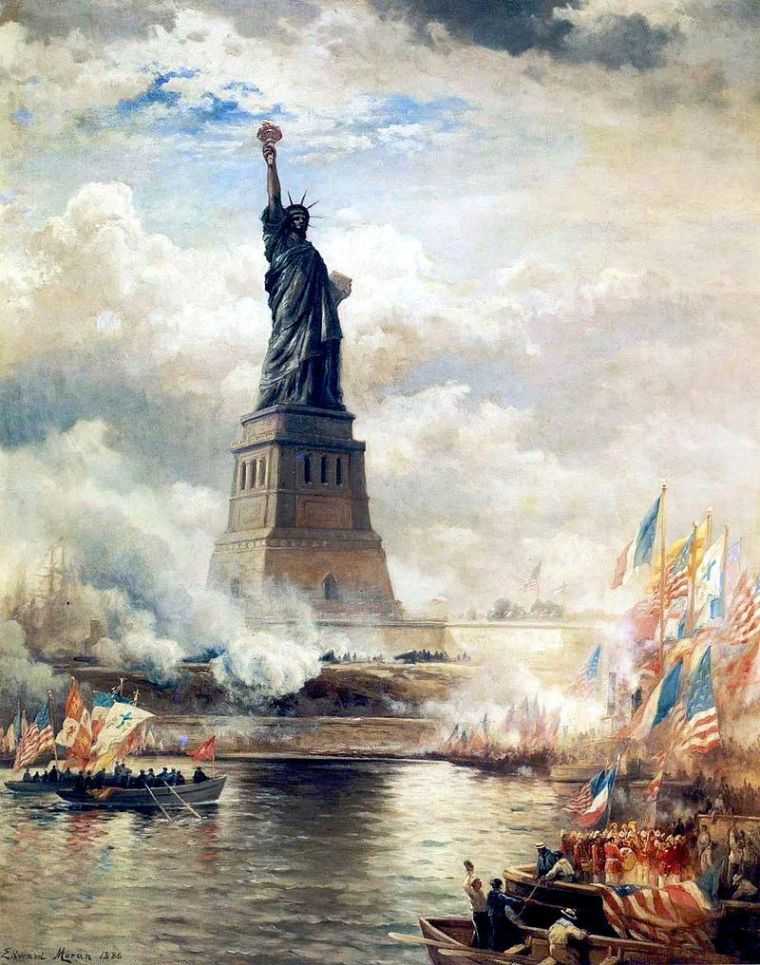
Unveiling of the Statue of Liberty Enlightening the World (1886) by Edward Moran. Oil on canvas. The J. Clarence Davies Collection, Museum of the City of New York. (Public Domain)
The schools were good, whether public or private. The libraries were ubiquitous. I will ever and always be in love with the Hudson River and the incredibly beautiful and historic Brooklyn Bridge. To my child-self, everything was magical, mystical, mythological and monolithic. Brooklyn’s proximity to Manhattan added to my enchantment. The Cloisters. Central Park. The magnificent Statue of Liberty, symbol of our highest ideal.
The New Colossus
Not like the brazen giant of Greek fame,
With conquering limbs astride from land to land;
Here at our sea-washed, sunset gates shall stand
A mighty woman with a torch, whose flame
Is the imprisoned lightning, and her name
Mother of Exiles. From her beacon-hand
Glows world-wide welcome; her mild eyes command
The air-bridged harbor that twin cities frame.
“Keep, ancient lands, your storied pomp!” cries she
With silent lips. “Give me your tired, your poor,
Your huddled masses yearning to breathe free,
The wretched refuse of your teeming shore.
Send these, the homeless, tempest-tost to me,
I lift my lamp beside the golden door!”
– Emma Lazarus (1849-1887)
I’m sure that had I been born in the mountains of Lebanon or in rural Turkey, these places would have offered their own joys and charms but I’m grateful for my Brooklyn, New York experience.
I too lived – Brooklyn, of ample hills, was mine; I too walk’d the streets of Manhattan Island, and bathed in the waters around it; I too felt the curious abrupt questionings stir within me In the day, among crowds of people, sometimes they came upon me, In my walks home late at night, or as I lay in my bed, they came upon me.
Walt Whitman (1819-1892), Leaves of Grass
This week’s prompt is “immigration.” Write in prose (up to 750 words) or poem about your experience or observation. Your work doesn’t have to be about immigration to the US. It can address or illustrate the refugee experience if you prefer.
There are so many on the move – and on the run – right now, historic numbers, and the world is fraught with anger and meanness on this topic. It seems a good subject to tackle through Wednesday Writing Prompt, though please know that I won’t publish and will delete anything encouraging of violence or hate.
Leave your prose or poem/s or a link to them in the comments section below. All work shared on theme will be published here next Tuesday. If it’s your first time coming out to play for Wednesday Writing Prompt, please send a short bio in the body of an email and a photo of yourself as an attachment to thepoetbyday@gmail.com for use as an introduction. You have until Monday evening, 8:30 p.m. PST, to respond to the prompt. You are welcome – encouraged – to join in no matter the status of your career: novice, emerging or pro.
my mother never knew the names for things
the trees were just trees, the flowers just flowers,
she knew life as a sigh and aspiration as a linchpin,
she could get to work and maneuver in the dark,
she could squeeze a penny too
and force tired feet into worn shoes
the fields that year taught the art of sleeping outside,
sleeping without walls, watching the stars and moon,
our dreams spun from sunsets and morning dew ~
we slept in bedrolls configured from old white sheets and
the khaki wool blankets my uncles took to war, i wondered
about my uncles as i did about many people, many things
and that summer held varied delights, climbing trees,
eating cherries without washing them . . . oh! ~
and there were blueberry bushes and fig trees and
i lined the path to the food hut with odd sunday stones
i said my own prayers while the big girls were at Mass
and marveled at my middle-aged mother’s plump knees
i marked her spirit for wearing bermudas, for joining
children’s games, sitting ’round fires, making ‘smores ~
now I wonder at summer camp morphing into metaphor,
all our lives we did those things: gathering dreams,
mom and me, outsider artists sleeping without walls
they dwelt in houses of silence
chewed through grudging fences
swam in oceans of best intentions
tried to find one another on the
shores of their fears and confusions,
alienation was their warrior shield, silence, the mom’s default position
their lives were lived in a boxing ring
the fist in the glove was a malignancy
and the mom passed her days sparring,
she thought the winner would be the
woman who was pretty and hushed
even when she got knocked out, she
wearied the charity of her own mother
she became embittered in isolation,
there was no one else she could
beat upon or say her grief to or even
show her bruises and lacerations ~
except for that small child of silence,
useless in matters of this magnitude
mom stressed
as she sat
with her 10-key
urgently
conscientiously
feeding it numbers
for a business
in Redhook
a commercial building
in old red brick
her calculations spun
Monday through Friday
dripping white paper
in ribbons
pooling on the floor
with all her adds
all her minuses
she accounted
in gray led
on lined green paper
A/R and A/P
payroll
chart of accounts
bank reconciliations
consolidated financials
transactions
neatly ticked and tied
to ledgers and subledgers
hand formulated
amounting to
zilch
zip
squat
zero
nothing
gone
forgotten
except
for the echo of her sighs
Sundays, summer ferry rides,
crossing the rough wide Hudson
from Brooklyn to Staten Island,
from one brave shore to another,
stalked by a colony of seagulls,
the boat frothing white waves in
its habitual and deliberate path.
I’d collect the cold green spray in
my warm hands, framing the tidbit
of raw river in the cup of my palms,
a child-self awed by the pleasures,
by whimsy and an affinity, organic
and ecstatic, like spindrift whorling
as if a dervish from boisterous waves
“And you that shall cross from shore to shore years hence, are more to me, and more in my meditations, than you might suppose.” Walt Whitman (1819-1892), Crossing Brooklyn Ferry
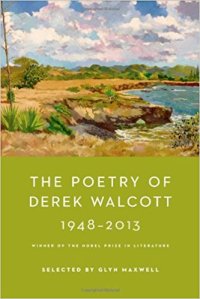
In honor of Derek Walcott who died a few days ago, the recommended read for this week is The Poetry of Derek Walcott 1948-2013. Walcott first poem was published when he was fourteen and this book was published in his 84th year. Never more than now has the world needed the grace, wisdom and universality of his poetry. This is a must add to your poetry book collection. It doesn’t include the epic Omeros, also recommended, but it does include some of his earlier work that I have not seen included elsewhere.
By shopping at Amazon through The Word Play Shopandusing the book links embedded in posts, you help to support the maintenance of this site. Thank you! (Some book links will just lead to info about the book or poet/author and not to Amazon.)
The WordPlay Shop offers books and other tools especially selected for poets and writers.
Michael Watson ~ After a couple of days of warmth and rain, today is seasonably cold. Next week is forecast to be very warm again, an unnerving scenario as we rely on the snow pack for our summer water supply.
Climate change is a complex issue, not so much because there is doubt that it is human caused and accelerating, but because it affects people unevenly. Here in Vermont folks are divided about the issue. Many are appreciative of our much briefer and milder winters. Others lament the loss of tourism jobs, the declining maple forests, and the increasing number of failed drinking water wells.
Much of the divide in opinion can be linked to whether a person lives their life inside or outside. City folk tend to lament cold, snowy, inconvenient weather. Those who spend most of their days outside are more likely to have a keen sense of the problems and losses that come with global climate change.
Those about to assume leadership of the United States deny climate change. They also reject ideas of diversity, stewardship, and mutual responsibility and community. But you already know this. What you may not know is that many idolize Andrew Jackson. Jackson defied the Supreme Court and stole the lands and farms of Naive people in the Southeast, sending The People on a Trail of Tears. He is so hated in Indian Country that many Native people refuse to use twenty-dollar bills.
Somehow, a few families managed to avoid deportation. I like to imagine they lived up in distant hollows or in the dense forested swamps of the river bottoms.
My father’s family identified as Native, although they refused to tell us younger ones what tribes we hail from. (They did instill in us a deep sense that governments can’t be trusted.) They grew up in Indiana at a time when being Native could cost you your farm, or your life. My understanding is that after my grandfather left the family, my grandmother moved the farm to a rocky, inhospitable, spectacularly beautiful location overlooking the Ohio River. She correctly assumed they would be safe there. My dad and his siblings walked downhill to school, then back up to home. Once, dad took me to see the homestead, in what is now a state park. It took us almost two hours to hike up. (No doubt my Polio body slowed us down.)
A few years ago I was introduce to the idea of “survivance.” The term was apparently a legal term in the Eighteenth Century, but was adapted for Native use by Jerald Vizenor, a much venerated Native Studies scholar who is no longer here in physical form. The term refers to active survival, a continued presence even as we are supposed to have been erased from the land.
I like to think of survivance as the task of refusing erasure. Beyond that, it is the art of living well in the face of hatred and genocide. I imagine the concept of continuing to live well while under threat might be applicable to the situation of many of us in 2017. (My wife, Jennie, a Jewess, contends that the term applies perfectly to folks who resisted the Holocaust, and I suspect she is right.) Survivance implies asking important questions and making difficult choices. When does one openly resist? When does one hide or, if possible, pass? How do we find and nurture joy, family, and community in the face of hatred?
For me, there is an even more fundamental definition of survivance: the task of nurturing and protecting the soul in the face of those who would obliterate it. We need to save our souls, (individual, cultural, and collective) from those who would destroy them, for soul loss is excruciatingly painful and may impact many generations. (Make no mistake, Jackson and his ilk wanted nothing less than the destruction of the Native soul; those who idealize him now want nothing less than the destruction of all that is “Other”.)
Perhaps we can learn something about survivance from those who came before us. There is much to be said for living on land no one else desires, holding ceremony in the deep night, and pretending to be one of the majority. There is much to gain from building coalitions, going to court, and telling our stories to a larger audience. There is much to be won from making, and sharing, art, music, and literature. My guess is that we will need to draw from all these, and more, during the years to come.
If you have time enough to follow only one blog, make it Michael’s:
MICHAEL WATSON, M.A., Ph.D., LCMHC (Dreaming the World and Journey Works) is a contributing editor toThe BeZine,an essayist and a practitioner of the Shamanic arts, a psychotherapist, educator, and an artist of Native American and European descent.
Michael lives and works in Burlington, Vermont, where he recently retired from his teaching position in undergraduate and graduate programs at Burlington College,. He was once Dean of Students there. He also had wonderful experiences teaching in India and Hong Kong, which are documented on his blog, Dreaming the World. In childhood Michael had polio, an event that taught him much about challenge, struggle, isolation, and healing.
Thank you for sharing your love of words. Comments will appear after moderation.







 Jamie Dedes' THE POET BY DAY Webzine