Page 4 of 11

“Embarrassed” – British Poet, Hollie McNish, delivers a rhymed and reasoned defense of breastfeeding in public

Hollie Poetry a.k.a. Hollie McNish, poet, author and spoken word artist

“Born in Reading to Glaswegian parents, Hollie studied French and German at King’s College, Cambridge, before earning a master’s degree in Development Economics.Hollie won the UK Slam Poetry Competition in 2009 and went on to finish 3rd in the global Slam Du Monde contest. A collection of her poems, Papers was published by Greenwich Exchange in 2012.

“A number of Hollie’s YouTube videos have gone viral and her account currently has over 3.9 million views.McNish’s first album, Versus, was released in September 2014 under the pseudonym Hollie Poetry, she was the first poet to record an album at Abbey Road Studios.Hollie has collaborated with Kate Tempest and George the Poet and they have appeared on stage with her during her 2015 tour. McNish received major national airplay on the BBC, first in January 2015 on Huw Stephens BBC Radio 1 show and then in May 2015 on BBC Radio 1Xtra in as part of a spoken word event.” Wikipedia

Embarrassed

I thought it was okay, I could understand the reasons
They said, “There might
be a man or a nervous child
seeing this small piece of flesh that they
weren’t quite expecting.”
So I whispered and tip-toed with nervous discretion
But after six months of her life sat sitting on lids,
sipping on milk, nostrils sniffing on piss
Trying not to bang her head on toilet roll dispensers
I wonder whether these public loo feeds offend her
‘Cause I’m getting tired of discretion and being polite
As my baby’s first sips are drowned drenched in shite
I spent the first feeding months of her beautiful life
Feeling nervous and awkward and wanting everything right
Surrounded by family ‘til I stepped out the house
It took me eight weeks to get the confidence to go into town
Now, the comments around me cut like a knife
As I rush into toilet cubicles
feeling nothing like nice
Because I’m giving her milk that’s not in a bottle
Which in the cocaine generation white powder would topple
I see pyramids, sales pitches, across our green globe
And female breasts–banned–unless they’re out just for show
And the more I go out, the more I can’t stand it
I walk into town, feel I’m surrounded by bandits
‘Cause in this country of billboards, covered in tits
And family newsagent magazines full of it
WH Smith top shelf’s out for men
Why don’t you complain about them then?
In this country of billboards, covered in tits
And family newsagent magazines full of it
W.H. Smith top shelves out for men
I’m getting embarrassed in case
a small flash of flesh might offend
And I’m not trying to parade it
I don’t want to make a show
But when I’m told I’d be better just staying at home
And when another friend
I know is thrown off a bus
And another mother told to get out of a pub
Even my grandma said that maybe I was sexing it up
And I’m sure the milk-makers love all this fuss
All the cussing, and worry, and looks of disgust
As another mother turns from nipples to powder
Ashamed or embarrassed by the comments around her
And as I hold her head up and pull my cartie across
And she sips on that liquor made from everyone’s God
I think, For God’s sake, Jesus drank it
So did Siddhartha, Muhammad, and Moses
And both of their fathers
Ganesh, and Shiva and Brigit and Buddha
And I’m sure they weren’t doing it sniffing on piss
As their mothers sat embarrassed sitting on cold toilet lids
In a country of billboards covered in tits
In a country of low-cut tops cleavage and skin
In a country of clothed bags and recycling bins
And as I desperately try to take all of this in
I hold her head up, I can’t get my head round the anger
Towards us and not to the sound of lorries
Off-loading formula milk
Into countries dripping in filth
In towns where breasts are oases of life
Now dried up in two-for-one offers enticed by labels, and gold standard rights
Claiming that breast milk is healthier, powdered and white
Packaged marketed and branded and sold at a price
That nothing is free in this money-fueled life
Which is fine if you need it or prefer to use bottles
Where water is clean and bacteria boiled
But in towns where they drown in pollution and sewage
Bottled kids die and they know that they do it
In towns where pennies are savored like sweets
We’re now paying for one thing that’s always been free
In towns empty of hospital beds, babies die,
Diarrhea-fueled, that breastmilk would end
So no more will I sit on these cold toilet lids
No matter how embarrassed I feel as she sips
Because in this country of billboards, covered in tits
I think we should try to get used to this

© Hollie McNish

She’s good. I’m so delighted to find her. Hollie’s website, Hollie on Amazon U.S. and on Amazon U.K.

Photo credit: Andrew Lih under CC BY-SA 3.0 license

CELEBRATING AMERICAN SHE-POETS (25): Olympian Alexi Pappas, draws attention to the art of the poem

Olympic_rings_without_rims.svg

So many of us are enchanted by Alexi Pappas, the Greek-American, poet, film-maker and Olympic champion. She’s not only wholesome, bright-spirited and hard-working, she’s a talent who, by virtue of interest and ethnic heritage,  links the historic roots of the Olympics with the modern event . . . and she’s drawing attention to our primary love, poetry. This is altogether a lovely package.

Scary Things

The thing about scary things
like spiders
is that they do not scare me
nearly as much
as the things I want the most.

The want things creep and stay
live in my mind–
a much harder place to reach and find
cannot be killed
will grow instead
unlike the spider in my bed
the scary want inside my head
is not afraid
and will not flee
rather than boo
says come and get me.

– Alexi Pappas

We couldn’t let this week go by without acknowledging Alexi Pappas, who has dual citizenship – U.S. and Greece. She explains here why she chose to run for Greece, but she was born in the States and her hometown is Alameda, California.

RELATED
Road to Rio is paved with poetry for runner Alexi Pappas, PBS Broadcasting
This Olympian — and poet — on her love for “freedom within boundaries”, PBS Broadcasting
Alexi Pappas, Wikipedia
Alexi Pappas, Dartmouth University Big Green (Sports)

CELEBRATING AMERICAN SHE-POETS (24): Julia Alvarez, The Woman I Kept to Myself

Dominican-American Julia Alvarez (b. 1950), novelist, essayist, poet, educator, a prominent critically and commercially successful literary Latina
Dominican-American Julia Alvarez (b. 1950), novelist, essayist, poet, educator, a prominent critically and commercially successful Latina

“Even I, childless one, intend to write
New Yorker fiction in the Cheever style
but all my stories tell where I came from.”
Family Tree

It’s always a special pleasure to explore the work of those who dance on the hyphen, who don’t quite fit here or there and have to make something new out of their life circumstance. Unique qualities of clarity and color seem to come from the richness inspired by bilingual skills and from that uncomfortable hyphenated place with its singular view. It leads as it must for any observant person to the rigorous exploration of the human condition and of cultural and gender-based stereotypes.

” … definitely, still, there is a glass ceiling in terms of female novelists. If we have a female character, she might be engaging in something monumental but she’s also changing the diapers and doing the cooking, still doing things which get it called a woman’s novel. You know, a man’s novel is universal; a woman’s novel is for women.”

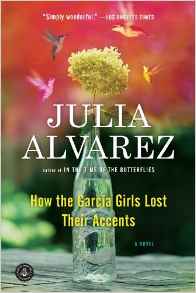
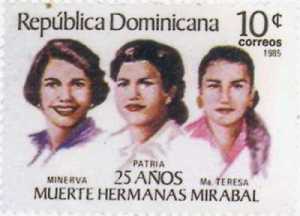
UnknownFrom the hyphen the Dominican-American Julia Alvarez birthed her first gift to us, How the Garcia Girls Lost Their Accents (Algonquin Books, 1991), a semi-autobiographical young adult work followed three years later with In the Time of  the Butterflies (Algonquin Books, 1994). The first book gave us the immigrant experience. The second established Julia as a writer who wanted to go a step beyond to bring to light and bare witness to the events – tragic, liberating and inspiring – of las hermanas Mirabal (the sisters Mirabal), known as Las Miraposas, the Butterflies. They were four sisters at the heart of the fight against the rule of the Dominican despot, Rafael Leonidas Truillo. He had three of the four sisters murdered along with some 50,000 other Dominicans and Haitians.

hermanas-mirabal-stamp1985

51QV06aUPtL._SX331_BO1,204,203,200_

It’s not surprising that Julia Alvarez chose to write about Las Mariposas. She was born in New York in 1950 when her parents first attempted to establish themselves in the U.S., but she lived her early years in the Dominican Republic. She lived there until she was ten years old when her family was forced to leave the country after Julia’s father participated in a failed attempt to overthrow Truillo.

51K6qLhrGlL._SX328_BO1,204,203,200_

I think that one of the reasons I began as a poet, and poetry was my first love, in English, was because … I especially like cadenced, rhymed poetry, and poetry in English was a way of still speaking Spanish. Because it made language more musical, more cadenced…rhyme, of course, because every other word in Spanish rhymes with an “a” or an “o” ending, so there was a way in which, to me, English poetry was a way to speak Spanish in English.

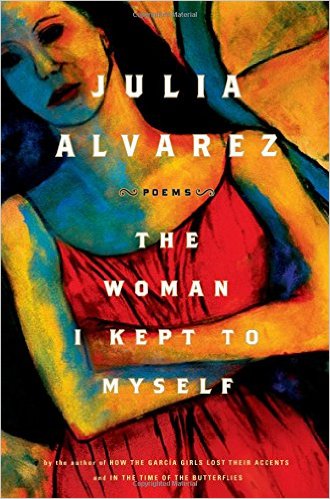
Over the past twenty-five years, Julia Alvarez prolific pen has poured out fiction for adults and young adults, collections of essays and, of course, poetry.  The Woman I Kept to Myself (Algonquin, 2004) is a collection in which she explores her life from the perspective of middle age …

We learn through what we love to love the world —
which might be all that we are here to do.
Meditation

There are seventy-five poems, each composed of three ten-line stanzas, a consistency that has inspired some mixed reviews. I find this style rather sophisticated and it lends cohesiveness to the work, which is certainly a celebration of the quotidian. Sometimes the conclusions are what is to be expected … nothing exciting, just life as usual; something accepted, not fought against. There’s a certain virtue in that.

We make our art
out of ourselves and what we make makes us.
Tom

© 2016, Jamie Dedes; portrait is from Julia’s Amazon page.

CELEBRATING AMERICAN SHE-POETS (23): Gwendolyn Brooks, Journalist, Poet, Living in the along …

51QfLM0er3L

“Live not for Battles Won.
Live not for The-End-of-the-Song.
Live in the along.”
Report from Part One

There is so much about Gwendolyn Brooks and her work that is remarkable and goes beyond the awards and acknowledgements, though these are many and prestigious and often firsts for her gender and race.

In 1968 Gwendolyn Brooks was named Poet Laureate of Illinois. In 1985, she was the first Black woman appointed U.S. Poet Laureate, known then as Consultant in Poetry to the Library of Congress. She received an American Academy of Arts and Letters Award, the Frost Medal, a National Endowment for the Arts Award, the Shelley Memorial Award, and fellowships from the Academy of American Poets and the Guggenheim Foundation.

Gwendolyn Brooks was born in Topeka, Kansas, but within a few weeks of her birth her family moved to Chicago, Illinois, her true roots and the source material for her poetry. She lived in Chicago until her death in December 2000. According to the family and friends who surrounded her at the end, she died as she lived with pencil in hand.

41XAHcIdQhL

“But in the crowding darkness not a word did they say.
Though the pretty-coated birds had piped so lightly all the day.
And he had seen the lovers in the little side streets.
And she had heard the morning stories clogged with sweets.
It was quite a time for loving. It was midnight. It was May.
But in the crowding darknesss not a word did they say.”
Old Marrieds

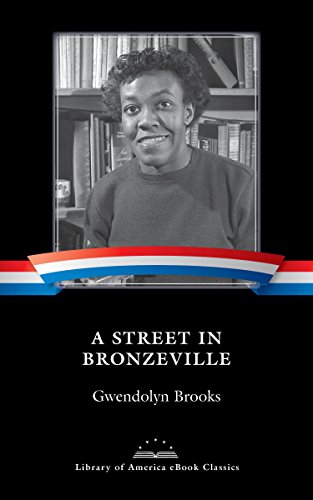
Gwendolyn’s first poem was published in a children’s magazine when she was thirteen years old. By the time she was sixteen 75 poems were published. Her first collection, A Street In Bronzville, was published in 1945. She never completed college because she saw herself as a poet and not a scholar. Maybe this is one reason why her poetry is so unselfconscious and down-to-earth.  There’s no posturing. It’s real and readable.  She experimented with many poetic forms and is known for her innovations to the sonnet. She seems to have invented a few forms of her own. Though her subject matter is serious and always compassionate and practical, often compellingly spiritual, she can – and often is – funny, even Suessian on occasion.

In writing of a particular time, place and people – as a journalist poet (a phrase she coined) – she not only chronicled the soul and lives of a people, she captured the essence of the eternals – the follies, the challenges, the good, the loving and the enduring – in the human condition, in the human soul … “To be in love,” she wrote, “is to touch things with a lighter hand.”

Exhaust the little moment. Soon it dies.
And be it gash or gold it will not come
Again in this identical disguise.
Annie Allen

Was she a student of Eastern mystics or Meister Eckhart? I rather doubt it. What we have here is a good woman writing from the perspective of her own sacred space, her refined intelligence and her acute observation and imagination. She certainly also writes out of the deep love she has for her people, the exploration of the complexities of being Black in America, and her rootedness and familiarity with the South Side of Chicago. I unreservedly recommend Gwendolyn Brooks for the sheer pleasure of her poetry, for some more understanding of the Black experience in America if you are not Black, for a connection with your roots if you are Black, for your understanding of your own soul and for your education as a poet.  If you haven’t met her yet, do so as soon as you can. A good place to start is with The Essential Gwendolyn Brooks from the American Poetry Project. It has a fine introduction by Elizabeth Alexander.

619tMNDYUbL._SX407_BO1,204,203,200_

John, Who Is Poor
Give him a berry, boys, when you may
And, girls, some mint when you can
And do not ask when his hunger will end
Nor yet when it began
(From Bronzeville Boys and Girls, 1956)

Library_Walk_23

We Real Cool

“We real cool. We
Left school. We

Lurk late. We
Strike straight. We

Sing sin. We
Thin gin. We

Jazz June. We
Die soon.”

― Gwendolyn Brooks

Gwendolyn Brooks, Journalist Poet, reads We Real Cool (If you are viewing this post from an email, you’ll likely have to link through to the site to see it.)

“She was learning to love moments. To love moments for themselves.”
Gwendolyn Brooks

© 2016, Jamie Dedes, All rights reserved; poems, Gwendolyn Brooks  estate; photograph of “Winnie” stone is in the public domain