Page 7 of 11

CELEBRATING AMERICAN SHE-POETS (17): NIKKI GIOVANNI, Quilting the Black-eyed Pea
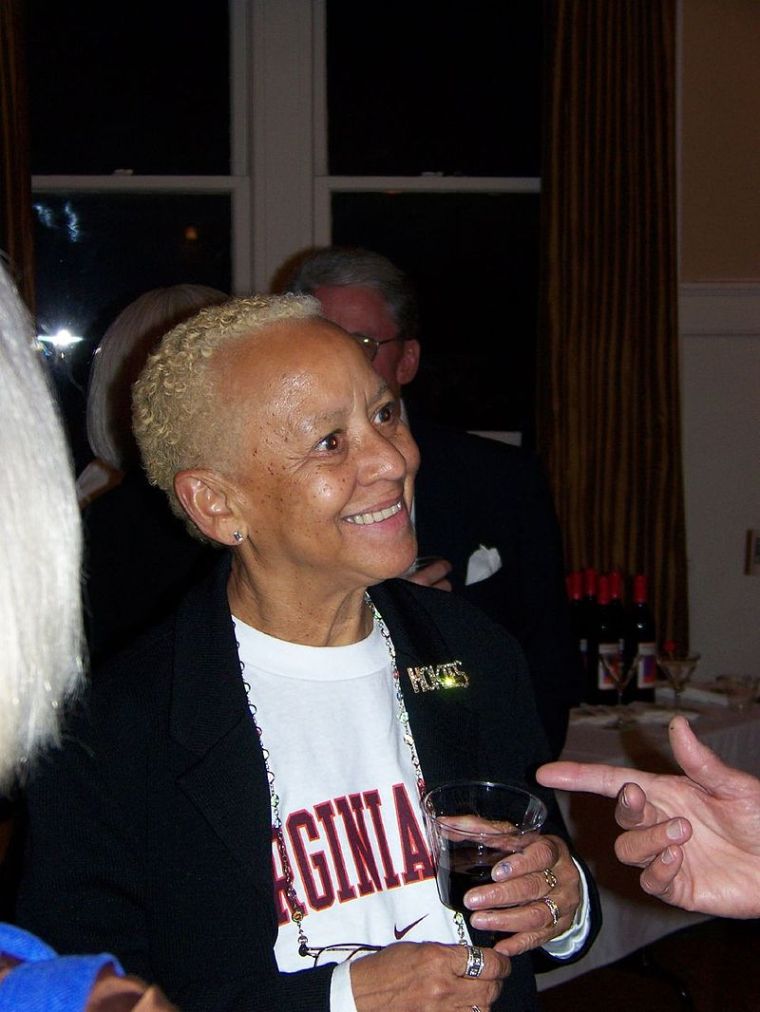
Nikki Giovanni (1943), American poet, writer, activist and educator

Everyone deserves Sanctuary a place to go where you are
safe
Art offers Sanctuary to everyone willing
to open their hearts as well as their lives”
excerpt for Art Sanctuary in Quilting the Black-Eyed Pea, poems and not quite poems

Nikki Giovanni is lauded as iconic, luminous, adventuresome and courageous.  She is all of these, but I think what I like most about her is that she is straight-forward, practical and compassionate. These characteristics are the underpinning that make her a rather extraordinary poet, a powerful combination of visceral and intellectual.

There is always something to do. There are hungry people to feed, naked people to clothe, sick people to comfort and make well. And while I don’t expect you to save the world I do think it’s not asking too much for you to love those with whom you sleep, share the happiness of those whom you call friend, engage those among you who are visionary and remove from your life those who offer you depression, despair and disrespect.”

Nikki Giovanni first came to note in the late ’60s and early ’70s as part of the Civil Rights, Black Arts and Black Power movements. The strength of her voice punctuated our poetic and political world and she has written, taught and advocated for uncommon good sense ever since. As with all of us, she has many roles in life including daughter, mother, friend and lung cancer survivor. It is clear in her work that she values family and community and supports and encourages these values in others.

Ms. Giovanni was born in Knoxville, Tennessee. She earned her undergraduate degree in history with honors at Fisk University and did her graduate work at the University of Pennsylvania and Columbia University. Her knowledge of history richly informs her perspectives in poetry, essay and talk. She taught at several universities including Virginia Tech and was at Virginia Tech for the shooting by Seung-Hui Cho in 2007 when he murdered thirty-seven people.  Cho was a student in her poetry class. She sensed something was amiss with him and asked the authorities to remove him from her class.  After the shooting, she spoke at the convocation.

We know we did nothing to deserve it. But neither does a child in Africa dying of AIDS. Neither do the invisible children walking the night awake to avoid being captured by a rogue army. Neither does the baby elephant watching his community being devastated for ivory. Neither does the Mexican child looking for fresh water….We are Virginia Tech….We will prevail.”

This video is the first of two in this post. If you are reading from an email subscription, you will have to link through to the site to view the videos.

Ms Giovanni’s early writing was a response to the assassinations of Martin Luther King, Jr., John and Robert Kennedy, and Medgar Evans.  Her first book (1968) Black Feeling, Black Talk/Black Judgement is considered by some to be the one of the most important books on the black-rights movement.  Younger people reading it will want to research the history of the era to put the book in context.

Ms. Giovanni has written some twenty-one books of poetry as well as autobiography and children’s books. She’s edited anthologies and collaborated on books with James Baldwin and Margaret Walker. She’s won countless awards for both her work and her activism. The following video is a reading of Quilting the Black-Eyed Pea (We’re Going to Mars).

I want to be clear about this. If you wrote from experience, you’d get maybe one book, maybe three poems. Writers write from empathy.”

portrait ~ Brett Weinstein under CC BY-SA 2.0

ON THE 101st ANNIVERSARY OF THE ARMENIAN GENOCIDE: Rape of Arevik by Silva Merjanian

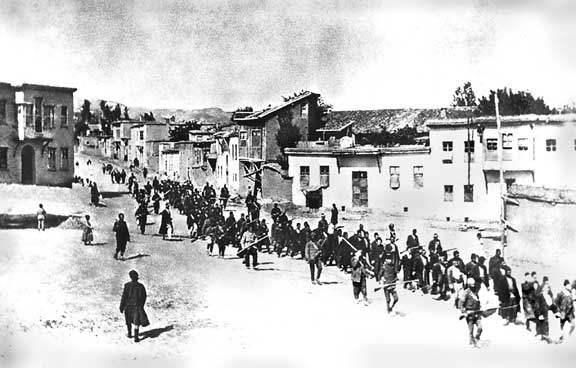
 Armenians are marched to a nearby prison in Mezireh by armed Turkish soldiers. Kharpert, Armenia, Ottoman Empire - April, 1915. *From the collection of Project SAVE Armenian Photograph Archives. Photographed by an anonymous German traveler.

Armenians are marched to a nearby prison in Mezireh by armed Turkish soldiers. Kharpert, Armenia, Ottoman Empire – April, 1915. From the collection of Project SAVE Armenian Photograph Archives. Photographed by an anonymous German traveler.

There were moonlit nights and many moonless nights
sober and drunken in one grain of sand
in billions of grains there were filthy hands
mud and fingernails between sunburned thighs
this is not my skin with nerves inside out
not my breast squeezed into faint whimpers
like dying swallows caught in a dry mouth

soon I’ll be a memory in last verse of songs
someone meant to write on a summer night
flesh to sand and sand to a story to tell
they’ll mention tattoos* and how I was a slave
look look how many stars in one grain of sand
in a billion grains in a billion tears
screams tangled like strings through my broken ribs

you did not know me then
before much before they tore off my clothes
and the desert night shivered with their rage
you did not see how my hair flowed like silk
on soft pillows where teenage dreams were weaved
you did not know me dressed with flowers in my hair
and my fathers arm around my adolescent frame
you did not see the stars from our wide windows
above the vineyard and my feet bare on the fertile soil
in our apricot tree’s cool summer shade

I’m in the evening news – in a pile of bones
look at the skull at the very left
see the sparrow lodged between those clenched jaws
I’m in the evening news a hundred years late
in the grains of sand shifting restless with shame
in the billion stars in your sky tonight
in my mother’s voice singing kenatzir pallas*
in the moonlit nights and the moonless nights
on a dagger’s blade in the Deir ez-Zor sand

– Silva Merjanian

24 April 2016 is the 101th anniversary of the Armenian Genocide, when thousands of women were dragged in the desert, raped and tortured before killed.

  • the reference to tattoos … they used to tattoo the women according to who owned them.
  • Kenatzir pallas is a lullaby very popular with Armenians and means “go to sleep my child”

“Silva’s poetry rewards the reader with the gift of exquisite lacework, adorned with choice words and skillfully wrought poetic imagery, which allow you to get a glimpse of both the intoxicating sensuality of survival and the scalpel scars on the tender skin of life. Many-layered, it excels alike in depicting the sphere of personal experience and of traumatic social issues.” – Dr. Aprilia Zank. Lecturer for Creative Writing and Translation Theory Ludwig Maximilian University, Munich, Germany in a review of Silva’s collection Rumor. Three poems rom this collection are Pushcart nominees. The net profits including the publisher’s go to The Armenian-Syrian Relief Fund. About $5,000 dollars have been raised to date.

© 2016, poem and book cover design, Silva Merjanian, All rights reserved; featured here with the permission of the poet; Silva’s website is HERE.; the header photograph is a public domian photograph courtesy of Project Save.

CELEBRATING AMERICAN SHE-POETS (13): Poet Laureate Natasha Trethewey, writing at the intersection of personal and cultural history

Natasha Trethewey (b. 1966), U.S. Poet Laureate, Poet Laureate of Mississippi, Pultizer Prize for Poetry, Robert W. Woodruff Professor of English and Creative Writing at Emory University
Natasha Trethewey (b. 1966), U.S. Poet Laureate, Poet Laureate of Mississippi, Pulitzer Prize for Poetry, Robert W. Woodruff Professor of English and Creative Writing at Emory University

After hearing Natasha Trethewey read at a poetry festival, Librarian of Congress Emeritus James H. Billington said he was “struck by a kind of classic quality with a richness and variety of structures with which she presents her poetry … she intermixes her story with the historical story in a way that takes you deep into the human tragedy of it.”

Natasha Trethewey is perhaps uniquely equipped by personal history, American history and public discourse, place of birth, education, inclination and innate talent to address a cruel and criminal aspect of our culture that dogs us unrelentingly: the roots, memory and legacy of racism. She is the daughter of a white father (poet Eric Trethewey) and black mother (social worker Gwendolyn Ann Turnbough).  Her background is rooted in the South. Born in Mississippi, when she was six years old her parents divorced and her young life was then split between Louisiana and Georgia. In Trethewey’s hands the juxtaposition of her biracial heritage and our shared history of colonialism, slavery and racism make a powerful case for the role of poetry to effectively and unflinchingly deliver truth.

At the time of her parent’s marriage and Trethewey’s birth anti-miscegenation laws were still in place, making their marriage illegal. Our laws against interracial marriage were struck down in 1967:

“Loving v. Virginia, 388 U.S. 1 (1967),[X 1] [X 2] is a landmark civil rights decision of the United States Supreme Court, which invalidated laws prohibiting interracial marriage.

“The case was brought by Mildred Loving, a black woman, and Richard Loving, a white man, who had been sentenced to a year in prison in Virginia for marrying each other. Their marriage violated the state’s anti-miscegenation statute, the Racial Integrity Act of 1924, which prohibited marriage between people classified as “white” and people classified as “colored”. The Supreme Court’s unanimous decision determined that this prohibition was unconstitutional, reversing Pace v. Alabama (1883) and ending all race-based legal restrictions on marriage in the United States.” [Wikipedia]

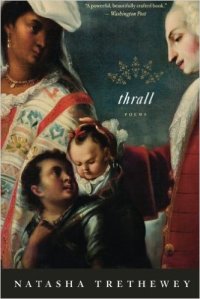
51T8yxaK1xL._SX331_BO1,204,203,200_ Thrall: Poems (Houghton Mifflin Harcourt Publishing Company, 2006) – a sequel to Native Guard (Houghton Mifflin Harcourt Publishing Company, 2005) –  is breathtakingly eloquent. Trethewey explores her relationship with her father in the first poem about a fishing trip. Written as an elegy though he is still alive, it tells him in effect that she is the better poet . . . or so I infered.

Tretheway moves on from that quiet meditation to questions of identity and race, exploring colonial attitudes about race reflected in the art of Spanish painters and the Casta (caste, categorization of mixed-race peoples) Paintings of 17th and 18th Century Mexico. I was unfamiliar with most of the paintings and painters, chose to look them up.  That, however, did not detract one iota from engagement with this collection.

The work is exquisite: formal, clear, precise, perceptive … Although the material is distressing, I find Trethewey’s style understated. These poems are not strident but they have sinew and bone. Her forms are mostly free verse. One poem is a series of cinquains and another is a villanelle.

13550802017232

In the video below, Trethewey offers some insight into the development of the collection and reads the eponymous poem. You will also find a sampling of her poems HERE.

Note: The painting Thrall that inspired the poem is by Juan de Pareja who was apparently the child of indentured servants and left as property to the Spanish painter Diego Rodríguez de Silva y Velázquez to whom he became an assistant. Juan de Pareja was born in 1606, freed in 1650 and died in 1670. The painting featured on the book’s cover is Spaniard and Indian Produce a Mestizo by Juan Rodríguez Juárez (1675-1728).

If you are reading this post from an email, you will have to click through to the site to view the video.

© 2016, essay, Jamie Dedes, All right reserved; Natasha Threthewey’s photograph, Jalissa Gray under CC BY-SA 3.0; cover design, publisher

CELEBRATING AMERICAN SHE-POETS (12): Sharon Frye, Last Chance for Rain

SharonSharon Gariepy Frye – a.k.a. Sharon Frye -is a photographer as well as a poet with one chapbook published, Last Chance for Rain (White Knights Press, 2014) and a new collection, Red Dashboard (Elizabeth Dillon, 51T8-CyhKSL._SX322_BO1,204,203,200_2016) to be published later this year, the exact date to be announced.

Last Chance for Rain offers us twenty poems. Each presents a compassionate look at the complex architecture of everyday lives – occasionally her own – with all their bays and battlements, their facades and their niches. Understanding comes with small intimate descriptions like this one of an elderly gentleman:

“She noticed his wrist, a small pear stone,
silver hair planted, bloomed over stone.”

excerpt from the Last Chance for Rain, the poem that lends its name to the book

When I first encountered Sharon’s poetry, I was impressed with the detail, the sense of a spiritual journey, and with her compassionate imagination, which is both her strength and her distinction. No surprise that Sharon was nominated for the Pushcart Prize for Poetry and most recently made the shortlist for the 2016 Blackwater International Poetry Festival.

JAMIE: Congratulations on making the Blackwater shortlist. It was so pleasant to see the announcement go up. I think it’s not the only award you’ve received. Bravo!

It seems to me your interests are as eclectic as most of us who read and/or are featured here: art and photography, music and dance, literature and poetry. I think I’m not alone in enjoying your nature photography. With the wealth of your interests, how and why did you come to focus on poetry?

SHARON: Thanks for the warm regards on making the Blackwater shortlist. I was a little surprised myself.

From an early age poetry dazzled me. I remember my first anthology of poetry was called Reflections on a Gift of Watemelon Pickle. I was mesmerized by the play and dance of words across the pages. I have been hooked ever since.

I began writing more as my children moved into adulthood, one by one. Now that I have an empty nest, I have more time to follow the muse. I have to say I am pleasantly surprised where it has taken me, from reading to FDNY firefighters, to Ireland and Sacramento…to various stops along Route 66.

JAMIE: This is a question people think is reserved for women, but I ask it of everyone I interview: How do you do it? How do produce a fair amount of poetry, well-crafted and well-considered, and juggle all your interests, your job with the U.S. Postal Service and your family responsibilities?

SHARON: It’s not easy, all this juggling… and I get frustrated. I try to be a good daughter to my aging parents, a good parent and an active grandmother. I also work full time as a rural mail carrier and am an active member of a local writing club. I think the experience and interaction with what has become my focus is also what inspires and serves as a catalyst to express – or record – some of my feelings and observations that result from these experiences.

I once wrote about the Asian man who was giving me a pedicure. I felt my heart expand as I considered what his life and history might have been. It’s a good practice, trying to perceive the worldview of those you come into contact with throughout the day. It gives the gift of empathy, which then always circles back to gratitude, always.

JAMIE: Do you find inspiration in the landscapes of Wyoming, where you come from, and Oklahoma, where you live now?

Jamie, you are a keen observer. I do love the landscape of my birthplace Wyoming and now those in my home of Oklahoma. There is just as much beauty in an Oklahoma sunset as there is on a snow-capped range nestled in the pines. I have learned to love Oklahoma’s red-dirt roads and often meander on a Sunday afternoon, taking pictures of abandoned farms and rusted Studebakers, forgotten in fields.

JAMIE: If I’m not mistaken, you have a strong affinity with what is probably your ancestral country, Ireland. You come honestly then by your love of and gift for poetry. Who is your favorite Irish poet and why?

SHARON: You are right, my maternal grandmother’s family hailed from Kilkenny. Of the Irish poets, I love Seamus Heaney, the earthiness of his words. You spoke of landscape: Heaney seemed to meld the inner landscape with the outer world in a mystical way. I also like some of Yeat’s work…The Stolen Child and A Prayer for my Daughter.

JAMIE: Tell us about Writing Knights and Equador Das Coisas.

SHARON: Writing Knights Press is an independent publishing company in Ohio. They publish many aspiring poets’s chapbooks, as they did my book, Last Chance for Rain. I was pleased that the publisher, Azriel Johnson, nominated one of my poems, Dollar Store Princess for a Pushcart Prize in 2015.

O Equador Das Coisas (the equator of things!) is a lovely journal of art and literature from Brazil. Editors Carol Piva and Germano Xavier have invited me to be a regular contributing poet, with my own page in the journal. Carol translates my poems from English to Portuguese for this endeavor… Oh, sometimes the world is so wonderfully small, you know? 😊

Poverty Line

It started with my back tooth,
much cheaper to extract wisdom.
Now tongue swirls in dark abyss
around black cavity, nothingness.

I feel unbalanced as I walk
one molar gone, orthodontic
shift in class, the have­-not caste,
one millstone followed by another.

How much grinding bore holes
in enamel, uprooting the bed?
Babies sucked from natal stream
drained the marrow, shriveled the bone.

Frayed blue collar underscores
my lopsided, one­-less­-tooth smile
while white starched collars
curl below rows of faultless teeth.

—Sharon Frye

Here is a slide show of Sharon’s photography ~

This slideshow requires JavaScript.

You’ll find some of Sharon’s poems in past issues of The BeZine. (Just type her name into the search feature.) We are sharing some of Sharon’s poems in the April issue – due out on the 15th – which celebrates poetry month.

© 2016, poem, words and photographs, Sharon Frye, All rights reserved