” . . . writing is a way of continuing to hope … perhaps for me it is a way of remembering I am not alone.” Lucille Clifton in an interview with Michael S. Glaser
I am one of those – like the people of Buffalo – who think of Lucille Clifton as a New Yorker. She was born in Depew and grew-up and was educated in Buffalo. I suppose some Californian’s claim her as theirs because she lived in Santa Cruz for a while. Most of the world, however, sees her as belonging to Maryland. I don’t know that she lived there longest but she was that state’s Poet Laureate from 1979 – 1985.
Lucille and Fred James Clifton (professor and sculptor) were friends with writer, playwright and publisher Ishmael Reed. It was he who introduced them to one another when he organized the Buffalo Community Drama Workshop. They acted together in a version of The Glass Managerie. Reed took some of Lucille’s poems to Langston Hughes who included them inThe Poetry of the Negro, 1746-1970.
Lucille Clifton won many grants and awards including the Ruth Lilly Poetry Prize, the Shelley Memorial Award, and Lannan Literary Award for Poetry. Two of her books were finalists for the Pulitzer Prize. In addition to poetry collections, she wrote a memoir and twenty-some children’s books. The latter include the popular well-regarded Everett Anderson series.
“Lucille Clifton is an African-American whose consciousness of her race and gender informs all of her poetry, though she never gets preachy. Instead, she has chosen a minimalist mode that clears out human society’s clutter, the mess we’ve made by identifying ourselves in contending genders, ethnicities, nations. Lightly, as if biting her tongue, with a wise smile, she shows us a radically egalitarian world where no one or no capitalized word lords it over others. …” Peggy Rosenthal, The Christian Century
Denise Levertov wrote of Lucille Clifton’s work as “authentic and profound.” I find it marked by pragmatism, strength, endurance and humor. You will see the later demonstrated in this poem and her intro to it, her ode: homage to my hips.
these hips are big hips.
they need space to
move around in.
they don’t fit into little
petty places. these hips
are free hips.
they don’t like to be held back.
these hips have never been enslaved,
they go where they want to go
they do what they want to do.
these hips are mighty hips.
these hips are magic hips.
i have known them
to put a spell on a man and
spin him like a top
“Sappho (/ˈsæfoʊ/; Attic Greek Σαπφώ [sapːʰɔ̌ː], Aeolic Greek Ψάπφω, Psappho [psápːʰɔː]) was a Greek lyric poet, born on the island of Lesbos. The Alexandrians included her in the list of nine lyric poets. She was born sometime between 630 and 612 BCE, and it is said that she died around 570 BCE, but little is known for certain about her life. The bulk of her poetry, which was well-known and greatly admired through much of antiquity, has been lost; however, her immense reputation has endured through surviving fragments.” [Wikipedia]Sunday: I began my dive into Dilys Wood’s Antarctica* (Greendale Press, 2008), spending my discretionary time engaged by this collection, which includes The South Pole Inn, a novella in verse.
“I dreamt I gave you the white continent
I wrapped it in white wedding wrap, embossed
with silver penguins and skiis …”
from Her Birthday Present in the section Love in a Freezing Climate: Four Poems
*****
“Wherever I look, the bacillus of melt
weakens the floes.”
from Future
DILYS WOOD is a poet, an editor and the founder (“convenor” as she might say) of the London-based Second Light Network of Women Poets (SLN), which produces the biannualARTEMISpoetryand includes a publishing arm, Second Light Publishing. I first encountered Dilys thanks toMyra Schneider. That award-winning poet with eleven published collections is a consultant to SLN.
While Internet and email have a way of helping to cross borders and make affinity-based connections, closing the gaps in culture and miles – in this case some 5,500 miles as the crow flies – the tools are imperfect. It’s not the same as meeting, talking and observing in person. However, when you read what people write, when they risk themselves by putting their very souls on paper, you do get to know something about their values and passions. My strongest sense of Dilys was as the quiet persistent energy behind a women’s poetry collective and an apparently indefatigable advocate for women’s right – including women over 40 – to poetic voice.
At the point in which I first encountered Myra, Dilys and SLN, Dilys had collaborated on (mainly with Myra) four anthologies of women’s poetry. She had two collections of her own poetry published,Women Come to a Death(Databases, 1999)andAntarctica. That was, I think around 2010. Since that time, we are gifted through Dilys and Myra, Anne Stewart (poetry p f) and others on the SLN team with so many fine anthologies and magazines of women’s poetry, that I can hardly keep track.
This slideshow requires JavaScript.
Dilys is modest in presenting herself. Her Poet’s Page on SLN’s website says simply –
Dilys started writing poetry again after retiring from the Civil Service, where her jobs included being secretary of the Women’s National Commission. She shortly after founded Second Light, focussed on the needs of women reconnecting with writing after forty. Second Light Network developed into a support group and, on a small scale (though reviews suggest significant), publisher of women’s poetry. Together with her own writing (Antarctica, 2008; Women Come to a Death, Katabasis, 1997), Dilys has been the joint editor (mainly with Myra Schneider) of 4 womens poetry anthologies.
If The Poet by Day was a poem, its title would have to have the tagline after Dilys Wood. This site is not the product of collaboration and membership. Nonetheless, its commitment to sharing information on poets and poetry, including gifted if lesser-known poets, and promoting and encouraging poets who are marginalized by their gender, ethnicity, disability or age – is very definitely inspired by Dilys work and commitment to mature women and the work and commitment of Myra Schneider and the other SLN women as well as by my own love of poets and poetry and the whole of poesy history and culture.
This is Dilys in her own words as she “spoke” in a guest blog post here several years ago:
NEW SAPPHOS, CHALLENGES FOR WOMEN POETS
I run a network for women poets and naturally I want our members to be treated equitably, with recognition of any woman’s potential to be in the top flight of creative artists.
Some poets feel that ‘male and female he made them’ should not be an issue. I disagree because I want to celebrate and gain personal inspiration from the last fifty years. There has been a vastly increased involvement of women as students of poetry, published poets, book purchasers and consumers of ‘products’ such as poetry festivals. I also want it debated why this has not meant equality of treatment by journals.
Why do some leading journals publish fewer poems by women and use fewer women reviewers? What part is played by prejudice and what by our diffidence? Do we submit enough work and persist when submissions are rejected? Are there subtle shades of prejudice? Are we taken seriously on ‘women’s topics’ but not when writing about spiritual experience or politics?
A first step is to convince ourselves that there is no ceiling. Emily Dickinson surely lives up to the epithet ‘unique genius’? Her work is incredibly economical, dense, universal and deeply moving. She is totally original in style and thought. Her work alone ought to kill the slur that biology-based inferiority explains historical under-achievement.
So many more women have found now their voice. Let’s celebrate poets who excite us, from Emily Bronte (say) to Jorie Graham (say). We can also start thinking seriously about differences and about inflated reputations. Let’s be wary about ‘celebrity status’. This tends to narrows true appreciation. Read voraciously. Include lesser known poets and dead poets. You will be impressed by how much exciting writing is on offer.
– Dilys Wood
* “Antarctica,” Greendale Press, 2008 (all proceeds to Second Light Network funds). �5.95 through poetry p f (scroll down on the page to which this is linked)
CHIRLANE McCAY is a writer and poet, a speechwriter and wife of New York City’s Mayor Bill de Blasio. She is also the mother of two children, Chiara and Dante.
According to her bio on de Blasio’s website,
“Chirlane began writing at a young age. In high school she discovered ways to use writing as a tool for activism. While studying at Wellesley College and the famed Radcliffe Publishing Course, Chirlane became a member of the Combahee River Collective, a pioneering black feminist collective, which inspired her to write groundbreaking prose and poetry.”
NEW YORK CITY: Former public Advocate and then mayoral candidate Bill de Blasio kisses his wife, Chirlane, after voting in the mayoral primary on September 10, 2013 (Photogrpah by Spencer Platt via Getty Images)
I Used To Think
I used to think
I can’t be a poet
because a poem is being everything you can be
in one moment,
speaking with lightning protest
unveiling a fiery intellect
or letting the words drift feather-soft
into the ears of strangers
who will suddenly understand
my beautiful and tortured soul.
But, I’ve spent my life as a Black girl
a nappy-headed, no-haired,
fat-lipped,
big-bottomed Black girl
and the poem will surely come out wrong
like me.
And, I don’t want everyone looking at me.
If I could be a cream-colored lovely
with gypsy curls,
someone’s pecan dream and sweet sensation,
I’d be
poetry in motion
without saying a word
and wouldn’t have to make sense if I did.
If I were beautiful, I could be angry and cute
instead of an evil, pouting mammy bitch
a nigger woman, passed over
conquested and passed over,
a nigger woman
to do it to in the bushes.
My mother tells me
I used to run home crying
that I wanted to be light like my sisters.
She shook her head and told me
there was nothing wrong with my color.
She didn’t tell me I was pretty
(so my head wouldn’t swell up).
Black girls cannot afford to
have illusions of grandeur,
not ass-kicking, too-loud-laughing,
mean and loose Black girls.
And even though in Afrika
I was mistaken for someone’s fine sister or cousin
or neighbor down the way,
even though I swore
never again to walk with my head down,
ashamed,
never to care
that those people who celebrate
the popular brand of beauty
don’t see me,
it still matters.
Looking for a job, it matters.
Standing next to my lover
when someone light gets that
“she ain’t nothin come home with me” expression
it matters.
But it’s not so bad now.
I can laugh about it,
trade stories and write poems
about all those put-downs,
my rage and hiding.
I’m through waiting for minds to change,
the 60’s didn’t put me on a throne
and as many years as I’ve been
Black like ebony
Black like the night
I have seen in the mirror
and the eyes of my sisters
that pretty is the woman in darkness
who flowers with loving
– Chirlane McCray
Thank you for sharing your love of words. Comments will appear after moderation.
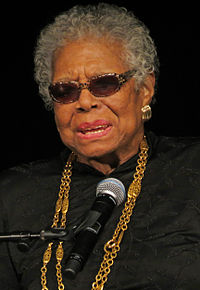
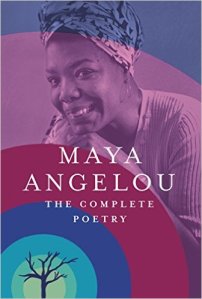
A reading by Maya Angelou yesterday on Poetry Please brought her front and center in my mind. How could we celebrate Black History Month and not include Maya Angelou? So here she is, not a conventional beauty, but a Beauty and a Refuge … wise and sassy Phenomenal Woman …
phenomenal |fəˈnämənəl|
adjective
1 very remarkable; extraordinary
2 perceptible by the senses or through immediate experience: the phenomenal world.
Pretty women wonder where my secret lies.
I’m not cute or built to suit a fashion model’s size
But when I start to tell them,
They think I’m telling lies.
I say,
It’s in the reach of my arms
The span of my hips,
The stride of my step,
The curl of my lips.
I’m a woman
Phenomenally.
Phenomenal woman,
That’s me.
I walk into a room
Just as cool as you please,
And to a man,
The fellows stand or
Fall down on their knees.
Then they swarm around me,
A hive of honey bees.
I say,
It’s the fire in my eyes,
And the flash of my teeth,
The swing in my waist,
And the joy in my feet.
I’m a woman
Phenomenally.
Phenomenal woman,
That’s me.
Men themselves have wondered
What they see in me.
They try so much
But they can’t touch
My inner mystery.
When I try to show them
They say they still can’t see.
I say,
It’s in the arch of my back,
The sun of my smile,
The ride of my breasts,
The grace of my style.
I’m a woman
Phenomenally.
Phenomenal woman,
That’s me.
Now you understand
Just why my head’s not bowed.
I don’t shout or jump about
Or have to talk real loud.
When you see me passing
It ought to make you proud.
I say,
It’s in the click of my heels,
The bend of my hair,
the palm of my hand,
The need of my care,
‘Cause I’m a woman
Phenomenally.
Phenomenal woman,
That’s me.


![Sappho (/ˈsæfoʊ/; Attic Greek Σαπφώ [sapːʰɔ̌ː], Aeolic Greek Ψάπφω, Psappho [psápːʰɔː]) was a Greek lyric poet, born on the island of Lesbos. The Alexandrians included her in the list of nine lyric poets. She was born sometime between 630 and 612 BCE, and it is said that she died around 570 BCE, but little is known for certain about her life. The bulk of her poetry, which was well-known and greatly admired through much of antiquity, has been lost; however, her immense reputation has endured through surviving fragments.](https://jamiededes.com/wp-content/uploads/2016/03/800px-sahpo_embrassant_sa_lyre-jules_elie_delaunay_mg_8275.jpg?w=634&h=1024)


 A reading by Maya Angelou yesterday on
 Jamie Dedes' THE POET BY DAY Webzine