It’s nothing new for poets to write poems against war, to write poems to raise the general consciousness of injustice, to express their pain and to speak truth to power. What is relatively new is the use of technology and social media to make it easy for poets to come together in protest as we see now with 100,000 Poets for Change (100TPC). In 2011, Michael Rothenberg, cofounder of 100TPC, put out a call for poets on Facebook and just five years later we have a huge global movement and a thriving community of poets and other creatives to stand up for peace, social justice and sustainability.
On the eve of the Iraqi War, poet Sam Hamill received an invitation from Laura Bush to attend a White House literary salon to celebrate the works of Emily Dickinson, Langston Hughes and Walt Whitman. Hamill had just read about President Bush’s plan for the invasion and saturation bombing of Iraq that would kill innumerable civilians, a plan that did not rule out the possibility of using nuclear weapons. Hamill felt he couldn’t sit restrained among politicians and poetic aristocracy. He had to speak out. He contacted colleagues, asking them to join with him in using this event to make a stand for peace.
Poetry readings were scheduled outside the White House and across the country on February 12, the day the event was scheduled. A website was started to collect and display antiwar poetry. Such prominent poets as Rita Dove, Peter Levitt, Lawrence Ferlinghetti, W.S. Merwin and Adrienne Rich contributed work. Their poems and many others were collected in a print volume. Contributions for the webstie continued to flow in for several years. The poems were screened by a team before publication. I contributed two, which were my first anti-war poems. Ultimately I think some 5,000 poems were collected. The poems are now archived in a university library.
We all know that Poets Against the War didn’t stop the invasion. Poet, peace activist and Jesuit priest, Daniel Berrigan wrote, “One is called to live nonviolently, even if the change one works for seems impossible.” So too are we called to speak truth to power, ignorance and cruelty no matter how hopeless things seem and no matter that we may never see the fruits of our labors in our lifetime. Peace has to start somewhere and it might just as well start with us.
If you are viewing this post from email, you’ll have to click through to the site to see the video.
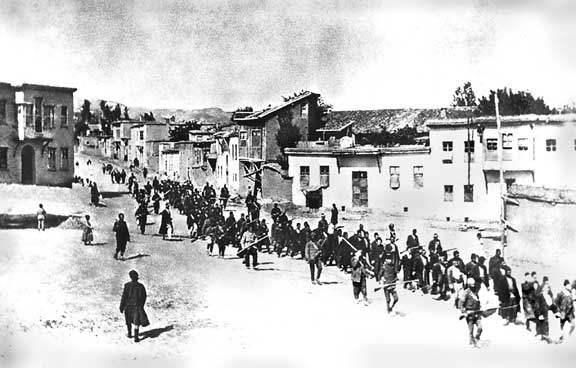
Armenians are marched to a nearby prison in Mezireh by armed Turkish soldiers. Kharpert, Armenia, Ottoman Empire – April, 1915. From the collection of Project SAVE Armenian Photograph Archives. Photographed by an anonymous German traveler.
There were moonlit nights and many moonless nights
sober and drunken in one grain of sand
in billions of grains there were filthy hands
mud and fingernails between sunburned thighs
this is not my skin with nerves inside out
not my breast squeezed into faint whimpers
like dying swallows caught in a dry mouth
soon I’ll be a memory in last verse of songs
someone meant to write on a summer night
flesh to sand and sand to a story to tell
they’ll mention tattoos* and how I was a slave
look look how many stars in one grain of sand
in a billion grains in a billion tears
screams tangled like strings through my broken ribs
you did not know me then
before much before they tore off my clothes
and the desert night shivered with their rage
you did not see how my hair flowed like silk
on soft pillows where teenage dreams were weaved
you did not know me dressed with flowers in my hair
and my fathers arm around my adolescent frame
you did not see the stars from our wide windows
above the vineyard and my feet bare on the fertile soil
in our apricot tree’s cool summer shade
I’m in the evening news – in a pile of bones
look at the skull at the very left
see the sparrow lodged between those clenched jaws
I’m in the evening news a hundred years late
in the grains of sand shifting restless with shame
in the billion stars in your sky tonight
in my mother’s voice singing kenatzir pallas*
in the moonlit nights and the moonless nights
on a dagger’s blade in the Deir ez-Zor sand
– Silva Merjanian
24 April 2016 is the 101th anniversary of the Armenian Genocide, when thousands of women were dragged in the desert, raped and tortured before killed.
the reference to tattoos … they used to tattoo the women according to who owned them.
Kenatzir pallas is a lullaby very popular with Armenians and means “go to sleep my child”
“Silva’s poetry rewards the reader with the gift of exquisite lacework, adorned with choice words and skillfully wrought poetic imagery, which allow you to get a glimpse of both the intoxicating sensuality of survival and the scalpel scars on the tender skin of life. Many-layered, it excels alike in depicting the sphere of personal experience and of traumatic social issues.” – Dr. Aprilia Zank. Lecturer for Creative Writing and Translation Theory Ludwig Maximilian University, Munich, Germany in a review of Silva’s collection Rumor. Three poems rom this collection are Pushcart nominees. The net profits including the publisher’s go to The Armenian-Syrian Relief Fund. About $5,000 dollars have been raised to date.
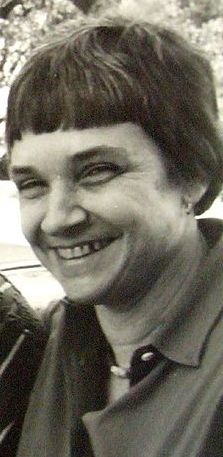
Adrienne Rich (1929-2012)Audre Lorde, Meridel Le Sueur, Adrienne Rich
Madeline Ostrander wrote this article for YES! Magazine, “a national, nonprofit media organization that fuses powerful ideas with practical actions.” Madeline was YES! Magazine‘s senior editor at the time of this writing. She is now an independent journalist and contributing editor to Yes! Magazine.
“I know you are reading this poem listening for something, torn between bitterness and hope…”
I was 19 when I first read Adrienne Rich and these words from “An Atlas of the Difficult World,” which seemed to tear down the barriers between the poem and me, and let me in.
Like Rich, I grew up at a distance from true poverty: “reader reading under a summer tree in the landscape of the rural working poor,” she writes. But I knew how fractured and unstable the world around me was becoming. I was part of the first generation to grow up knowing about climate change, brought to world attention by James Hansen and to my school classroom by a forward-thinking science teacher. I was in high school when the Soviet Union collapsed; as a child, I had nightmares about nuclear war. Rich’s poetry gave me hope that stories could change things—could force us to confront and heal what is painful and give us hope, strength, and compassion.
Rich belonged to an activist strain of poetry; she believed words needed to be reclaimed by the people who have been left out of the history books.
When Rich died a profound loss at a time when we urgently need more storytelling that reaches across our fragmented, politically divided culture. “Atlas” is still one of the most searing and honest descriptions I’ve read about how broken and divisive the modern world is. It’s a 26-page poem that sweeps across the landscapes and histories of North America and elevates people and scenes that are ordinary, neglected, and counted out—farmworkers made sick from pesticides, a woman beaten by her partner, the wasting of our ecological landscapes, weedy fields of Jerusalem artichoke “that fed the hobos, could feed us all.”
Here is a map of our country …
This is the haunted river flowing from brow to groin
we dare not taste its water
This is the desert where missiles are planted like corms …
This is the cemetery of the poor …
This is the sea-town of myth and story when the fishing fleets
went bankrupt … processing frozen fish sticks hourly wages and no shares
Occupy didn’t exist then, of course, but Rich was crafting poetry for the 99 percent: “a poetry older / than hatred. Poetry / in the workhouse, laying of the rails.”
Rich’s long, image-dense lines could seem of out-of-step with a world obsessed with rapid-fire information, Twitter, and text messages. But Rich knew that the marginalization of poets is always a detriment to civil society. In the early 1980s, she traveled to Nicaragua, where she felt the culture “manifested a belief in art, not as commodity, not as luxury, not as suspect activity, but … one necessity for the rebuilding of a scarred, impoverished, and still-bleeding country.”
Rich belonged to an activist strain of poetry; she believed words needed to be reclaimed by the people who have been disempowered and left out of the history books. Her own life is a testament to the power of story in creating cultural change. Rich started college in the late 1940s, when she says even Elizabeth Barrett Browning’s writing was radical for a university campus and certainly no one spoke of feminist ideas in the classroom.
Early in her career, Rich had to scrape together a new kind of language. She used poetry to utter ideas that were almost unspeakable at the time: her poetry pulled back the veil around women’s sexuality and lesbian love and exposed the power and politics that enable war and violence: “I felt driven—for my own sanity—to bring together in my poems the political world ‘out there’—the world of children dynamited or napalmed, of the urban ghetto and militaristic violence—and the supposedly private, lyrical world of male/female relationships,” she said. She published Snapshots of a Daughter in Law, which she calls her first book to overtly tackle sexual politics, in 1963. Decades later, her poetry is still radical, but it’s also a mainstay in college literature classrooms across the country. Her poetry has been a beacon to feminists and social justice activists for several generations, and is included a digital poetry anthology pieced together by organizers of Occupy Wall Street.
Rich never wanted her poetry to be a medium primarily for academe. And she never believed words alone could solve the abuses and inequalities that she wrote about. But reclaiming, decolonizing, and taking charge of language was for Rich the first step in become personally whole and politically powerful. “Because when poetry lays its hand on our shoulder, we can be to an almost physical degree touched and moved. The imagination’s roads open again, giving the lie to that slammed and bolted door, that razor-wired fence, that brute dictum,” she said in a 2006 speech at the National Book Awards, where she received a Medal for Distinguished Contribution to American Letters.
We owe Rich a debt for unlocking the doors that barred the voices of women from art, academe, and the halls of influence for so long. And though she insisted on marking each poem with a date—so that it would stand in the historical context in which she wrote it—everything about her poetry still speaks with urgency and timeliness. Her work illuminates the dark, messy, often painful territory of sex, race, violence, and poverty in America but holds all of us responsible for taking power, ending suffering, and breaking apart social inequalities. In “Atlas,” she writes, “A patriot is one who wrestles for the / soul of her country / as she wrestles for the soul of her own being.” This is what Rich did her whole life, and her poetry enjoins the rest of us to do the same.
Guerrilla poets strike out for common sense, inclusion, social justice and all our best human ideals:Zero Forbidden Goals (ZFG) is a collective of artists from the Greater Sacramento area. It engages ideals and education through poetry, music and art delivered in a community setting, which is essentially what the “guerrilla” in “guerrilla art” refers to. I just found out about them today. All things considered: rather fabulous.
“In the past year ZFG has worked to bring an innovative brand of guerrilla art to Northern California with events such as Guerrilla Art Flash Mobs, National (Guerrilla) Poetry Month, Gorilla Storytime, Chainlink Poetry, and FLOW Sacramento.”
David Loret De Mola invites guerilla poets to participate in “Guerrilla” Poetry Month by sending in your videos.
“Whether you rap or you slam ZFG invites you and yours to take part in Guerrilla Poetry Month 2016! Just film your piece and send links to ZFGpromotions@gmail.com or hit us @ZFGpromotions.
Find out more at http://www.ZFGpromotions.com
We look forward to hearing from you!”
“Zero Forbidden Goals is a group of young creatives based in Northern California working to cultivate the next generation of art on the West Coast. Since it’s conception in 2014, the collaborative comprised of poets, emcees, musicians, writers, photographers, videographers, engineers, visual artists, and designers have been working to support the creative landscape and general accessibility of the arts on the West Coast by working alongside schools, local businesses, and non-profit organizations to provide and support arts programming.
“In addition to sanctioned art collaborations, Zero Forbidden Goals is known for unpredictable public pop-up art events, installations, and exhibitions. From interactive visual arts to flash mob dance parties, ZFG was founded on the belief that you can turn any slab of concrete into a stage and any empty lot into an art gallery.” from the website

 On the eve of the Iraqi War, poet Sam Hamill received an invitation from Laura Bush to attend a White House literary salon to celebrate the works of Emily Dickinson, Langston Hughes and Walt Whitman. Hamill had just read about President Bush’s plan for the invasion and saturation bombing of Iraq that would kill innumerable civilians, a plan that did not rule out the possibility of using nuclear weapons. Hamill felt he couldn’t sit restrained among politicians and poetic aristocracy. He had to speak out. He contacted colleagues, asking them to join with him in using this event to make a stand for peace.




 Guerrilla poets strike out for common sense, inclusion, social justice and all our best human ideals:
 Jamie Dedes' THE POET BY DAY Webzine