I don’t remember when I first encountered Paul Brookes (Wombwell Rainbow) and his prodigious work marked by a keen appreciation for art and history and his observations of everyday life salted with irony and humor and his rich Yorkshire Dialect. I think Paul either submitted work to The Poet by Day, Wednesday Writing Prompt or to an issue of The BeZine, maybe both. I do remember I had to look up Wombwell. It seemed to me a rather odd name for a blog. Wombwell (clearly not Paul’s family name) turned out to be the town were Paul currently lives in Northern Yorkshire and “Wombwell” may mean “Womba’s Well” or “well in a hollow.”
What prompted today’s post is that I am able to bring you one of Paul’s poetry readings. I’ve used this as an excuse to also get to know Paul better. Read on: this is an interesting interview. I think you’ll enjoy it as much as I have. / J.D.
INTERVIEW
JAMIE: Paul, are you the only poet in your family? How did you come to poetry?
PAUL: The only published one, yes. When I was seven or eight I remember holding my head in my hands at home when my English homework was to write a nonsense poem in the style of Edward Lear or Lewis Carroll. I had brain freeze. Off the cuff Mam wrote one for me about an Elephant with a propeller for a nose. It was very funny, though the elephant died. His propeller was used as his grave stone. Mam was also the youngest editor of NALGO magazine when she worked as a secretary for the hospital board in Harrogate. I don’t know where she got her creativity with words.
JAMIE:Quite frequently you write in Yorkshire dialect, which as a reader I find charming and challenging. What made you decide to do that?
PAUL: Dialect is always said to be dying out and being replaced by Received Pronunciation. I remember my late Mam balling at the broadness of my late sister’s dialect when she was chatting with her mates on the telephone. No mobiles then. My Mam encouraged us to have a “telephone” voice so we wouldn’t sound “so common!” Dialect for me provides metaphor, strength, muscularity and gives a sense of place. (Editor’s emphasis.) I know it is challenging but worthwhile. It is often painted as a comic device, used by lowly characters in plays and satirised by Monty Python in the Four Yorkshiremen sketch, however this micky taking has a long history. In the nineteenth century there were locally published Almanacs in which dialect was used for humorous purposes. Yorkshire folk love not taking themselves seriously. Yorkshire dialect is often shoehorned into rhyme. I wanted to use it in unrhymed poetry to hark back to our Norse ancestors.
JAMIE:Pride of place is obviously important to you. You’ve named your blog for the town in which you live. Is the Yorkshire literary tradition – quite impressive from the Bronte sisters to Ian McMillan – an inspiration?
PAUL: I was dragged up by Yorkshire writers, studying Barry Hines “KES” in school, Ted Hughes selected poems, Tony Harrison’s selected poems. Ian McMillan is often seen as a “professional” Yorkshireman, bigging up the county. He also has his tongue well and truly in his cheek when doing this, an aspect folk from other parts of the country don’t see. They view it instead as the over earnest promotion of “God’s country.”
I was not born in Wombwell but a small town between Harrogate and Knaresborough called Starbeck. You have to pass through it to get from one to the other. Starbeck is a place between tourist destinations. A “through” town.
From there we moved a lot to Darringto, a place by the side of the A1, close to a notorious black-spot for car accidents, to various places in Barnsley, Wilthorpe, Pogmoor, Ward Green, and the little village of Dodworth.
I love being settled in Wombwell and getting to know familiar customers in the supermarket where I work part-time. I love engrossing myself in the local history and culture, gaining a sense of belonging.
JAMIE:We’re coming close to putting a wrap on 2019. What’s on your literary agenda for 2020?
PAUL: Hope to have the final part of A Pagan’s Year finished. It will be called Ghost Holiday and be about pagan festivals and stories from August to December. This is in collaboration with my great Dutch friend and amazing artist Marcel Herms. Also on the agenda for 2020 is Skyfish, poems about delight written in response to the paintings of Iranian artist Hiva Moazed.
POETRY READING
If you are reading this from an email subscription, you’ll likely have to link through to the site to view the video.
PAUL BROOKES (Wombwell Rainbow) is a shop assistant. He lives in a cat house full of teddy bears. His chapbooks are The Fabulous Invention Of Barnsley (Dearne Community Arts, 1993). First part of four connected books, other three unpublished as yet. Second book is made up of four short stories, already published in Alien Buddha Press’s short story anthologies ). The Headpoke and Firewedding (Alien Buddha Press, 2017.This is the first book of a threesome called “A Pagan’s Year”,and covers June and July) ,A World Where (Speculative poetry) and She Needs That Edge (narrative poetry) with Nixes Mate Press, 2017, 2018) The Spermbot Blues (Sci-Fi poetry with OpPRESS, 2017), Port Of Souls, responses to paintings by Marcel Herms (Alien Buddha Press, 2018),Please Take Change (Cyberwit.net, 2018)
Stubborn Sod, by Marcel Herms (paintings) and I,(poetry) ,(Alien Buddha Press, 2019.This is the second part of “A Pagan’s Year” January to May), As Folk Over Yonder ( ebook with Afterworld Books, 2019). Forthcoming Skyfish, responses to paintings by Hiva Moazed and companion book to “Port of Souls” (Alien Buddha Press, 2019)
Jamie Dedes. I’m a freelance writer, poet, content editor, and blogger. I also manage The BeZineand its associated activities and The Poet by Dayjamiededes.com, an info hub for writers meant to encourage good but lesser-known poets, women and minority poets, outsider artists, and artists just finding their voices in maturity. The Poet by Day is dedicated to supporting freedom of artistic expression and human rights. Email thepoetbyday@gmail.com for permissions, commissions, or assignments.
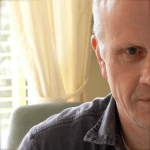
John Anstie is the lead for the next issue of The BeZine, which is open for submission to its December issue through November 15. The theme is “Life of the Spirit.” Submission to bardogroup@gmail.com Please read our submission guidelines. Meanwhile, I invite you visit John’s site and get to know this fine musician, poet, grandfather, trainer of dogs for the blind, and so much more. In short, a renaissance man.
Dear Earth, you are a sacred aqueous Isle
in a dark and endless sea of universe.
You may never reveal your strategy.
We may be bound by genetic code
to the presupposing chemical destiny
of one great astrophysical master plan
for all living things. We, who represent
your malaise, your chronic infestation;
we, like a fleeting itch in your long life,
will never comprehend it. But, in truth
you know too well that we can never
understand more than one percent
of all there is to know. You contain
the knowledge that is beyond us.
We are but a rash on your skin.
One day, we know you will
raze all of our delusions,
prepare us for the day
when a blinding light
will inoculate you
and inform us of
a moment when
extant humans
will, at last be
prepared to
distinguish
the l i e s
f r o m
truth
and
so
we
a r e
m e r e
a t o m i c
p a r t i c l e s
inside a temporal chalice
The focus of The BeZine, a publication of The Bardo Group Beguines, is on sacred space (common ground) as it is expressed through the arts. Our work covers a range of topics: spirituality, life, death, personal experience, culture, current events, history, art, and photography and film. We share work that is representative of universal human values however differently they might be expressed in our varied religions and cultures. We feel that our art and our Internet-facilitated social connection offer a means to see one another in our simple humanity, as brothers and sisters, and not as “other.” The BeZine is a space where we hope you’ll delight in learning how much you have in common with “other” peoples. We hope that your visits will help you to love (respect) not fear. For more see our Info/Mission Statement Page.
Thank you for sharing your love of words. Comments will appear after moderation.
“Alas! Can tranquil nature give me rest,
Or scenes of beauty, soothe me to repose?”
Charlotte Turner Smith
To Hope
Oh, Hope! thou soother sweet of human woes!
How shall I lure thee to my haunts forlorn!
For me wilt thou renew the wither’d rose,
And clear my painful path of pointed thorn?
Ah come, sweet nymph! in smiles and softness drest,
Like the young hours that lead the tender year,
Enchantress! come, and charm my cares to rest:—
Alas! the flatterer flies, and will not hear!
A prey to fear, anxiety, and pain,
Must I a sad existence still deplore?
Lo!—the flowers fade, but all the thorns remain,
‘For me the vernal garland blooms no more.’
Come then, ‘pale Misery’s love!’ be thou my cure,
And I will bless thee, who, tho’ slow, art sure.”
– Charlotte Turner Smith
Reflections on Some Drawings of Plants
I can in groups these mimic flowers compose, These bells and golden eyes, embathed in dew; Catch the soft blush that warms the early Rose, Or the pale Iris cloud with veins of blue; Copy the scallop’d leaves, and downy stems, And bid the pencil’s varied shades arrest Spring’s humid buds, and Summer’s musky gems: But, save the portrait on my bleeding breast, I have no semblance of that form adored, That form, expressive of a soul divine, So early blighted, and while life is mine, With fond regret, and ceaseless grief deplored— That grief, my angel! with too faithful art Enshrines thy image in thy Mother’s heart.
– Charlotte Turner Smith
The Moon
Queen of the silver bow, by thy pale beam
Alone and pensive I delight to stray,
And watch thy shadow trembling in the stream,
Or mark the floating clouds that cross thy way.
And while I gaze, thy mild and placid light
Sheds a soft calm upon my troubled breast;
And oft I think, fair planet of the night,
That in thy orb the wretched may have rest;
The sufferers of the earth perhaps may go,
Released by death, to thy benignant sphere;
And the sad children of despair and woe,
Forget in thee, their cup of sorrow here.
Oh, that I soon may reach thy world serene,
Poor wearied pilgrim in this toiling scene.
– Charlotte Turner Smith
RELATED
In 1783 , Charlotte Turner Smith wrote Elegiac Sonnet. This was while – along with her husband and children – she was in debtor’s prison. LibriVox recordings of the poems are HERE and are available at no charge.
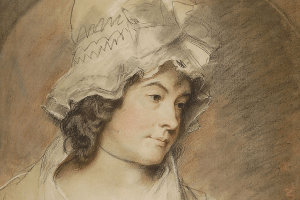
Charlotte Turner Smith by George Romney / Public Domain
CHARLOTTE TURNER SMITH (1749 – 1806) was an English Romantic poet and novelist. She initiated a revival of the English sonnet, helped establish the conventions of Gothic fiction, and wrote political novels of sensibility. A successful writer, she published ten novels, three books of poetry, four children’s books, and other assorted works. She saw herself as a poet first and foremost. Poetry in her day was considered the most exalted form of literature. She is now credited with transforming the sonnet into an expression of woeful sentiment.W
According to Poetry Foundation, “William Wordsworth identified her as an important influence on the Romantic movement.”
Much of Smith’s work drew attention to the injustices of the British Class System.
When Smith divorced her husband, she attempted to use her writing to provide for her children and to support her attempts to gain legal protection as a woman. Her life experiences and observations provided themes for her poetry and novels. She included portraits of herself and her family in her novels.
Smith’s popularity waned and by 1803 she was destitute and ill, likely suffering from rheumatoid arthritis. She could barely hold a pen. She had to sell her books to pay off her debts. In 1806, Smith died. Largely forgotten by the middle of the 19th century, her works have now been republished. She is recognized as an important Romantic writer.
Find her books at no or low-cost on Amazon Kindle HERE.
Jamie Dedes. I’m a freelance writer, poet, content editor, and blogger. I also manage The BeZineand its associated activities and The Poet by Dayjamiededes.com, an info hub for writers meant to encourage good but lesser-known poets, women and minority poets, outsider artists, and artists just finding their voices in maturity. The Poet by Day is dedicated to supporting freedom of artistic expression and human rights. Email thepoetbyday@gmail.com for permissions, commissions, or assignments.
Noteworthy comments on publishing experience, which you will see if you link through to Anne’s site. (The automatic reblog feature didn’t pick up on that part of the article.) Thank you, Anne Copeland. Well done.
Pumpkins are magical. They herald in the autumn; they fulfill our needs to create art related to the season and to celebrate it. We fill them with light to welcome others to our homes, and to provide the way from home to home as we gather treats for the season. We have all kinds of celebrations for them from competitions for the largest or best pumpkin to the best decorated pumpkins to pie baking and pie eating competitions. We listen in awe to their amazing history and laugh at their folklore. We begin to invite friends and relatives to luscious dinners featuring this wonderful orange treat. Pumpkins warm our hearts as the autumn begins to bring the chill air. We invite you into the welcoming pages of this book, and to fill your souls with all the good things you remember, and your stomachs with the most delightful…


 PAUL BROOKES (
 Jamie Dedes. I’m a freelance writer, poet, content editor, and blogger. I also manage

 John Anstie is the lead for the next issue of
  The focus of The BeZine, a publication of The Bardo Group Beguines, is on sacred space (common ground) as it is expressed through the arts. Our work covers a range of topics: spirituality, life, death, personal experience, culture, current events, history, art, and photography and film. We share work that is representative of universal human values however differently they might be expressed in our varied religions and cultures. We feel that our art and our Internet-facilitated social connection offer a means to see one another in our simple humanity, as brothers and sisters, and not as “other.” The BeZine is a space where we hope you’ll delight in learning how much you have in common with “other” peoples. We hope that your visits will help you to love (respect) not fear. For more see our I



 Jamie Dedes' THE POET BY DAY Webzine