Myra Schneider – Poet, poetry teacher and consultant to Second Light Network of Women Poets
“I believe the role of the poet is to reflect on human experience and the world we live in and to articulate it for oneself and others. Many people who suffer a loss or go through a trauma feel a need for poetry to give voice to their grief and to support them through a difficult time. When an atrocity is committed poems are a potent way of expressing shock and anger, also of bearing witness. I think that the poet can write forcefully, using a different approach from a journalist, about subjects such as climate change, violence, abuse and mental illness and that this is meaningful to others. I very much believe too that poetry is a way of celebrating life. I think it deserves a central place in our world.” A Life Immersed in Poetry: Myra Schneider, Celebrating Over 50 Years as Poet and Writer
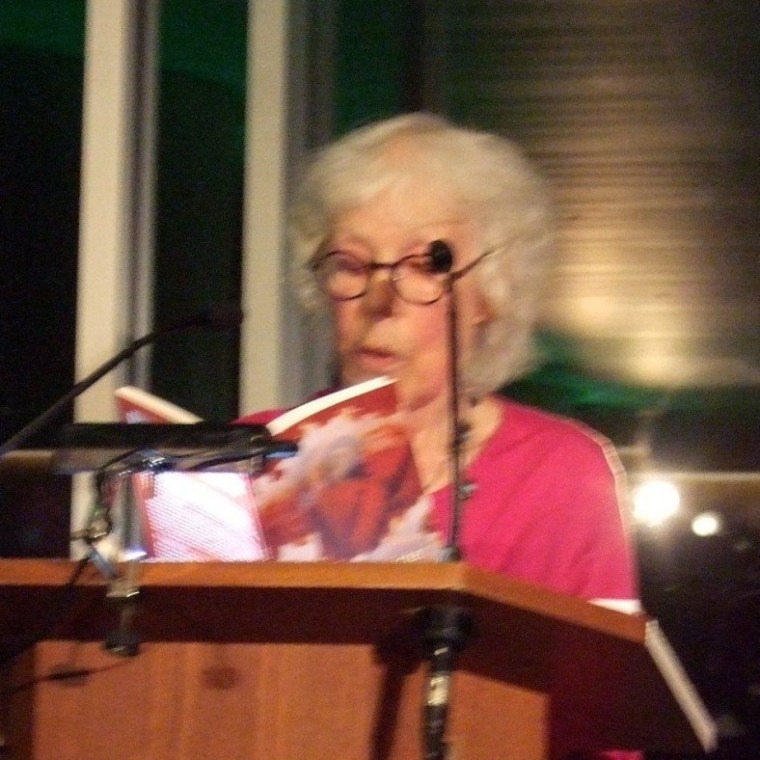
What a delight today to bring you four of Myra Schneider’s poems from her tenth collection, Lifting the Sky. I believe I’ve read nearly all of Myra’s collections. I’ve reviewed a number of them. I am never disappointed. She soothes and inspires with layers of color and texture and keen and compassionate observations of nature, people and the human condition. I’ve also read and reviewed Writing Your Self: Transforming Personal Material (written with John Killick) and Writing My Way Through Cancer. These too I would recommend without reservation. Yes! I am an enthusiastic fan.
You can visit Myra HERE and you can purchase her books directly from her. Myra’s Amazon U.S. Page HERE. Myra’s Amazon U.K. Page HERE. Some of Myra’s books are also available through Anne Stewart’s poetry p f, another recommendation, by the way. Lifting the Sky is available on Kindle.
THE TUBULAR BELLS
were a surprise. At first I thought
they were icicles in a frozen waterfall
but they seemed to be fluid as honey
dropping from a comb. Then I noticed
the kitchen table and washing machine
were edgeless, melting away
and I wondered if they’d been magicked
by the instrument, its gold that was so unlike
the sleekness of a Pharaoh’s death mask,
the solidity of Cellini’s over-elaborate
salt cellar or the jewel-studded crown
worn by Holy Roman Emperors –
such symbols of pomp, self-importance.
The bells summoned buttercups, lilies,
their stamens tipped with orange powder,
the different ochres of fallen leaves
For moments I believed they were healing
the wounded world but they disappeared.
Hopeless, I stood by the January window
until I saw dusk was rivering the sky
with saffron and lemon, took heart.
– Myra Schneider
I PEGASUS
lift my hooves for gallop,
rise as my white wings open.
Wind rushes into my pricked ears.
Excitement whinnies from my mouth,
ripples through my flanks, drives me
towards a place that’s always cloudless.
Below me are snow-spattered peaks,
valleys where rivers wander, where trees
are laden with oranges, small suns
which pay homage to the sphere above.
Below me are huge cities with domes,
spires and innumerable buildings,
the tallest invade the blue of sky.
I miss nothing: the glassy stare
of cars stampeding like maddened cattle,
humans fleeing from burning towns,
forests felled like mighty armies,
the sea hurling itself in fury
at the land, barren fields thirsting
for water, skeletons of starved creatures.
I choose a verdant slope when I land,
hoof its milky grass and a spring
bubbles up from earth that’s rich
with squirming worms. Then I rejoice
for I am the breath in and the breath out,
I am the quickening which comes unbidden
to the mind, blossoms into words
that tug the heart, I am sounds which bell
the air and enthral the ear, shapes
and colours which come together
to sing. I counter hatred, destruction.
I will not be stamped out.
– Myra Schneider
OH MOON
multiple in shape and mood, I can’t resist you
as slip of an eel with tips longing to touch
and kiss, as a silent circle of self queening
the measureless iris-blue that’s only
an optical illusion, as an orange sun hung
low in the sky to herald cornucopia,
as Salome in swirling veils, a saviour who throws
light on dangerous passageways. Oh moon,
ferrier of calm to those enduring pain
in tousled beds, lean over the homeless
lying in sweaty tents, search out the terrified
who’ve fled to the mountains where they ward off
cold at night by huddling in crevices to sleep,
bring them your silvergold bracelets of hope.
– Myra Schneider
LIFTING THE SKY
Plant yourself in the quiet on a familiar floor
or on an uncut summer lawn
and, thinking of seabirds, stretch out your arms,
let them ascend through the unresisting air.
With palms facing upwards, travel your hands
till your fingertips almost meet,
then release your breath, begin to separate yourself
from the weight of all that lies on you.
Allow your mind to open to this moment and your arms
to rise as they lift the palpable blue
high above the crown of your head.
Your wings will fold away
but raise them slowly to the blue again, maybe
a lightness like liquid amber will flow through you.
– Myra Schneider
Lifting the Sky: an exercise in qigong the Chinese practice of breathing, movement and meditation.
Poet and writer, I am a former columnist and associate editor of a regional employment publication. Currently, I run this site, The Poet by Day, an information hub for poets and writers. I am the managing editor of The BeZine published by The Bardo Group Beguines (originally The Bardo Group), a virtual arts collective I founded. I am a weekly contributor to Beguine Again, a site showcasing spiritual writers. My work is featured in a variety of publications and on sites, including: Levure littéraure, Ramingo’s Porch, Vita Brevis Literature,Compass Rose, Connotation Press, The Bar None Group, Salamander Cove, Second Light, I Am Not a Silent Poet, Meta / Phor(e) /Play, and California Woman. My poetry was recently read byNorthern California actor Richard Lingua for Poetry Woodshed, Belfast Community Radio. I was featured in a lengthy interview on the Creative Nexus Radio Show where I was dubbed “Poetry Champion.”
“What if our religion was each other. If our practice was our life. If prayer, our words. What if the temple was the Earth. If forests were our church. If holy water–the rivers, lakes, and ocean. What if meditation was our relationships. If the teacher was life. If wisdom was self-knowledge. If love was the center of our being.” Ganga White, teacher and exponent of Yoga and founder of White Lotus, a Yoga center and retreat house in Santa Barbara, CA
“Every pair of eyes facing you has probably experienced something you could not endure.” Lucille Clifton
Thank you for sharing your love of words. Comments will appear after moderation.
My mom had her first mastectomy in 1949 when she was pregnant with me. Things were different then. Mom and her contemporaries had no support after mastectomy. They had the surgery, were sent to get fitted for prostheses … and that was that. There were no hospital or clinic classes in art and poetry for healing. There were no support groups, no talk therapy. Perhaps worst of all, there was no privacy about medical records. My mother actually turned down a promising job opportunity because the firm’s board members wanted to review her medical records before hire.
Things have improved since Mom’s day, thank goodness. Privacy and rights are better protected. There’s patient support available before, during and after mastectomy. There are more options after recovery then chosing between having or not having prostheses. I’m artsy enough myself, I guess, that I love – and am touched – that some women choose to cover their scars with gorgeous, colorful and creative designs like the one below, which triggered this post. Allegedly Facebook kept taking this photograph down, seeing it as offensive. Who knows? Maybe they do. Maybe they don’t. I can’t image why they would. This is a brave and beautiful thing. There’s nothing obscene about it.
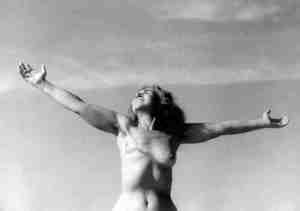
Tattoos over breast-surgery scars started – as far as I know – with a poet and writer, Deena Metzger:
c photo by Hella Hammid
Deena (b. 1936), the proud Amazon. This photograph of her is iconic and became – with the addition of the verse below – “The Poster,” which was designed by Sheila Levrant de Bretteville.
I am no longer afraid of mirrors where I see the sign of the amazon, the one who shoots arrows. There was a fine red line across my chest where a knife entered, but now a branch winds about the scar and travels from arm to heart. Green leaves cover the branch, grapes hang there and a bird appears. What grows in me now is vital and does not cause me harm. I think the bird is singing. I have relinquished some of the scars. I have designed my chest with the care given to an illuminated manuscript. I am no longer ashamed to make love. Love is a battle I can win. I have the body of a warrior who does not kill or wound. On the book of my body, I have permanently inscribed a tree.
Appropo our upcoming June issue of The BeZine, I particularly appreciate Deena’s essay, The Language and Literature of Restoration.. I think the quotation (below) is relevant to our concerns for our earthly environment, which is the focus of the June issue. Deena is holding us – lovers of nature, writers, poets, and lovers of the arts – accountable for our part in what comes next, extinction or survival.
“Extinction stalks us. Not an act of God, but a consequence of how we have chosen to live our lives. Such choices are handed to us by language and literature. Literature that is reduced to media, obsessed with violence, conflict, sensationalism, nationalism and speciesism. We are each responsible – we participate – no exceptions. The antidote for extinction is restoration. Languages and literatures that lead toward restoration are essential. So we have to try ….” MORE
“THE BeZINE” CALL FOR SUBMISSIONS thebezine.com is open for the upcoming June edition to be published on June 15, deadline June 10. This is an entirely volunteer effort, a mission. We are unable to pay contributors but neither do we charge for submissions or subscriptions. The theme is sustainability. We publish poetry, fiction, creative nonfiction, feature articles, art and photography, and music videos and will consider anything that lends itself to online posting. There are no demographic restrictions. We do not publish work that promotes hatred or advocates for violence. All such will be immediately rejected. We’d like to see work that doesn’t just point to problems but that suggests solutions. We are also interested in initiatives happening in your community – no matter where in the world – that might be easily picked up by other communities. Please forward your submissions to bardogroup@gmail.com No odd formatting. Submit work in the body of your email along with a BRIEF bio. Work submitted via Facebook or message will not be considered for publication. We encourage you to submit work in your first language, but it must be accompanied by translation into English.
– Jamie Dedes
Thank you for sharing your love of words. Comments will appear after moderation.
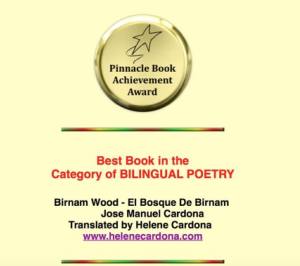
I know my Spanish isn’t anywhere good enough to fully appreciate José Manuel Cardona’s exquisite poetry, so it was with joy that I received the news of the publication of Birnam Wood: El Bosque de Birnam(Salmon Poetry; Bilingual edition, 2018) from Hélène Cardona along with a copy, her translation of her dad’s work.It has all the elements I most treasure in poetry. It is spiritually rich, vigorous, intuitive, conscious, disciplined and classic in its diction. It delivers warp and weave of Western mythology and, given his roots, it’s not surprising that his work sometimes puts one in mind of the Spanish mystic poets of the Catholic Church: Teresa of Avila and St. John of the Cross … And who better to translate his work, than his own daughter, a literary translator and a poet in her own right.
Señor Cardona, poet, writer, and translator from Ibiza, Spain, died last year. In his early life, the Franco regime forced him into exile in France. Years later, when the socialists came to power in Spain, he was offered a ministry position, which was ultimately denied him by the still heavily embedded Franquist administration. He remained blacklisted for several years.
Señor Cardona was also an attorney and translator who worked most of his life for the United Nations.
Here with permission are two poems from this collection, a highly recommended read indeed, most valued.
Ode to a Young Mariner
To my brother Manuel
The sea is a bride with open arms,
with stout rubber balls for breasts.
It is difficult to refuse her caress,
dryfrom the lips her brackish aftertaste,
forget her sweet bitterness.
Underneath her waters wails a rosaryof dead
centaurs, watchmen of the shadows.
Handsome men, hard as anchors torn
from the chest of a barbarian god.
It is difficult to refuse the call
of the sea, cover one’s ears,
grasp the neck with both hands
and become suddenly mute, or pluck out one’s eyes
and feed them to the fish. To ignore the gulls
and red masts and so many pennants,
and the ships arriving from unknown countries
and the ships departing for others
barely known, or perhaps for ours.
Because we carry within
like a blue keel or masts and spars
the marine bitterness of kelp,
the stripes on the back of fishes,
the tarry death
and our initials written in the sea.
Brother moving away to the bridge
like one more piece of our island,
the sea of mariners, your bride.
You know the smell of death
because you tread beneath a cemetery
that can be yours and you go brightly.
You know how the sea smells of life,
how at times she spits a ferocious foam,
how she wails wild and rises
like an atavistic being, a primitive creature.
We all carry death within written in furrows
like a name traced by the keel
of your boat in the sea. We are all sailors
of a sleeping bride with round breasts.
I don’t want to depart for the land,
to sprout like a eucalyptus branch
my eyes blinded by grass.
Wait for me, brother, when you anchor
your vessel in the sea you’ve loved.
No need to depart so alone, mariner
brother of a seaman gripped
by the earth’s open jaws.
From Birnam Wood / El Bosque de Birnam (Salmon Poetry, 2018), by José Manuel Cardona, translated by Hélène Cardona
Oda a un joven marino
A mi hermano Manuel
El mar es una novia con los brazos abiertos,
con los pechos macizos como balas de goma.
Es difícil negarse a su caricia,
secarse de los labios su regusto salobre,
olvidar su amargor azucarado.
Bajo sus aguas gime un rosario de muertos
centauros veladores de las sombras.
Hombres hermosos, duros, como anclas arrancadas
del pecho de un dios bárbaro.
Es difícil negarse a la llamada
del mar, taparse los oídos,
agarrar con las dos manos el cuello
y enmudecer de súbito, o arrancarse los ojos
y darlos a los peces. Ignorar las gaviotas
y los mástiles rojos y tantas banderolas,
y los barcos que llegan de países ignotos
y los barcos que parten para otros países
que apenas se conocen, o quizá para el nuestro.
Porque nosotros llevamos adentro
como una quilla azul o arboladura
el amargor marino de las algas,
las barras sobre el dorso de los peces,
la muerte alquitranada
y nuestras iniciales escritas en el mar.
La mar de los marinos, vuestra novia
hermano que te alejas sobre el Puente
como un pedazo más de nuestra isla.
Tú sabes el olor que huele a la muerte
porque pisas debajo un cementerio
que puede ser el tuyo y vas alegre.
Tú sabes como huele el mar a vida,
como vomita a veces fiera espuma,
como salvaje gime y se rebela
igual que un ser atávico, criatura primitiva.
Llevamos todos dentro la muerte escrita a surcos
como un nombre trazado por la quilla
de tu barco en el mar. Somos todos marinos
de una novia dormida con los pechos redondos.
Yo no quiero partir para la tierra,
brotar como una rama de eucalipto
con los ojos cegados por la hierba.
Espérame tú, hermano, cuando ancles tu nave
en la mar que has amado.
No has de partir tan solo, marinero
hermano de un marino atenazado
por las fauces abiertas de la tierra
From Birnam Wood / El Bosque de Birnam (Salmon Poetry, 2018) by José Manuel Cardona, first published in El Bosque de Birnam (Consell Insular de Eivissa, Ibiza 2007)
Poem to Circe IX
Humanly I’m illuminated.
I’m amazed every day by the roaring
Song that overflows like erosive
Blackberry juice, by the joyful
And boisterous song of men.
Voices stretch like branches,
Footprints like branches, flesh
Kindred to my flesh, and life’s
Juicy wind ripens.
I reincarnate with their centuries old footprints,
Their secular voices, their joy
So often painful, like a sick
Child carried on one’s back.
Oddly it’s on this island, Circe,
I have the strength to live.
Here humanity is embraced and screams
Mixing laughter with its colors,
Speaking the same language with varied
Accents. Love’s display
Becomes a ritual we officiate.
We arrived and the miracle happened.
It was the sea and the wind in the bells.
We came from far, from years
Thirsty as dust, from humble
fishermen’s nets on barren shore.
We arrived and the miracle with us.
It has jumped into the net like a liquid fish
And it has multiplied for all
And we satiated ourselves, and all of us
We walk through the sand as one.
You see, Circe, the miracle occurs
Whenever man wants it. The search
That is the mystery of all things.
From Birnam Wood / El Bosque de Birnam (Salmon Poetry, 2018), by José Manuel Cardona, translated by Hélène Cardona
Poema a Circe IX
Iluminado soy humanamente.
Me sorprendo a diario con el canto
Que ruge y se desborda como un jugo
Erosivo de moras, con el canto
Alegre y tumultuoso de los hombres.
Se distienden las voces como pámpanos,
Las huellas como pámpanos, la carne
Semejante a mi carne, y es el viento
Jugoso de la vida el que madura.
Reencarno con sus huellas de hace siglos,
Sus voces seculares, su alegría
Tantas veces penosa, como el hijo
Enfermo que se lleva a las espaldas.
Es en esta isla, Circe, donde siento
La fuerza de vivir extrañamente.
Aquí la humanidad se abraza y grita
Mezclando con la risa sus colores,
Hablando el mismo idioma con acentos
Variados. La evidencia del amor
Se transforma en un rito que oficiamos.
Llegamos y el milagro se produjo.
Ha sido el mar y el viento en las campanas.
Veníamos de lejos, de los años
Sedientos como polvo, de las redes
De humildes pescadores en mar yerma.
Llegamos y el milagro con nosotros.
Ha saltado a la red como un pez líquido
Y se ha multiplicado para todos
Y nos hemos saciado, y todos, todos
Andamos por la arena como un solo.
Ya ves, Circe, el milagro se produce
Siempre que el hombre lo quiere. La búsqueda
He ahí el misterio de todas las cosas.
From Birnam Wood / El Bosque de Birnam (Salmon Poetry, 2018) by José Manuel Cardona, first published in El Bosque de Birnam (Consell Insular de Eivissa, Ibiza 2007)
José Manuel Cardona
José Manuel Cardona (July 16, 1928 – July 4, 2018) is the author of El Vendimiador (Atzavara, 1953), Poemas a Circe (Adonais, 1959), El Bosque de Birnam: Antología poética (Consell Insular d’Eivissa, 2007).
He was co-editor of several literary journals and wrote for many publications. He participated in the II Congreso de Poesía in Salamanca and belonged to the Cántico group.
He worked for the United Nations most of his life, in Geneva, Paris, Rome, Vienna, Belgrade, Sofia, Kiev, Tbilisi, Moscow, St. Petersburg, and Panama, among many places.
Hélène Cardona
Hélène Cardona is the author of seven books, most recently Life in Suspensionand Dreaming My Animal Selves, and the translations Birnam Wood (José Manuel Cardona), Beyond Elsewhere(Gabriel Arnou-Laujeac), winner of a Hemingway Grant, Ce que nous portons (Dorianne Laux); and Whitman et la Guerre de Sécession: Walt Whitman’s Civil War Writings for WhitmanWeb. Her work as been translated into 15 languages.
Publications include Washington Square Review, World Literature Today, Poetry International, The Brooklyn Rail, Hayden’s Ferry Review, Asymptote, Drunken Boat, Anomaly, The London Magazine, The Warwick Review and elsewhere.
Acting credits include Chocolat, Jurassic World, Dawn of the Planet of the Apes, The Hundred-Foot Journey, Mumford, and Serendipity, among many.
Poet and writer, I am a former columnist and associate editor of a regional employment publication. Currently, I run this site, The Poet by Day, an information hub for poets and writers. I am the managing editor of The BeZine published by The Bardo Group Beguines (originally The Bardo Group), a virtual arts collective I founded. I am a weekly contributor to Beguine Again, a site showcasing spiritual writers. My work is featured in a variety of publications and on sites, including: Levure littéraure, Ramingo’s Porch, Vita Brevis Literature,Compass Rose, Connotation Press, The Bar None Group, Salamander Cove, Second Light, I Am Not a Silent Poet, Meta / Phor(e) /Play, and California Woman. My poetry was recently read byNorthern California actor Richard Lingua for Poetry Woodshed, Belfast Community Radio. I was featured in a lengthy interview on the Creative Nexus Radio Show where I was dubbed “Poetry Champion.”
“What if our religion was each other. If our practice was our life. If prayer, our words. What if the temple was the Earth. If forests were our church. If holy water–the rivers, lakes, and ocean. What if meditation was our relationships. If the teacher was life. If wisdom was self-knowledge. If love was the center of our being.” Ganga White, teacher and exponent of Yoga and founder of White Lotus, a Yoga center and retreat house in Santa Barbara, CA
“Every pair of eyes facing you has probably experienced something you could not endure.” Lucille Clifton
Thank you for sharing your love of words. Comments will appear after moderation.
“We are the memories we don’t remember, which live in us, which we feel, which make us sing and dance and pray the way we do, feelings from memories that flare and bloom unexpectedly in our lives like blood through a blanket from a wound made by a bullet fired by a man shooting us in the back for our hair, for our heads, for a bounty, or just to get rid of us.” Tommy Orange, There There
Notes:
Séan Hemingway [Ernest’s grandson] To Present Award During Ceremony at the John F. Kennedy Presidential Library and Museum, April 7, 2019
There There is also Amazon’s Best Book of 2018
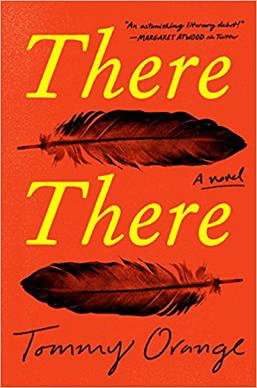
Critically-acclaimed debut author Tommy Orange is the winner of the 2019 PEN/Hemingway Award for his novel There There(Knopf, 2018), PEN America announced today. Honoring a distinguished first novel, Tommy Orange will receive $25,000 underwritten by the Hemingway Family and the Hemingway Foundation, as well as a month-long Residency Fellowship valued at $10,000 at the Ucross Foundation in Wyoming, a retreat for artists and writers. Séan Hemingway, the grandson of the American writer Ernest Hemingway, will present the prestigious literary award to Tommy Orange on Sunday, April 7, during a ceremony at the John F. Kennedy Presidential Library and Museum in Boston.
Orange’s There There illuminates the lives of urban Native Americans, and explores their struggles with identity and authenticity. This year’s judges—authors Cristina Garcia, Dinaw Mengestu, and Scott Simon—called There There a “devastatingly beautiful novel, as acutely attuned to our current cultural and political condition as it is to the indelible legacy of violence that brought us here.” The judges added that “The breadth and scope of this novel are matched only by the fierce and relentless intelligence that Orange brings to his characters, who despite tragedy, heartbreak and loss, reside in a remarkable world of hard-earned grace.”
“Orange’s novel is striking in its range and depth, and it is exceptional for a debut novel to disrupt and expand the landscape of American fiction the way that There There has,” said Literary Awards Program Director Nadxieli Nieto. “It is exactly this kind of groundbreaking work that the PEN/ Hemingway Award honors.”
“She told me the world was made of stories, nothing else, just stories, and stories about stories.” Tommy Orange, There There
Tommy Orange is an enrolled member of the Cheyenne and Arapaho Tribes of Oklahoma, and was born and raised in Oakland, California. He received his MFA from the Institute of American Indian Arts (IAIA), and was a 2014 MacDowell Fellow and a 2016 Writing by Writers Fellow. Orange joins other notable PEN/Hemingway winners and honorees including Marilynne Robinson, Edward P. Jones, Jhumpa Lahiri, Colson Whitehead, Jennifer Haigh, ZZ Packer, George Saunders, Ha Jin, Yiyun Li, Teju Cole, and Ottessa Moshfegh—a four-decade lineage of literary excellence founded in 1976 by Mary Hemingway, the widow of Ernest Hemingway, to honor her late husband and draw attention to debut novels. (See the complete list here.)
The two PEN/Hemingway runners-up are Akwaeke Emezi for Freshwater (Grove) and Ling Mafor Severance (Macmillan). Two writers will receive Honorable Mention: Meghan Kenny for The Driest Season (W.W. Norton) and Nico Walker for Cherry (Knopf). Runners-up and Honorable Mentions each receive a Residency Fellowship at the Ucross Foundation in Wyoming.
“Opal and Jacquie’s mom never let them kill a spider if they found one in the house, or anywhere for that matter. Her mom said spiders carry miles of web in their bodies, miles of story, miles of potential home and trap. She said that’s what we are. Home and trap.” Tommy Orange, There There
This feature is courtesy of PEN America. Book cover illustrations courtesy of Knopf.
The PEN/Hemingway Award Ceremony will take place at the John F. Kennedy Presidential Library on Sunday, April 7, from 2 to 3pm and is free and open to the public. Renowned novelist Viet Thanh Nguyen will be the keynote speaker. Those interested in attending should call the library at (617) 514-1643 or register online at www.jfklibrary.org to reserve a seat.
The PEN/Hemingway Award Ceremony is supported by the John F. Kennedy Presidential Library and Museum, the John F. Kennedy Library Foundation, the Hemingway Family, and the Friends of the Ernest Hemingway Collection.
The Ernest Hemingway Collection at the John F. Kennedy Presidential Library spans Hemingway’s entire career, and contains ninety percent of existing Hemingway manuscript materials, making the Kennedy Library the world’s principal center for research on the life and work of Ernest Hemingway. Jacqueline Kennedy Onassis described Mary Hemingway’s gift of Ernest Hemingway’s papers to the Kennedy Library as helping “to fulfill our hopes that the Library will become a center for the study of American civilization, in all its aspects.”
*****
PEN America stands at the intersection of literature and human rights to protect open expression in the United States and worldwide. We champion the freedom to write, recognizing the power of the word to transform the world. Its mission is to unite writers and their allies to celebrate creative expression and defend the liberties that make it possible.
The John F. Kennedy Presidential Library and Museumis one of fourteen presidential libraries administered by the National Archives and Records Administration and is supported, in part, by the John F. Kennedy Library Foundation, a non-profit organization. The Kennedy Presidential Library and the Kennedy Library Foundation seek to promote, through educational and community programs, a greater appreciation and understanding of American politics, history, and culture, the process of governing and the importance of public service.
Poet and writer, I was once columnist and associate editor of a regional employment publication. I currently run this site, The Poet by Day, an information hub for poets and writers. I am the managing editor of The BeZine published by The Bardo Group Beguines (originally The Bardo Group), a virtual arts collective I founded. I am a weekly contributor to Beguine Again, a site showcasing spiritual writers. My work is featured in a variety of publications and on sites, including: Levure littéraure, Ramingo’s Porch, Vita Brevis Literature,Compass Rose, Connotation Press, The Bar None Group, Salamander Cove, Second Light, I Am Not a Silent Poet, Meta / Phor(e) /Play, and California Woman. My poetry was recently read byNorthern California actor Richard Lingua for Poetry Woodshed, Belfast Community Radio. I was featured in a lengthy interview on the Creative Nexus Radio Show where I was dubbed “Poetry Champion.”
“What if our religion was each other. If our practice was our life. If prayer, our words. What if the temple was the Earth. If forests were our church. If holy water–the rivers, lakes, and ocean. What if meditation was our relationships. If the teacher was life. If wisdom was self-knowledge. If love was the center of our being.” Ganga White, teacher and exponent of Yoga and founder of White Lotus, a Yoga center and retreat house in Santa Barbara, CA
“Every pair of eyes facing you has probably experienced something you could not endure.” Lucille Clifton
Thank you for sharing your love of words. Comments will appear after moderation.
 What a delight today to bring you four of Myra Schneider’s poems from her tenth collection, Lifting the Sky. I believe I’ve read nearly all of Myra’s collections. I’ve reviewed a number of them. I am never disappointed. She soothes and inspires with layers of color and texture and keen and compassionate observations of nature, people and the
  human condition. I’ve also read and reviewed Writing Your Self: Transforming Personal Material (written with John Killick) and Writing My Way Through Cancer. These too I would recommend without reservation. Yes! I am an enthusiastic fan.
 Poet and writer, I am a former columnist and associate editor of a regional employment publication. Currently, I run this site, The Poet by Day, an information hub for poets and writers. I am the managing editor of The BeZine published by The Bardo Group Beguines (originally The Bardo Group), a virtual arts collective I founded. I am a weekly contributor to Beguine Again, a site showcasing spiritual writers. My work is featured in a variety of publications and on sites, including: Levure littéraure, Ramingo’s Porch, Vita Brevis Literature,Compass Rose, Connotation Press, The Bar None Group, Salamander Cove, Second Light, I Am Not a Silent Poet, Meta / Phor(e) /Play, and California Woman. My poetry was recently read by Northern California actor Richard Lingua for Poetry Woodshed, Belfast Community Radio. I was featured in a lengthy interview on the Creative Nexus Radio Show where I was dubbed “Poetry Champion.”


 “THE BeZINE” CALL FOR SUBMISSIONS


 Señor Cardona, poet, writer, and translator from Ibiza, Spain, died last year. In his early life, the Franco regime forced him into exile in France. Years later, when the socialists came to power in Spain, he was offered a ministry position, which was ultimately denied him by the still heavily embedded Franquist administration. He remained blacklisted for several years.

 Poet and writer, I am a former columnist and associate editor of a regional employment publication. Currently, I run this site, The Poet by Day, an information hub for poets and writers. I am the managing editor of The BeZine published by The Bardo Group Beguines (originally The Bardo Group), a virtual arts collective I founded. I am a weekly contributor to

 Jamie Dedes' THE POET BY DAY Webzine