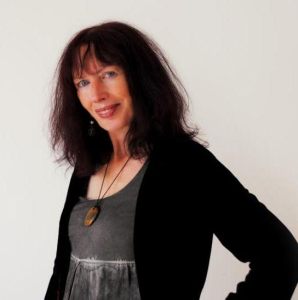
Kanchana Ugbabe (photo courtesy of and (c) Penguin India
The Fordham Department of English has welcomed a new colleague, Kanchana Ugbabe of Nigeria, to serve in the newly created position of Writer at Risk in Residence for one year beginning this fall.
The pilot position was made possible through the efforts of the Creative Writing program in partnership with PEN America, Artists at Risk Connection (ARC), Westbeth Artists Housing, ArtistsSafety.net, and Residency Unlimited. The residency is the second effort of the New York City Safe Haven Prototype, a multi-organizational artist residency program designed to house, integrate, and nurture artists at risk.
Ugbabe is a professor of English and African Literature at the University of Jos, Nigeria, and the author of a collection of short stories, Soulmates(Penguin Books, 2011). She has edited two collections of essays on the writings of the Nigerian novelist Chukwuemeka Ike and contributed three chapters to the Dictionary of Literary Biography focusing on African writers. Ugbabe holds a doctorate from Flinders University of South Australia, Adelaide, Australia. She holds a master’s in English literature from the University of Madras, India.
Since arriving at Fordham in mid-October, Ugbabe has been visiting English classes as well as courses in other departments, such as “Women and Independence in Africa,” taught by Fawzia Mustafa, Ph.D., professor of African and African-American studies and English. This spring, Ugbabe will teach her own class, “Creating Dangerously: Writing from Contact Zones.”
Over the last decade, the political crisis over ‘indigene’ rights and political representation in Ugbabe’s home city of Jos has developed into a protracted communal conflict affecting most parts of the area.
As a writer and South Asian woman settled in an increasingly unstable part of Nigeria, the risks and uncertainty became personal, Ugbabe says. These risks weighing upon her became intrinsically associated with a place she considered home—the town of Jos, which in the early days was a quaint, attractive outpost but has now devolved into a deeply fractured, overpopulated town rife with ethno-religious conflict. Ugbabe and her family, along with Nigerian friends, colleagues, and neighbors, found themselves at the center of the vortex of events. Disruption of work and a climate of insecurity escalated over the years as Jos deteriorated and the town became divided along ethnic and religious lines.
An invitation from Harvard University, to serve as Visiting Scholar with the Women and Gender Studies program, enabled Ugbabe to leave Jos and continue her writing and academic work in the peaceful environment of Cambridge, Massachusetts. The period also enabled her to distance herself temporarily from the tumult in Jos and to gain new perspective on the risks faced by fellow writers and academics in her beloved home country, Nigeria. As that fellowship neared its end, the Artists at Risk Connection (ARC) reached out to Ugbabe with the new opportunity at Fordham. This year-long pilot position will allow Ugbabe to continue writing and make headway with her research while being part of an enriching, safe, and encouraging community.
Street Scene: Jos, Nigeria The pollution comes from thousands of motorbikes which are the main transport in town. Photo courtesy of Andrew Moore under CC BY-SA 2.0 Generic license
Jos is a city in the Middle Belt of Nigeria.
“The city has a population of about 900,000 residents based on the 2006 census. Popularly called ‘J-town’, it is the administrative capital of Plateau State.
“The city is located on the Jos Plateau at an elevation of about 1,238 metres or 4,062 feet high above sea level. During British colonial rule, Jos was an important centre for tin mining. In recent years it has suffered violent religious clashes between its Muslim and Christian populations in 2001, 2008, 2010, and 2011.” MORE
A Decade of Suffering
“In the past decade, more than 3,800 people have been killed in inter-communal violence in Plateau State, including as many as 1,000 in 2001 in Jos and more than 75 Christians and at least 700 Muslims in 2004 in Yelwa, southern Plateau State. In November 2008, two days of inter-communal clashes following local government elections in Jos left at least 700 dead.” MORE
Some of the killings in Jos hit very close to home for Ugbabe. In 2007, a university professor was kidnapped and never found. Around that same time, church members were attacked, a neighbor’s home was set on fire, and a colleague’s daughter was killed in a bomb blast, to name just a few incidents.
This feature is compiled courtesy of Artists at Risk, PEN America, Human Rights Watch, Fordham University and Wikipedia
The Artists at Risk Connection (ARC) brings together organizations around the world that are committed to defending and promoting artistic freedom of expression, and to ensuring that artists everywhere can live and work without fear.
PEN America stands at the intersection of literature and human rights to protect open expression in the United States and worldwide. It champions the freedom to write, recognizing the power of the word to transform the world. Its mission is to unite writers and their allies to celebrate creative expression and defend the liberties that make it possible.
Human Rights Watch
If you are reading this in an email subscription, you’ll likely have to link through to the site to view this video.
Thank you for sharing your love of words. Comments will appear after moderation.
What’s it like for a poet and a singer/songwriter to pool their talents and produce an album? That’s something I’ve wondered about. I thought perhaps some of you have as well. When I found out that Diane Barbarash and Allison Grayhurst did just that, I asked them to share their experience with us here. / J.D.
I should first explain that Allison and I were extremely close friends back in Toronto, my old hometown. Several years ago I moved 3,000 miles west, landing in Vancouver on the west coast of Canada. I think it’s hard to maintain friendships with such distance so over time we focused more on our private lives and lost our regular communication.
Sometime in 2016 Allison and I reconnected, and it was as if we had never skipped a beat. I truly felt a piece of myself had returned and so it followed that I downloaded her compilation and was immersed in the book on that auspicious New Year’s Eve. I don’t even know what possessed me, but I remember the moment clearly. I suddenly picked up my guitar, scanned the poem I had just read and a verse flowed from a few of the lines like magic. It came so easily; musically it sounded like “something.”
So I went to another poem and had a similar experience. I should insert here that I was at that time fresh off of a three-year creative block in which I was only able to write a few songs, not many for such a time period. When these two random verses came forward from Allison’s poetry I felt more alive than I had in a long time. I can’t tell you how I knew but I knew something big had opened. The following day I contacted Allison and proposed the project. She very kindly gave me her blessing and her trust, and then I got to work!
The first poem that became a song was Animal Sanctuary. I think I sent Allison the first half, just to see how she felt. She loved it. I remember feeling nervous because I had changed the wording of course, the order of things, because a song is going to demand its own unique rhythm and one that flows with the chord progression. Even with just a half a song, we knew we had something. The writing of the album continued from January until July 2017. It was recorded in four days in August and mixed and mastered that same month.
River has been the most beautiful artistic relationship I have ever experienced. I’ve previously co-written with other musicians and one other Canadian poet, so I have had some collaborative experience, but mostly it’s been a solo road, writing my own material. I admit I am biased here… I think Allison is truly a great writer and I have not read poetry that moves me so deeply into my human rawness as hers does. It’s an honor that I’ve been able to bring her work out into the forefront.
Songs, like other art, cannot be forced by the mind. They have to come from the heart and you have to give yourself over to them as they flow out. This is how I’ve always known I am in the presence of true love, the unexplainable lyrical and musical combination that gives birth to what becomes a song.
Composing with Allison’s poetry became this kind of pure-heart experience. I am changed because of this album and definitely hope that there is more to come.
– Diane Barbarash
DIANE BARBARASH started writing songs even before she learned how to play guitar at thirteen. She was an active performer in Toronto’s folk club circuit before moving to Vancouver where she perused her love of recording. She has released three albums prior to River butconsiders River her true debut.
River – songs from the poetry of Allison Grayhurst was released in October 2017 and is available on Bandcamp, iTunes, and Amazon. Diane’s Amazon page is HERE. . . Diane on Soundcloud.
Allison Grayhurst:
When Diane first approached me about this project, my initial response was surprise and trepidation, along with excitement. I didn’t think such a thing was possible – for although there is a natural rhythm in my poetry, I didn’t think there could be music. I was nervous that I wouldn’t like what I heard. Even though I completely trusted Diane and was already a fan of her musical abilities, I was full of scepticism. However, after hearing how Diane combined her musical gifts with my poems to create separate identities – songs – I was blown away. I never imagined such a thing possible and I can’t imagine that anyone but Diane could have tuned in so well to my poems, creating songs from my poems that I would be happy with. Her instinctual genius, both musically and vocally, astounds me and resonates in complete harmony with my poetry. She has honoured my work every step of the way. I am in awe of Diane’s talent and brilliance.
Diane wrote the songs using my poems. Once the songs were complete, Diane sent me each song as an mp3 and a word file of the lyrics. I went over the lyrics meticulously and got back to her with any changes I wanted. There weren’t many changes, but there were a few that I felt necessary to keep true to the poems. Diane made the changes upon my suggestion – sometimes sending me back several versions. We did this until it fit musically for her and I was happy with it lyrically. As we both mutually respect each other’s artistic integrity, the process was quick and easeful.
.
– Allsion Grayhurst
.
Three poems by Allison Grayhurst
.
River
I will run my breath across your eyelids,
go to you, trace the edges of your hands,
finding infinity inside your torment. I will
drift into you like wind and you will not mind
my lips like a concentrated shadow on your skin,
darkening but leaving no weight. You will let me
be inside your picture, a background to your lyrics,
softly at first, I will heal the red in the whites of your eyes.
I will release my wardrobe for you and you will be the mania
that I climb through to reach tranquility. I will
cup your flesh and stretch you through this intimacy because
I own you as you own me and it is not a bad thing, not
blasphemy or anything
to fear. It is your hands, mine – these
poignant burial grounds that have been excavated,
these days of standing close, depending upon the ease
of our mutual exposure. I will speak in your ear and you
will step into my voice
like stepping into a river.
First published in InnerChildPress
Now I am Two
It is this way, togetherness:
A covenant with tenderness and speaking thoughts
only glimpsed.
The snow falls like rain as the afternoon moves
without time, our hands pressed as one,
lips and then, something better. Always
miraculous, unexpected, awakening. Always
us, vanishing and then re-emerging with these things
of harmony and friction engulfing our scent and path. Soon,
the tiger lilies will bloom and being just us will be made difficult
with the children gathered in our arms. But this ‘difficult’ is
whole and adds to our liberation – making coffee, laughing
at things shared and only ours.
It is what was prayed for, what years and hardship has not
diluted, but has fused into an unbreakable bond – us –
the summoning of all our parts – ancient, immediate
so that even when death comes or fate and terrible sobbing,
neither of us will ever be again
without the other
alone.
First published in Anchor & Plume: Kindred, Issue 5, Nest
ALLISON GRAYHURST (Allison Grayhurst.com) is a member of the League of Canadian Poets. Three of her poems were nominated for “Best of the Net” in 2015, and one eight-part story-poem was nominated for “Best of the Net” in 2017. She has over 1125 poems published in more than 450 international journals and anthologies. Her book Somewhere Falling was published by Beach Holme Publishers, a Porcepic Book, in Vancouver in 1995. Since then she has published sixteen other books of poetry and six collections with Edge Unlimited Publishing. Prior to the publication of Somewhere Falling she had a poetry book published, Common Dream, and four chapbooks published by The Plowman. Her poetry chapbook The River is Blind was published by Ottawa publisher above/ground press December 2012. In 2014 her chapbook Surrogate Dharma was published by Kind of a Hurricane Press, Barometric Pressures Author Series. In 2015, her book No Raft – No Ocean was published by Scars Publications. More recently, her book Make the Wind was published in 2016 by Scars Publications. As well, her book Trial and Witness – selected poems, was published in 2016 by Creative Talents Unleashed (CTU Publishing Group). She is a vegan. She lives in Toronto with her family. She also sculpts, working with clay. Allison’s Amazon page is HERE.
The Grand Canal in Venice from Palazzo Flangini to Campo San Marcuola, Canaletto, about 1738. The J. Paul Getty Museum, Los Angeles / This photograph of the painting is in the public domain.
 I stood in Venice, on the Bridge of Sighs,
    A palace and a prison on each hand:
    I saw from out the wave her structures rise
    As from the stroke of the enchanter’s wand:
    A thousand years their cloudy wings expand
    Around me, and a dying Glory smiles
    O’er the far times, when many a subject land
    Looked to the wingéd Lion’s marble piles,
Where Venice sate in state, throned on her hundred isles!
Lord Byron (1788-1824), Childe Harold's Pilgrimage
I’ve been so enjoying Linda Ibbotson’s Facebook and blog posts about her travels, art and poetry readings and thought some of you might enjoy her site as well. She’s done a wonderful post on Contemplating the Muse, Linda Ibbotson/Poet, inspired by a recent adventure in Venice, a taste of which is included below today. To read the entire post and see the fabulous photographs she included link HERE. You can link to pianist Ivan Ilić’s site HERE. / J.D.
Meanwhile, with LInda’s permission …
“When I seek another word for ‘music’, I never find any other word than ‘Venice’.” Friedrich Nietzsche.
When pianist Ivan Ilić announced his cd Reicha Rediscovered was to be launched in Venice at the magnificently restored Palazzetto Bru Zane, (The Centre de musique romantique française) it was music to my ears and the catalyst that awakened my desire to attend this wonderful momentous occasion. It was also an exciting opportunity for me to rediscover Venice!
Venice, known also as La Serenissima is shaped like a fish, 118 small islands spanned by over 400 named bridges and resembles a theatre of stone!
Visually, a masterpiece! From the ancient splendour of Baroque, Byzantine and Moorish influenced Gothic architecture, particularly in the Chiesa’s (churches), the delicate Murano artisan glass chandeliers, the prodigious work of Renaissance artists such as Carpaccio, Titian and Tintoretto, influenced by light and play of light on water (a legacy to European art) to the contemporary Venice Biennale spectacularly captured in 2017 by Lorenzo Quinn’s giant hands of Support at Ca’ Sagredo Hotel.
After viewing the impressive Piazza San Marco and the Rialto, paradoxically, the only way to find Venice is to lose yourself in the labyrinth. You will discover timeless haunts such as Caffè Florian est. 1720, famous for its delicious hot chocolate and where a plethora of artists, musicians and writers; Byron, Verdi, Hemmingway to name a few frequented, the renowned Libreria Acqua Alta bookshop where books are kept safely afloat in a gondola and bathtubs, Hotel Danielli, the location for The Tourist movie and where George Sand stayed, the decorative mask and costume shops Marega and Ca del Sol well as quieter residential areas of Santa Croce and San Polo where the early morning washing hangs from windows to dry.
The Finale, another glorious concert as Interpreti Veneziani play Vivaldi at Chiesa san Vidal near the Accademia bridge. The final fading notes of a cello, fragrance of a nearby oleander, the creaking crowded Grand Canal night vaporetto indelibly etched in my mind.
Venice is compelling, the ultimate lure for the artistic and intrepid traveller!
Reicha Rediscovered is the first in a series released by Chandos; one of the world’s premiere classical record companies , produced by Swiss National Radio and supported by the Palazzetto Bru Zane. Antoine Reicha was a contemporary of Beethoven and many of his compositions unpublished, stored in France’s National Library. / L.I.
Linda Ibottson
LINDA IBBOTSON is a poet, artist and photographer from the UK, currently residing in County Cork, Ireland. Her poetry, artwork and photography has been published internationally including Levure Litteraire,Enchanting Verses Literary Review, Irish Examiner, California Quarterly , Fekt and Live Encounters, also read on radio and performed in France by Irish musician and actor Davog Rynne.
Her painting Cascade featured as the cover of a cd. She writes a poetry and arts blog Contemplating the Muse.
Linda was invited to read at the Abroad Writers Conference in Lismore Castle, Butlers Townhouse, Dublin and Kinsale.
“Each day I squeeze the contents of my heart over whatever expression I’m wearing & imprint it onto a notebook page–my version of St. Veronica’s veil.”
Joseph Hesch (A Thing for Words) lives in a beautiful region, upstate New York, at the confluence of my own beloved Hudson River and the Mohawk River. It’s a fine setting for a poet.
This is a prequel to this month’s The BeZine. It’s on theme by a slender thread but profoundly supports the core objective of the Zine, which is to recognize that “other” isn’t other at all and to respect and honor all humanity. Enjoy! … and visit The BeZine on the 15th for our November edition, HUNGER, POVERTY AND THE WORKING CLASS AS SLAVE LABOR. Read more about our core-team member,Joseph Hesch, HERE.
When you’re in the middle of it, living and learning, learning about living, living as a means of learning, you don’t notice how you might be different from (or the same as) some guys across the ocean or across the room. You don’t notice much about anything but what’s inside the three inches of air surrounding your body.
They are Them, There, Then. You are You, Here, Now. Context is but a ghost, barely a specter of a concept through which you your place in a wider world. You accept ideas, tenets, the virtual castle walls within which you secure your position as the center of the Universe. You don’t question. God just IS, He is a He and you need to toe his line in order to win the lovely parting gifts they hand you for completing the Home version of this dicey Game of Life.
The other day, I asked myself not only who I am, but what, forcing myself to look beyond myself as this sack of meat, its spark of intellectual and essential energy and the possessor of opposing thumbs that answers to Joseph, Joe, Joey and any of a hundred or so discrete alphanumeric identifiers that differentiate me from you. And you and you, as well.
I saw such a small thing, a cluster of cells both good and ill, beneficial and malignant, functional and inert, held modestly upright by some universally accepted beliefs that inherently make me superior to so much of the rest of the inhabitants of this blue marble upon which we stand as it falls, rises, or circles in the vastness of the Universe.
And so much of what I see is just a matter of dumb luck, some bit of kismet that Valentine met Maria and Patrick loved Lizzy and they all somehow decided to leave their homes in Europe to come to this coast-to-coast set of geographic coordinates that may make this the most varied and valuable piece of real estate on the planet. They came to this place where people can be free to become the monarchs of their own existence. Here in this nation established upon the premise that all men are created equal.
Except, of course, if you were on the wrong end of our “peculiar institution,” where white men owned black men who did the physical labor that either built or buttressed the Whites’ socioeconomic standing. And that sin was committed even in my hometown, tucked up here in the upper right corner of your map, which is the oldest chartered municipality in the country.
And also except if you were a member of the class of original inhabitants of this breadth of the continent. Then you were crushed in the essentially forgotten, if considered at all, dirty little secret of American’s Manifest Destiny, which included eviction, subjugation, military intimidation, interdiction and an open-air type of incarceration. And, quite often, our Euro-America’s God-blessed version of the final solution to the “Indian problem,” eradication.
Which brings us rambling back to my original premise. When you are so busy trying to make it from First to Twelfth Grade, from freshly minted believer to elder keeper of whatever Word you follow, from allowance grabber to worker bee and then retirement check-cashing senior, you don’t think of these things. You pretty much have to live within your insulated little castle keep, those walls of ideas and ideals I spoke of before.
It’s human nature. Self-preservation, self-centeredness, selfishness, maybe even a selective selflessness, draw blinders around us from which we might occasionally sneak a peek outside ourselves. Then we pull our heads back within the silken bonds of our own spiritual and intellectual cells. There in the comforting darkness we see house-of-mirrors reflections of ourselves, warm and fuzzy, clean and bright, dark and angry, volatile and violent. And we accept them or reject them with but a blink, a wink or a meditative, prayerful closing of the eyes.
Please forgive me this tedious ramble. I’ve been reading again, something I haven’t done as much as when I was younger. Back then it was hardcore youthful inquisitiveness, feeding the insatiable intellectual beast as much trivia, possibly necessary minutiae and winning team history it could take. Now, it’s my own version of sticking this silver-pated gourd out of the dusty crust of virtual Hesch topography to see what I missed. In my old age I’ve become another type of Self-something. Self-aware. It’s embarrassing and painful, yet somehow freeing.
I see the mistakes, poor judgments and failures I’ve made. I see the victories, loves and lucky guesses, too. On electronic and physical pages I’ve cast them out there like stars across a desert sky. And now I see how they tell stories and give necessary direction, even if I have almost reached my ultimate destination.
I just thought I’d pass this on to you, since you’re traveling that way, Slán abhaile. Auf wiedersehen. Safe travels. Ramble Tamble. Down the road I go.
This started its life as a poem, then grew like some good ol’ southern kudzu, spilling all around the page, seemingly taking over everything from my writing hand to better judgment. By the way, Ramble Tamble is the title of the first cut on Creedence Clearwater Revival’s classic 1970 album, Cosmo’s Factory. It’s one of the rockingest songs I know, a great road song and might be as good a fit for our current times as it was for my youth.

 Ugbabe is a professor of English and African Literature at the University of Jos, Nigeria, and the author of a collection of short stories, Soulmates (Penguin Books, 2011). She has edited two collections of essays on the writings of the Nigerian novelist Chukwuemeka Ike and contributed three chapters to the Dictionary of Literary Biography focusing on African writers. Ugbabe holds a doctorate from Flinders University of South Australia, Adelaide, Australia. She holds a master’s in English literature from the University of Madras, India.





 Jamie Dedes' THE POET BY DAY Webzine