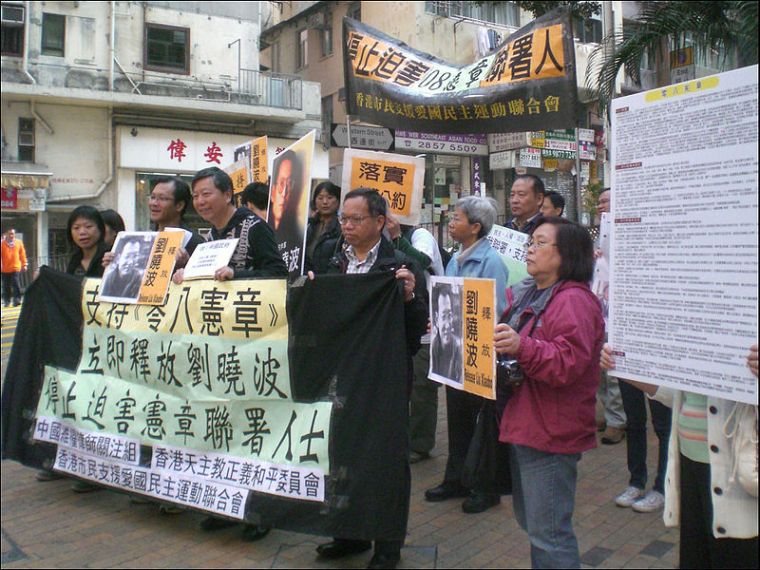
Politial protest in Hong Kong against the detention of Liu Xiaobo, Photo courtesy of Pederez under CC BY-SA 2.0 license
The death of Liu Xiaobo will forever mar China’s reputation under international law and global human rights standards, PEN America said today and called on China to Release Late Literary Icon’s Wife, Liu Xia
Liu Xiaobo, a brilliant writer, literary critic, and pro-democracy activist, was a founding member and former president of the Independent Chinese PEN Center. After his arrest, PEN America honored Liu with the 2009 PEN/Barbara Goldsmith Freedom to Write Award, kicking off an international campaign for his freedom that culminated in his receipt—in absentia—of the 2010 Nobel Peace Prize.
PEN America held a candlelight vigil earlier this evening at the Permanent Mission of the People’s Republic of China to the U.N. to honor Liu Xiaobo’s legacy and protest continued human rights abuses in China, where more than forty writers are currently in jail. This free, public event featured readings from the work of Liu and his wife, Liu Xia, who remains under house arrest in China without charge since her husband’s receipt of the Nobel Prize.
PEN America Executive Director Suzanne Nossel released the following statement today in response to news of Liu Xiaobo’s death today:
“The death of Liu Xiaobo today from a virulent cancer contracted while serving an 11-year prison sentence will forever be a black mark marring China’s reputation under international law and global human rights standards.
“As President of the Independent Chinese PEN Center, Liu Xiaobo was a friend and compatriot for writers all over the world who struggle against tyranny using words as their sole weapon. Liu Xiaobo’s purported crime was no crime at all, but rather a visionary exposition on the potential future of a country he loved.
“For the act of penning seven sentences, China punished Liu Xiaobo with a long prison term, limiting his access to state-of-the-art medical care that might have prevented his illness or improved his prognosis. China’s refusal to honor Liu Xiaobo’s last wish to travel overseas for treatment and its decision to hold him incommunicado during his dying days are a cruel epitaph in the tale of a powerful regime’s determination to crush a brave man who dared challenge a government that sustains its rule through suppression and fear. Liu Xiaobo was not afraid. His courage in life and in death is an inspiration to those who stand for freedom in China and everywhere.
“Our thoughts are with Liu Xiaobo’s family and friends, especially his beloved wife, the poet Liu Xia, who has been kept under house arrest, harassed, and hounded for years without charge. The only thing the Chinese government can do now to expiate its complicity in the death of Liu Xiaobo is to grant his wife, Liu Xia, the freedoms in life that her husband gained only in death. PEN America calls on China to immediately grant Liu Xia freedom of movement, expression, and travel lest their crimes against Liu Xiaobo claim a second victim.”
PEN America stands at the intersection of literature and human rights to protect open expression in the United States and worldwide. The organization champions the freedom to write, recognizing the power of the word to transform the world. Its mission is to unite writers and their allies to celebrate creative expression and defend the liberties that make it possible.
Thank you for sharing your love of words. Comments will appear after moderation.
The Poetry Foundation announced recently that poet Kristen Tracy won its 2017 Emily Dickinson First Book Award for her manuscript Half-Hazard. The occasional prize (last awarded in 2012) is designed to recognize an American poet at least 40-years-old who has yet to publish a first collection of poetry. Tracy’s manuscript Half-Hazard, which was previously a finalist for the Yale Younger Poet Prize and a semi-finalist for the Walt Whitman Award and Sarabande Books’ Kathryn A. Morton Prize, will be published by Graywolf Press in 2018. The cash award is $10,000. Tracy was honored at the Pegasus Awards ceremony at the Poetry Foundation on June 12.
KRISTEN TRACY grew up in a small Mormon farming community in Idaho. She earned an MA in American Literature from Brigham Young University, an MFA from Vermont College, and a PhD in English from Western Michigan University. Her poems have appeared in more than two dozen literary journals.
“The Poetry Foundation is proud to recognize Kristen Tracy, whose manuscript was selected from more than one thousand submissions to this year’s Emily Dickinson First Book Award contest, and to partner with Graywolf Press in publishing these distinctive poems,” said Poetry Foundation President Henry Bienen.
In describing Half-Hazard, Jeff Shotts, Executive Editor at Graywolf Press, noted that it is “full of warnings and dangers, as well as wry observations, and also full of a kind of joy made sweeter by its being earned, lived, and perceived.” Shotts continued, “It’s a great honor for Graywolf to publish Tracy’s unusual and accomplished debut through our ongoing collaboration with the Poetry Foundation and the Emily Dickinson First Book Award. Discovering important new voices is at the heart of this award and the missions of both the Press and the Foundation.”
Tracy’s book, Half-Hazard, is scheduled to be published by Graywolf Press, fall 2018. Meanwhile, you can visit Kristen Tracy’s website. She also writes for children, tweens and teens, so it’s a site full of cheer and color. Her Amazon page is HERE.
The Poetry Foundation, publisher of Poetry magazine, is an independent literary organization committed to a vigorous presence for poetry in our culture. It exists to discover and celebrate the best poetry and to place it before the largest possible audience.
The Poetry Foundation seeks to be a leader in shaping a receptive climate for poetry by developing new audiences, creating new avenues for delivery and encouraging new kinds of poetry through innovative literary prizes and programs. For more information, please visit poetryfoundation.org.
Tracy K. Smith (b. 1977), Pulitzer Prize winning poet and new U.S. Poet Laureate
“When some people talk about money
They speak as if it were a mysterious lover
Who went out to buy milk and never
Came back, and it makes me nostalgic
For the years I lived on coffee and bread,
Hungry all the time, walking to work on payday
Like a woman journeying for water
From a village without a well, then living
One or two nights like everyone else
On roast chicken and red wine.” Tracy K. Smith, Life on Mars
On Wednesday Librarian of Congress Carla Hayden announced the appointment of Tracy K. Smith as the Library’s 22nd Poet Laureate Consultant in Poetry for 2017-2018. Smith will take up her duties in the fall, opening the Library’s annual literary season in September with a reading of her work in the Coolidge Auditorium.
Smith, a Pulitzer Prize-winning poet and a professor at Princeton University, succeeds Juan Felipe Herrera as Poet Laureate.
“It gives me great pleasure to appoint Tracy K. Smith, a poet of searching,” Hayden said.
“Her work travels the world and takes on its voices; brings history and memory to life; calls on the power of literature as well as science, religion and pop culture. With directness and deftness, she contends with the heavens or plumbs our inner depths—all to better understand what makes us most human.”
“I am profoundly honored,” Smith said. “As someone who has been sustained by poems and poets, I understand the powerful and necessary role poetry can play in sustaining a rich inner life and fostering a mindful, empathic and resourceful culture. I am eager to share the good news of poetry with readers and future readers across this marvelously diverse country.”
Smith joins a long line of distinguished poets who have served in the position, including Juan Felipe Herrera, Charles Wright, Natasha Trethewey, Philip Levine, W.S. Merwin, Kay Ryan, Charles Simic, Donald Hall, Ted Kooser, Louise Glück, Billy Collins, Stanley Kunitz, Robert Pinsky, Robert Hass and Rita Dove.
The new Poet Laureate is the author of three books of poetry, including Life on Mars (2011), winner of the 2012 Pulitzer Prize for Poetry; “Duende” (2007), winner of the 2006 James Laughlin Award and the 2008 Essence Literary Award; and The Body’s Question (2003), winner of the Cave Canem Poetry Prize. Smith is also the author of a memoir, Ordinary Light(2015), a finalist for the 2015 National Book Award in nonfiction and selected as a notable book by the New York Times and the Washington Post.
For her poetry, Smith has received a Rona Jaffe Writers Award and a Whiting Award. In 2014, the Academy of American Poets awarded her with the Academy Fellowship, given to one poet each year to recognize distinguished poetic achievement. In 2016, she won the 16th annual Robert Creeley Award and was awarded Columbia University’s Medal for Excellence.
In the Pulitzer Prize citation for Life on Mars, judges lauded its “bold, skillful poems, taking readers into the universe and moving them to an authentic mix of joy and pain.” Toi Derricotte, poet and Academy of American Poets chancellor, said “the surfaces of a Tracy K. Smith poem are beautiful and serene, but underneath, there is always a sense of an unknown vastness. Her poems take the risk of inviting us to imagine, as the poet does, what it is to travel in another person’s shoes.”
Born in Falmouth, Massachusetts in 1972, and raised in Fairfield, California, Tracy K. Smith earned a B.A. in English and American literature and Afro-American studies from Harvard University and an M.F.A. in creative writing from Columbia University. From 1997 to 1999, she was a Stegner Fellow in poetry at Stanford University. Smith has taught at Medgar Evers College of the City University of New York, at the University of Pittsburgh and at Columbia University. She is currently the Roger S. Berlind ’52 Professor in the Humanities and director of the creative writing program at Princeton University.
Background of the Laureateship
The Library of Congress Poetry and Literature Center is the home of the Poet Laureate Consultant in Poetry, a position that has existed since 1937, when Archer M. Huntington endowed the Chair of Poetry at the Library. Since then, many of the nation’s most eminent poets have served as Consultant in Poetry to the Library of Congress and, after the passage of Public Law 99-194 (Dec. 20, 1985), as Poet Laureate Consultant in Poetry—a position which the law states “is equivalent to that of Poet Laureate of the United States.”
During his or her term, the Poet Laureate seeks to raise the national consciousness to a greater appreciation of the reading and writing of poetry. The Library keeps to a minimum the specific duties required of the Poet Laureate, who opens the literary season in the fall and closes it in the spring. In recent years, Laureates have initiated poetry projects that broaden the audiences for poetry.
The Great Hall of the U.S. Library of Congress. Public domain photo.
The Library of Congress is the world’s largest library, offering access to the creative record of the United States—and extensive materials from around the world—both on site and online. It is the main research arm of the U.S. Congress and the home of the U.S. Copyright Office. Explore collections, reference services and other programs and plan a visit at loc.gov, access the official site for U.S. federal legislative information at congress.gov, and register creative works of authorship at copyright.gov.
“In his text, the writer sets up house … For a man who no longer has a homeland: Writing becomes a place to live …” Theodor W. Adorno in Minima Moralia: Relections of Damaged Life
The world’s gone mad, but we still have books and writing for refuge, strength and inspiration.


 Jamie Dedes' THE POET BY DAY Webzine