Page 62 of 91

THE SUNDAY POESY: Opportunities, Events and Other News & Information

PBD - blogroll

CALL FOR SUBMISSIONS

Opportunity Knocks 

CROSSROADS POETRY SERIES MANUSCRIPT, Reading fee: $15.00 USD, $20.00 CAD DEADLINE 12/1/2016. “The Crossroads Poetry Series is … seeking book length collections of poems that are a minimum of 50 pages in length for publication in 2017. We hope to publish at least 2 collections of work. Only one poem per page and single spaced. All selected manuscripts will be awarded a book contract (with the possibility of a second book contract), $250, 10 copies, 8% royalties, and a primary run of 500 copies. All submissions must be accompanied by submissions fee or they will not be read. Simultaneous submissions are welcome providing that you notify us if your manuscript is to be published elsewhere. We look forward to reading your work.” DETAILS HERE

CALAMARO, a print poetry magazine, accepts submissions year round – formal as well as free verse – from 2 – 30 lines. DETAILS HERE

COMPETITIONS

Opportunity Knocks
9780996259644PROUD TO BE: WRITING BY AMERICAN WARRIORS (anthology) Deadline: June 1, 2016 (postmarked). No reading fee.  5 categories for the contest, $250 prize in each: Short Fiction, Poetry, Interview with a Warrior, Essay, Photography. Details HERE.

SECOND LIGHT OPEN POETRY COMPETITION for Long and Short Poems for Women! “Second Light is a very generous and encouraging organisation. Here’s a chance for longer poems, with magazine publication and a London reading as well as the prizes! Entry by post or email – and I [Alison Blackenbury] will read all entries.” Closing date 31 August. DETAILS HERE

THE AKRON POETRY PRIZE “was founded to bring to the public writers who speak in original and compelling voices. Each year, The University of Akron Press offers the Akron Poetry Prize, a competition open to all poets writing in English. The winning poet receives $1,500 and publication of his, her, or their book. The final selection will be made by a nationally prominent poet. The final judge for 2016 is Allison Joseph. Other manuscripts may also be considered for publication in the series. SUBMISSIOS ACCEPTED between April 15 and June 15 DETAILS HERE

SPECIAL ANNOUNCEMENT

THE AURORA PRIZE for Awakening Humanity: On behalf of the survivors of the Armenian Genocide and in gratitude to their saviors. The Aurora Prize for Awakening Humanity will be granted annually to an individual whose actions have had an exceptional impact on preserving human life and advancing humanitarian causes.

  • The Aurora Prize Laureate will be honored with a US $100,000 award.
  • That individual will have the unique opportunity to continue the cycle of giving by selecting an organization that inspired their work to receive a US $1,000,000 grant.
  • The Aurora Prize will be awarded annually on April 24 in Yerevan, Armenia
  • Selection Committee: George Clooney, Co-Founder, Not On Our Watch, Humanitarian, performer and film maker; Elie Wiesel, President of the Elie Wiesel Foundation for Humanity, Nobel Laureate; Vartan Gregorian,  Co-Founder, 100 LIVES, President of the Carnegie Corporation of New York;; and, Leymah Gbowee: Nobel Laureate, Liberian peace activist and women’s rights advocate

TIDBIT

REMINDERS

  • THE CREATIVE NEXUS™ arts aggregate publishes a new edition weekly HERE
  • THE BeZINE April issue was published on the 15th and celebrates interNational Poetry Month HERE.
  • WOVEN TALE PRESS is currently celebrating Poetry Month HERE.
  • SAVANNAH BOOK FESTIVAL is February 16-19, 2017, keep watching their site for details.
  • 100,000 POETS FOR CHANGE (100TPC) registration is HERE if you want to organize an event in your area
  • THE BeZINE (HERE) theme for the May issue is Books that Changed Our Lives. Submit one or two paragraphs on a book that changed your life and why along with a two-line bio to bardogroup@gmail.com DEADLINE May 10, 2015.
  • 101st ANNIVERSARY OF THE ARMENIAN GENOCIDE is today. Silver Merjaian’s commemorative poem, Rape of Arevik is HERE
  • THE BeZINE submission guidelines HERE
  • SECOND LIGHT NETWORK OF WOMEN POETS submission guidelines for ARTEMISpoetry HERE

THE POET BY DAY SUNDAY POESY

Submit your event, book launch and other announcements at least fourteen days in advance to thepoetbyday@gmail.com. Publication is subject to editorial discretion.

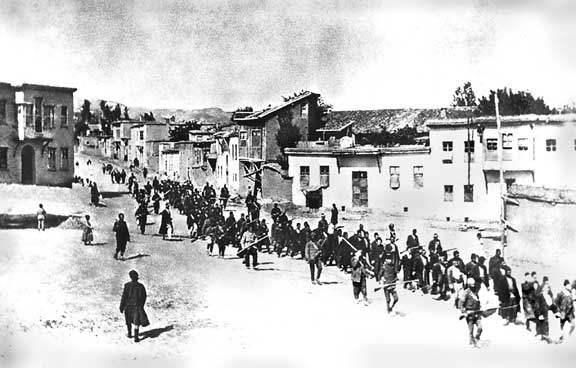
ON THE 101st ANNIVERSARY OF THE ARMENIAN GENOCIDE: Rape of Arevik by Silva Merjanian

 Armenians are marched to a nearby prison in Mezireh by armed Turkish soldiers. Kharpert, Armenia, Ottoman Empire - April, 1915. *From the collection of Project SAVE Armenian Photograph Archives. Photographed by an anonymous German traveler.

Armenians are marched to a nearby prison in Mezireh by armed Turkish soldiers. Kharpert, Armenia, Ottoman Empire – April, 1915. From the collection of Project SAVE Armenian Photograph Archives. Photographed by an anonymous German traveler.

There were moonlit nights and many moonless nights
sober and drunken in one grain of sand
in billions of grains there were filthy hands
mud and fingernails between sunburned thighs
this is not my skin with nerves inside out
not my breast squeezed into faint whimpers
like dying swallows caught in a dry mouth

soon I’ll be a memory in last verse of songs
someone meant to write on a summer night
flesh to sand and sand to a story to tell
they’ll mention tattoos* and how I was a slave
look look how many stars in one grain of sand
in a billion grains in a billion tears
screams tangled like strings through my broken ribs

you did not know me then
before much before they tore off my clothes
and the desert night shivered with their rage
you did not see how my hair flowed like silk
on soft pillows where teenage dreams were weaved
you did not know me dressed with flowers in my hair
and my fathers arm around my adolescent frame
you did not see the stars from our wide windows
above the vineyard and my feet bare on the fertile soil
in our apricot tree’s cool summer shade

I’m in the evening news – in a pile of bones
look at the skull at the very left
see the sparrow lodged between those clenched jaws
I’m in the evening news a hundred years late
in the grains of sand shifting restless with shame
in the billion stars in your sky tonight
in my mother’s voice singing kenatzir pallas*
in the moonlit nights and the moonless nights
on a dagger’s blade in the Deir ez-Zor sand

– Silva Merjanian

24 April 2016 is the 101th anniversary of the Armenian Genocide, when thousands of women were dragged in the desert, raped and tortured before killed.

  • the reference to tattoos … they used to tattoo the women according to who owned them.
  • Kenatzir pallas is a lullaby very popular with Armenians and means “go to sleep my child”

“Silva’s poetry rewards the reader with the gift of exquisite lacework, adorned with choice words and skillfully wrought poetic imagery, which allow you to get a glimpse of both the intoxicating sensuality of survival and the scalpel scars on the tender skin of life. Many-layered, it excels alike in depicting the sphere of personal experience and of traumatic social issues.” – Dr. Aprilia Zank. Lecturer for Creative Writing and Translation Theory Ludwig Maximilian University, Munich, Germany in a review of Silva’s collection Rumor. Three poems rom this collection are Pushcart nominees. The net profits including the publisher’s go to The Armenian-Syrian Relief Fund. About $5,000 dollars have been raised to date.

© 2016, poem and book cover design, Silva Merjanian, All rights reserved; featured here with the permission of the poet; Silva’s website is HERE.; the header photograph is a public domian photograph courtesy of Project Save.

POET, WRITER, ARTIST and COLLEGE LIBRARIAN: Corina Ravenscraft on “The Poetic Evolution”

Corina Ravenscraft
Corina Ravenscraft

Poetry moves us. It makes us think, feel, inspires us to do more, be more. It has been here as long as people could speak and sing, and its energy and intention will probably outlast the end of humanity. Like everything in life, it has had to evolve and adapt. One of the main purposes of poetry, to communicate something with someone else, has necessitated new ways of reaching an audience. This is especially true now, in this digital age of instant gratification and social media.

Poetry has learned to deliver its message via video, recorded poetry slams, Skype, flash mob poetry in action…blink and you might miss it. But even if you DO miss it, you can probably find a recording of it somewhere. No longer is it simply written words on an immortal page in some heavy, dusty collection of poetry, or an oral history sung through the ages and generations. There are still formal forms, still meters (or even free form, as even it has a “beat”), still rhymes (or not), still those who will read it and listen to it. Some things about it do not change.

There have been many famous poets who have attempted to define what poetry “is”; the well-known, poetic “greats”, and they all have valid definitions. I tend to agree with one of my favorites, Robert Frost, who said:

“Poetry is when an emotion has found its thought and the thought has found words.”

To me, poetry is a type of communication that touches the heart and soul.

In honor of (inter)National Poetry Month celebrations, I share a couple of poetic videos with all of you. Both of these “spoke” to me. I hope that you find them as powerful as I did, and maybe that you will look at poetry as more than dry, printed words on a page. It is very much a living thing. And it continues to evolve, just like people do. 🙂

First, is a poem by actor Woody Harrelson.

Next, is a piece by rapper Prince Ea

– Corina Ravenscraft

© 2016, essay and portrait, Corina Ravenscraft, All rights reserved; View The BeZine contributing writer Corina Ravenscraft’s bio HERE; view a comprehensive interview with Corina HERE. Corina’s blog is Dragon’s Dream.

CELEBRATING AMERICAN SHE-POETS (13): Poet Laureate Natasha Trethewey, writing at the intersection of personal and cultural history

Natasha Trethewey (b. 1966), U.S. Poet Laureate, Poet Laureate of Mississippi, Pultizer Prize for Poetry, Robert W. Woodruff Professor of English and Creative Writing at Emory University
Natasha Trethewey (b. 1966), U.S. Poet Laureate, Poet Laureate of Mississippi, Pulitzer Prize for Poetry, Robert W. Woodruff Professor of English and Creative Writing at Emory University

After hearing Natasha Trethewey read at a poetry festival, Librarian of Congress Emeritus James H. Billington said he was “struck by a kind of classic quality with a richness and variety of structures with which she presents her poetry … she intermixes her story with the historical story in a way that takes you deep into the human tragedy of it.”

Natasha Trethewey is perhaps uniquely equipped by personal history, American history and public discourse, place of birth, education, inclination and innate talent to address a cruel and criminal aspect of our culture that dogs us unrelentingly: the roots, memory and legacy of racism. She is the daughter of a white father (poet Eric Trethewey) and black mother (social worker Gwendolyn Ann Turnbough).  Her background is rooted in the South. Born in Mississippi, when she was six years old her parents divorced and her young life was then split between Louisiana and Georgia. In Trethewey’s hands the juxtaposition of her biracial heritage and our shared history of colonialism, slavery and racism make a powerful case for the role of poetry to effectively and unflinchingly deliver truth.

At the time of her parent’s marriage and Trethewey’s birth anti-miscegenation laws were still in place, making their marriage illegal. Our laws against interracial marriage were struck down in 1967:

“Loving v. Virginia, 388 U.S. 1 (1967),[X 1] [X 2] is a landmark civil rights decision of the United States Supreme Court, which invalidated laws prohibiting interracial marriage.

“The case was brought by Mildred Loving, a black woman, and Richard Loving, a white man, who had been sentenced to a year in prison in Virginia for marrying each other. Their marriage violated the state’s anti-miscegenation statute, the Racial Integrity Act of 1924, which prohibited marriage between people classified as “white” and people classified as “colored”. The Supreme Court’s unanimous decision determined that this prohibition was unconstitutional, reversing Pace v. Alabama (1883) and ending all race-based legal restrictions on marriage in the United States.” [Wikipedia]

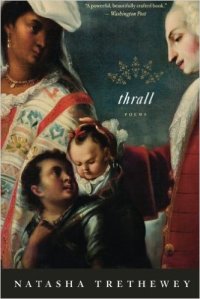
51T8yxaK1xL._SX331_BO1,204,203,200_ Thrall: Poems (Houghton Mifflin Harcourt Publishing Company, 2006) – a sequel to Native Guard (Houghton Mifflin Harcourt Publishing Company, 2005) –  is breathtakingly eloquent. Trethewey explores her relationship with her father in the first poem about a fishing trip. Written as an elegy though he is still alive, it tells him in effect that she is the better poet . . . or so I infered.

Tretheway moves on from that quiet meditation to questions of identity and race, exploring colonial attitudes about race reflected in the art of Spanish painters and the Casta (caste, categorization of mixed-race peoples) Paintings of 17th and 18th Century Mexico. I was unfamiliar with most of the paintings and painters, chose to look them up.  That, however, did not detract one iota from engagement with this collection.

The work is exquisite: formal, clear, precise, perceptive … Although the material is distressing, I find Trethewey’s style understated. These poems are not strident but they have sinew and bone. Her forms are mostly free verse. One poem is a series of cinquains and another is a villanelle.

13550802017232

In the video below, Trethewey offers some insight into the development of the collection and reads the eponymous poem. You will also find a sampling of her poems HERE.

Note: The painting Thrall that inspired the poem is by Juan de Pareja who was apparently the child of indentured servants and left as property to the Spanish painter Diego Rodríguez de Silva y Velázquez to whom he became an assistant. Juan de Pareja was born in 1606, freed in 1650 and died in 1670. The painting featured on the book’s cover is Spaniard and Indian Produce a Mestizo by Juan Rodríguez Juárez (1675-1728).

If you are reading this post from an email, you will have to click through to the site to view the video.

© 2016, essay, Jamie Dedes, All right reserved; Natasha Threthewey’s photograph, Jalissa Gray under CC BY-SA 3.0; cover design, publisher