Page 18 of 19

American English as a first language …

That’s Gallagher, American comedian and prop comic. Thanks to clever John of Johnbalaya for this. He’s written an essay to go with the video. Check it out HERE. And, the five funny figures of speech (Malapropism, Spoonerism, Paraprosdokain, Tom Swifty, and Wellersim) are explained by Mark Nichol on Daily Writing Tips HERE.  Thanks to Laurel D. for that one.

Happy Saturday, Everyone!

Smile! … and write on ….

FYI: Fellowships and Poetry Prizes for Young Poets

The Nine Muses
The Nine Muses

.

The Poetry Foundation is pleased to announce a $1.2 million gift from the Dorothy Sargent Rosenberg Memorial Fund to support the work of aspiring young poets. The Memorial Fund has awarded the prestigious “Dorothy Prizes” to young poets since 2004, and the Poetry Foundation has offered the Ruth Lilly Poetry Fellowships to young poets since 1989. With this new endowment, the current $15,000 Ruth Lilly Poetry Fellowship prize will nearly double, thereby giving five young poets a more auspicious start to their careers. The newly enhanced prize will be named the Ruth Lilly and Dorothy Sargent Rosenberg Fellowships, honoring two extraordinary women and their commitment to poetry. The first of these new fellowships will be announced and awarded in 2014.

“The Poetry Foundation is thrilled to begin this important fellowship program with a poetry organization that shares our dedication to and support of promising young poets,” said John Barr, president of the Poetry Foundation. “Some of our most noted poets writing today are Lilly Fellowship recipients who have benefited from being given the time to work and the confidence that this prize engenders.”

The Dorothy Prizes—officially the Dorothy Sargent Rosenberg Annual Poetry Prizes—were established by Dorothy’s husband, Marvin Rosenberg, playwright and acclaimed Shakespeare scholar, in memory of his wife, herself a published poet. Over the past nine years more than 350 prizes, ranging from to $1,000 to $10,000, have been awarded to fine young writers under the age of 40. Entries for this year’s upcoming contest are due on or before October 5.

“Now it is time for the balance of Marvin’s bequest to be deployed in a long-lasting way for the benefit of young poets,” said Barr Rosenberg, Marvin and Dorothy’s son and trustee of the Memorial Fund. “We are delighted to make this gift on Marvin’s behalf to the Poetry Foundation, so that the funds can continue to be dedicated to Marvin’s long-held dream of giving encouragement and substantial financial support to promising young writers. This is exactly what Marvin would have wished.”

“This gift adds another dimension to Ruth Lilly’s legacy of encouraging young writers at a crucial time in their careers,” said Don Share, editor of Poetry magazine. “It will provide more support for each poet and help to sustain a more diverse spectrum of writers.”

The Ruth Lilly Poetry Fellowships have encouraged the further writing and study of poetry among such esteemed poets and Fellowship recipients as Katherine Larson, Roger Reeves and Christian Wiman. The first Ruth Lilly Poetry Fellowship winner, Saskia Hamilton, has gone on to author several books of poetry and was named a Guggenheim Fellow in 2009. She now edits the journal Literary Imagination.

The success of the Dorothy Prizes can be seen in the consistently high quality of the lyric poetry submitted. Names of honorees, their winning work and a selection of Dorothy’s own poems can be viewed online. This year’s contest will be the last administered by the Rosenbergs, but they hope that the Dorothy Prizes may continue to flourish in the future. Individuals or organizations interested in taking over the administration of the Dorothy Prizes in 2014 are invited to be in contact with proposals via the Dorothy Prizes website.

* * *

About the Poetry Foundation
The Poetry Foundation, publisher of Poetry magazine, is an independent literary organization committed to a vigorous presence for poetry in our culture. It exists to discover and celebrate the best poetry and to place it before the largest possible audience. The Poetry Foundation seeks to be a leader in shaping a receptive climate for poetry by developing new audiences, creating new avenues for delivery, and encouraging new kinds of poetry through innovative literary prizes and programs. For more information, please visit poetryfoundation.org.

About Poetry Magazine
Founded in Chicago by Harriet Monroe in 1912, Poetry is the oldest monthly devoted to verse in the English-speaking world. Monroe’s “Open Door” policy, set forth in Volume 1 of the magazine, remains the most succinct statement of Poetry’s mission: to print the best poetry written today, in whatever style, genre or approach. The magazine established its reputation early by publishing the first important poems of T.S. Eliot, Ezra Pound, Marianne Moore, Wallace Stevens, H.D., William Carlos Williams, Carl Sandburg and other now-classic authors. In succeeding decades it has presented—often for the first time—works by virtually every major contemporary poet.

– Poetry Foundation

Photo credit ~ Photographer unknown. The Muses Sarcophagus, which depicts the nine muses and their attributes. It was carved in marble around the first haf of the second century and by the Via Ostiense. The photograph is in the public domain. The sarcophagus in house at the Louvre Museum in the Department of Greek, Etruscan and Roman antiquities, Denon wing, ground floor, room 25

Against the Evidence, I Live By Choice ~ David Ignatow

41jATvIjAMLI was reminded of David Ignatow (1914-1997, American poet and editor) yesterday when I read Luke Prater’s poem about the death of a fly, Calvin’s God, which is well done.

In his poem Luke mentions Ignatow, who wrote I Killed A Fly.

I’m thinking Ignatow has a spare and direct style that is worth studying, especially if you are serious about your own poetry. Here is a sample of his work from a favorite collection. There are a number of people who read here who will relate to this, a good Sunday night read.

.

AGAINST THE EVIDENCE

by David Ignatow

As I reach to close each book
lying open on my desk, it leaps up
to snap at my fingers. My legs
won’t hold me, I must sit down.
My fingers pain me
where the thick leaves snapped together
at my touch.
All my life
I’ve held books in my hands
like children, carefully turning
their pages and straightening out
their creases. I use books
almost apologetically. I believe
I often think their thoughts for them.
Reading, I never know where theirs leave off
and mine begin. I am so much alone
in the world, I can observe the stars
or study the breeze, I can count the steps
on a stair on the way up or down,
and I can look at another human being
and get a smile, knowing
it is for the sake of politeness.
Nothing must be said of estrangement
among the human race and yet
nothing is said at all
because of that.
But no book will help either.
I stroke my desk,
its wood so smooth, so patient and still.
I set a typewriter on its surface
and begin to type
to tell myself my troubles.
Against the evidence, I live by choice.

© poem and cover art, Wesleyan Poetry Series, used here under fair use

ARTEMIS POETRY

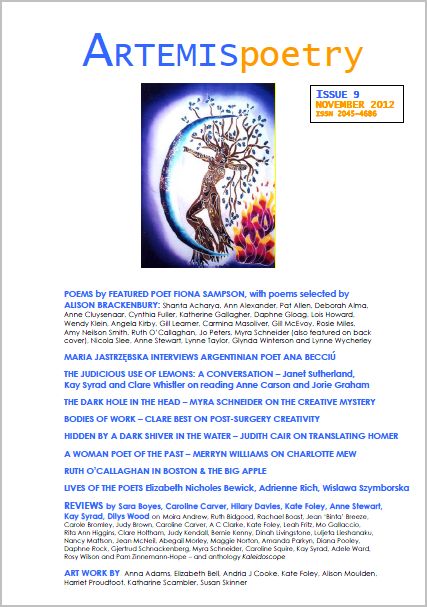
artemispoetrycoverissue9frontNo matter what happens on any given day, when the latest issue of a favored literary magazine crosses the threshold of my home, it’s a good day. Recently I received the November issue of ARTEMISpoetry for review. That was a very good day indeed. The writing and art is by women.The reading is for everyone. I venture to say that this publication of the Second Light Network, while not well-known, is making a mark and growing an audience.

Between the covers of ARTEMISpoetry, I found a rich selection of poems, features, reviews and interviews, biography, and art.

The journal opens with an interview of the Argentinian, Ana Becciú.

“I continue writing because I need to know and to understand … the voices within us, understand the surface of the words we use every day, voices that pronounce suffering, loss, the voices of all of us lost in this present society.”

There follows an exploration on the pleasures of reading and an essay by Myra Schneider on the “mystery of the creative moment.” I enjoyed the detail in Clare Best‘s engaging feature on her project and process for Self-portrait without Breasts. The project evolved from her decision to have a prophylactic double-mastectomy and to go flat chested and not have reconstructive surgery or use prosthesis.

“Cast me and I will become what I must.”

I think the feature I most enjoyed was Judith Cair’s piece on her experience translating passages from Homer’s Odyssey.

“The act of translating is beginning to influence my own writing. Even in writing poems far removed from Ancient Greece, I realize that there is an undertow of lines from the Odyssey, which may or may not be consciously acknowledged. And sometimes I am left with such a strong impression of a particular episode that I must re-imagine it for myself.”

The main course in this delightful menu addressing the interests of poets is the poetry itself. Among the many poems enjoyed is Anne Cluysenaar’s Hearing Your Words, offered here with the permission of the publisher and poet.

HEARING YOUR WORDS
For Ruth Bidgood, reading in Aberystwyth

by Anne Cluysenaar, © 2013, All rights reserved

I used, as a child, to imagine my death, or rather
beyond it. A ship setting out, in flames, at dusk,
counteracting the planet’s roll, on the sunrise path
to a waveless far horizon lit from beneath.

This came to mind, just now, clicking on close-up
through the café window – sea meeting that sky,
distantly smooth, arching high, up above
a jumble of chimneys and roofs backlit at sundown.

I found myself catching my breath, gravity’s curve
seen through such a small frame, from here where we sit
with our cups of tea. Vastness out there, our past.
But on planets elsewhere, other seas, other lives beginning.

Later, among the books, hearing your words,
it was waves I thought of – from land we may never see
reaching across the bulge of this little earth
to break, not one the same, on familiar shores.

taken from a poem diary From Seen to Unseen and Back by Anne Cluysenaar, forthcoming from Cinnamon Press, 2014.

ARTEMISpoetry is published  twice-a-year in November and May. Members receive their copy as part of their membership. Issues are available to nonmembers. For information, link HERE.  The next submission deadline is August 31, 2013. For membership and submission information, link HERE.

© 2013 essay, Jamie Dedes, All rights reserved
© 2012, journal cover and art, Second Light Network, All rights reserved – Many thanks to Anne Stewart for forwarding the cover and to Myra Schneider, Dilys Wood, and Anne Cluysenaar for the poem