PEN America’s Freedom to Write program drew our attention late last month to the Cambodian government’s efforts to shut down several news outlets saying this represents a clear attempt to stifle a free press in advance of the 2018 elections. IFEX, an international network of organizations committed to the defence and promotion of freedom of expression as a human right, calls for solidarity in the face of the Cambodian government’s crackdowns on independent media and civil society.
Cambodia, located in the Southern portion of the Indochina Peninsula, has a population of over 15 million. The country’s minority groups include Vietnamese, Chinese, Chams, and thirty hill tribes.The capital and largest city is Phnom Penh, the political, economic, and cultural centre of Cambodia.
The kingdom is a constitutional monarchy with Norodom Sihamoni, a monarch chosen by the Royal Throne Council, as head of state. He was also an ambassador to UNESCO. The head of government is Hun Sen, who is currently the longest serving non-royal leader in South East Asia and has ruled Cambodia for over thirty years.
Cambodia faces many challenges including widespread poverty, pervasive corruption, lack of political freedoms, low human development, and a high rate of hunger. The country has been described by Human Rights Watch’s Southeast Asian Director, David Roberts, as a “vaguely communist free-market state with a relatively authoritarian coalition ruling over a superficial democracy.”
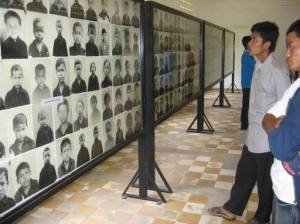
Rooms of the Tuol Sleng Genocide Museum contain thousands of photos taken by the Khmer Rouge of their victims.
According to Human Rights Watch, “Prime Minister Hun Sen, a former Khmer Rouge commander, has been in power since 1985. His rule has relied on security force violence and politically motivated persecution of opposition members, activists, and human rights workers. Security forces commit killings and torture with impunity. Authorities regularly restrict the right to peaceful assembly by suppressing protests and banning nonviolent gatherings and processions. The politically powerful have carried out forced evictions and illegal land grabs for decades. Government officials and judges are mired in corruption. Garment industry workers, primarily women, are subject to sexual discrimination and other rights abuses.” MORE
Reports are that The Voice of Democracy and Moha Nokor Radio, both independent radio stations, were ordered by the Ministry of Information to close. The Voice of Democracy, a Khmer-language station, is affiliated with the Cambodian Center for Independent Media, an independent media organization. Maha Nokor, which also broadcasts in Khmer, is seen as one of the few outlets where opposition media parties can share their message.
The Cambodian Flag
The Cambodian government’s Finance Ministry recently accused two U.S.-funded independent media outlets, Radio Free Asia and Voice of America, of failing to register with the country’s tax officials and of operating without official media licenses. Apparently both programs have operated within Cambodia for years.
Another major media outlet, Cambodia Daily, was accused by the Finance Ministry of failing to pay $6.3 million in taxes, an accusation which the Daily contends is politically motivated. Failure to pay the tax, the Ministry declared, may result in the newspaper’s closure. On Tuesday, Prime Minister Hun Sen made remarks in favor of shutting down the newspaper if they fail to pay, and the Ministry of Information has refused to renew the Daily’s media license until the disputed bill is resolved. The Cambodia Daily, which has operated since 1993, is one of only three English-language newspapers within Cambodia and as such serves as a vital voice of news from Cambodia for the international community.
“These closures and threatened closures are an attempt by Hun Sen’s government to shut down media outlets that it believes may criticize them in the run-up to the 2018 Cambodian elections,” said James Tager, Senior Program Manager of Free Expression Programs at PEN America. “Press freedom and media diversity are not political chess pieces to be removed when convenient; they are underpinnings of a democratic society. PEN America calls on the Cambodian government to cease its attempts to shutter Cambodia Daily, The Voice of Democracy, and other media outlets, and to respect press freedom and diverse media voices.”
A number of human rights groups have been accused of not paying appropriate taxes to the government after Prime Minister Hun Sen ordered an investigation into the tax payments of NGOs registered in Cambodia.On August 23, the Foreign Affairs Ministry ordered the National Democratic Institute, a U.S.-based NGO that works to support and foster democratic institutions, to cease its operations in the country. The Ministry, alleging that the Institute had failed to meet registration requirements under the country’s Law on Associations and Non-Governmental Organizations, also ordered the NGO’s international staff to exit the country within a week.
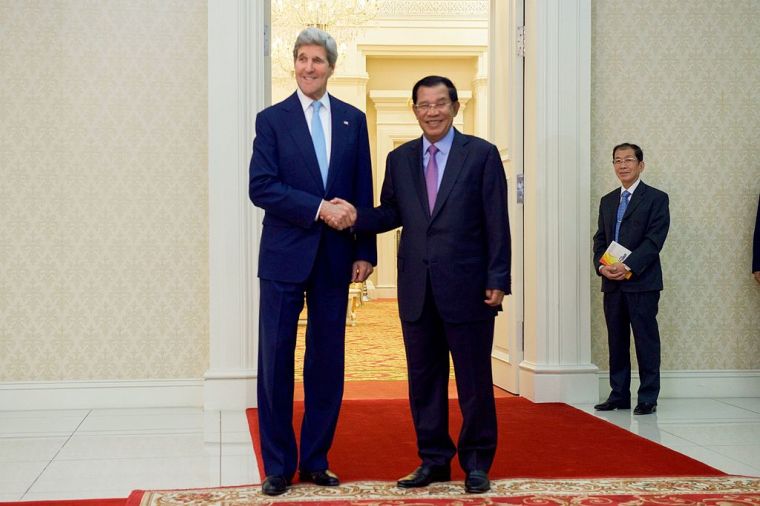
Then Secretary of State John Kerry meeting with Hun Sen, the 34th Prime Minister of Cambodia (2016), in an effort to encourage unity among the Asian Pacific nations with regard to the South China Sea.
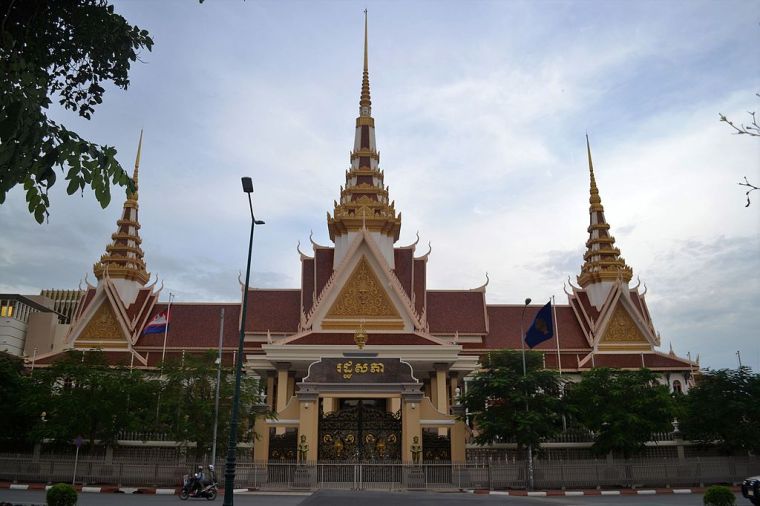
This feature is complied primarily courtesy of PEN America, Reuters, IFEX, Human Rights Watch and Wikipedia. Photo credits: the Cambodian National Assembly by Io Herodotus under CC BY-SA 4.0; Tuol Sleng Genocide Museum is in the public domain; drawing of the Cambodian Flag under CC0; Kerry and Hun Sen by the U.S. Department of State and therefore in the public domain.
PEN America’s stated mission is to “stand at the intersection of literature and human rights to protect open expression in the United States and worldwide” It is important that we as poets and writers stand alongside PEN in championing “the freedom to write, recognizing the power of the word to transform the world.” PEN unites “writers and their allies to celebrate creative expression and defend the liberties that make it possible.”
Thank you for sharing your love of words. Comments will appear after moderation.
at the medical center you put your ear
to the trunk of a birch and listened to my heart
while i roasted potatoes in a snowed-under parking lot
and managed the effects of a shrinking brain
when i heard the door to the crematorium slam shut,
i found myself floating on waves of heat that flayed my skin,
mom held me in mourning and sang Salve Regina
(she was slightly off-key)
but i found the grandmother stone you left in my hand
it pulled me back to the earth and the snow
i heard you say you savored the taste of my blood
in the kalamata olives you ate the day i died
i listened to doves cooing and watched the wind
wrap silver filigree around tree branches
the morning was crisp and fresh
the others came with arms full of flowers to say goodbye
but your arms were empty and heavy with love
i decided to live
Say this city has ten million souls,
Some are living in mansions, some are living in holes:
Yet there’s no place for us, my dear, yet there’s no place for us.
Once we had a country and we thought it fair,
Look in the atlas and you’ll find it there:
We cannot go there now, my dear, we cannot go there now.
In the village churchyard there grows an old yew,
Every spring it blossoms anew:
Old passports can’t do that, my dear, old passports can’t do that.
The consul banged the table and said,
“If you’ve got no passport you’re officially dead”:
But we are still alive, my dear, but we are still alive.
Went to a committee; they offered me a chair;
Asked me politely to return next year:
But where shall we go to-day, my dear, but where shall we go to-day?
Came to a public meeting; the speaker got up and said;
“If we let them in, they will steal our daily bread”:
He was talking of you and me, my dear, he was talking of you and me.
Thought I heard the thunder rumbling in the sky;
It was Hitler over Europe, saying, “They must die”:
O we were in his mind, my dear, O we were in his mind.
Saw a poodle in a jacket fastened with a pin,
Saw a door opened and a cat let in:
But they weren’t German Jews, my dear, but they weren’t German Jews.
Went down the harbour and stood upon the quay,
Saw the fish swimming as if they were free:
Only ten feet away, my dear, only ten feet away.
Walked through a wood, saw the birds in the trees;
They had no politicians and sang at their ease:
They weren’t the human race, my dear, they weren’t the human race.
Dreamed I saw a building with a thousand floors,
A thousand windows and a thousand doors:
Not one of them was ours, my dear, not one of them was ours.
Stood on a great plain in the falling snow;
Ten thousand soldiers marched to and fro:
Looking for you and me, my dear, looking for you and me.
i belong to the wind, to grandmother moon
to the vision of the hawk, the depth of the sea
i am the heart of a lion drinking the sun
i am the true journey, the undiscovered path
i am the life in the fox, centered and silent,
apparent in the stillness between breaths
i am the flame of meaning that lights the night
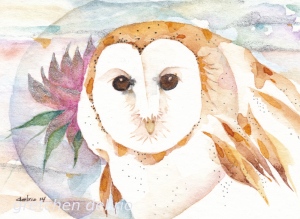
see me with your old soul, your wise owl eyes
What is your vision of that essential energy that is the base of all things seen and unseen? Does your vision lean toward the scientific or the metaphysical? Tell us in prose or poem. If you feel comfortable, share your work – or a link to it – in response to this theme. All writing shared will be published next Tuesday. You have until Monday evening – 8 p.m. PST – to respond.