THE ELEPHANTQUAKE and other poems by readers …
Much to my delight there are seven poetic responses this week. Bravo, my friends! Five of the poems are responses to last Wednesday’s Writing Prompt:
“How do you generally receive the night? With joy, reluctance or fear? Do you sleep well or not? Tell us in poem or prose. If you would feel comfortable doing so, please put a link to your response in the comments section below – or, if the work is short enough – just include it there that we might all enjoy it. Responses to Wednesday Writing Prompts are published here on the following Tuesday.”
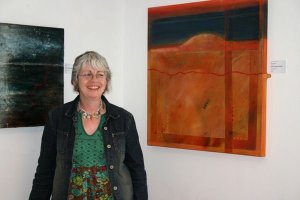 I was introduced to the multitalented (poetry, art and asemic writing) Sonja Benskin Mesher when I featured Rueben Woolley and his work. Sonja designed the covers for his collections. I’ve been enamoured ever since. Sonja says, ” I have worked full time as a visual artist since 1999, and have spent those years exploring ways to communicate thoughts and concerns with my paintings and drawings. It’s not all you see on the surface, it goes deeper than that. The work goes back touched and collected. My present surroundings, here in Wales, and that of Cornwall where I spend much of my time, inform the work, and inspire the subject matter. Then with the work I remember, and try to make sense of it all.”
. vanta black .
‘ is dark at night, i lay here looking’
yes
‘ not totally black though,
i like the greys and shadow.
i like when the cars go by,
the lights go across the walls’
yes
‘ i do not think i will like very black,
not vantablack like anish kapoor’
said the bear quietly.
it is alright to say so.
© Sonja Benskin Mesher
 I think Sharmishtha Basu – artist, poet and writer – has been blogging as long as I have, which would mean since 2008. I’ve watched her grow her talent and expand her art and writing world into a small industry. She illustrates her own poems, has sixteen blogs and self-publishes on Amazon. From the tentative writer she was initially, she has grown strong and confident as a result of hard persistent work. Visit Sharmishtha’s Gravatar Profile for links to her blogs.
PEACEFUL IS YOUR PRESENCE
Peaceful is your presence
Like losing oneself
In embrace of peace itself
Losing self awareness
for some certain moments
Turning away from worries
Frictions and tensions
That won’t leave wakeful mind.
Who says you invoke only
Fear, terror and darkness.
© Sharmishtha Basu
 Renee Espiru (Just Turtle Flight) writes poetry and short stories and is adept at digital art, producing interesting illustrations to accompany her poetry. She says she’s been writing from a young age and that her ” writing is based on my life’s experience and my observation of life. I have been asked the question of where I come by my ideas … and have come to the conclusion that without life observed there would be nothing on which to base any writing at all.” Over the years, I’ve always appreciated Renee’s willingness to take on any writing challenge thrown at her. Renee’s work is often featured in The BeZine.
A SIPHON FOR DREAMS
The night is a siphon for dreams
drifting thru stars & moonbeams
nudging in its’ turn each muse
igniting imaginations’ fuse
visiting angels night’s shadows
a lighting of a candles’ tallow
© March 2017 Renee Espriu
 Gary W. Bowers (One With Clay, Image and Text) was born in California and lives now in Arizona. He is a poet and artist with a quick wit and a unique and engaging style. Gary’s creative specialties are acrostic poetry, portraiture, ceramic sculpture, Ticonderoga Black pencil drawing and, most recently, mixed media that includes oil pastel. Check out his blog. Inquiries about purchase of posted artwork, or commission of custom work including but certainly not limited to acrostic portraiture, may be made via e-mail to onewithclay@hotmail.com. HERE is the artwork that Gary did for me.
nightie night
shutter lids o halfanearth
shadow has your number.
cue the creatures oer your girth
batten down n slumber.
slow the breathing ebb the sway
as the starscapes twinkle
and the dreams come out to play
and the brows unwrinkle.
© Gary Bowers
Gary’s poem in response to my baseball season kick-off with a poem – Line Up for Yesterday – by Ogden Nash.
Though life has its hashes
And reasons to grieve,
It gave us two Nashes:
One Ogden, one Steve.
(Steve Nash, one of the most brilliant of basketball’s Phoenix Suns, was the hardest-working player in the NBA, back in the day.)
© Gary Bowers
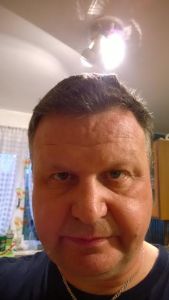 Paul Brooks’ blog (The Wombwell Rainbow) is subtitled “Inspiration. History. Imagination.” All true. Check it out. I find his imagination charming and it’s something you can appreciate given his poem shared here today. Paul’s newest collection, The Spermbot Blues, his second chapbook is tentatively to be published by OpPRESS this Spring. Announcement pending. We’ll let you know.
THE ELEPHANTQUAKE
Elephantquake bossed a vast forest.
no rain, all lakes, tanks, ponds,
water holes arid. It thirsts
It searched for water.
It knows of a hidden lake
always full and goes there
to save itself. After five nights
it revelled and splashed in the lake.
Daily it marched upon moonhares,
maimed and wounded them,
on its route to the lake.
One day moonhares met
to save themselves
from the elephantquake
Some said “Abandon this place.”
Others “It’s our ancient home.
Let’s find an alternative.
Let’s see if we can scare off
rampage of elephantquake.”
Some of them said, “We know
of a trick that works
with elephantquake.
we need a sharp person.
A moonhare has a message
for elephantquake. It says
“I come from Moon who doesn’t
want you supping lake as bound
there you kills and maim hundreds
of hares. Lake is forbidden.
Return to your forest home.
“But where’s this Moon, your home? asks
elephantquake “In this lake.
It consoles the survivors
of your rampage.” “Then, let me see him,” requests the elephantquake.
“Come alone with me, I will
show you.” Moonhare takes it one
night to shows Moon’s silvery
reflection in the lake, says
“Here it is, my home, the Moon.
Lost in meditation.
Move quietly, salute it.
Don’t disturb it and bring wrath.”
Elephantquake sees it as real,
salutes it, leaves quietly,
returns to its forest home.
Hares heave sigh in relief.
© Paul Brooks
U.K. poet, Juli (Juxtaposed, Subject to Change), responded to The Spoon Theory or How To Continue to Be Happily Artful Despite Chronic, Catastrophic and/or Life-threatening Illness with this treasure.
Spoons
When I wake to the day
And straight away
Feel bereft for the theft
Of my spoons in the night,
I must reset my pace
For the hours I face
And the fact I don’t keep
All my spoons in one place,
Is what lessens my plight
Though the day’s still a fight
And I grieve at the waste
Unless I stop pretending,
Surrender to fate and
Just focus on mending
And wait.
When I wake up renewed,
With all spoons am imbued,
I feel hope that I’ll cope
With the basics, at least –
Unless there’s a treat
Or appointment to keep.
I will try for an even keel
Mostly, unless I feel
Daring – spoons sparing.
And, if I succeed –
Which means no extra need –
I retire to bed with
A positive head.
My spoons are my wealth
For my life is defined
By the soundness of health
In my body and mind.
It is measured and treasured by
One simple goal:
That of having control
Just as much as I’m able,
But, oh! For a ladle
To hold in reserve that
Makes up for how much
I rely on my nerves.
© Juli
“In politics being deceived is no excuse.” Leszak Kolakowski
 Recommended read: On Tyranny: Twenty Lessons from the Twentieth Century by Timothy Snyder. Left, right or center – American or not – it’s a must read for our chaotic times … and not just the list of lessons but Prof. Snyder’s commentary on each. This book is a rational enlightening little gem and a powerful wake-up call.
Lesson Two: “Defend Institutions. It is institutions that help us preserve decency. They need our help as well. Do not speak of ‘our institutions’ unless you make them yours by action on their behalf. Institutions do not protect themselves. They fall one after the other unless each is defended from the beginning. So choose an institution you care about – a court, a newspaper, a law, a labor union – and take its side.” Prof. Snyder
THE WORDPLAY SHOP: books, tools and supplies for poets, writers and readers


