For sale: baby shoes. Never worn.” Ernest Hemingway (1899-1961), American journalist and author
That’s Hemingway’s shortest story according to an oft told and often disputed tale. Hemingway was allegedly challenged to write a story in six words (some accounts say ten) to win a wager. To be a story, it had to have a beginning, a middle, and an end. The anecdote probably is a fabrication.
At any rate, I rather like the idea. I’m no Hemingway, but what the heck. Here’s two of my tries, mystery both.
Meticulous diary
Pages missing
No alibi
****
Moonlight sonata
Sudden pause
Lion roared
WRITING PROMPT
Your turn: write a six-word story.
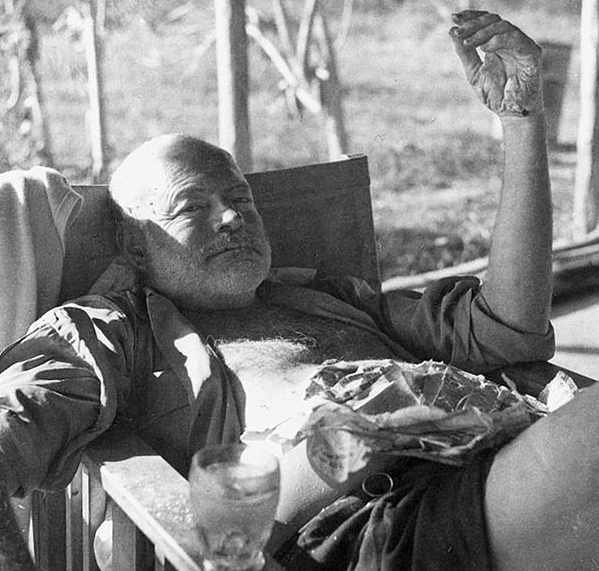
Photo credit ~ via Wikipedia Ernest Hemingway at a fishing camp in Kenya in 1954. “His hand and arms are burned from a recent bushfire; his hair burned from the recent plane crashes.”
Thank you for sharing your love of words. Comments will appear after moderation.
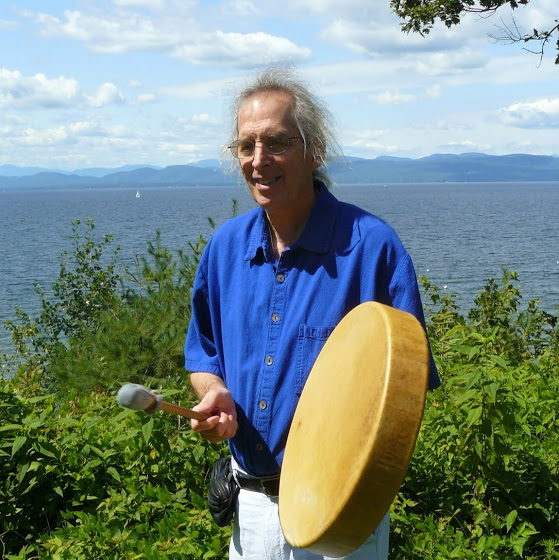
MICHAEL WATSON, M.A., Ph.D., LCMHC is a poet of the spirit, if not of the pen, and a contributing editor to The BeZine, an essayist and a practitioner of the Shamanic arts, psychotherapist, educator and artist of Native American and European descent.
Michael lives and works in Burlington, Vermont,where he recently retired from his teaching position in undergraduate and graduate programs at Burlington College,. He was once Dean of Students there. He also had wonderful experiences teaching in India and Hong Kong, which are documented on his blog. In childhood Michael had polio, an event that taught him much about challenge, struggle, isolation, and healing.
This interview was originally featured in the June issue of The BeZine.
JAMIE: I often tell people that if they have time for only one blog, it should be yours, DREAMING THE WORLD. You bring such a wealth of understanding, experience and education to your posts, so gently delivered and so healing. Thank you! You write a lot about nature. Did you grow up in the country?
MICHAEL: Thank you, Jamie. I am deeply moved and honored. My dad was in the Air Force so we moved periodically. He hailed from Southwest Indiana, from a hillside farm overlooking the Ohio river. My mom grew up on a farm in Texas, a couple of hours west of Dallas. The upshot was we tended to be stationed near one family or the other. When I was six or so, we lived in rural Lincolnshire, England, on an estate, complete with a game warden, where I spent untold hours in the woods with friends. Then we moved to rural Illinois, where we lived on the edge of a small town, and I was free to roam the countryside. From there we spent a year in suburban Ft. Worth, Texas, then we lived in urban Ohio while I finished high school and college. No matter where we were my parents had a garden, and made sure we kids had access to Nature. Given the option, I would head for the forest or prairie. I spent quite a few fabulous summers on my uncle’s farm in the fertile Ohio river valley near Madison. My dad’s family encouraged me to understand myself as part of the Natural world.
JAMIE:How did you get interested in therapy as a profession?
MICHAEL: I had a good therapist in college, then was clinical coordinator for a large “Free Clinic”. After working for the Soil Conservation Service for a while (I had a splendid job where I was outside most of the time, often in wilderness), I realized my legs were not going to tolerate the demands on them, and I had best find a more sedentary job. I already had an MA in Studio Art, and was offered a position as a community based artist, so I grabbed the opportunity to explore engaging people in arts for healing. I also went back to school to get a degree in counseling. During that time I provided some services to patients in the local university medical center, and when I finished my degree they offered me a part-time position, as did an outpatient clinic in town. One of my teachers worked in the clinic, and when he decided to leave his private practice, he essentially gave it to me.
JAMIE:What spurred your interest in shamanism?
MICHAEL: My dad’s side of the family has always identified as Native, although they steadfastly refused to tell us our tribal identity. One of my cousins, who is a genealogist, has tried several times to trace our family, without success. There are birth certificates for family members that go back three or four generations, then there is simply no record. All the birth certificates list us as being Caucasian. Indiana was a very nasty place for Native people during much of the last two centuries and it was very common for light skinned Natives to pass. My grandmother used to say, “We must protect the children.”
Anyway, I mostly didn’t think much about Natives, except to identify with the cowboys when we kids played cowboys and Indians. I could never figure out why my dad got upset with me for being a cowboy! Then in college there were all these books about Native American healers and shamans. A lot of those books turned out to be fraudulent but they got my attention. When I went to New Mexico for grad school I had many Native friends. I ran a small ranch in the mountains so I could afford school, and got a real hit of the sacredness of that country. Eventually I moved to California, then back East. I kept meeting Native elders who offered to teach me something. I’d protest that I wasn’t Native and they would look at me as though I was completely out to lunch. Often they would say, “We know more about you than you do.” I guess they were right.
When I was living in northern California I had a vision that turned my life upside down, and set me to trying to understand what I was being asked to do. That was forty years ago. I still ask the Powers what they want, and I’m still not the best at engaging with them.
JAMIE: You have lived virtually all your life with polio: traumatic, painful and disabling. I know you’ve thought a lot about disability, about cultural misconceptions and about meaning. What is the most important thing you think we need to know as a culture about the nature of disability and the impact – not so much of the disability itself – but of the assumptions that are made about people with disability?
MICHAEL: I was seven when we came back from England. I started school, second grade, and after a week we had the Labor Day weekend holiday. I developed Polio during that weekend and spent the next year trying to recover. I was in the iron lung and had significant paralysis; I made a rapid recovery (one of those “miraculous” recoveries that happened fairly often) and left the hospital after only a bit more than three months. We Polios were encouraged to believe we were not disabled, but many of us were. Much later, we discovered there is a correlation between the severity of the illness, the degree of one’s recovery, and the disabling that comes with Post-Polio Syndrome. PPS had been studied for about a hundred years, but everyone conveniently forgot about it once the vaccines arrived and the epidemics ended. (The same thing happened with us Polios, we were forgotten, even by the March of Dimes, an organization that had promised to support us, and our families, for as long as we needed them.)
Being an enlisted person in the military means one is not well paid; a lot of military families are on food stamps! As it turned out, I most likely survived Polio only because I was in a military hospital, and the Air Force literally did whatever was necessary to support me during the acute phase of the illness; they even flew in two top Polio docs to help me.
Being a closet Native and a Polio who tried, rather unsuccessfully, to pass as able, I learned a lot about the way our culture attends to people with disabilities. There is a strong Calvinistic streak in the culture, one that subtly, or not so subtly, places the blame for disabling events on the disabled person and their family. There is a strange cultural belief that disability is a moral failure, rather than an act of Fate; there is also a belief that physical disability implies cognitive impairment. (There are more reportedly Ph.D.s among Polio survivors than any other segment of the population.) There is also a willful refusal to notice and address all sorts of physical and cultural barriers that greatly affect disabled people.
I have worked on issues of disability throughout my adult life. When I am teaching about the experience of disability I remind students/participants that disability is largely a social construct; even the medical definition of disability is socially constructed, a fact many doctors forget. (Actually, younger physicians tend to be much more aware of this.) I often ask those present to speak about the experiences that disable them; I find it immensely useful to aid individuals to understand the experience of being disabled by locating parallel experiences in their own lives. The truth is, most of us have had moments when someone else’s attitudes, behaviors, or beliefs are/were disabling to us. Disability is created!
Oh, one more thing. There is, in North America, a cultural expectation that persons with disability will be either unceasingly cheerful or despondent. We should never be angry. Well, what is one to say to that? I have a wide array of responses to my experience, certainly including anger.
[I very much appreciate this written by Michael on his blog: “We find it useful to define disability as a lack of access to the social and/or physical environment, a lack created by the beliefs and behaviors of self, or, especially, others. While many disability activists and theorists find this definition overly broad, we believe it aids people to understand the experience of disability, building empathy and community.”
JAMIE:You also have been involved in education at the university level for good part of your life. How do you feel about the current emphasis on vocational vs. liberal arts/humanities? What price do we pay or will we pay for this?
MICHAEL: I have long encouraged students to explore widely, to engage the fine and liberal arts, and to create internships and other avenues for applying their learning in the everyday world. Being educated in the fine/performing arts, and the liberal arts, gives one models for being creative, and understanding historical and cultural context, as well as opportunities to learn about human nature. Hopefully, one also gets enough science to be able to understand the broader ecosystem implications of one’s behavior. Unfortunately, those who have overly specialized training tend to be lacking in tools.
JAMIE:What is the major work or interest of the next year for you?
MICHAEL: I’m dealing with progressive Post-Polio Syndrome, and approaching seventy, so I am practicing becoming more choosy about the projects I take on. I will continue to see clients in my counseling and healing practices. I have a list of photographic and writing projects, and Jennie, my wife, and I are working on new toy theater shows. Now that I am no longer classroom teaching, I’m also working to create time to read for fun!
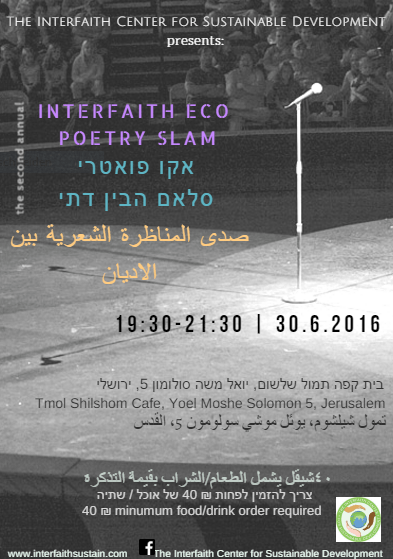
c The Interfaith Center for Sustainable Development/Interfaith Eco Poetry Slam صدى المناظرة الشعرية بين الاديان האקו-פואטרי סלאם הבין דתי
The Second Annual Interfaith Eco-Poetry Slam in Jerusalem invites you to an exciting evening of artistic expression and spoken-word poetry! Come witness a diverse lineup of poets from different faiths and cultures as they share their relationship to the Earth and their Religion through spoken-word poetry. This event calls upon you to step out of your comfort zone, meet the “other”, and be inspired by a unique atmosphere of openness and curiosity. This is a refreshing opportunity to share and listen instead of question and try to problem-solve.
All are welcome who come with an open mind and an open heart!
This event seeks to challenge us all to reach beyond our own faith-communities by focusing on the common challenges and goals of global environmental sustainability.
CONTACT INFORMATION
If you are interested in reading, performing, or even just joining in the audience please respond by email or phone to: mbekierz@interfaithsustain.com; call at: 058.769.0291; or fill out this form: http://goo.gl/forms/eRkA38sENtTdJX8B2
WHEN, WHERE and HOW MUCH
Date: Thursday June 30th Time: 7:30pm-9:30pm Location: Tmol Shilshom, Yoel Moshe Solomon 5, Jerusalem Target Audience: All People, All Faiths, All Cultures, Religious or Not Price: minimum amount to order is 40 shekel
This event will be held primarily in English, with poems also read in Hebrew, Arabic, and other languages.
في هذا المساء ستكون اللغة الإنجليزية هي المتحدث بها ما عدا الأغاني التي سيقرأونها بلغات أخرى
نحن وبكل سرور ندعوكم لهذا المساء الممتع بإيمانيات لفظية وشاعرية محكيّة، تعالوا للإستمتاع تنوع مختلف وواسع من الشعراء من مختلف الديانات والثقافات، حيث انهم يتبادلون المشاعر مع العالم وإيمانهم من خلال شعراء-سلام
هذا الحفل يدعوك للخروج من مكانك المريح للقاء ‘الآخر’، لإستقطاب الإلهام من بيئة فريدة من نوعها من انفتاح وفضول
انها فرصة منعشة ولمرة واحدة للمشاركة واستماع ولإحتواء بدال وضع الشك والمحاولة للوصول الى اجوبة
الى كل القادمين منفتحي العقل ندعوكم بكل سرور هذا المساء الخاص الذي يتطلب منا التحدي للمحاولة وللخروج للحظة من حدود إيماننا الخاصة/المجتمعّية مع التركيز على التحديات والأهداف المشتركة لنا جميعاً بالإستدامة العالمية.
ان كنت راغباً بالقراءة او بالظهور او حتى ان تكون جزئاً من الجمهور – نرجوا ان توافق على المشاركة بالميل mbekierz@interfaithsustain او بالتلفون 0587690291
او بموقع الإنترنت The Interfaith Center Of Sustainable لمتابعة القراءة تفضل بزيارة صفحة الفيسبوك خاصتنا
مركز حوار الأديان للتطوير والتنمية
بيئة الشعر بين الأديان السنوي الثاني
التاريخ: يوم الخميس 30.07.2016
المكان: “اتمول شلشوم” شارع يوئيل موشيه سولومون 5 – القدس
الجمهور: كل انسان من اي دين او ثقافة
التكلفة: 40 شاقل ليس اقل من ذلك
HEBREW
האירוע יתנהל ברובו באנגלית, למעט שירים שיוקראו בעברית ובשפות שונות.
אנו מזמינים אתכם בשמחה רבה לערב מרתק של אמנות ורבאלית ופואטיקה מדוברת!
בואו לחוות מגוון רחב של משוררים משלל הדתות והתרבויות, כאשר הם חולקים את מערכת יחסיהם עם העולם ואת אמונתם באמצעות הפואטרי-סלאם.
האירוע הזה קורא לך לצאת מאיזור הנוחות שלך, לפגוש את ‘האחר’, ולקבל השראה מאווירה ייחודית של פתיחות וסקרנות.
זו הזדמנות מרעננת וחד פעמית לחלוק ,להקשיב ולהכיל ,במקום להטיל ספקות ולנסות להגיע לתשובות.
כל הבאים עם ראש פתוח ולב פתוח מוזמנים בשמחה! הערב המיוחד מבקש לאתגר את כולנו לנסות לצאת לרגע מגבולות אמונותינו הפרטיות\קהילתיות ע”י התמקדות באתגרים והמטרות השותפים לכולנו בקיימות הגלובלית.
אם אתה מעוניין להקריא, להופיע או אפילו רק להיות חלק מהקהל – נא אשר השתתפות באיימיל או בטלפון: mbekierz@interfaithsustain.com או 058-769-0291.
לקריאה נוספת אנא בקר בדף הפייסבוק שלנו The Interfaith Center of Sustainable Development או באתר האינטרנט http://www.interfaithsustain.com
המרכז הבין דתי לפיתוח בר קיימא מציג:
האקו-פואטרי סלאם הבין דתי השנתי השני
תאריך: יום חמישי ה30 ליוני
שעה: 19:30-21:30
מקום: “תמול שלשום”, יואל משה סולומון 5, ירושלים
קהל יעד: כל בני האדם מכל דת או תרבות
מחיר: 40 ₪- כולל אוכל ושתיה עד מחיר זה
Thank you for sharing your love of words. Comments will appear after moderation.
THE REMEMBERED ARTS JOURNAL, Modern Life, Awakened Art accepts poetry submissionsandcreative writing, essays, performing arts, crafts and visual arts. “In the competitive, compartmentalized, modern world, it can be easy to neglect the creative impulses that make us human. We put aside our sketching and scribbling to pay our bills, raise our children, serve our communities, and pursue our ambitions. The Remembered Arts Journal is a forum for reviving almost forgotten artistry. Its purpose is to encourage readers and contributors rediscover the joy of creating and sharing works of art.” A lovely fledgling publication, they’ve produced two issues to date and it looks like they’re working on monthly publication. The deadline for the July issue is past, so just watch for their announcement for August. Details HERE.
THE OFFBEAT, affiliated with the Department of Writing, Rhetoric, and American Cultures at Michigan State University, reads year round. It’s published twice-yearly and accepts submission of “unique” works of poetry, fiction and nonfiction, and sequential art. Consistent with its name, the editors are looking for “writing that falls off the beaten path in an intriguing way.” Details HERE.
THREE-PENNY REVIEW, a literary magazine, accepts submissionsof poetry, fiction and articles for their quarterly. Details HERE.
BY&BY POETRY, another fledgling publication (2015) accepts submissions year round for its “eclectic online showcase or both established and up-and-coming poets.” Details HERE.
THE COSSAC REVIEW accepts submissions of poetry, fiction, nonfiction and translation year round. Details HERE.
NUMINOUS MAGAZINE accepts submissions of poems “of a spiritual nature written in any style. Details HERE.
ENCHANTED CONVERSATION, a Fairy Tale Magazine accepts submissions of poetry and stories six times a year. Be sure to adhere to themes and deadlines. This is an online publication of Kate Wolord, a freelance writer, editor, blogger and anthologist. Details HERE.
COMPETITIONS/CONTESTS
Opportunity Knocks
OFFBEAT is accepting submissions for its first annual nonfiction writing contest. Word limit 4,000 words. There’s a $12 entry fee and the deadline is August 15. Details HERE.
BOOK PUBLICATION
Kudos
Life in Suspension(Salmon Poetry, 2016), the latest collection of poet, actor and translator, HÉLÈNE CARDONA, debuted with stellar reviews.
Hélène co-edits Fulcrum: An Antholgy of Poetry and Aesthetics, is Co-International Editor of Plume, essay contributor to The London Magazine, and co-producer of the documentary Pablo Neruda: the Poet’s Calling. She writes children stories and co-wrote with John FitzGerald the screenplay Primate, based on his novel. She is fluent in English, French, Spanish, German, Italian and Greek and has received fellowships from the Goethe-Institut, in Bremen, Germany, and the University of Andalucía, Spain. This collection was written in English and translated into French. Both versions are included in the book.
Hélène Cardona keenly understands poetry’s insistence that we slow down, downshifting into a more measured and conscious pace. Her powerful poems are written line by certain line, which is how her readers gratefully experience them.” —Billy Collins, former U.S. Poet Laureate
Look for an intimate interview with Hélène coming to THE POET BY DAY, Celebrating American She-Poets series soon.
TIDBIT
Introducing poet and artist, Marlene McNew, also know as “The Ski Poet.” Marlene is an accomplished artist as well as a poet. She writes of skiing, Parkinson’s Disease, struggle, hope and victory.
THE POET BY DAY SUNDAY POESY
Submit your event, book launch and other announcements at least fourteen days in advance to thepoetbyday@gmail.com. Publication is subject to editorial discretion.