Page 348 of 433

DILYS WOOD’S “ANTARCTICA”…the work of a highly original poet
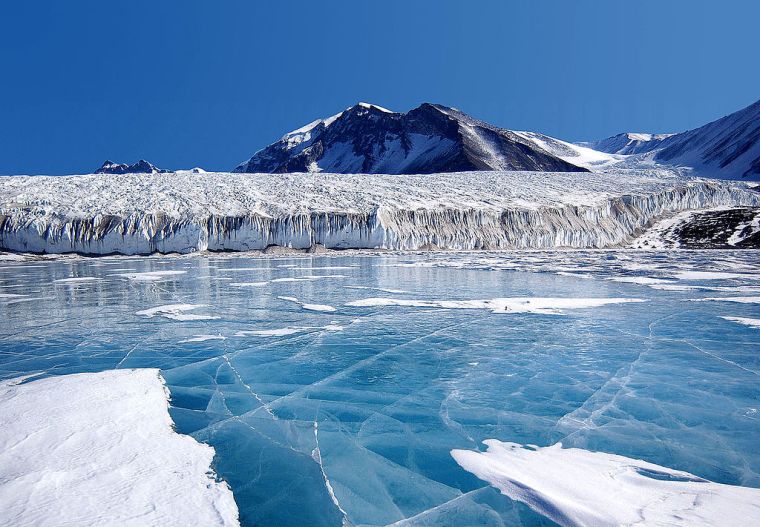
Antarctica: The blue ice covering Lake Fryxell, in the Transantarctic Mountains, comes from glacial meltwater from the Canada Glacier and other smaller glaciers. The freshwater stays on top of the lake and freezes, sealing in briny water below.

Editorial Note: Today The Poet by Day features two stellar poets, Myra Schneider and Dilys Wood. Myra, an award-winning poet, poetry coach and author of eleven collections, reviews Antarctica by distinguished poet, Dilys Wood, author of two collections, founder of Second Light Network of Women Poets, managing editor of ARTEMISpoetry (biannual magazine), and co-editor and publisher of poetry anthologies.

Myra Schneider‘s Review of Dilys Wood: Antarctica (Greendale Press, 2008)

Polar explorer Apsley Cherry-Garrard in front of his typewriter in the Terra Nova hut at Cape Evans (Ross Island, Antarctica)

codwantarctica100In her collection, Antarctica, Dilys Wood has drawn on her considerable knowledge of this continent in remarkable ways. One of these is to produce a brilliant four page monologue, Apsley Cherry-Garrard addresses the Royal Geographical Society. Cherry-Garrard was a member of Captain Robert Falcon Scott’s tragic expedition to the South Pole in 1912 although he was not in the final group which reached the Pole. He was also in the team which found Scott in 1913, blamed himself for Scott’s death and had problems with depression for the rest of his life. The imagined lecture marvellously creates the sense of what it feels like to be in Antarctica:

Darkness at noon. But how also explain
too much light? Trapped inside a diamond,
you haul sledge in some spot rifted with crevasses –
you wrench off goggles to guide the team
and know you’ll not sleep that night, eyes sewn
with the burning wires of snow-blindness!

The speaker emerges as an emotionally charged man who was still bound up with his Polar experiences when the First World War, which he fought in, was over. References to the war heighten the tension in the poem. He also reveals his concern for the planet and anticipates the possibility of climate change:

……Not hard to guess
how steel’s icy sheen might have whirled round,
freezing life across five million square miles!

This ice-age, then, could be reversed? At a stroke!

The short poem Snow is an original way to write about finding the bodies of Scott and his two companions. This is also in Cherry-Garrard’s voice. He begins by comparing the frozen spicules of snow with the very different snowflakes on the nursery window which his father lifted him to look at when he was a child. Then, after one verse about the tent buried in a drift and his distress, he relates an arresting dream he’d had of ‘women called Mary’ searching for Jesus. They become mourners walking behind his father’s coffin.

Nearly three-quarters of the book is occupied by The South Pole Inn, a long and ambitious dramatic narrative. It is set in West Ireland in the 1920s mainly in The South Pole Inn which was bought and given this name by Tom Crean who had taken part in early Antarctic exploration. These expeditions feature in the poem but it is Crean’s wife Nell who is the key character. The story centres on her need for a fuller life and her love affair with Frank Worsley, a friend of Crean’s who was also member of the expeditions. There is an exciting plot about smuggling out of the country money left by Tom’s old aunt so that it’s kept in the family. This has connections with the earlier Irish Troubles. Although the main characters are known people they and the story around them are invented. Fact and fiction are seamlessly woven together and every aspect of the Irish background is totally convincing. Each chapter of the poem is in the voice of one of the main characters. The dialogue is earthy, the action immediate and the characters feel very alive. Here is Nell in the first chapter revealing her frustration:

                    I said I wouldn’t –
would never, never marry. But Tom Crean

He’d spent those years away, hadn’t he?
Smelled different, so I thought. Oceans, ice.
Not like the spiders who never leave
the stinking cupboard. Forgetting, of course,
He came back! Christ what for? Why crawl back?

Tom, it’s like you’ve gone nowhere, done nothing.
A sliver of ice nailed through my husband’s tongue!

Some of the short poems feature women. These include Love in a Freezing Climate, a sequence of witty and imaginative poems, all of which also focus on the extreme coldness. Here is the first which has a wonderful extravagance:

Her Birthday Present

I dreamt I gave you the White Continent.
I wrapped it in white wedding wrap, embossed
with silver penguins and skies. Your parcel
was tied up with rainbow ribbons – Aurora –
because you said Let’s go and see the Lights.
Out there it’s like bathing in pure colour!
Dreaming, I hold your gift: only then
I ask, What is it? What shall I say it is?
Is it something soft, bright, rich, gorgeous
or ice, more ice and, under ice, bare rock?

Antarctica establishes Dilys Wood as a highly original poet. Her work is complex, probing and her use of language exciting and varied. She is particularly known as organizer of the Second Light Network and as the gifted editor of ARTEMISpoetry, the Network’s comprehensive magazine for women poets which includes articles and book reviews – her own are outstanding. Her achievements as an organizer, editor and critic shouldn’t be allowed to obscure the fact that she is an outstanding poet.

– Myra Schneider

Note: Antarctica can be purchased through Second Light or poetry p f. All proceeds go to the Second Light Network of Women Poets.

RELATED FEATURES:

© 2016, Myra Schneider, All rights reserved; feature here with the permission of the author; Antarctic photograph courtesy of Joe Mastroianni of the U.S. National Science Foundation and in the public domain; Cherry-Garrard photograph is by Herbert Ponting – British Antarctic Expedition 1910-13 (Ponting Collection) Reference: P2005/5/475 and in the public domain

THE SUNDAY POESY: Opportunities, Events and Other News & Information

PBD - blogroll

CALL FOR SUBMISSIONS

Opportunity Knocks 

CROSSROADS POETRY SERIES MANUSCRIPT, Reading fee: $15.00 USD, $20.00 CAD DEADLINE 12/1/2016. “The Crossroads Poetry Series is … seeking book length collections of poems that are a minimum of 50 pages in length for publication in 2017. We hope to publish at least 2 collections of work. Only one poem per page and single spaced. All selected manuscripts will be awarded a book contract (with the possibility of a second book contract), $250, 10 copies, 8% royalties, and a primary run of 500 copies. All submissions must be accompanied by submissions fee or they will not be read. Simultaneous submissions are welcome providing that you notify us if your manuscript is to be published elsewhere. We look forward to reading your work.” DETAILS HERE

CALAMARO, a print poetry magazine, accepts submissions year round – formal as well as free verse – from 2 – 30 lines. DETAILS HERE

COMPETITIONS

Opportunity Knocks

9780996259644PROUD TO BE: WRITING BY AMERICAN WARRIORS (anthology) Deadline: June 1, 2016 (postmarked). No reading fee.  5 categories for the contest, $250 prize in each: Short Fiction, Poetry, Interview with a Warrior, Essay, Photography. Details HERE.

SECOND LIGHT OPEN POETRY COMPETITION for Long and Short Poems for Women! “Second Light is a very generous and encouraging organisation. Here’s a chance for longer poems, with magazine publication and a London reading as well as the prizes! Entry by post or email – and I [Alison Blackenbury] will read all entries.” Closing date 31 August. DETAILS HERE

THE AKRON POETRY PRIZE “was founded to bring to the public writers who speak in original and compelling voices. Each year, The University of Akron Press offers the Akron Poetry Prize, a competition open to all poets writing in English. The winning poet receives $1,500 and publication of his, her, or their book. The final selection will be made by a nationally prominent poet. The final judge for 2016 is Allison Joseph. Other manuscripts may also be considered for publication in the series. SUBMISSIOS ACCEPTED between April 15 and June 15 DETAILS HERE

SPECIAL ANNOUNCEMENT

THE AURORA PRIZE for Awakening Humanity: On behalf of the survivors of the Armenian Genocide and in gratitude to their saviors. The Aurora Prize for Awakening Humanity will be granted annually to an individual whose actions have had an exceptional impact on preserving human life and advancing humanitarian causes.

  • The Aurora Prize Laureate will be honored with a US $100,000 award.
  • That individual will have the unique opportunity to continue the cycle of giving by selecting an organization that inspired their work to receive a US $1,000,000 grant.
  • The Aurora Prize will be awarded annually on April 24 in Yerevan, Armenia
  • Selection Committee: George Clooney, Co-Founder, Not On Our Watch, Humanitarian, performer and film maker; Elie Wiesel, President of the Elie Wiesel Foundation for Humanity, Nobel Laureate; Vartan Gregorian,  Co-Founder, 100 LIVES, President of the Carnegie Corporation of New York;; and, Leymah Gbowee: Nobel Laureate, Liberian peace activist and women’s rights advocate

TIDBIT

REMINDERS

  • THE CREATIVE NEXUS™ arts aggregate publishes a new edition weekly HERE
  • THE BeZINE April issue was published on the 15th and celebrates interNational Poetry Month HERE.
  • WOVEN TALE PRESS is currently celebrating Poetry Month HERE.
  • SAVANNAH BOOK FESTIVAL is February 16-19, 2017, keep watching their site for details.
  • 100,000 POETS FOR CHANGE (100TPC) registration is HERE if you want to organize an event in your area
  • THE BeZINE (HERE) theme for the May issue is Books that Changed Our Lives. Submit one or two paragraphs on a book that changed your life and why along with a two-line bio to bardogroup@gmail.com DEADLINE May 10, 2015.
  • 101st ANNIVERSARY OF THE ARMENIAN GENOCIDE is today. Silver Merjaian’s commemorative poem, Rape of Arevik is HERE
  • THE BeZINE submission guidelines HERE
  • SECOND LIGHT NETWORK OF WOMEN POETS submission guidelines for ARTEMISpoetry HERE

THE POET BY DAY SUNDAY POESY

Submit your event, book launch and other announcements at least fourteen days in advance to thepoetbyday@gmail.com. Publication is subject to editorial discretion.

LATE BREAKING NEWS: The Occult Arts and The Sacred Feminine hosted by Canadian Musician Zena Hegarty and Friends

13006735_10153629617438367_2093003550898297979_n

Apr 24 at 9 PM to Apr 25 at 11 AM in EDT

Created for Nocturnal Frequency Radio

This week we have the incomparable Tamara Wyndham. She has naturally lived her life as a sacred journey, which expresses the adage ‘We are not human beings having a spiritual experience. We are spiritual beings having a human experience.’ – Pierre Teilhard de Chardin

We get the opportunity this week to discuss topics from the sacred feminine to the profound place where inspiration comes from to ceremonial magic.

Check out:

© 2016, photograph, Zena Hagerty, All rights reserved

ON THE 101st ANNIVERSARY OF THE ARMENIAN GENOCIDE: Rape of Arevik by Silva Merjanian

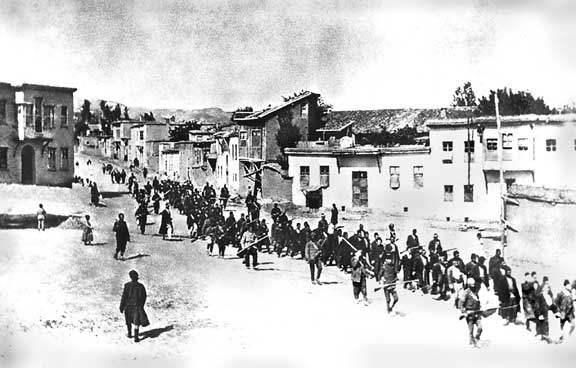
 Armenians are marched to a nearby prison in Mezireh by armed Turkish soldiers. Kharpert, Armenia, Ottoman Empire - April, 1915. *From the collection of Project SAVE Armenian Photograph Archives. Photographed by an anonymous German traveler.

Armenians are marched to a nearby prison in Mezireh by armed Turkish soldiers. Kharpert, Armenia, Ottoman Empire – April, 1915. From the collection of Project SAVE Armenian Photograph Archives. Photographed by an anonymous German traveler.

There were moonlit nights and many moonless nights
sober and drunken in one grain of sand
in billions of grains there were filthy hands
mud and fingernails between sunburned thighs
this is not my skin with nerves inside out
not my breast squeezed into faint whimpers
like dying swallows caught in a dry mouth

soon I’ll be a memory in last verse of songs
someone meant to write on a summer night
flesh to sand and sand to a story to tell
they’ll mention tattoos* and how I was a slave
look look how many stars in one grain of sand
in a billion grains in a billion tears
screams tangled like strings through my broken ribs

you did not know me then
before much before they tore off my clothes
and the desert night shivered with their rage
you did not see how my hair flowed like silk
on soft pillows where teenage dreams were weaved
you did not know me dressed with flowers in my hair
and my fathers arm around my adolescent frame
you did not see the stars from our wide windows
above the vineyard and my feet bare on the fertile soil
in our apricot tree’s cool summer shade

I’m in the evening news – in a pile of bones
look at the skull at the very left
see the sparrow lodged between those clenched jaws
I’m in the evening news a hundred years late
in the grains of sand shifting restless with shame
in the billion stars in your sky tonight
in my mother’s voice singing kenatzir pallas*
in the moonlit nights and the moonless nights
on a dagger’s blade in the Deir ez-Zor sand

– Silva Merjanian

24 April 2016 is the 101th anniversary of the Armenian Genocide, when thousands of women were dragged in the desert, raped and tortured before killed.

  • the reference to tattoos … they used to tattoo the women according to who owned them.
  • Kenatzir pallas is a lullaby very popular with Armenians and means “go to sleep my child”

“Silva’s poetry rewards the reader with the gift of exquisite lacework, adorned with choice words and skillfully wrought poetic imagery, which allow you to get a glimpse of both the intoxicating sensuality of survival and the scalpel scars on the tender skin of life. Many-layered, it excels alike in depicting the sphere of personal experience and of traumatic social issues.” – Dr. Aprilia Zank. Lecturer for Creative Writing and Translation Theory Ludwig Maximilian University, Munich, Germany in a review of Silva’s collection Rumor. Three poems rom this collection are Pushcart nominees. The net profits including the publisher’s go to The Armenian-Syrian Relief Fund. About $5,000 dollars have been raised to date.

© 2016, poem and book cover design, Silva Merjanian, All rights reserved; featured here with the permission of the poet; Silva’s website is HERE.; the header photograph is a public domian photograph courtesy of Project Save.