“To hear a poem spoken in the voice of the person who wrote it is not only to witness the rising of words off the page and into the air, but to experience an aural reenactment of exactly what the poet must have heard, if only internally, during the act of composition. “ Billy Collins (b. 1941), U.S. Poet Laureate
The Voice of the Poet series was developed in 2005 by Random House. We only just discovered it and since I am enamoured of Auden’s work and am focusing on him right now, we picked up that one. However, this audio series includes other notable poets such as Elizabeth Bishop, Robert Lowell, Frank O’Hara, and a collection of five women poets: Gertrude Stein, Edna St. Vincent Millay, H.D., Louise Bogan and Muriel Ruckeyser. Each set includes a CD of poetry readings collected from a variety of sources and occasions and a small book with the texts of the poems and a brief commentary by J.D. McClatchy, a poet, literary critic and an editor of the Yale Review. I completely enjoyed the Auden collection, recommend it if you are an Auden fan, and am moving on to get whatever others in the series can still be found. I would have written something else for today, but I just couldn’t pull myself away from this. It’s the sort of thing you enjoy and value if poetry – or a specific poet – is central in your life.
* * * *
“Pack up the moon and dismantle the sun.”
The day would not be complete without a poem. Here’s Funeral Blues, one of Auden’s more well-known poems . . .
“In fact, in lyric poetry, truthfulness becomes recognizable as a ring of truth within the medium itself.” Seamus Heaney
In the pantheon of Irish literary gods, there is a poet of our generation who stood in solidarity with people of conscience the world over. His name is Seamus Haney. We are the richer for his life and work and, as of Friday, the poorer for his death. His are works of truth and morality, soul and soil. He rested gracefully on the divide between poetry and activism and honored both, never strident or sensational. The poetry critic Helen Vendler wrote of him as a “private mind and heart caught in the changing events of a geographical place and a historical epoch…”
.
“Between my finger and my thumb The squat pen rests. I’ll dig with it.” Digging
Seamus Haney, a farmer’s son, a teacher, a prophet, a writer of poetry and plays, a lecturer and translator, a husband and father, won the Nobel Prize for Literature in 1995. He was a decent human being who had – in spades – the Irish gift for lyricism and story-telling. An accessible poet, he wrote for and about ordinary people. He was into whole-world living but didn’t forget his beginnings: Mossbawn, County Derry, Northern Ireland. “Home” to him had the traditional meaning of origin, rootedness and belonging, not a structure to be bought or sold or moved at whim. He had a solid knowledge of the classics and played with them ingeniously, often irreverant but never pedantic. People everywhere recite his works. Politicians quote him.
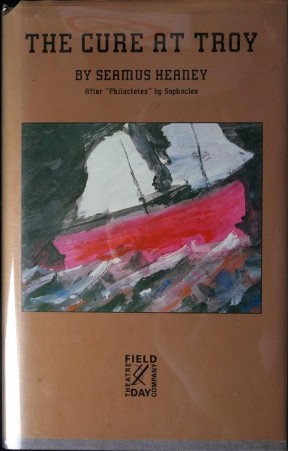
. “History says, Don’t hope On this side of the grave, But then, once in a lifetime The longed-for tidal wave Of justice can rise up And hope and history rhyme” The Cure of Troy
.
Robert Lowell said Seamus Heaney was “the most important Irish poet since Yeats’” and most would agree with that.
.
“When a poem rhymes, when a form generates itself . . . when a metre provokes consciousness into new postures, it is already on the side of life. When a rhyme surprises and extends the fixed relations between words, that in itself protests against necessity. When language does more than enough, as it does in all achieved poetry, it opts for the condition of overlife, and rebels at limit . . . The vision of reality which poetry offers should be transformative, more than just a printout of the given circumstances of its time and place . . . “The Redress of Poetry
.
Niamh Clune, writer and poet, publisher and musician
For Niamh Clune (Founder and CEO of Plumtree Books and Art), the loss of Seamus Heaney is a personal one. She posted this comment on Facebook on Friday and her comment – along with one of Seamus’ poems – close this post more eloquently than any words of mine would.
“Today, I lost someone I loved, someone who had a profound influence on me as a young impressionable girl growing up as an Irish exile in London . . . I knew him for his modesty, reason, temperance and wit. I am deeply saddened by his passing, as I know people whose lives he touched across the world will also be. I am sure he will rest in peace.” Niamh Clune
Blackberry-Picking
Late August, given heavy rain and sun
For a full week, the blackberries would ripen.
At first, just one, a glossy purple clot
Among others, red, green, hard as a knot.
You ate that first one and its flesh was sweet
Like thickened wine: summer’s blood was in it
Leaving stains upon the tongue and lust for
Picking. Then red ones inked up and that hunger
Sent us out with milk cans, pea tins, jam-pots
Where briars scratched and wet grass bleached our boots.
Round hayfields, cornfields and potato-drills
We trekked and picked until the cans were full
Until the tinkling bottom had been covered
With green ones, and on top big dark blobs burned
Like a plate of eyes. Our hands were peppered
With thorn pricks, our palms sticky as Bluebeard’s.
We hoarded the fresh berries in the byre.
But when the bath was filled we found a fur,
A rat-grey fungus, glutting on our cache.
The juice was stinking too. Once off the bush
The fruit fermented, the sweet flesh would turn sour.
I always felt like crying. It wasn’t fair
That all the lovely canfuls smelt of rot.
Each year I hoped they’d keep, knew they would not.
– Seamus Heaney
.
” I alway had this notion that you earned your living and that poetry was a grace.”




 Jamie Dedes' THE POET BY DAY Webzine