I don’t know what to write I don’t know what to write I don’t know what to write.
Is exactly what I wrote when trying that age old advice for writer’s block:
Sit down and write something, anything. Just get words on the page.
I’m not saying it is bad advice. Quite the contrary. But repeating the sentences isn’t working.
Oh, I know, I’ll try my old trick of using a random word generator.
*click* The word is: carnival.
A juicy word! Here we go.
Heeeere we go.
Go.
Ugh.
My mind is like a carnival?
That’s it, that’s all she wrote.
It’s more like the carnival that left town. Quiet. Dead. Random bits of debris blowing around.
That was almost lyrical and then it wasn’t. A sudden gust of wind that just as suddenly went still.
So goes the ongoing wrestling match with my demons. Well, not demons, that’s an unfair characterization. My Muse is not a demon and my demons are not Muses.
…
There are those who would say that having writer’s block is simply lack of discipline. Just sit down and write words is the cure.
I get the point but I think it’s unfair. I have always prided myself on being a disciplined writer. I don’t take for granted my ability to quite easily write a thousand words a day. It takes me about twenty minutes.
So when I say I’m blocked, it’s not for lack of words. Knocking out a thousand words with no purpose is unfulfilling. What I yearn for is that pull, that feeling of being in the flow, when the words that flow from my fingertips are not just words but a cohesive chain with something to say.
I have read the experts like Natalie Goldberg, Anne Lamott, and Julia Cameron. They are all right and they are all wrong. Their guidance matters and at some point they have all helped me.
The best thing for me to remember is that the good words don’t go away forever. Writer’s block isn’t permanent. That is the focus that keeps me going, knowing they will return and we will flow together again.
But until that happens, I am both thirsty and hungry and yearn for pretty words and meaty thoughts and the satiation I can only feel after feasting on a good turn of phrase.
Until then, I will keep ahold of that good juicy random word. I will work it over like a bad tooth until I find the story that flows from the word carnival. I’ll carry it around in my virtual rucksack until I figure out how to build the word and sentences and phrases that go beyond “my mind is like a carnival.”
Somehow. Somewhere.
My carnival awaits.
Karen Fayeth (Oh Fair New Mexico): Raised most of my life in New Mexico, my job brought me to Northern California. I don’t usually identify myself as a Californian, simply a New Mexican living in California. In the first couple years after moving, I distanced myself from my home state thinking it backward and remote. Then I began to visit home more frequently and truly learned a love for my home state that only comes by gaining perspective. I’m a writer, a crafter, a photographer and labor at a “real job” during the days.
Thank you for sharing your love of words. Comments will appear after moderation.
“What is hell? I maintain that it is the suffering of being unable to love.” Fyodor Dostoevsky, The Brothers Karamazov
One winter I ate the sun, it warmed
It warmed the moon dancing with my heart
It calmed the seas that ran in my veins
It drew spring flowers from crusts of ice
I wrote a poem to the sun, to the future
I wrote another to the eons gone by
Still another told of history’s lessons
But it was love kept me anchored
Earthy, and yet not earthbound, love
Jamie Dedes. I’m a freelance writer, poet, content editor, and blogger. I also manage The BeZineand its associated activities and The Poet by Dayjamiededes.com, an info hub for writers meant to encourage good but lesser-known poets, women and minority poets, outsider artists, and artists just finding their voices in maturity. The Poet by Day is dedicated to supporting freedom of artistic expression and human rights and encourages activist poetry. Email thepoetbyday@gmail.com for permissions, commissions, or assignments.
An easy prompt this week: What would you do – differently or the not – if you got another shot at this life. Tell us in your poem/s.
please submit your poem/s by pasting them into the comments section and not by sharing a link
please submit poems only, no photos, illustrations, essays, stories, or other prose
PLEASE NOTE:
Poems submitted through email or Facebook will not be published.
IF this is your first time joining us for The Poet by Day, Wednesday Writing Prompt, please send a brief bio and photo to me at thepoetbyday@gmail.com to introduce yourself to the community … and to me :-). These are partnered with your poem/s on first publication.
PLEASE send the bio ONLY if you are with us on this for the first time AND only if you have posted a poem (or a link to one of yours) on theme in the comments section below.
Deadline: Monday, December 16 by 8 pm Pacific Time. If you are unsure when that would be in your time zone, check The Time Zone Converter.
Anyone may take part Wednesday Writing Prompt, no matter the status of your career: novice, emerging or pro. It’s about exercising the poetic muscle, showcasing your work, and getting to know other poets who might be new to you.
You are welcome – encouraged – to share your poems in a language other than English but please accompany it with a translation into English.
Jamie Dedes. I’m a freelance writer, poet, content editor, and blogger. I also manage The BeZineand its associated activities and The Poet by Dayjamiededes.com, an info hub for writers meant to encourage good but lesser-known poets, women and minority poets, outsider artists, and artists just finding their voices in maturity. The Poet by Day is dedicated to supporting freedom of artistic expression and human rights and encourages activist poetry. Email thepoetbyday@gmail.com for permissions, commissions, or assignments.
USDA logo for Supplemental Nutrition Assistance Program / Public Domain
“Almost 1.4 million veterans live in households that participate in SNAP (formerly food stamps), CBPP analysis of data from the Census Bureau’s American Community Survey finds. In every state, thousands of low-income veterans use SNAP to help put food on the table. Florida has the largest number of veterans participating in SNAP (120,000), followed by California and Texas (97,000 apiece). In Oregon, Rhode Island, West Virginia, and Washington, D.C., at least 10 percent of veterans live in households that received SNAP in the last year. SNAP Helps Almost 1.4 Million Low-Income Veterans, Including Thousands in Every State MORE, Center on Budget and Policy Priorities, byBRYNNE KEITH-JENNINGS and LEXIN CAI
the unconscionable dance in the canyons of power,
lined with megalithic buildings, the edifice complex
of the spin-meister’s lie, that the demigods can do
anything – anything – walking this asphalt valley
a parade, flailing lemmings trussed and trusting their
die-cut dreams to the pitiless whim of the military/
industrial/medical alliance, whose war-cries are of
greed and arrogance, believing they’ll live forever,
today’s sovereignty, tomorrow’s guarantee. But it’s
all delusion – cultures die and the hope-crushing
architects of cuts and austerity measures are like
the rich man in the Lazarus story, there’ll be
some kind of backlash, some kind of hell to pay …
Rich Lazarus! richer in those gems, thy tears, Than Dives in the robes he wears: He scorns them now, but oh they’ll suit full well With the purple he must wear in hell” Richard Crenshaw (c.1613-1649), English cleric, teacher, metaphysical poet, Steps to the Temple. Sacred Poems, Delights of the Muses (1646)
New SNAP Rule Would Cost Many of Nation’s Poorest Their Food Aid
by Robert Greenstein, Center on Budget and Policy Priorities Statement
The emphases are mine. / J.D.
On December 4, the Trump Administration issued a draconian rule in the Supplemental Nutrition Assistance Program (SNAP, or food stamps) that will cut off basic food assistance for nearly 700,000 of the nation’s poorest and most destitute people. Those affected — SNAP participants ages 18 through 49 who aren’t raising minor children in their homes — are among the poorest of the poor, according to U.S. Department of Agriculture (USDA) data. Their average income is just 18 percent of the poverty line. Their average monthly SNAP benefits are about $165 per month.
A longstanding, harsh provision of SNAP limits these 18- through 49-year-olds to just three months of benefits, while not employed for at least 20 hours a week, out of every three years. Because of its severe nature, this provision of law also allows states to seek, and USDA to grant, waivers of this three-month cut-off for areas where insufficient jobs are available for these individuals, such as when unemployment is elevated.
From the provision’s enactment in 1996 until now, both Democratic and Republican presidents alike have operated under a common set of criteria in granting waivers from the three-month cut-off. And Democratic and Republican governors alike have sought and secured these waivers. Thirty-six states currently have waivers for parts of their state where unemployment is highest.
Now, the Trump Administration is abandoning this longstanding, bipartisan practice, however, and replacing it with a much more restrictive rule that will increase hunger and destitution. The new rule sharply restricts states’ ability to protect unemployed adults from the harsh time limit. It does so by substantially narrowing the criteria that states have most commonly used to qualify for waivers, thereby greatly shrinking the number of areas that can qualify for relief. As a result, the Trump Administration itself estimates that the rule will cut off basic food aid to nearly 700,000 unemployed or underemployed individuals.
Most of these individuals are ineligible for any other form of government financial assistance because they aren’t elderly, severely disabled, or raising minor children. For many of them, SNAP is the only assistance they can receive to help make ends meet.
What’s more, the final rule is more severe than the proposed rule, which itself was very harsh. States currently can request waivers when they experience rapidly rising unemployment, as typically occurs at the onset of economic downturns based on the Department of Labor’s determination that the state qualifies for extra federal unemployment benefits. But under the final rule, states must rely on historical data that would not reflect the onset of economic downturns until many months later. Moreover, far fewer areas will qualify for waivers during a widespread, national recession. A state with spiking unemployment reaching levels as high as 9 percent would not qualify for a waiver if national unemployment were also high, such as at 8 percent. This will limit a core strength of SNAP — its responsiveness to changes in economic conditions so that individuals who lose their source of income can quickly qualify for temporary food assistance. Instead of mitigating a recession’s harm, the new rule will exacerbate it.
Another Flawed “Work Requirement” Proposal
Adding to these concerns, although participation in a work or training program counts toward fulfilling the 20-hours-a-week requirement, states are not required to provide work or training slots to these individuals — and most states don’t. Furthermore, pounding the pavement and searching hard for a job does not count toward meeting the requirement. If you can’t find a 20-hour-a-week job on your own, you’re cut off SNAP anyway.
The Administration’s portrayal of the new rule as a reasonable “work requirement” thus is misleading — as noted, most states don’t offer any job, training opportunity, or slot in a work program to most people subject to the three-month limit. And people who are “playing by the rules” and looking hard for a job are cut off nonetheless.
In addition, the history of the three-month cut-off shows that some people who should qualify for an exemption from it because they suffer from a significant health condition often don’t get an exemption — and lose their SNAP benefits anyway, because they can’t satisfy the paperwork and other bureaucratic hurdles involved in securing an exemption. That’s especially troubling now, because the Administration is giving states little time to prepare for this sweeping change. Properly identifying which destitute individuals in formerly waived areas should be subject to the three-month time limit and which should be exempt (due to conditions that affect their ability to work) can require both training staff and allocating additional administrative resources.
Rule Hits People of Color, Those With Limited Education and in Rural Areas Hardest
Cutting off basic assistance doesn’t appear to help individuals get jobs, as research into the SNAP time limit, and similar rules in Medicaid, demonstrates. The rule will hit hardest those with the greatest difficulties in the labor market. That includes adults with no more than a high school education, whose unemployment rate is much higher than the overall unemployment rate; people living in rural areas where jobs are often harder to find; and people who are between jobs or whose employers have cut their hours to less than 20 hours a week, which is common in the very-low-wage labor market even when the economy is strong.
People of color are likely to lose benefits disproportionately under the rule, given their much higher unemployment rates and continued racial discrimination in labor markets. The African American unemployment rate has long been roughly double the non-Hispanic white unemployment rate. Studies have found that white job applicants are much likelier to receive callbacks after job applications or interviews than equally qualified Black applicants.
Here’s how the new rule will harm these groups. Under the new rule, an area can qualify for a waiver only if its average unemployment rate over a recent 24-month period has been 20 percent higher than the national average for the same time period and was 6 percent or higher. But a local area with an overall 5.8 percent unemployment rate can have an African American unemployment rate closer to 10 percent, as well as an unemployment rate around 10 percent for people of all races who are age 25 or over who lack a high school diploma or GED.
The Administration and House Republican leaders sought, but failed, to secure these policy changes as part of the farm bill that Congress passed on a bipartisan basis last year. The Administration is now implementing through executive action what it failed to secure through legislation.
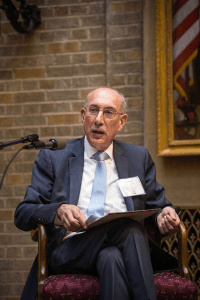
Robert Greenstein, UDSA photograph / Public Domain
Instead of punishing those facing destitution and other difficult circumstances, the Administration should seek to assist them by pursuing policies such as more and better job training and employment programs, a higher minimum wage, and a strengthened Earned Income Tax Credit. Denying them basic food and nutrition is not the route that a fair and compassionate administration of either party should take.
Note: The Center on Budget and Policy Priorities (CBPP) is a progressive American think tank that analyzes the impact of federal and state government budget policies. It was founded by Robert Greenstein, the author of this feature. CBPP is 501(c)(3) nonprofit organization, the Center’s stated mission is to “conduct research and analysis to help shape public debates over proposed budget and tax policies and to help ensure that policymakers consider the needs of low-income families and individuals in these debates.”
Jamie Dedes. I’m a freelance writer, poet, content editor, and blogger. I also manage The BeZineand its associated activities and The Poet by Dayjamiededes.com, an info hub for writers meant to encourage good but lesser-known poets, women and minority poets, outsider artists, and artists just finding their voices in maturity. The Poet by Day is dedicated to supporting freedom of artistic expression and human rights and encourages activist poetry. Email thepoetbyday@gmail.com for permissions, commissions, or assignments.

 California. I don’t usually identify myself as a Californian, simply a New Mexican living in California. In the first couple years after moving, I distanced myself from my home state thinking it backward and remote. Then I began to visit home more frequently and truly learned a love for my home state that only comes by gaining perspective. I’m a writer, a crafter, a photographer and labor at a “real job” during the days.





 Jamie Dedes' THE POET BY DAY Webzine