“Even so, there were times I saw freshness and beauty. I could smell the air, and I really loved rock ‘n’ roll. Tears were warm, and girls were beautiful, like dreams. I liked movie theaters, the darkness and intimacy, and I liked the deep, sad summer nights.” Haruki Murakami, Dance Dance Dance
The warmth and longer days now in Northern California bring to mind summers in the City of Ultimate Bliss.
The heat rose that summer, as it did every year,
in thick nauseating sooty waves from red bricked
buildings, black asphalt and gray sidewalks,
the unrelenting humidity trapping us in sweat.
Brooklyn it seemed, that younger heaven,
had slipped into the Hudson and found its way
out to the great Atlantic and on to some tropic.
We so yearned for an air-conditioned escape,
cold sodas and chilled bowls of ice cream.
Cool back then could be had for the purchase of
two red tickets, one for my mom and one for me.
Only fifty-cents each for air-conditioned movie seats,
heart-throbbing honey-dreams and sugared
drops of sultry lives and deftly stirred emotions.
Poet and writer, I was once columnist and associate editor of a regional employment publication. Currently I run this site, The Poet by Day, an information hub for poets and writers. I am the managing editor of The BeZine published by The Bardo Group Beguines (originally The Bardo Group), a virtual arts collective I founded. I am a weekly contributor to Beguine Again, a site showcasing spiritual writing.
My work is featured in a variety of publications and on sites, including: Levure littéraure, Ramingo’s Porch, Vita Brevis Literature,Compass Rose, Connotation Press, The Bar None Group, Salamander Cove, Second Light, I Am Not a Silent Poet, Meta / Phor(e) /Play, and California Woman.
Thank you for sharing your love of words. Comments will appear after moderation.
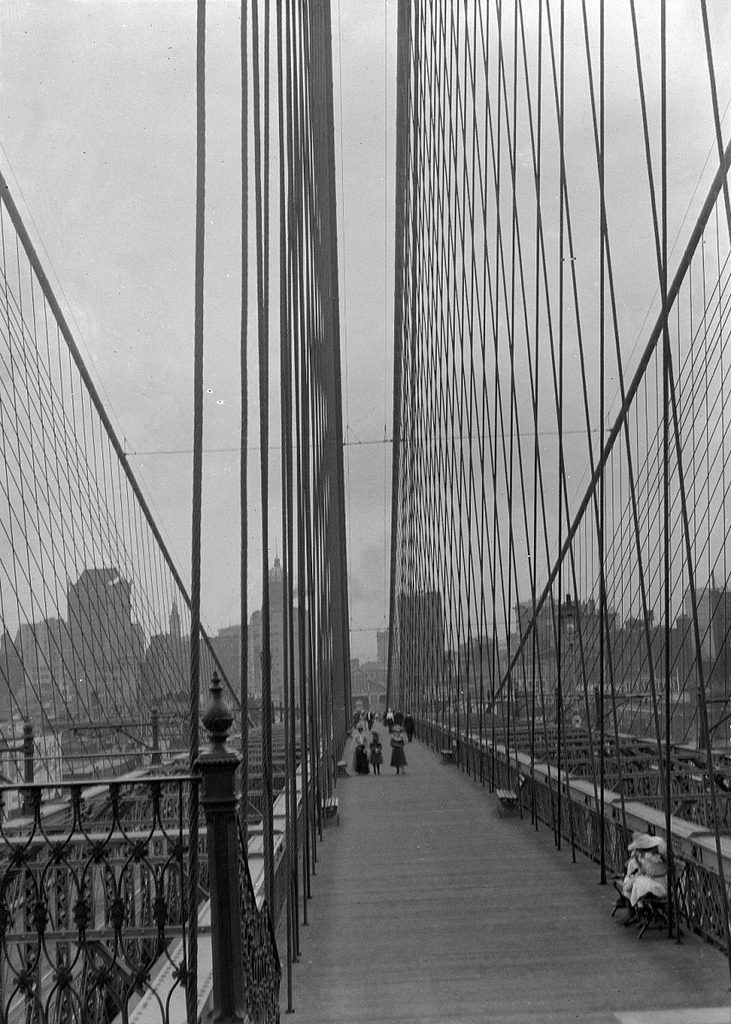
Brooklyn Bridge, looking west from Brooklyn, July 1899
The courageous immigrants of the elder generations cast the shards of their hopes and dreams across the landscape of this continent as prophecy. They worked hard and long for their visions. These people included my Lebanese maternal grandparents with their first-born children. They arrived in New York in 1897 on a boat from Syria. They petitioned for citizenship in 1925. Included also was my Turkish father who arrived here alone in 1919. He was just seventeen, eager to make good and to earn dowries for his four older sisters. The distaff side eventually settled in Brooklyn. That’s where they were when I was born and that’s where I was raised.
These were people who came to America in “the days of sail,” as the great New York writer, Irish-American Pete Hamill, would say. Today’s immigrants can and often easily do visit their countries of origin. They connect with their families and their linguistic and cultural roots. This was something that was generally not available to the people of my grandparent’s generation and before. Among the many reasons for this was an often crushing poverty. In Ireland “American wakes” were held for the sons and daughters who left for the United States. Heart-shattered parents knew it was unlikely they’d ever see their children again.
The immigrants I knew growing up worked hard. The immigrants that I know today work hard, often holding more than one job. They make real – though generally quiet – contributions to their communities, work places and their new country. They serve in the military. They make sure their children are educated.
Because of parents and grandparents who were resourceful and brave enough to come to this country, we had as children, not just economic opportunity, but a wealth of artistic and educational resources. On occasion we went, for example, to the Leonard Bernstein‘s Young People’s Concerts at the New York Philharmonic. I remember Mr. Bernstein with his charming and contagious enthusiasm calling our imaginations to Peter and the Wolf. We didn’t have to travel far to have access to talents like Mr. Bernstein or to visit museums, cathedrals, art galleries, music venues, theater (movies and stage), parks and so much more. It was all right there, ready to be plucked and savored like so many sweet and juicy summer plums.
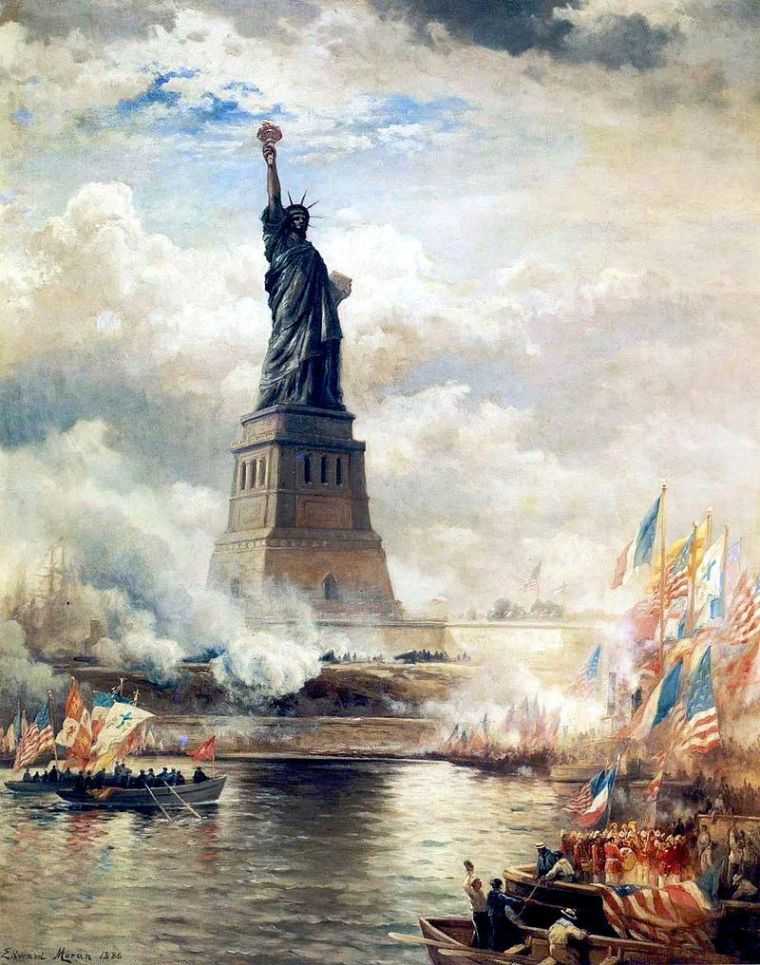
Unveiling of the Statue of Liberty Enlightening the World (1886) by Edward Moran. Oil on canvas. The J. Clarence Davies Collection, Museum of the City of New York. (Public Domain)
The schools were good, whether public or private. The libraries were ubiquitous. I will ever and always be in love with the Hudson River and the incredibly beautiful and historic Brooklyn Bridge. To my child-self, everything was magical, mystical, mythological and monolithic. Brooklyn’s proximity to Manhattan added to my enchantment. The Cloisters. Central Park. The magnificent Statue of Liberty, symbol of our highest ideal.
The New Colossus
Not like the brazen giant of Greek fame,
With conquering limbs astride from land to land;
Here at our sea-washed, sunset gates shall stand
A mighty woman with a torch, whose flame
Is the imprisoned lightning, and her name
Mother of Exiles. From her beacon-hand
Glows world-wide welcome; her mild eyes command
The air-bridged harbor that twin cities frame.
“Keep, ancient lands, your storied pomp!” cries she
With silent lips. “Give me your tired, your poor,
Your huddled masses yearning to breathe free,
The wretched refuse of your teeming shore.
Send these, the homeless, tempest-tost to me,
I lift my lamp beside the golden door!”
– Emma Lazarus (1849-1887)
I’m sure that had I been born in the mountains of Lebanon or in rural Turkey, these places would have offered their own joys and charms but I’m grateful for my Brooklyn, New York experience.
I too lived – Brooklyn, of ample hills, was mine; I too walk’d the streets of Manhattan Island, and bathed in the waters around it; I too felt the curious abrupt questionings stir within me In the day, among crowds of people, sometimes they came upon me, In my walks home late at night, or as I lay in my bed, they came upon me.
Walt Whitman (1819-1892), Leaves of Grass
This week’s prompt is “immigration.” Write in prose (up to 750 words) or poem about your experience or observation. Your work doesn’t have to be about immigration to the US. It can address or illustrate the refugee experience if you prefer.
There are so many on the move – and on the run – right now, historic numbers, and the world is fraught with anger and meanness on this topic. It seems a good subject to tackle through Wednesday Writing Prompt, though please know that I won’t publish and will delete anything encouraging of violence or hate.
Leave your prose or poem/s or a link to them in the comments section below. All work shared on theme will be published here next Tuesday. If it’s your first time coming out to play for Wednesday Writing Prompt, please send a short bio in the body of an email and a photo of yourself as an attachment to thepoetbyday@gmail.com for use as an introduction. You have until Monday evening, 8:30 p.m. PST, to respond to the prompt. You are welcome – encouraged – to join in no matter the status of your career: novice, emerging or pro.
We sat on the worn stone steps of summer
on salty Brooklyn nights in Dyker Heights,
senior year pending, pregnant with promise.
Hours of sipping cokes, jamming sessions.
Stan on drums. Tony played keyboard.
You sang bass and strummed a new guitar.
Your saucy sister chorine sprinkled star dust. We were just kids trafficking in dreams.
You’d drive me home at curfew in your
dad’s blue Nova, into a violet dusk, the
maple shadows standing guard by Mom’s.
Now gone. Gone, you and our old roost . . .
No more of your music. No old friends.
Just meandering the strangest streets,
mumbling something off-key, strumming
the memory of you, a new guitar, and the last
of the summers when we trafficked in dreams.
“Of love and summer, you are in the dreams and in me …” Walt Whitman
LESSON THIRTEEN: HINDER THE ONE-PARTY STATE “The parties that took over states were once something else. They exploited a historical moment to make political life impossible for their rivals. Vote in local and state elections while you can.” Prof. Snyder, On Tyranny, Twenty Lessons from the Twentieth Century
Go to art, not war.
Poem on …
Thank you for sharing your love of words. Comments will appear after moderation.
My cousin Dan and me as kids and probably the last time he was shorter than I am. He stands 6’5′ and I stand around 5’2″ – give or take a bit depending on my shoes.
I was definitely the product you’d expect from the odd and awkward situation in which I grew up and surely I showed little talent, no free thinking and no genius or particular promise. The poem is not good – some youth write profoundly beautiful and wise poetry and young people today are far more savvy than I ever was – but it does illustrate that after fifty years or so writing will improve. We writers often have our doubts, but we are an unrelenting bunch. We write, write, write. We enrich, reform and reframe as if every word of ours will spark more Light in the collective unconscious, which I rather think they do.
Make of Me a Tree
I am young, Lord,
but my heart is true,
Make of me a tree
Make me strong and supple
That when tempests blow,
I shall stand unyielding.
Let me be humble in the
Praise of Your Majesty
And testify to Your greatness.
When rains besiege
Let me be shelter
To those who have not found Your Son,
For
Yes! I am young
but my heart is true:
Make of me a tree.
Amen.
– Jamie Dedes
As for cousin Dan in the photograph (six years younger than me), he was inspired by the poem to paint a lovely “portrait” of a tree. These days it’s Father Dan – Rev. Fr. Daniel S. Sormani, C.S.Sp. – a theologian and professor at Ateneo de Manila University in the Philippines. Dan always showed real promise. Like my son, Richard, and Dan’s brother, Christopher, even as a toddler he was smart and funny. So many of you appreciated Dan’s piece What Have We Done That People Can Pick Up Weapons and Kill?Come March, Dan will be back in the United States. We will get to visit for the first time in forty years.
And, yes!, I did want to become a nun. I was told there would be family background checks and I feared rightly that there were things in my parent’s history that would embarrass my mom. I became a now-and-again wife, a mother, a writer, a poet. No regrets. The life mission is essentially the same though the vehicle of service differs and the actions are grounded in ethics not creed, which is not to imply that the two are necessarily exclusive.
Note: The photograph of the two of us together was taken at a fundraiser our mothers were helping with for the Guild for Exceptional* Children in Bay Ridge, Brooklyn, New York. This remains a worthy effort and worth your time if you happen to live in that area and are looking for a good cause to support.





 Jamie Dedes' THE POET BY DAY Webzine