“My genes are in mice, and not in the banal way ….”
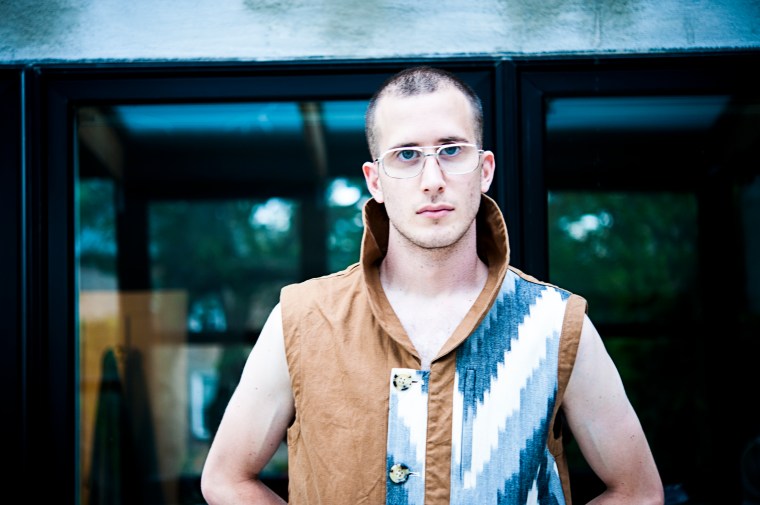
Max Ritvo (December 19, 1990 – August 23, 2016) was an American poet. Milkweed Editions posthumously published a full-length collection of his poems, Four Reincarnations, to positive critical reviews.
Max Ritvo was born in Los Angeles, California on December 19, 1990 A graduate of Harvard-Westlake School in Los Angeles, Ritvo earned his BA in English from Yale University, where he edited a literary magazine and performed with a sketch comedy troupe, and his MFA in Poetry from Columbia University. In 2014, he was awarded a Poetry Society of America Chapbook Fellowship for his chapbook AEONS. On August 1, 2015, he married Victoria Jackson-Hanen, a Ph.D. candidate in psychology at Princeton University, in a ceremony officiated by the poet Louise Glück. He was a poetry editor at Parnassus: Poetry in Review and a teaching fellow at Columbia.
Ritvo was diagnosed with Ewing’s sarcoma (a rare pediatric cancer) at age sixteen and died from the disease at his home in Los Angeles on August 23, 2016.
Ritvo’s work has appeared in Poetry, The New Yorker, Boston Review and as a Poem-a-day on Poets.org. He gave numerous written and radio interviews before his death.
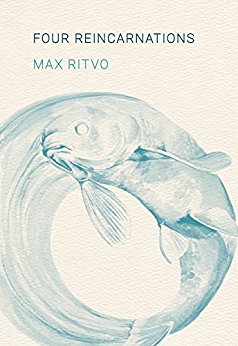
Four Reincarnations, a full-length collection of Ritvo’s poems, was published by Milkweed Editions in September 2016.
According to Lucie Brock-Broido of Boston Review, Ritvo is
“a Realist, a gifted comic, an astronomer, a child genius, a Surrealist, a brainiac, and a purveyor of pure (and impure) joy. His work is composed, quite simply, of candor, of splendor, and of abandon.”
Louise Glück wrote of his first published collection that it was “one of the most original and ambitious first books in my experience… marked by intellectual bravado and verbal extravagance.”
“…the poems are equally conscious of impending death and of the next day’s life, having spent time in a pool of self-skepticism and then emerged shining, shockingly clean…”
While noting that Ritvo “seems to have written most of this book with the clarity, the near equanimity, the distance from ordinary reversals and struggles, of much older poets who know that they are dying,” Burt also writes, “But mortality is rarely his only subject: shyness, gratitude, and erotic attachment are as important as death itself.”
Literary critic Helen Vendler reviewed his work and likened him to Keats. She wrote:
“Ritvo had the luck to study at Yale with Louise Glück and at Columbia with Lucie Brock-Broido, and to attract, before his death, many admirers of his ecstatic originality. Although he is inimitable, his example is there for young poets wanting to forsake simple transcriptive dailiness for the wilder country of the afflicted but dancing body and the devastated but joking mind.”
David Orr, reviewing Four Reincarnations for the New York Times, wrote “It is good-humored (“My genes are in mice, and not in the banal way / that Man’s old genes are in the Beasts”), appealingly sly (“Enoch has written / We are made in His image / but God may have many images./ He may want even more”) and at times surprisingly whimsical (“Every day a chicken dies so that my mom may live”). Orr also quoted, then commented on the end of Ritvo’s poem, The Hanging Gardens:
“This is very fine, and if it acquires a sheen of sentiment because of what it suggests will never emerge — that is, more poems from Ritvo — this doesn’t change the fact that a reader knowing nothing of poetry or this author might find it worth rereading. This is the life poetry leads beyond the confines of the poetic career; the life in which lines exist for what they are, not for future lines they might suggest. The life in which an early poem is also a poem, and a first book is also a book.”
In 2017, Milkweed Editions announced the Max Ritvo Poetry Prize, an annual US$10,000 award and publication contract, supported by the Alan B. Slifka Foundation.
Note: I knew Max Ritvo had a fatal cancer but his death somehow didn’t cross my radar until English poet Reuben Woolley posted an obit earlier this week on Facebook. Such an impossibly sad loss. It has been weighing on me and – however belatedly – I wanted to do a write-up as homage but deadlines and other responsibilities are pressing. Hence, this post is from Wikipedia. Forgive me for not doing my own writeup, though that will come one day. It’s on my ever-lengthening to-do list.
Here is Max reciting My Litter during his self-proclaimed “final tour.” (If you are reading this from an email subscription, it’s likely you will have to link through to the site to view the video.) Max’s Amazon page is HERE. May he rest in peace and may the healing power of the Universe support his wife and family in their lives and loss.
Thank you for sharing your love of words. Comments will appear after moderation.
Saint Lucian poet, Derek Walcott (1930-2017) Nobel Prize in Literature 1992; picture taken at his honorary dinner, Amsterdam, May 20th 2008
“… the truest writers are those who see language not as a linguistic process but as a living element…” Derek Walcott
Derek Walcott died this morning at the age of 87 after gifting the world with some of its finest poetry.
There is much in Derek Walcott’s life and work that is worth noting but for those who self-publish or are considering doing so, Walcott was a part of that long tradition. In his late teens he self-published his first works – 25 Poems (1948) and Epitaph for the Young: XII Cantos (1949) – with money borrowed from his mother, a school teacher and principal. He sold copies to friends and recouped the costs. I’m sure that if he was a teen today he’d be blogging his poems.
Bill Moyers once interviewed Walcott …
” . . .about the United States’ discomfort with its role as an empire and the difference between the American dream and the “black man’s dream.” The Caribbean-born writer also speaks of poets’ obsession with language and truth telling, and the “divine discontent” at the heart of all art.”
The reason I remembered this long-ago interview is that as a first-generation American I appreciated what he had to say about the motivations behind immigration to the States, about the ideals we have that are valued even though we fall far short of living up to them. I searched for and found the transcript online this afternoon and mention it here because I think some of what Walcott said is relevant to current struggles. Link HERE to read the transcript.
Virginia Woolf (1881-1941), English writer and one of the foremost modernists of the 20th Century
“After completing the manuscript of her last (posthumously published) novel, Between the Acts, Woolf fell into a depression similar to that which she had earlier experienced. The onset of World War II, the destruction of her London home during the Blitz, and the cool reception given to her biography of her late friend Roger Fry all worsened her condition until she was unable to work.[20] On 28 March 1941, Woolf drowned herself by filling her overcoat pockets with stones and walking into the River Ouse near her home. Woolf’s body was not found until 18 April 1941.[35] Her husband buried her cremated remains under an elm in the garden of Monk’s House, their home in Rodmell, Sussex.” Wikipedia
A sad end for a complicated soul and a hugely talented one, but her gifts to us live on as we continue – seventy-five years after her death – to read her writings, to share her preoccupation with transformation through art.
One of my favorite Woolf quotes has – predictably – to do with poetry and women . . .
“I would venture to guess that Anon, who wrote so many poems without signing them, was often a woman.”
… and with silence and simple daily things …
“Better is silence..Let me sit with bare things, this coffee cup, this knife, this fork, things in themselves, myself being myself.” – Virginia Woolf, The Waves
For Virginia Woolf fans, Rebecca Brooks created a blog dedicated to everything Virginia Woolf: her life, death, writing, context, relationships, mental illness, literary techniques and more: The Virginia Woolf Blog; The life and legacy of Virginia Woolf – Recommended. Enjoyable and informative. Bravo, Rebecca!
Thank you for sharing your love of words. Comments will appear after moderation.
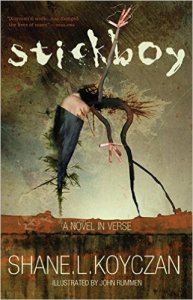
A novel in verse about a boy who was bullied. *****
I first encountered Shane Koyczan’s work when he presented his poem We Are Moreat the 2010 Winter Olympics at Vancouver. Like so many others, I was enraptured and sought out more of his poetry. At that time all that was available were a few YouTube videos. Since then, Shane has been on many tours and has published three books and a studio album. He is fast, furious, funny, compassionate and human. His ideals are real.
Shane is noted for his poems against bullying and about cancer, illness, loss, and eating disorders. One video of Shane’s anti-bullying poem To This Day(a TED video)has had nearly 1,900,000 views alone. Having said that, the version I like best is below, which has 7,000-plus views but is accompanied by dance and is delightfully artful. Shane’s Amazon page is HERE.
“We so seldom understand each other. But if understanding is neither here nor there, and the universe is infinite, then understand that no matter where we go we will always be smack dab in the middle of nowhere. All we can do is share some piece of ourselves, and hope that it’s remembered. Hope that we meant something to someone” Shane Koyczan
Thank you for sharing your love of words. Comments will appear after moderation.
 Max Ritvo (December 19, 1990 – August 23, 2016) was an American poet. Milkweed Editions posthumously published a full-length collection of his poems, Four Reincarnations, to positive critical reviews.
Ritvo was diagnosed with Ewing’s sarcoma (a rare pediatric cancer) at age sixteen and died from the disease at his home in Los Angeles on August 23, 2016.



 Jamie Dedes' THE POET BY DAY Webzine