It’s great to get a poem or story published. It’s about income and getting read and for some it’s validation as well. These are all important (even vital), but I was reminded recently that our poetry and other writing is about so much more.
“The title of David Cooper’s book on Kabbalah invites us to re-think the Creator as Creating: God is a Verb. While I don’t want to equate science to God in a religious sense, I want to borrow this re-conception. Science is creative, creating, if you will, knowledge of the world. Science is a verb.”
Jamie Dedes
A friend of mine came to visit and glowed when she told me she’d read Michael’s introduction. God is a Verb and Science is a verb popped out at her. Something she’d been struggling with suddenly fell into place. Other company arrived and I wasn’t able to get further explanation. I’m pleased but not surprised with her reaction to Michael’s piece. It demonstrates the power of words to bring joy, clarification and healing.
My own recent experience: a few people commenting or emailing me saying my post here – not with a bang but a whimper – helped release needed tears.
On another occasion a woman in Scotland wrote to say she’d read my poem – Wabi Sabi – to her wabi sabi group. They found it inspiring. Wow! While I do need my payments, it’s this sort of thing – this human connection – that is satisfying right down to the marrow of my bones.
Poetry is also important as an entry point into sacred space for both artist and audience. This is motivation for everyone to practice their art, whether professionally or as amateur, which is not a pejorative. I’m sure many of you – if not all of you – know what I mean. There’s a shift that happens. Sometimes it feels more like channeling than writing. The experience is illuminating, healing and peaceful. An unexpected insight often arrives just when you need it.
Our job as poets and writers goes even further: we bear witness, we give voice to the voiceless, and we observe and commemorate.
English Poet Myra Schneider at her 80th Birthday celebration and the launch of her 12th collection
Myra Schneider said in an interview HERE, that “I believe the role of the poet is to reflect on human experience and the world we live in and to articulate it for oneself and others. Many people who suffer a loss or go through a trauma feel a need for poetry to give voice to their grief and to support them through a difficult time. When an atrocity is committed poems are a potent way of expressing shock and anger, also of bearing witness. I think that the poet can write forcefully, using a different approach from a journalist, about subjects such as climate change, violence, abuse and mental illness and that this is meaningful to others. I very much believe too that poetry is a way of celebrating life. I think it deserves a central place in our world.”
So, as we celebrate poetry this month, be sure to give yourself time to read and write … for the sake of your spirit and for the rest of us too.
Please join us at The BeZine on April 15th for our special interNational poetry issue. Michael Dickel is the lead editor.
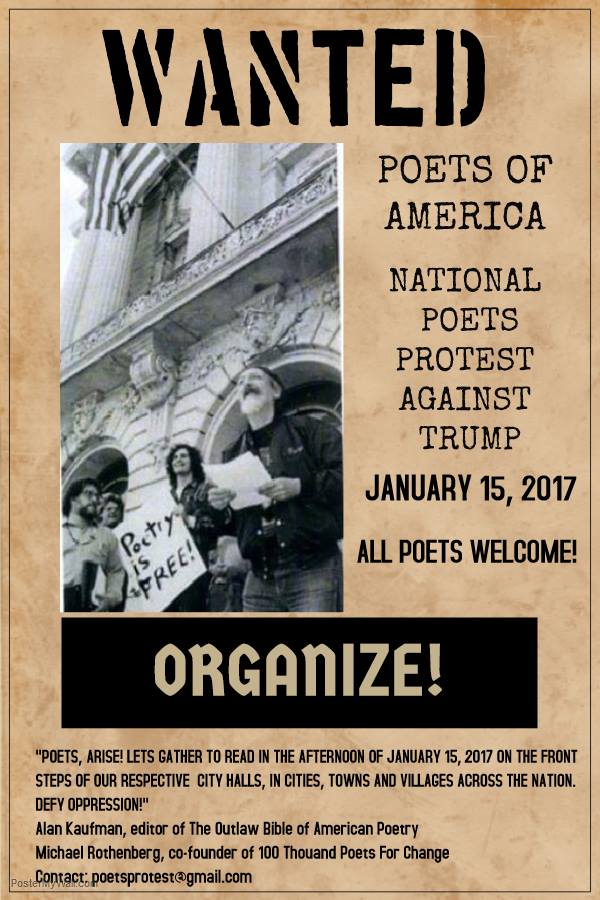
“On January 15, 2017, poets around the U.S., in cities, towns and villages, will gather on the steps of their local city hall to read poetry against the coming dictatorship of Trump.”
“Outlaw poets” is a term of endearment used in reference to poets whose work is featured in the Outlaw Bible. The following is a partial list of the characteristics of such poets:
anti-authoritarian personality;
anti-Vietnam war activists known for their anti-war rhymes (many poets write about Vietnam who are by no means outlaw poets).
Elder poets that gained notoriety via unconventional forms
Poets deliberately not included in most academic curriculums
Often inspirational to or inspired by the so-called “Beat” movement in American poetry during the mid-20th century
and
Michael Rothenberg is co-founder (with Terri Carrion) of 100 Thousand Poets For Change. He is an American poet, songwriter, editor, and active environmentalist who recently moved to Florida from the San Francisco Bay area. Born in Miami Beach, Florida, Rothenberg received his Bachelor of Arts in English at the University of North Carolina at Chapel Hill. In 1993 he received his MA in Poetics at New College of California. In 1989, Rothenberg and artist Nancy Davis began Big Bridge Press, a fine print literary press, publishing works by Jim Harrison, Joanne Kyger, Allen Ginsberg, Philip Whalen and others. Rothenberg is editor of Big Bridge, a webzine of poetry. Rothenberg is also co-editor and co-founder of Jack Magazine
It’s probable that The BeZineJanuary 15, 2017 issue will be devoted to this event. Save the date for both live and virtual events and prepare to submit your poems. Let them be both truthful and artistic . . .
Tell all the Truth but tell it slant —
Success in Circuit lies
Too bright for our infirm Delight
The Truth’s superb surprise
As Lightning to the Children eased
With explanation kind
The Truth must dazzle gradually
Or every man be blind — Emily Dickinson
Δ
The latest issue of ARTEMISpoetry (UK) just landed in the USA with its usual rich assortment of essays, book reviews, art, announcements and – Yes! – of course, a wealth of good poems. (Apologies for not getting a better photograph of the cover.) ARTEMISpoetry is the bi-annual journal (November and May) of the Second Light Network and published under its Second Light Publications imprint. The poetry is by women forty-plus or better. The poems are for everyone. You can order this issue and others through Anne Stewart‘s poetry p fand/or sign up for membership. Membership includes a journal subscription.
CALLS FOR SUBMISSIONS
Opportunity Knocks
Poetry Deadlines: Issue 18, February 28, 2017 and Issue 19, August 31, 2017. “Women poets only, of any age. Unpublished poetry only and not out in submission elsewhere. Strict limit: max 4 poems; the total number of lines in all should not exceed 200 lines (i.e. you could send a poem of 200 lines and this would restrict your submission to just one poem). Two copies, A4 paper only [U.S. standard letter paper – 8 1/2 x 11 is the closest we have in the US to A4], typed or neatly handwritten. Each numbered sheet to bear the poet’s contact details (name, address, telephone, e-mail). Send to ARTEMISpoetry, ATTN.: Dilys Wood, 3 Springfield Close, East Preston, West Sussex, BN162 SZ.”
Response by April 30 for Issue 18 and October 31 for Issue 19. Kate Foley is the poetry editor for Issue 18.
Artwork – Black and white photographs or line-art sketches are welcome for submission. Four max.
For new and emerging writers, Second Light also offers “remote” – i.e., distance – workshops. Check out the website for details.
Δ
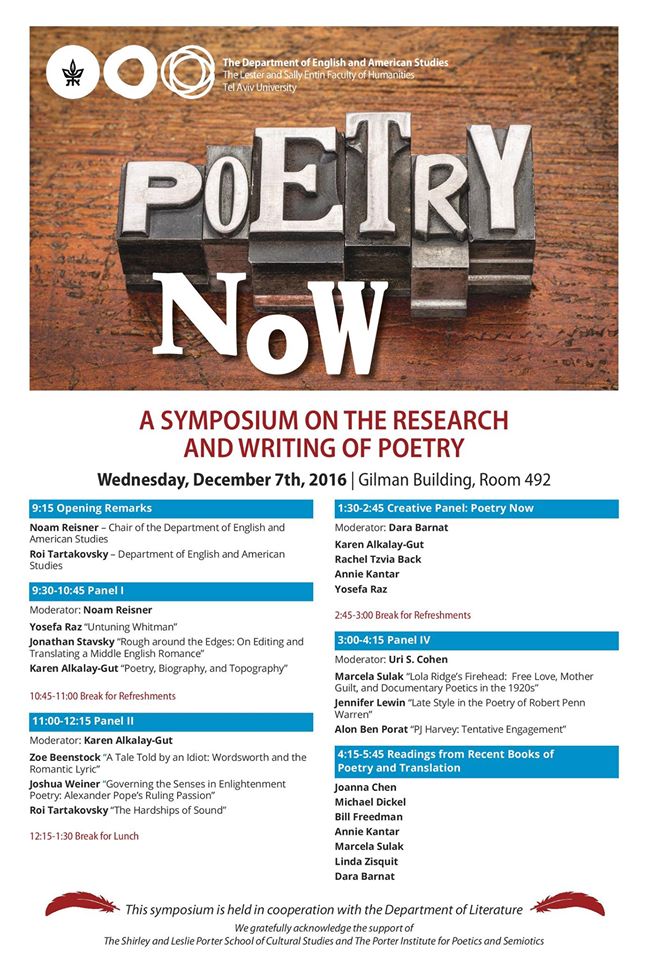
HEADS-UP: December 7, 2016,
Poetry Now @ The Department of English and American Studies, The Lester and Sally Entin Faculty of Humanities, Tel Aviv University
Wednesday, October 5 at 6:30 PM – 8 PM in CDT Cream City Tattoo Gallery, 11 6th Ave N, St Cloud, MN 56303-4746, United States
Music— 6:30 Dean Severson doing guitar
Words—7:00 Michael Dickel doing poetry
American-Israeli poet Michael Dickel will read from his collection of poetry, War Surrounds Us, while surrounded by the Surreal Deal show of artist Jerry Ingeman —whose work graces the cover of the collection and will be on display. Jerry and Michael might chat a bit about art, poetry, and the meaning of life. Or not. Book will be available for purchase and autograph. Michael will also read one or two works from his forthcoming book, The Palm Reading after The Toad’s Garden.
RELATED FEATURES:
• Poem and analysis by Vivian Eden: Haaretz, Israel. Poem of the Week Recycled Violence: The World Has Gone Mad Again. (online: http://bit.ly/1NwUf6R)
• Review and interview by Jamie Dedes: The Poet by Day— The Poet As Witness: “War Surrounds Us,” an interview with American-Israeli Poet, Michael Dickel (text: http://bit.ly/1IcMLyj)
• Interview by Laura Shovan: Author Amok: World Poetry Series (text: http://bit.ly/1JeOMe7)
• Interview by Laura LaMarca: Johntext United Kingdom (text: http://bit.ly/1GdJxjC)
• Interview by Ilene Prusher, Let’s Get Lit: “War Surrounds Us” on TLV1.FM (podcast: http://bit.ly/1JQJb25)
Thank you for sharing your love of words. Comments will appear after moderation.
By now, those who pay attention to poetry and in particular the poetries of witness and activist poetries, know well that it follows from a long tradition. Yet others, especially cultural and political conservatives, argue “protest” poetry or “political” poetry both do not constitute “Literature,” and that such poetry cannot help but be time-bound little more than contemporaneous commentary. I have been told that some of my poetry is “journalistic,” and that I am caught in a “fashionable” trend from the mid-1950s that has no literary roots beyond, possibly, the Beats. Such arguments simply are nonsense.
Carolyn Forché’s volumes Poetry of Witness: The Tradition in English 1500–2001 and Against Forgetting: Twentieth-Century Poetry of Witness demonstrate, with excellent examples, a long history of social and political engagement in English poetry. In fact, one might claim just the opposite of the (usually disguised political) claims that the tradition began in the middle of the 20th C. could be made, that solipsistic confessional poetry that is more autobiography than engaged in the world emerges from that time, in counter-balance to a history of poetry engaged in the outside world.
For this post, I provide two examples of poets from the first half of the 20th Century who engaged in the world.
*****
The first, two poems come from the well-known poet William Butler Yeats: Easter, 1916, written in response to a political protest forcefully broken up by the British, who executed 16 of the protesters. The poem, written in September 1916 and published in 1928, ends with a powerful commentary on the protest, the execution-martyrdom that resulted, and, prophetically, the continuation of the Irish struggle: “A terrible beauty is born.”
Easter, 1916
I have met them at close of day
Coming with vivid faces
From counter or desk among grey
Eighteenth-century houses.
I have passed with a nod of the head
Or polite meaningless words,
Or have lingered awhile and said
Polite meaningless words,
And thought before I had done
Of a mocking tale or a gibe
To please a companion
Around the fire at the club,
Being certain that they and I
But lived where motley is worn:
All changed, changed utterly:
A terrible beauty is born.
That woman’s days were spent
In ignorant good-will,
Her nights in argument
Until her voice grew shrill.
What voice more sweet than hers
When, young and beautiful,
She rode to harriers?
This man had kept a school
And rode our wingèd horse;
This other his helper and friend
Was coming into his force;
He might have won fame in the end,
So sensitive his nature seemed,
So daring and sweet his thought.
This other man I had dreamed
A drunken, vainglorious lout.
He had done most bitter wrong
To some who are near my heart,
Yet I number him in the song;
He, too, has resigned his part
In the casual comedy;
He, too, has been changed in his turn,
Transformed utterly:
A terrible beauty is born.
Hearts with one purpose alone
Through summer and winter seem
Enchanted to a stone
To trouble the living stream.
The horse that comes from the road,
The rider, the birds that range
From cloud to tumbling cloud,
Minute by minute they change;
A shadow of cloud on the stream
Changes minute by minute;
A horse-hoof slides on the brim,
And a horse plashes within it;
The long-legged moor-hens dive,
And hens to moor-cocks call;
Minute by minute they live:
The stone’s in the midst of all.
Too long a sacrifice
Can make a stone of the heart.
O when may it suffice?
That is Heaven’s part, our part
To murmur name upon name,
As a mother names her child
When sleep at last has come
On limbs that had run wild.
What is it but nightfall?
No, no, not night but death;
Was it needless death after all?
For England may keep faith
For all that is done and said.
We know their dream; enough
To know they dreamed and are dead;
And what if excess of love
Bewildered them till they died?
I write it out in a verse—
MacDonagh and MacBride
And Connolly and Pearse
Now and in time to be,
Wherever green is worn,
Are changed, changed utterly:
A terrible beauty is born.
– William Butler Yeats
Yeats’ poem, Nineteen Hundred and Nineteen, comments powerfully and bitterly on violence, war, oppression, and the loss of our own humanity in modern times. The poem, in six parts, has a history of difficult critical reception—critics had a hard time reconciling it with others of Yeats’ works. However, since the later part of the 20th Century, his poem has had a more thoughtful reading by the critics, possibly giving weight to saying he was “ahead of his time.”
Nineteen Hundred and Nineteen
I.
Many ingenious lovely things are gone
That seemed sheer miracle to the multitude,
protected from the circle of the moon
That pitches common things about. There stood
Amid the ornamental bronze and stone
An ancient image made of olive wood —
And gone are Phidias’ famous ivories
And all the golden grasshoppers and bees.
We too had many pretty toys when young:
A law indifferent to blame or praise,
To bribe or threat; habits that made old wrong
Melt down, as it were wax in the sun’s rays;
Public opinion ripening for so long
We thought it would outlive all future days.
O what fine thought we had because we thought
That the worst rogues and rascals had died out.
All teeth were drawn, all ancient tricks unlearned,
And a great army but a showy thing;
What matter that no cannon had been turned
Into a ploughshare? Parliament and king
Thought that unless a little powder burned
The trumpeters might burst with trumpeting
And yet it lack all glory; and perchance
The guardsmen’s drowsy chargers would not prance.
Now days are dragon-ridden, the nightmare
Rides upon sleep: a drunken soldiery
Can leave the mother, murdered at her door,
To crawl in her own blood, and go scot-free;
The night can sweat with terror as before
We pieced our thoughts into philosophy,
And planned to bring the world under a rule,
Who are but weasels fighting in a hole.
He who can read the signs nor sink unmanned
Into the half-deceit of some intoxicant
From shallow wits; who knows no work can stand,
Whether health, wealth or peace of mind were spent
On master-work of intellect or hand,
No honour leave its mighty monument,
Has but one comfort left: all triumph would
But break upon his ghostly solitude.
But is there any comfort to be found?
Man is in love and loves what vanishes,
What more is there to say? That country round
None dared admit, if Such a thought were his,
Incendiary or bigot could be found
To burn that stump on the Acropolis,
Or break in bits the famous ivories
Or traffic in the grasshoppers or bees.
II.
When Loie Fuller’s Chinese dancers enwound
A shining web, a floating ribbon of cloth,
It seemed that a dragon of air
Had fallen among dancers, had whirled them round
Or hurried them off on its own furious path;
So the platonic Year
Whirls out new right and wrong,
Whirls in the old instead;
All men are dancers and their tread
Goes to the barbarous clangour of a gong.
III
Some moralist or mythological poet
Compares the solitary soul to a swan;
I am satisfied with that,
Satisfied if a troubled mirror show it,
Before that brief gleam of its life be gone,
An image of its state;
The wings half spread for flight,
The breast thrust out in pride
Whether to play, or to ride
Those winds that clamour of approaching night.
A man in his own secret meditation
Is lost amid the labyrinth that he has made
In art or politics;
Some Platonist affirms that in the station
Where we should cast off body and trade
The ancient habit sticks,
And that if our works could
But vanish with our breath
That were a lucky death,
For triumph can but mar our solitude.
The swan has leaped into the desolate heaven:
That image can bring wildness, bring a rage
To end all things, to end
What my laborious life imagined, even
The half-imagined, the half-written page;
O but we dreamed to mend
Whatever mischief seemed
To afflict mankind, but now
That winds of winter blow
Learn that we were crack-pated when we dreamed.
IV.
We, who seven years ago
Talked of honour and of truth,
Shriek with pleasure if we show
The weasel’s twist, the weasel’s tooth.
V.
Come let us mock at the great
That had such burdens on the mind
And toiled so hard and late
To leave some monument behind,
Nor thought of the levelling wind.
Come let us mock at the wise;
With all those calendars whereon
They fixed old aching eyes,
They never saw how seasons run,
And now but gape at the sun.
Come let us mock at the good
That fancied goodness might be gay,
And sick of solitude
Might proclaim a holiday:
Wind shrieked — and where are they?
Mock mockers after that
That would not lift a hand maybe
To help good, wise or great
To bar that foul storm out, for we
Traffic in mockery.
VI.
Violence upon the roads: violence of horses;
Some few have handsome riders, are garlanded
On delicate sensitive ear or tossing mane,
But wearied running round and round in their courses
All break and vanish, and evil gathers head:
Herodias’ daughters have returned again,
A sudden blast of dusty wind and after
Thunder of feet, tumult of images,
Their purpose in the labyrinth of the wind;
And should some crazy hand dare touch a daughter
All turn with amorous cries, or angry cries,
According to the wind, for all are blind.
But now wind drops, dust settles; thereupon
There lurches past, his great eyes without thought
Under the shadow of stupid straw-pale locks,
That insolent fiend Robert Artisson
To whom the love-lorn Lady Kyteler brought
Bronzed peacock feathers, red combs of her cocks.
– William Butler Yeats
If you are viewing this from an email subscription, you’ll likely have to link through to this site to view the video here of Yeats reading Nineteen Hundred and Nineteen.
*****
For the second example, I move to a lesser-known writer. John Cornford, the great-grandson of Charles Darwin, died during the Spanish Civil War under “uncertain circumstances at Lopera, near Córdoba in 1936.” We have no idea how much he might have contributed to poetry, had he survived. However, his poems written during the Spanish Civil War did survive, and were published posthumously. Born in 1915 in Cambridge, England, he was a committed communist. “Though his life was tragically brief, he documented his experiences of the conflict through poetry, letters to family and his lover, and political and critical prose which spoke out against the fascist regime and its ideologies.”
Sandra Mendez, a niece of John Cornford who also holds the copyright to his work, created a song from his poem “To Margot Heinemann.” The YouTube below is her performing that song.
If you are viewing this from an email subscription, you’ll likely have to link through to this site to view the video here of Yeats reading Nineteen Hundred and Nineteen.
These are just two of many examples that could be drawn from the long history of English letters. Engaged poetry, poetry of witness, activist poetry, political poetry—all comprise an important aspect, perhaps the most important aspect, of what we call “Poetry.”
– Michael Dickel







 Jamie Dedes' THE POET BY DAY Webzine