Yesterday in Part 1 of this piece I closed with …
“Painting is silent poetry, and poetry is painting with the gift of speech.”
~Simonides of Ceos (556-468 BCE), Greek lyric poet
I chose that quote for two reasons. First, Myra Schneider‘s way with poetry lends truth to Simonides’ observation that “poetry is painting with the gift of speech.” Second, Simonides was known in his day for presenting the human condition in terms that were basic yet moving. I’ve never been able to find enough of Simonides’ work to confirm that for myself. I suspect that not much of his work survives for anyone to really know. However, I have read a great deal of Myra’s work. I can say with confidence that her canvas is lively and colorful, her poetic sensibility accessible and affective.
There is nothing that does not seem to lend itself to poetry in Myra’s mind. Nature. Art. Music. Beauty. Humanity. Events great and small. Even those things that some would see as too pedestrian to inspire are ink in Myra’s pen, inspiration for meditations on larger concerns. For example, from Circling the Core (Enitharmon Press), the poem Milk Bottle shared with readers in the May 2015 issue of The BeZine. These are subjects to be explored and savored in Myra’s poetry … and never more so than in her newest collection.
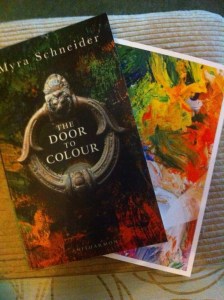
The Door to Colour (Enitharmon Press) came out last November. (I’m sorry to present this review so late. Life sometimes gets in the way of intention, but the operative word is “life.”) Short story: I enjoyed it. I recommend it. It is worth – in fact it calls for – frequent and careful reading. And, if you find yourself recuperating from some devastating event, you will surely find balm in the artistry of this collection and its shared experience of life with all its colors and shadows.
The Door to Colour starts with a simple piece, Le Citron, after Monet’s painting of the same name and includes several poems inspired by works of art or music.
There’s the human element, of course, and one of my faves, His Room, which everyone who has ever raised a child will appreciate. “On the door: posters, cuttings/and a warning: Parents Keep Out,/I knock, Am admitted . . .’I’ve got to find out if life/has any meaning,’ he tells me/He is fifteen, I am forty-five …/and the meanings I’d thought I’d found/have vanished. But behind him/I see myself at fifteen overwhelmed …”
And then there’s the poem Silence, which asks “what colour is noise?” It’s one to post above your computer. In Panic you’ll likely recognize yourself.
The narrative poem, Minotaur ends the collection. It is an alternate view of the Greek myth of Theseus and the Minotaur and it will stay with you long after reading. This poem moves, moves, moves.
I thoroughly enjoyed The Throw, for its details. The Throw is “kind to my uncomfortable body,” It is a poem to which you’ll relate if you are of an age when discomfort is your constant companion.
The poem, Cloud, made me think of Rilke for its concern, not its style. “I can’t believe/the divine exists in a fixed place overhead-/isn’t god the energy driving the universe/the dimensions of its mathematics visible/in patterns on this planet …” And let me whet your appetite with this tidbit from Garden: ” . . . Go/into the garden where dandelions pit themselves/against primroses …”
The door to color turns out to be the door to transformation and transcendence and no doubt the reading is as deeply felt as the writing was … Each poem asks to be devoured . . .
… and so to close this piece – with Myra’s permission – the gift of two poems for you to read from The Door to Colour … Enjoy!
LOST
after Chagall: Adam et Eve chassés du Paradis
There is no music now in paradise.
The garden’s ripped by cries of consternation,
a blinding white circle of face belongs
to a figure whose body is flower-blur
and stems twinned with leaves, a figure
inseparable from this place, its din.
There is no music now in paradise.
Tranquillity is a shrivelled fruit, trees
wrenched from roots are hurtled to the sky,
birds plummet to ocean, stampeding hooves
smash grasses. The tempter’s vanished,
panic-bitten humans are in flight.
There is no music now in paradise.
The word sin hisses in ears, guilt
lays its eggs, hearts work like clappers,
selves are in tatters. Though daisies
will rise again, moments gleam with sound
there is no music now in paradise.
– Myra Schneider
ON THE TRAIN
Sometimes when the computer’s in sulk,
when you’ve failed to appease your partner,
mother, child or cat, when you’ve hurried
down roads hoping to escape the conundrum
of yourself or limped from the dentist’s to daylight
with all the stuffing knocked from body and mind
even though pain is no longer boring into your teeth,
all you can do is climb chilling flights of steps,
clamber on board and thank god or your lucky stars
that no one’s bellowing the obvious into a mobile.
All you can do is gaze at the backsides of houses,
their clumsy sheds and drooping lines of washing,
at hoardings, factories, and outbursts of October leaves,
at glints from sudden streams, interludes of grass.
All you can do is accept the sumptuous dark of chocolate
melting in your mouth, gaze at the magenta lipstick
filling a double-spread in the magazine you picked up
at Whistlestop, imagine buying it though you never
colour your face, then feel inferior as you read
about the woman who rules the National Trust.
All you can do is smack shut the complacent pages
and look at the everyday girl who’s sitting opposite.
Her pinkish high-heeled shoes are fragile as slippers,
her face is creased with fatigue. You doubt she could rule
a pocket-sized kitchen or a stack of pots in a shed
but you can’t take your eyes off her handbag,
its amber clip, the silvergold lustre of its fabric,
the zips to its many enticing compartments.
– Myra Schneider
 ” . . . reading, writing and sharing poems is healing and if one is to be fully involved in writing it is crucial to read poetry and read poems closely.” Myra Schneider in an interview with me, February 2011.
© 2015, review, Jamie Dedes, All rights reserved; 2015, poems and photographs, Myra Schneider, All rights reserved
Thank you for sharing your love of words. Comments will appear after moderation.





 Jamie Dedes' THE POET BY DAY Webzine