POETRY ON THE BIG SCREEN: “It is difficult to have the heart to write a poem.”
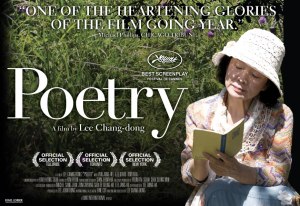
“The apricot throws itself on the ground. It is crushed and trampled for its next life.” Yang Mija “sees” while walking through an orchard and takes notes in her poetry notebook
Poetry (2009), the second movie suggestion for a holiday break movie, is a Korean movie with English subtitles. It speaks quietly about life and art, devastation and redemption. Like the most refined poetry, it is nuanced, honest and dramatic without being melodramatic or manipulative. It is a spare work, whittled down to essentials. It whispers. It never shouts. Its pacing is leisurely and thoughtful. There is no suggestive music here to help you grasp the story’s progression. There are no stars who’ve been nipped, tucked, brushed, trussed and boosted. These people are real. They could be me or you or a next-door neighbor. The story could be anyone’s story anywhere in the world. Indeed, Director Lee Chang-dong got the basic idea for the screenplay from news reports..
“ … this story was finally born from a combination of different elements: the sexual assault case, the suicide of a girl, and the lady in her 60s writing a poem.” Lee Chang-dong
Yoon Jeong-hee stars in the leading role (Yang Mija) and it is the lean script (though the movie is over two hours long) and Jeon-hee’s exquisitely understated acting that transfix us. Watch her face. Watch her body movements. These also are a kind of poetry.
“I’m quite a poet. I do like flowers and say odd things.” Yang Mija
Yang Mija is a sixty-six year-old grandmother charged with the care of a teenaged grandson, Jongwook – or Wook – whose mother is divorced and living in Busan. Wook is lazy and ungrateful and shows no respect for his grandmother or sensitivity to her age and her loneliness.
“You’re sprouting a mustache but acting like a child.” Yang Mija to Wook
Wook is part of a gang of male friends, fellow students, who over the course of six months repeatedly rape a young woman who subsequently drowns herself. News of this comes coincident with Yang Mija’s diagnosis of Alzheimer’s disease and her first poetry class. It is her poetry classes and effort to write a poem that provide the through-line for this story.
“The most important thing is seeing.” the poetry instructor to the class on the first day
 We walk alongside Yang Mija as she struggles with these multiple challenges – not without some humor – and sorts through her emotions regarding her grandson’s actions, her sympathy for the drowned girl, and the desire of other parents to hide the boys’ culpability by buying off the drowned girl’s mother. While Yang Mija may be suffering the early stages of memory loss, she hasn’t lost her moral compass.
As she moves from one experience to the next, Yang Mija questions: How do you write a poem? Where does the poetry come from? When she decides her grandson must face the consequences of his actions, she is finally able to write her poem.
Agnes’s Song
How is it over there?
How lonely is it?
Is it still glowing red at sunset?
Are the birds still singing on
the way to the forest?
Can you receive the letter
I dared not send?
Can I convey the confession
I dared not make?
Will time pass and roses fade?
Now it is time to say goodbye,
Like the wind that lingers
And then goes, just like shadows.
To promises that never came,
To the love sealed till the end,
To the grass kissing my weary ankles,
and to the tiny footsteps following me,
It is time to say goodbye.
Now as darkness falls
will a candle be lit again?
Here I pray nobody shall cry
and for you to know
how deeply I loved you.
The long wait in the middle
of a hot summer day.
An old path resembling my father’s face.
Even the lonesome wild flower
shyly turning away.
How deeply I loved.
How my heart fluttered at
hearing your faint song.
I bless you
before crossing the black river
with my soul’s last breath.
I am beginning to dream…
A bright sunny morning again I awake,
blinded by the light and meet you
standing by me.
– Yang Mija
“It is not difficult to write a poem. It is difficult to have the heart to write a poem.” the poetry instructor on the last day of class. Yang Meja is not in attendance but has left a bouquet of flowers and her poem.
You can stream Poetry on Amazon, if you are interested. It’s quite a memorable film.
© 2016, review, Jamie Dedes, All rights reserved; Photographs, poem, quotes courtesy of and property of the filmmaker and used here under fair use.
♥
THE WORDPLAY SHOP: books, tools and supplies for poets, writers and readers
LITERATURE AND FICTION oo Editor’s Picks oo Award Winners oo NY Times Best Sellers





 Jamie Dedes' THE POET BY DAY Webzine